Right Whale — The “Right” Whale to Hunt, Now Fighting for Survival
What is a right whale?
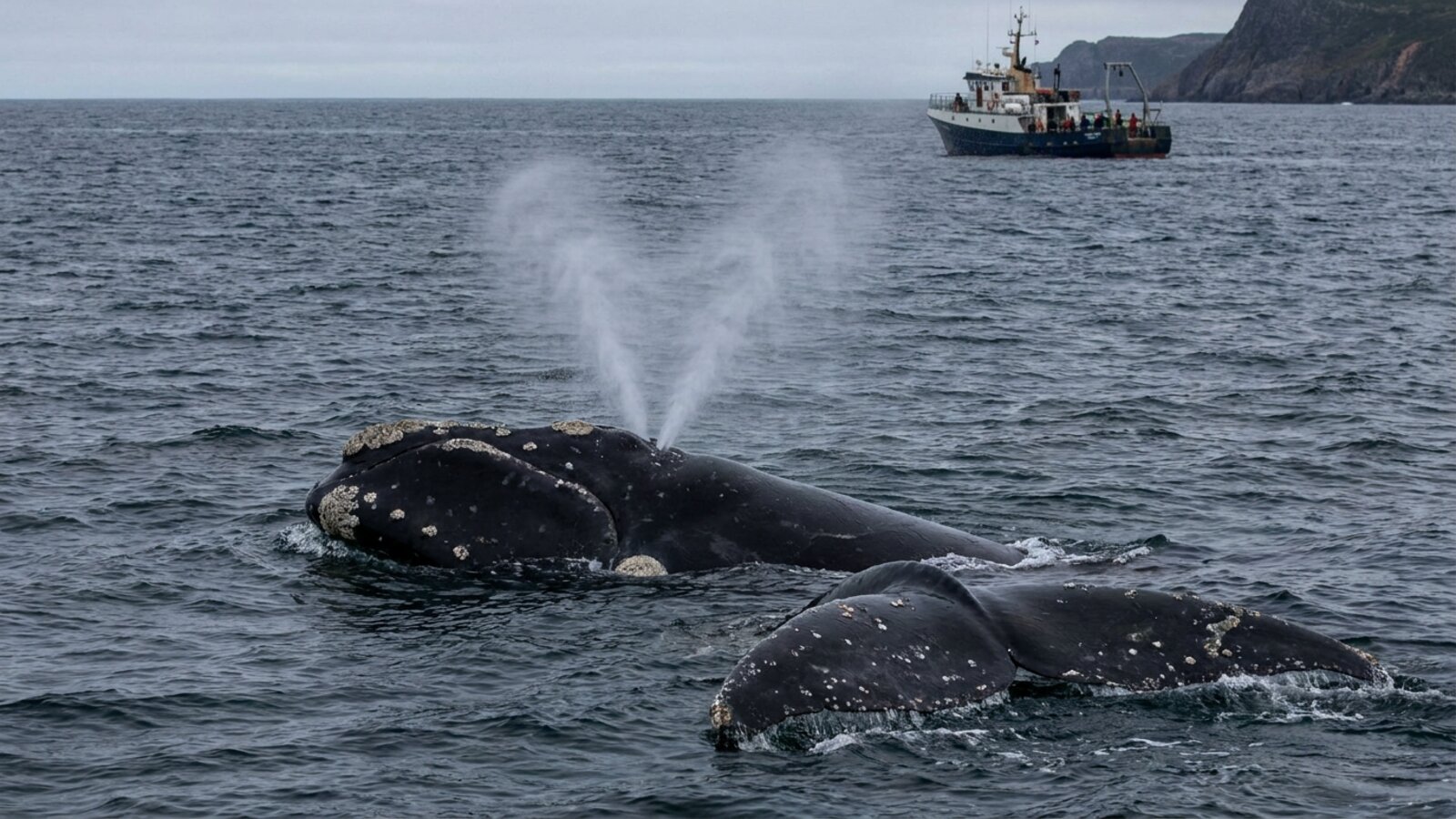
Right whales are large, stocky baleen whales with no dorsal fin, a huge arched mouth, and rough white patches called callosities on their heads. There are three species: the North Atlantic, North Pacific and Southern right whale.
The North Atlantic right whale is one of the rarest whales on Earth; see endangered marine mammals for the other species closest to extinction.
They belong to the family Balaenidae with their Arctic cousin, the bowhead whale. Adults of the North Atlantic species grow up to about 52 ft long; calves are about 14 ft at birth. The callosities are raised patches of rough skin that look white because they are colonised by whale lice (cyamids). Each whale’s pattern is unique, which lets researchers identify individuals from aerial photos. See why do right whales have callosities?
Why is it called the right whale?
Because whalers considered it the “right” whale to hunt: slow, close to shore, rich in oil and baleen, and it floated when killed.
That reputation nearly wiped the North Atlantic species out. Commercial whalers had reduced it to near extinction by the early 1890s. Right whales have been protected internationally since 1935, yet the North Atlantic population never recovered the way some other whales did.
What do right whales eat?
Copepods and other tiny zooplankton, filtered by swimming slowly with the mouth open (skim feeding).
Right whales have very long, fine baleen that traps prey as small as a grain of rice. Their favourite food in the North Atlantic, the copepod Calanus finmarchicus, has shifted north and east as the Gulf of Maine warms, pulling the whales into the Gulf of St. Lawrence, where they met new fishing gear and shipping lanes. See planktonic crustaceans.
Where do right whales live?
North Atlantic right whales range along the U.S. and Canadian East Coast; North Pacific right whales are scattered across the North Pacific; Southern right whales circle the Southern Hemisphere.
North Atlantic females give birth in winter in the shallow coastal waters of South Carolina, Georgia and northeastern Florida, the only known calving area for the species. Some whales travel more than 1,000 miles each fall to get there. Pregnancy lasts about a year, and a single calf is born.
| Species | Range | Status (approx.) |
|---|---|---|
| North Atlantic right whale (E. glacialis) | Western North Atlantic | ~384 (2024); critically endangered |
| North Pacific right whale (E. japonica) | North Pacific, incl. Bering Sea | Very rare; eastern stock among the smallest whale populations |
| Southern right whale (E. australis) | Southern Hemisphere | Recovering strongly in many areas |
Why are North Atlantic right whales endangered?
Because they are being killed by people faster than they can reproduce. Entanglement in fishing gear and vessel strikes are the leading causes of death and serious injury.
NOAA declared an Unusual Mortality Event in 2017 that is still open. As of mid-2026 it covered 176 whales: 43 dead, 41 seriously injured and 92 with sublethal injuries or illness. Of the 43 deaths, 15 were from vessel strikes and 11 from entanglement, with many others not examined. Only about a third of right whale deaths are thought to be documented at all. Females in particular now live to about 45 instead of 70 or more, and chronic entanglement stress means they have calves less often.
There is cautious good news. The official estimate rose from 376 whales in 2023 to 384 in 2024, and 11 calves were born in 2024. With only around 70 reproductively active females, though, every death matters. Seasonal vessel speed restrictions, dynamic slow zones and the move to ropeless or weak-rope fishing gear are the main tools to bring human-caused deaths down.
How do you identify a right whale?
A right whale is a big, dark, rotund whale with no dorsal fin, a strongly arched jawline, white callosities on the head, and a V-shaped blow.
From a boat or plane, the absence of a dorsal fin on a broad black back is the first clue; humpbacks, fin whales and minke whales all have a fin or hump. When a right whale exhales, the two blowholes are widely spaced, producing a bushy, V-shaped spout up to about 5 m tall that is easy to recognise when seen from in front or behind. The flippers are short and broad, more like paddles than the long wings of a humpback, and the tail flukes are wide, smooth-edged and all black underneath. Many right whales have irregular white patches on the belly, and the head can make up about a quarter of the body length.
The closest relative, the bowhead whale, also lacks a dorsal fin but lives among Arctic sea ice, has no callosities and has a distinctive white chin. In practice, location usually separates them.
How do right whales behave?
Right whales are slow swimmers that spend a lot of time at or near the surface, which is part of what made them easy to hunt and makes them vulnerable to ships today.
They often feed just below the surface, moving forward with the mouth open in long, straight passes. They also gather in “surface active groups,” where a female is surrounded by several males jostling for position, rolling and slapping their flippers. These groups are thought to be part of courtship and mating, and they can last for an hour or more. Right whales breach, slap their tails and sometimes lie still at the surface. Southern right whales off Argentina and South Africa are known for “sailing,” holding their tails raised in the wind for long periods.
Right whales are also vocal. Their best-known sound is a short rising “upcall” that seems to work as a contact call. Because it is distinctive, scientists use networks of underwater microphones and listening buoys to detect upcalls in near real time, which helps trigger shipping alerts and slow zones.
How do right whales reproduce?
Females give birth to a single calf after a pregnancy of about a year, then nurse it for roughly a year before it becomes independent.
Historically, a healthy North Atlantic female might calve about every three years. In recent decades the average interval has become longer, and in some years very few calves were born, which researchers have linked to poor body condition, the energy cost of carrying fishing gear and changes in food supply. Calves stay very close to their mothers and are especially at risk from vessel strikes because they spend a lot of time at the surface.
Right whales mate in a system where sperm competition matters more than fighting. Males are not aggressive to one another in the way many land mammals are; instead, several males may mate with the same female. To match this, right whales have some of the largest testes of any animal, each pair weighing up to roughly a tonne.
What is being done to save right whales?
The main tools are slowing ships down, keeping ships and boats away from whales, and changing fishing gear so whales are less likely to become entangled.
- Vessel speed rules: In the United States, larger vessels must slow to 10 knots in seasonal management areas along the East Coast, and voluntary slow zones are set up when whales are detected outside those areas.
- Approach limits: US federal rules prohibit approaching within 500 yards of a North Atlantic right whale, by boat, paddleboard or drone, without a permit.
- Fishing gear: Weak rope or weak links that break more easily, fewer vertical lines, seasonal closures and trials of ropeless (“on-demand”) gear aim to cut entanglements.
- Canadian measures: Since the deaths of 2017, Canada has used fishing closures and speed restrictions in the Gulf of St. Lawrence when right whales are present.
- Monitoring and rescue: Aerial surveys, acoustic monitoring and trained disentanglement teams track the population and free entangled whales where possible.
Anyone boating along the US East Coast in winter and spring can help by watching for whales, keeping speeds low, staying at least 500 yards away and reporting sightings or entangled whales to the authorities.
What about the North Pacific right whale?
It is one of the rarest large whales in the world, with an eastern population thought to number only a few dozen animals.
Illegal Soviet whaling in the 1960s killed hundreds of North Pacific right whales and devastated what was left after commercial whaling. Today a small eastern population is found mainly in the Bering Sea and Gulf of Alaska, and a larger but still small western population lives near Russia and Japan. Sightings are rare enough that each one is scientifically valuable, and much of what is known comes from acoustic recordings rather than direct observation.
Why is it called a right whale?
Whalers considered it the “right” whale to hunt because it was slow, swam near shore, and floated when killed.
How many North Atlantic right whales are left?
About 384 at the start of 2024, according to NOAA’s October 2025 estimate.
How big is a right whale?
North Atlantic right whales grow up to about 52 ft. Calves are about 14 ft at birth.
What are the white patches on right whales?
Callosities: rough skin patches colonised by whale lice. Each pattern is unique.
What do right whales eat?
Copepods and other small zooplankton, which they skim from the water with very fine baleen.
What kills North Atlantic right whales?
Mainly entanglement in fishing gear and collisions with ships.
Where do right whales give birth?
North Atlantic right whales calve in winter off South Carolina, Georgia and northeastern Florida.
How long do right whales live?
They probably can live at least 70 years, but human-caused deaths now cut many lives short; females average about 45.
- NOAA Fisheries, North Atlantic Right Whale species page (archived)
- NOAA Fisheries, 2017–2026 North Atlantic Right Whale Unusual Mortality Event
- WBUR, Right whale population rose in 2024 (Oct 2025)
Blane Perun has been exploring Earth’s oceans and marine life for over 25 years. Founder of TheSea.Org in 1999, underwater photographer, coral aquaculture pioneer, and explorer of 80+ countries.
About Blane Perun →