Fin Whale — The Greyhound of the Sea
The fin whale (Balaenoptera physalus) is a baleen whale and the second-longest animal on Earth after the blue whale, with a maximum confirmed length of 25.9 m (85 ft) and adults typically 18.5 to 22 m long. Slender and fast, it can sustain about 37 to 41 km/h, earning the nickname “greyhound of the sea”. It lives in every major ocean, feeds on krill, copepods, small schooling fish and squid, and its low-pitched calls are among the lowest-frequency sounds made by any animal. Industrial whaling killed more than 725,000 in the Southern Hemisphere alone; the species is now listed as Vulnerable by the IUCN, with a global population estimated at under 100,000 to about 119,000.
The American naturalist Roy Chapman Andrews wrote that the fin whale’s “beautiful, slender body is built like a racing yacht and the animal can surpass the speed of the fastest ocean steamship”. It is one of the fastest of all large whales, and its speed long protected it from whalers.
A rorqual built for speed
The fin whale, also called the finback or common rorqual, and in the past the herring whale or razorback, is a member of the rorqual family, Balaenopteridae. Its relatives include the blue whale, the humpback whale, the sei whale, Bryde’s whale and the minke whales. All are baleen whales that feed by gulping huge mouthfuls of water and prey and straining it through plates of baleen. The species was first described by Friderich Martens in 1675, and Carl Linnaeus based his 1758 name Balaena physalus on that account; the name comes from the Greek physa, “blows”, a reference to its tall spout. The many names given to stranded specimens over the following century were finally merged under Balaenoptera physalus in 1903.
Genetic studies have produced some surprises. DNA evidence suggests that the fin whale may be more closely related to the humpback and, in at least one study, the gray whale, both in other genera, than to the minke whales in its own genus. Fin whales also hybridise with blue whales, even though the genetic distance between the two species has been compared to that between a gorilla and a human. Hybrids with features of both are known from the North Atlantic and North Pacific, and DNA testing of whale meat on sale in Japan has turned up blue-fin hybrids.
Subspecies
As of 2023, four subspecies had been named. The northern fin whale, B. p. physalus, lives in the North Atlantic; the southern fin whale, B. p. quoyi, in the Southern Hemisphere; and most experts treat North Pacific fin whales as a third, for which a 2019 genetic study suggested the name B. p. velifera. The three groups rarely, if ever, mix. A fourth, “pygmy” subspecies, B. p. patachonica, was proposed in 2004 on the basis of smaller, darker whales caught in the Antarctic, but it has not been genetically established and is not recognised by the Society for Marine Mammalogy.
How big is a fin whale?
Size varies by hemisphere and sex, with females larger than males. In the Northern Hemisphere adult males average about 18.5 m (61 ft) and females about 20 m (66 ft), weighing roughly 38.5 and 50.5 tonnes. In the Southern Hemisphere they average 20.5 m (67 ft) and 22 m (72 ft), at about 52.5 and 63 tonnes. Mediterranean fin whales are generally smaller.
The record lengths come from the whaling era. The longest ever reported was a 27.3 m (89.6 ft) female in the Southern Hemisphere, but the maximum length confirmed by a reliable measurement is 25.9 m (85 ft): a whaling inspector aboard the factory ship Southern Princess confirmed one female of that length in the 1930s, and the scientist David Gaskin measured another in the 1961–62 season. The heaviest fin whale actually weighed, piece by piece, was a 22.7 m pregnant female caught by Japanese whalers in the Antarctic in 1948, at 69.5 tonnes not counting fluids lost during flensing. A whale at the maximum confirmed length is estimated to weigh about 95 tonnes, anywhere from 76 to 114 tonnes depending on its fat condition, which can vary by about half over a year. At birth a calf is already about 6 to 6.5 m (20 to 21 ft) long and weighs about 1.8 tonnes.
A lopsided face
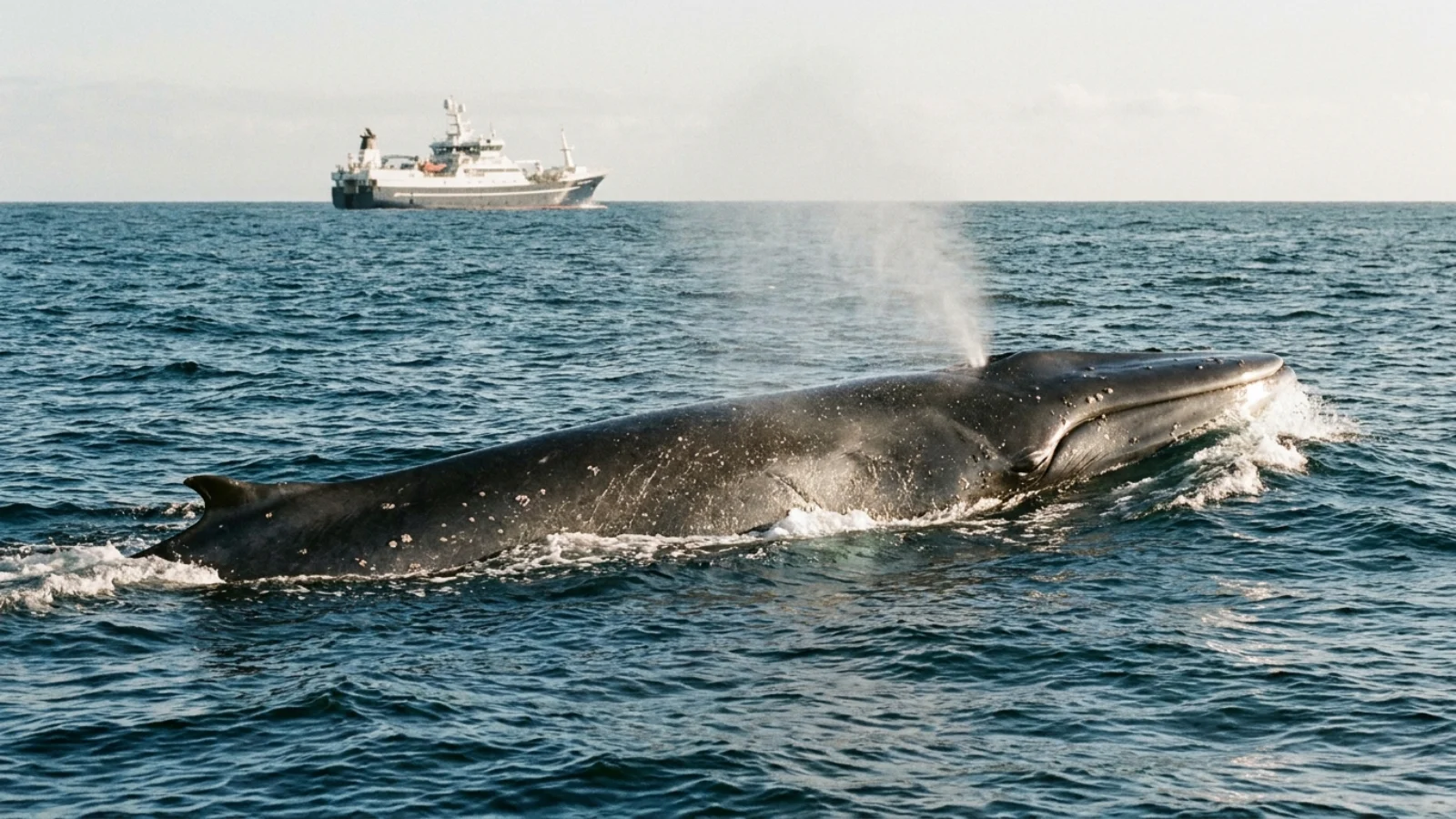
The fin whale is brownish to grey on the back and white underneath, with a long, slender body, a broad, flat V-shaped head and paired blowholes. A curved dorsal fin, usually 45 to 60 cm tall, sits about three-quarters of the way along the back. A pale chevron marking starts behind the blowholes and sweeps back along each side. Between 56 and 100 throat pleats run from the chin to the navel, allowing the throat to balloon enormously when the whale feeds.
Its most remarkable feature is that its colouring is asymmetrical. The left side of the head is dark grey, but on the right side the lower jaw is white or pale grey, and the pale “right mandible patch” sometimes extends as a blaze onto the upper jaw and back behind the blowholes. Dark stripes run back from the eye and ear on the right side, separated by a pale “interstripe wash”. The markings are more vivid in North Atlantic fin whales than in the North Pacific. One suggestion was that the pattern evolved because fin whales swim on their right side when lunging at prey near the surface and often circle to the right, but they turn to the left just as often, and no explanation has been accepted. Omura’s whale and some minke whales show a similar asymmetry.
The greyhound of the sea
Fin whales are among the fastest of all whales. They can sustain speeds of about 37 to 41 km/h (23 to 25 mph), and bursts of up to 46 km/h (29 mph) have been recorded. That speed protected them for most of the nineteenth century: open-boat whalers could rarely catch them, and a dead fin whale often sank, so chasing one was usually a waste of effort.
They are also more sociable than most rorquals, often travelling in pairs or in groups of six to ten, and feeding aggregations can reach a hundred animals. When feeding they blow five to seven times in quick succession, and the vertical, narrow spout can reach 6 m (20 ft) or more. Before a long dive a fin whale arches its back high out of the water but rarely shows its flukes. Feeding dives reach up to 470 m (1,540 ft); off California and Baja California the average feeding dive lasts about six minutes, with a maximum of 17.
What does a fin whale eat?
Fin whales are filter feeders. They eat small crustaceans, especially krill and copepods, along with small schooling fish and squid. They lunge at dense patches of prey, often at the surface and frequently on their right side, engulfing a huge volume of water before forcing it out through the baleen. The mouth’s lining has an unusually stretchy nerve system that copes with this extreme expansion.
Whaling records show how varied the diet can be. Of more than 19,500 fin whales caught by Japanese whalers in the North Pacific between 1952 and 1971, 64.1 per cent had eaten only krill, 25.5 per cent copepods, 5 per cent fish, 3.4 per cent krill and copepods and 1.7 per cent squid. In the northern Bering Sea they fed mainly on capelin, Alaska pollock and Pacific herring; around the Aleutians and in the Gulf of Alaska, on krill; off Kamchatka, mainly on herring. Off California between 1959 and 1970, 86 per cent of sampled whales had eaten the krill Euphausia pacifica, and a few had taken northern anchovy.
Songs from the deep
Male fin whales produce long, loud, low-frequency sounds. With those of blue whales, they are the lowest-frequency sounds made by any animal. Most are down-swept pulses of about 16 to 40 hertz, at or below the lower limit of human hearing, each lasting one to two seconds and arranged in patterned sequences of 7 to 15 minutes that can be repeated for days. Their source levels reach about 184 to 186 decibels (relative to 1 micropascal at 1 m), and they can be detected hundreds of miles away. When American scientists first recorded these regular, pure sounds, they wondered whether they came from faulty equipment, geological activity or even a Soviet submarine-detection system before showing that they were whales.
Because only males call and the calls coincide with the breeding season, they are thought to be reproductive displays. Researchers have suggested that the great rise in ocean noise from shipping and naval activity over the past century may have slowed the species’ recovery by interfering with communication between males and females. Fin whale songs are so powerful that they penetrate more than 2,500 m into the seabed, and seismologists have used them to survey the structure of the ocean crust.
Life cycle
Fin whales mate in temperate, lower-latitude waters in winter. Gestation lasts 11 to 12 months, and a calf is weaned at six or seven months, when it is 11 to 12 m long, then follows its mother to the summer feeding grounds, staying with her for about a year. Females give birth every two or three years. They reach sexual maturity at 6 to 12 years old, at lengths of about 17.7 to 19 m in the Northern Hemisphere and 20 m in the Southern, and physical maturity at 25 to 30 years. The maximum lifespan is at least 94 years, and some individuals have been estimated at 135 to 140 years old. A study of individually identified whales in Massachusetts Bay suggests that calves learn migration routes from their mothers and return to their mother’s feeding area in later years.
Where fin whales live
The fin whale is cosmopolitan, found in all the world’s major oceans from polar to tropical waters. It avoids only the waters next to the polar pack ice and some enclosed seas such as the Red Sea, though it enters the Baltic. It is most common in temperate and cool waters. In the North Atlantic it ranges from the Gulf of Mexico and the Mediterranean north to Baffin Bay and Svalbard, and in the North Pacific from central Baja California to Japan and north to the Chukchi Sea, with high densities in the northern Gulf of Alaska and the south-eastern Bering Sea from May to October.
Fin whales are migratory, moving between high-latitude feeding grounds in summer and lower latitudes in winter, but the pattern is poorly understood. Hydrophone recordings track a southward autumn movement in the North Atlantic from Labrador and Newfoundland past Bermuda to the West Indies, while some animals seem to stay in high latitudes year-round. In the Southern Hemisphere they move from Antarctic feeding grounds in summer toward breeding areas in winter, but because they migrate through the open ocean, those breeding grounds have never been located.
Predators
The only known predator of the fin whale is the killer whale. There are at least 20 eyewitness and second-hand accounts of attacks or harassment, but only a few confirmed kills. Fin whales usually flee rather than fight. In October 2005, 16 killer whales chased a fin whale for about an hour in the Canal de Ballenas, Gulf of California, before killing it, and in June 2012 another pod killed a fin whale in La Paz Bay after a chase of more than an hour, biting at its jaw while others flanked it.
The whaling era
Steam-powered catcher boats and harpoons that exploded on impact changed everything. As other species were overhunted, the industry turned to the still-abundant fin whale, mainly for its blubber, oil and baleen. Factory ships with stern slipways, introduced in 1925, made the slaughter far more efficient. In the 1937–38 season alone more than 29,000 fin whales were taken, and from 1953–54 to 1961–62 the Antarctic catch averaged more than 30,000 a year, until fin whales became so scarce that whalers switched to sei whales. By 1975–76 fewer than 1,000 a year were being caught.
The totals are staggering. About 704,000 fin whales were killed in Antarctic whaling alone between 1904 and 1975, and other tallies put the Southern Hemisphere total at more than 725,000 between 1905 and 1976; more than 74,000 were taken in the North Pacific and more than 55,000 in the North Atlantic. The Soviet Union falsified its records, over-reporting fin whale catches to hide illegal kills of protected species. Full protection came in the Southern Hemisphere in 1976, the North Pacific in 1976 and the North Atlantic in 1987.
How many fin whales are left?
Estimates are uncertain. Global figures range from fewer than 100,000 to about 119,000. The International Whaling Commission estimates that the Southern Hemisphere held about 400,000 before whaling and about 85,200 by 1979, though it acknowledges the methods were flawed; other estimates put the southern population at 15,000 in 1983 and 38,000 in 1997. The North Atlantic was last formally assessed in 2016, at about 70,000, and IUCN models published in 2018 suggest numbers there are rising. Recovery in the south is predicted to remain below half of the pre-whaling population even by 2100. Despite the losses, the fin whale is estimated to be the most abundant wild mammal by total biomass, at about 8 million tonnes. The IUCN lists it as Vulnerable, and it is on Appendix I of CITES.
Whaling today
Fin whales are still hunted. Greenland has an aboriginal subsistence quota of 19 a year from the IWC. Iceland, which objected to the IWC moratorium, resumed hunting fin whales in 2006 and its company Hvalur has killed hundreds since; a temporary ban was imposed in the summer of 2023. Iceland then cancelled its fin whale hunts in 2024 and 2025, partly because demand had fallen and the business was not seen as profitable, but Hvalur resumed in June 2026, killing two fin whales, the first since 2023, under a recommended limit of 150 for the season. Iceland’s government said it planned to introduce a bill to ban whaling that autumn. Japan, which left the IWC in 2019, added fin whales to its commercial whaling list in May 2024 with a quota of 59, and that summer its new factory ship Kangei Maru took a 19.6 m male, Japan’s first commercial fin whale catch in about half a century.
Ship strikes and other threats
Collisions with ships are a major cause of death, particularly from large, fast vessels over the continental shelf, and in some areas they account for a substantial share of large-whale strandings. In April 2014 a fin whale about 60 ft long arrived in New York harbour stuck on the bow of a container ship, and in May 2021 two dead fin whales were found on the bow of the Australian destroyer HMAS Sydney when it docked in San Diego. Japan’s coast guard monitors whales in the Tsushima Strait, where collisions are common. Ocean noise is a further concern.
Where to see fin whales
Fin whales are regular sightings on whale-watching trips in many parts of the world. In the Southern California Bight they occur year-round, with the best sightings from November to March. They can even be seen from land there, and they are watched from boats off Tadoussac in the St Lawrence estuary in Quebec. Look for a tall, narrow spout, a long back that seems to roll on and on, and a small swept-back fin appearing soon after the blow. If the whale’s head shows, the white right jaw is the clincher. For a museum view, a 19.2 m skeleton hangs in the “Fin Whale Passage” at the Natural History Museum of Los Angeles County, and a nearly 21 m male that stranded at Pevensey in 1865 is displayed at the Museum of Zoology in Cambridge.
How big is a fin whale?
Adults are usually 18.5 to 22 m long and weigh about 38 to 63 tonnes; the largest confirmed was 25.9 m (85 ft).
Is the fin whale the second-largest animal?
Yes. It is the second-longest animal on Earth after the blue whale.
How fast can a fin whale swim?
It can sustain about 37 to 41 km/h, with bursts recorded up to 46 km/h.
What do fin whales eat?
Krill, copepods, small schooling fish such as capelin, herring and anchovy, and squid.
Are fin whales endangered?
The IUCN lists the fin whale as Vulnerable; it is listed as endangered under US law.
How many fin whales are left?
Estimates range from under 100,000 to about 119,000 worldwide.
Why is the fin whale’s jaw white on one side?
Its colouring is asymmetrical: the right lower jaw is white and the left dark. No explanation has been accepted.
Are fin whales still hunted?
Yes, by Greenland under an aboriginal quota, by Iceland (which resumed in 2026 after two years without hunting) and by Japan since 2024.
- Wikipedia contributors, “Fin whale” (2023 snapshot, accessed November 2026).
- CTV/CP24 (22 June 2026), “Iceland kills first whales since 2023, resuming commercial hunt”.
- Mongabay (8 August 2024), “Japanese ship hunts massive fin whale, country’s first in 50 years”.
Blane Perun has been exploring Earth’s oceans and marine life for over 25 years. Founder of TheSea.Org in 1999, underwater photographer, coral aquaculture pioneer, and explorer of 80+ countries.
About Blane Perun →