Bryde’s Whale — The Tropical Rorqual
Bryde’s whale (pronounced “BROO-dus”) is a medium-sized rorqual, usually about 12 to 15 m long and 12 to 25 tonnes, that lives in tropical and warm-temperate waters between about 40°N and 40°S. It is best told from its look-alike, the sei whale, by three parallel ridges on top of its head. Scientists call it the “Bryde’s whale complex” because the number of species is still unsettled: the common Bryde’s whale (Balaenoptera brydei) and the smaller Eden’s whale (B. edeni) are usually recognised, and in 2021 the Gulf of Mexico population was named a separate species, Rice’s whale, now one of the rarest whales on Earth.
B. brydei honours Johan Bryde, the Norwegian consul in South Africa who helped set up the country’s first modern whaling station. B. edeni honours Sir Ashley Eden, a former British High Commissioner of Burma, who helped obtain the specimen it was described from.
A whale nobody can quite classify
Bryde’s whale is the least understood of the large rorquals, and much of the confusion comes from its history. In 1878 John Anderson, first curator of the Indian Museum in Calcutta, described Balaenoptera edeni from an 11 m whale that had stranded in June 1871 at Thaybyoo Creek on the Gulf of Martaban in Burma, more than 32 km up the creek; it was said to have “roared like an elephant” before it died. In 1913 the Norwegian scientist Orjan Olsen examined a dozen “sei whales” brought into the South African whaling stations at Durban and Saldanha, realised they were something else and named them Balaenoptera brydei. In 1950 the two names were merged, and for decades all such whales were simply called B. edeni.
Whalers kept confusing them with sei whales. In the 1950s Japanese scientists noticed that “sei whales” caught off Japan came in two forms: a northern one with long, fine baleen and short throat pleats, and a southern one with short, coarse baleen and longer pleats. The northern form was the true sei whale; the southern form was Bryde’s whale, and the difference was soon confirmed by the extra ridges on its head. In the 1960s the same mistake was uncovered in catches off Brazil.
Today scientists speak of the “Bryde’s whale complex”. Two genetically distinct forms are usually recognised: the larger common Bryde’s whale, B. brydei, which lives worldwide in warm waters, and the smaller Eden’s or Sittang whale, B. edeni, which may be restricted to the coastal Indo-Pacific. There is also a smaller coastal form of B. brydei off southern Africa, and possibly an “Indo-Pacific Bryde’s whale” distinguished by its skull. Omura’s whale, described in 2003, was once thought to be a pygmy Bryde’s whale but is now a species in its own right. In Japan the whale is now called nitari-kujira, the “look-alike whale”, for its resemblance to the sei.
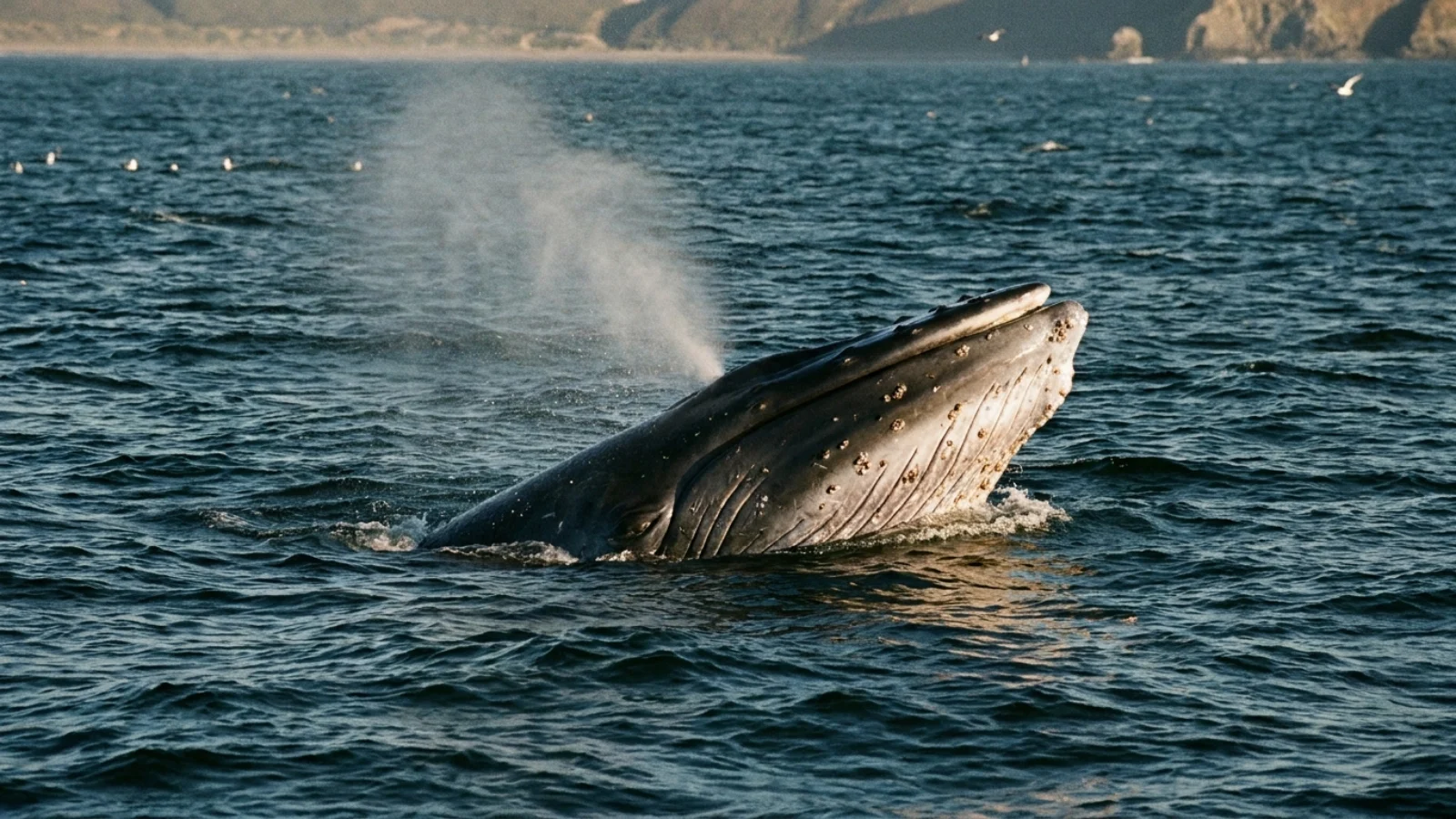
Rice’s whale: the Gulf’s own species
The most dramatic chapter in the story concerns the Gulf of Mexico. In 1965 the cetologist Dale Rice recognised a small group of Bryde’s-like whales living there, and in the 1990s it became clear that they were isolated. A 2014 genetic study by Patricia Rosel and Lynsey Wilcox found that they formed a distinct lineage that did not belong to either member of the Bryde’s whale complex, but a new species could not be formally described without a type specimen. That came in 2019, when a dead whale washed up in Everglades National Park; its skeleton went to the Smithsonian, and in 2021 Rosel, Wilcox and colleagues showed that its skull, especially the nasal bones, was also distinctive. They named the species Balaenoptera ricei, Rice’s whale.
Outwardly Rice’s whale is almost identical to Bryde’s whale, with the same three head ridges, and it is separated by its skull, its genetics and its calls. Its closest living relative, according to the 2021 study, is Eden’s whale. It grows to about 12.65 m and lives in a narrow band of the continental slope, mostly at depths of about 150 to 410 m in and around De Soto Canyon off north-west Florida, Alabama and eastern Louisiana. It does not migrate. A tagged whale spent its days feeding at or near the seafloor at depths of up to 271 m and its nights near the surface.
Rice’s whale is one of the most endangered whales in the world, listed as Critically Endangered by the IUCN and endangered under the US Endangered Species Act. NOAA’s 2022 stock assessment estimated just 51 individuals, about half of them possibly mature, on the basis of 2017–2018 surveys, and a new assessment using 2023–2024 sightings was in progress in 2026. Scientists believe the 2010 Deepwater Horizon spill killed nearly a fifth of the population. Critical habitat in waters 100 to 400 m deep was proposed in July 2023, but a final decision has been delayed until July 2027. In March 2026 a federal Endangered Species Committee exempted certain Gulf oil and gas activities from consultation under the Act, a decision that was being challenged in court. For more on the species and its neighbours, see our guide to the marine mammals of the Gulf of Mexico.
Size and shape
Bryde’s whales are moderately sized rorquals, smaller than sei whales but larger than Omura’s and minke whales. The largest Olsen measured was a 14.95 m female caught off Durban in November 1912, and the longest measured at the Donkergat whaling station in Saldanha Bay were a 15.51 m female and a 14.56 m male, both of the offshore form. At physical maturity the coastal form off South Africa averages 13.1 m for males and 13.7 m for females, the offshore form 13.7 and 14.4 m, and the coastal form near Japan slightly less, at about 12.9 and 13.3 m. Body mass ranges from about 12 to 25 tonnes. A calf is roughly 3.4 to 4.2 m long at birth and weighs about a tonne.
Bryde’s whales are remarkably slender, even more so than fin whales: the body’s greatest depth is about a seventh of its length, compared with about 1/6.5 to 1/6.75 in fin whales and 1/5.5 in the stockier sei whale. They are dark, smoky grey above and usually white below, and their skin is often marked with white or pinkish oval scars from cookiecutter shark bites. The upright, hooked dorsal fin averages about 34 cm, is often ragged along its trailing edge, and sits about two-thirds of the way along the back.
How to tell Bryde’s whale from a sei whale
The two species look so alike that whalers mixed them up for decades, but there are reliable differences. Bryde’s whale has a straight snout with three parallel ridges running from the blowholes to the tip, while the sei whale has a single central ridge and a slightly arched snout. Bryde’s whales usually have dark grey lower jaws, while sei whales are lighter. Inside the mouth, Bryde’s whales have 250 to 370 pairs of short, slate-grey baleen plates with long, coarse bristles, compared with the sei’s longer, black plates and fine, woolly fringes. And Bryde’s whale’s 40 to 70 throat pleats run all the way to or past the navel, while the sei’s stop well short. Behaviour helps too: Bryde’s whales are more active at the surface, especially near the coast.
Erratic surfacers
Bryde’s whales have a reputation for unpredictable behaviour. They surface at irregular intervals and can change direction for no obvious reason, and they sometimes exhale underwater. Their blow is columnar or bushy, about 3 to 4 m high. They usually dive for 5 to 15 minutes, occasionally up to 20, after four to seven blows, and can reach depths of 292 m. When they dive they do not show their flukes. They normally cruise at about 1.6 to 6.4 km/h but can reach 19 to 24 km/h. Most sightings are of single whales or pairs, though loose aggregations of up to 20 form around good feeding areas. Their calls include short, powerful, low-frequency sounds that have been compared to a human moan.
What do Bryde’s whales eat?
Bryde’s whales take a wide variety of schooling fish, planktonic crustaceans and squid, and their diet changes with place and season. In the western North Pacific, whales sampled by Japanese research vessels between 2000 and 2007 had eaten mainly Japanese anchovy and various krill; near the coast in May and June krill dominated, while further offshore in late summer the diet was almost entirely anchovy. Off South Africa the coastal form eats mainly anchovies, horse mackerel and pilchards, while the offshore form eats mainly krill and deep-sea fish, and one was found “full of baby squid”. In the Gulf of California they feed chiefly on Pacific sardine and thread herring and have been seen eating pelagic red crabs off southern Baja California. Off Brazil they have been watched feeding on sardines.
They also use a wider range of feeding methods than most rorquals: skimming at the surface, lunging, adding twisting movements to lunges off south-eastern Brazil, and using bubble nets in places such as Tosa Bay in Japan. In the northern Gulf of Thailand they are known for “trap” or “tread-water” feeding, hanging vertically at the surface with the mouth wide open so that small fish fleeing predators swim straight in, a technique also used by humpback whales in the north-east Pacific.
Breeding
Unlike many baleen whales, Bryde’s whales do not seem to have a fixed breeding season. They breed in alternate years, apparently in any season, with a peak in autumn. Gestation is estimated at about 12 months, mothers nurse their calves for 6 to 12 months, and both sexes become sexually mature at roughly 8 to 13 years old, when females are about 12 m long.
Where Bryde’s whales live
The common Bryde’s whale lives in the Atlantic, Pacific and Indian oceans between about the 40th parallels, preferring productive tropical, subtropical and warm-temperate waters of about 16 to 22°C. Unlike most large baleen whales, some populations stay in warm water all year rather than migrating to polar feeding grounds. In the North Pacific they occur north to Honshu in the west and southern California in the east, throughout the eastern tropical Pacific and off Peru and Ecuador, and south to the North Island of New Zealand. Resident or semi-resident groups live off the main and north-western Hawaiian Islands and the Northern Mariana Islands. In the Atlantic they range north to Cape Hatteras, through the wider Caribbean and year-round off Brazil, and were first recorded in the Azores in 2004. Off South Africa the coastal form stays year-round between Cape Recife and Saldanha Bay, while the larger offshore form migrates to equatorial West Africa in winter. Eden’s whale is known from the coasts of Myanmar, Bangladesh, India, Thailand, Vietnam and China and from the East China Sea off southern Japan.
Whaling
Bryde’s whales were not a major commercial target until the 1970s, when the industry had depleted other species. Modern Bryde’s whaling began from coastal stations in Japan in 1906 and continued there until 1987, and Japanese, Soviet, Taiwanese and Philippine whalers also took them in the western North Pacific. More than 20,000 were caught there between 1911 and 1987, and Japan was later found to have under-reported its catch from the Bonin Islands between 1981 and 1987, declaring 2,659 when the true figure was 4,162. About 5,542 were taken off Peru between 1968 and 1983, and over 2,000 off South Africa’s Cape Province. In total more than 30,000 were caught between 1911 and 1987, including over 1,400 taken by Soviet whalers in the Southern Hemisphere, of which only 19 were reported. Many “sei whales” killed by the pirate whaling ship Sierra in the South Atlantic between 1969 and 1976 are believed to have been Bryde’s whales. Artisanal whalers have also taken them off Indonesia and the Philippines.
Bryde’s whales are still hunted today. Japan’s Fisheries Agency set a 2026 catch limit of 153 Bryde’s whales, 133 for factory-ship whaling and 20 for coastal whalers, the largest allowance for any species in its programme that year.
Status and threats
Globally, Bryde’s whale may number up to 90,000 to 100,000, two-thirds of them in the Northern Hemisphere, though data are insufficient to determine trends. The IUCN lists it as Least Concern under the name B. edeni; B. brydei has not been assessed separately. Some local populations are in trouble. In New Zealand, where Bryde’s whales live in the Hauraki Gulf, the species was classed as nationally critical in 2016 with about 200 animals left. Ship strikes are a threat in busy coastal waters, and ocean noise is a growing concern for all rorquals, which communicate with low-frequency sound. In US waters the eastern tropical Pacific and Hawaiian stocks are protected under the Marine Mammal Protection Act.
Killer whales are their main natural predator. Around 2011 a videographer filmed a pod of about 20 killer whales hunting and killing a Bryde’s whale weighing an estimated 20 tonnes in the Sea of Cortez.
Where to see Bryde’s whales
Because they live in warm water year-round, Bryde’s whales can be seen in places where few other great whales occur: in the Hauraki Gulf near Auckland, in the Gulf of California, off the Canary Islands and Madeira, around Rio de Janeiro and Ilhabela in Brazil, off South Africa and in the upper Gulf of Thailand, home of the trap-feeding whales. In the Gulf of Mexico, any Bryde’s-like whale over the north-eastern continental slope is likely to be a Rice’s whale, a species too rare and too far offshore to be a whale-watching target. In March 2019 a diver photographing a bait ball off South Africa was briefly caught in the mouth of a feeding Bryde’s whale and spat out unharmed, a reminder that feeding whales should be given plenty of room. More rorqual profiles, including the sei whale and fin whale, are in our whales hub.
How do you pronounce Bryde’s whale?
“BROO-dus”. It is named after Johan Bryde, a Norwegian consul in South Africa.
How big is a Bryde’s whale?
Adults are usually about 12.9 to 14.4 m long and weigh about 12 to 25 tonnes; the longest measured was 15.51 m.
How do you identify a Bryde’s whale?
Look for three parallel ridges on top of the head; sei whales have only one.
Is Rice’s whale the same as Bryde’s whale?
No. The Gulf of Mexico population was named a separate species, Balaenoptera ricei, in 2021.
How many Rice’s whales are left?
NOAA’s 2022 assessment estimated about 51, making it one of the rarest whales in the world.
What do Bryde’s whales eat?
Schooling fish such as anchovy, sardine and pilchard, plus krill and occasionally squid or pelagic crabs.
Are Bryde’s whales endangered?
Globally Bryde’s whale is listed as Least Concern, but Rice’s whale is Critically Endangered.
Are Bryde’s whales still hunted?
Yes. Japan set a 2026 catch limit of 153 Bryde’s whales.
- Wikipedia contributors, “Bryde’s whale” and “Rice’s whale” (2023 snapshot, accessed November 2026).
- Congressional Research Service, “The Rice’s Whale: Conservation Efforts, Implications for Ocean Sectors, and Considerations for Congress”, IF12835 (updated 8 May 2026).
- World Animal News (12 May 2026), Japan’s 2026 whaling season catch limits (Fisheries Agency figures).
Blane Perun has been exploring Earth’s oceans and marine life for over 25 years. Founder of TheSea.Org in 1999, underwater photographer, coral aquaculture pioneer, and explorer of 80+ countries.
About Blane Perun →