How Much Does a Blue Whale Weigh? — Average, Record and How We Know
An adult blue whale usually weighs somewhere between about 85 and 130 tonnes (roughly 190,000 to 290,000 pounds), and the heaviest on record was a female of about 173 to 190 tonnes. Weight depends heavily on population and sex: northern blue whales average about 100 tonnes for males and 112 tonnes for females, while Antarctic blue whales average about 112 tonnes for males and 130 tonnes for females. Females are larger than males. The record animal, a 27.6-metre female caught in the Southern Ocean on 20 March 1947, is usually listed as “190 tons”, a figure that is either 190 metric tonnes or 190 short tons (about 173 tonnes) depending on the source.
A typical adult blue whale weighs about as much as 100 to 130 tonnes, and the heaviest one ever recorded tipped the scales at roughly 173 to 190 tonnes.
How much does a blue whale weigh?
The blue whale is the largest animal known to have existed, and its weight is the clearest measure of that. Most adults weigh somewhere between about 85 and 130 tonnes, and the very largest have been estimated at close to 200 tonnes. For a sense of scale in familiar units, NOAA Fisheries says blue whales can weigh up to 330,000 pounds, with North Atlantic and North Pacific animals exceeding 100,000 pounds and Antarctic blue whales exceeding 330,000 pounds.
That range is wide for a reason. “The blue whale” is not one uniform animal but a species spread across every ocean, divided into several subspecies and populations that differ in average size. Females are larger than males. Weight also changes through the year, because blue whales fatten up on krill in summer feeding grounds and live off those reserves while migrating and breeding. A blue whale weighed at the end of a feeding season and the same whale weighed months later would not give the same number.
Average blue whale weight by population
The best summary figures come from body weight relationships built from whales that were measured and weighed during commercial whaling. In the Northern Hemisphere, males weigh an average of about 100 metric tonnes (220,000 pounds) and females about 112 tonnes (247,000 pounds). Eastern North Pacific blue whales, the population seen off California and Mexico, are smaller: males average about 88.5 tonnes and females about 100 tonnes.
Antarctic blue whales are the true heavyweights. Their males average about 112 tonnes (247,000 pounds) and their females about 130 tonnes (290,000 pounds). Pygmy blue whales, the subspecies found in the Indian Ocean and South Pacific, are the lightest, with males averaging roughly 83.5 to 99 tonnes.
Length follows the same pattern. Sexually mature female blue whales average about 22 metres in the eastern North Pacific, 24 metres in the central and western North Pacific, 21 to 24 metres in the North Atlantic, 25.4 to 26.3 metres in the Antarctic, 23.5 metres off Chile and 21.3 metres for pygmy blue whales. Because weight rises roughly with the cube of length, a few metres of extra length translates into many extra tonnes, which is why Antarctic females dominate the weight records.
| Population | Average male weight | Average female weight |
|---|---|---|
| Northern Hemisphere | ~100 t (220,000 lb) | ~112 t (247,000 lb) |
| Eastern North Pacific | ~88.5 t (195,000 lb) | ~100 t (220,000 lb) |
| Antarctic | ~112 t (247,000 lb) | ~130 t (290,000 lb) |
| Pygmy blue whale | ~83.5-99 t (184,000-218,000 lb) | Not separately listed |
What is the heaviest blue whale ever recorded?
The record-holder is a female blue whale caught in the Southern Ocean on 20 March 1947. Guinness World Records lists her at 27.6 metres (90 feet 6 inches) long and 190 tonnes. Wikipedia, citing its own sources, gives the same record as 173 tonnes, which equals 190 short tons. The difference matters: a metric tonne is 1,000 kilograms, while a US short ton is 2,000 pounds, about 907 kilograms. A “190-ton” whale is therefore either 190 tonnes or about 173 tonnes depending on which ton was meant, and published accounts do not agree. The safe statement is that the heaviest blue whale on record weighed somewhere between about 173 and 190 tonnes, with estimates for other individuals running up to about 199 tonnes.
Curiously, the heaviest whale was not the longest. Guinness lists the longest blue whale as a female landed at the Grytviken whaling station on South Georgia in 1909, measured at 107 Norwegian feet, or 33.57 metres. Her weight was never recorded. Guinness notes that she probably weighed more than the 1947 record-holder, but nobody put her on a scale, so she does not hold the weight record.
Even the length records deserve caution. The International Whaling Commission’s whaling database lists 88 individuals longer than 30 metres, including one of 33 metres, but problems with how whalers took measurements mean that anything longer than about 30.5 metres is considered suspect. The longest scientifically measured blue whale was 30 metres from the tip of the snout to the notch of the tail.
How do you weigh a blue whale?
No scale has ever lifted a whole adult blue whale. The weights in the record books come from commercial whaling, when whales were cut up on factory ships and shore stations and the pieces were weighed one by one. This process, called flensing for the removal of blubber and then cutting up the meat and bones, makes it possible to add up a total weight, but it misses something: blood and other body fluids drain away during butchering and are never weighed.
In 1976 the whale biologist Christina Lockyer compiled body weight data for right, gray, blue, fin, Bryde’s, sei, humpback and minke whales in the journal of the International Council for the Exploration of the Sea. She adjusted the weight-length formulas to allow for those losses, adding about 6 percent of body weight for baleen whales and about 10 percent for sperm whales. Her work showed that all the cetacean weights she examined fit a formula of the form weight equals a constant times length raised to a power, with the exponent generally close to 3. That is the mathematical reason a longer whale is so much heavier, and it is why weight-length formulas built from whaling data are still used to estimate the weight of whales that were only measured, never weighed.
Lockyer also found that species carry their weight differently. Right whales are the heaviest for their length and carry the most blubber, while the rorquals, the family that includes blue, fin, Bryde’s, sei and minke whales, have proportionally more muscle. A later study by Lockyer and Waters on Icelandic fin and sei whales found that a simple weight-length formula was not enough to allow for variation in body fat, and that girth needed to be included to estimate weight reliably. The same problem affects blue whales: two animals of the same length can differ by many tonnes depending on how well they have fed.
Why estimates vary so much
Because so few blue whales were weighed directly, most weight figures for very large individuals are calculations rather than measurements. When those calculations are pushed to the longest blue whales on record, the results become enormous. In a 2024 paper in PeerJ on the fossil whale Perucetus, Ryosuke Motani and Nicholas Pyenson calculated body weight estimates of about 270 tons for the largest blue whales measured by length. That number is an extrapolation from length, not a weighed animal, and it shows how sensitive weight estimates are to the measured length and the formula used.
There are physical limits too. Hydrodynamic and metabolic models suggest that a blue whale could not exceed about 33 metres, because a larger animal could not take in enough energy from feeding to pay for its own body. That ceiling also caps the plausible weight.
How scientists estimate blue whale weight today
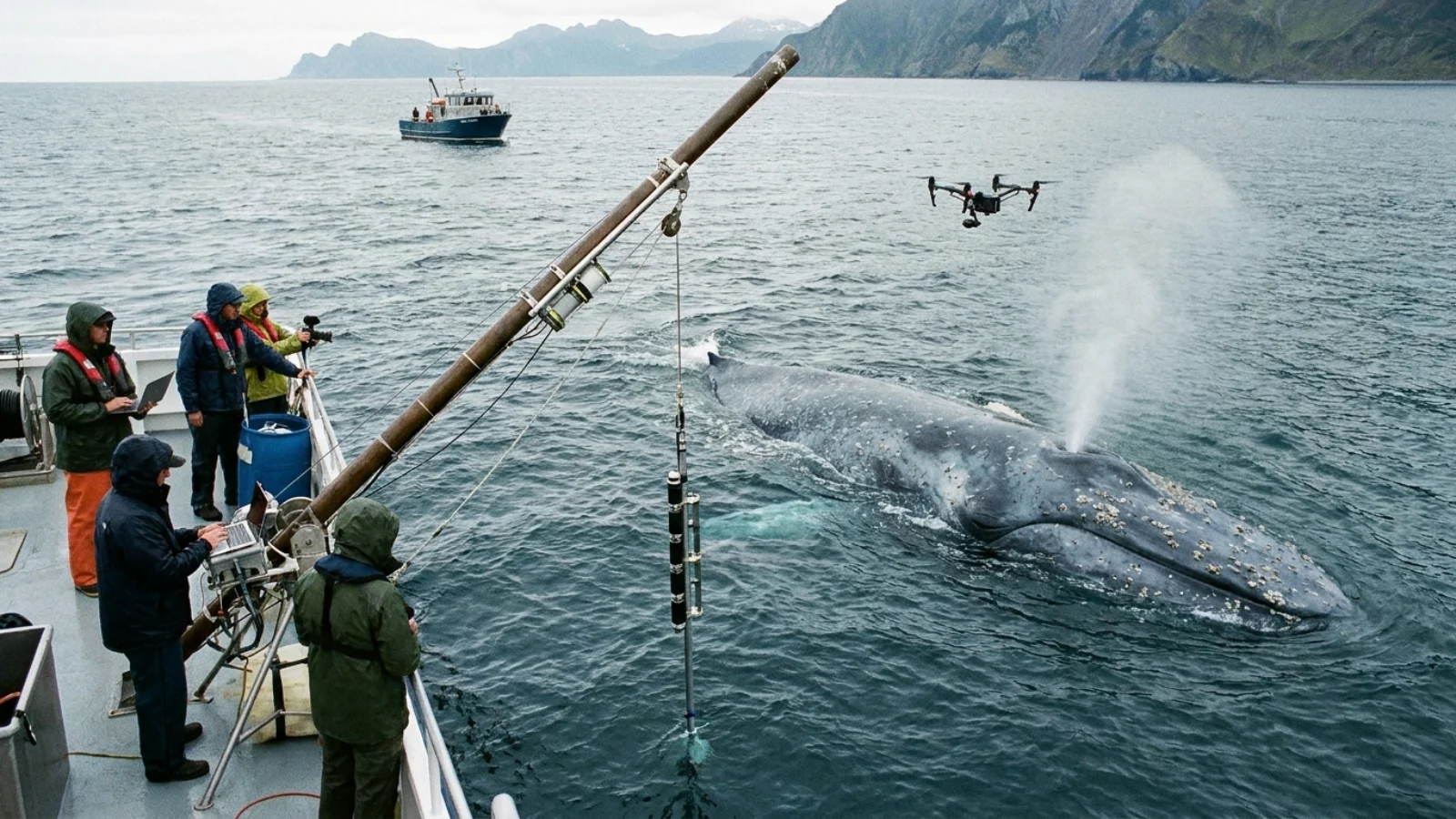
Since the International Whaling Commission banned all hunting of blue whales in 1966, nobody weighs them in pieces any more. Instead researchers use drones. Aerial photogrammetry, measuring a whale’s length and width from carefully calibrated overhead photographs, lets scientists reconstruct its body shape and volume, and from volume and an estimate of tissue density, its mass.
The approach is being tested and refined. In a 2026 study in the Journal of Physiology, Cicciarella and colleagues validated drone measurements against hands-on measurements of bottlenose dolphins in human care and estimated individual body mass with a mean error of 6.4 percent. A 2025 study in Ecology and Evolution by Burslem and colleagues combined drone-based body volume with tissue density from suction-cup tags to estimate the fat reserves of free-swimming sperm whales. For blue whales specifically, a 2025 study by Glarou and colleagues in the Journal of Comparative Physiology B used drone photogrammetry in sub-Arctic Icelandic waters, where the blue whales measured averaged 21.97 metres long, to estimate body size and then their daily energy needs.
These methods mean that, for the first time, scientists can follow the weight of living blue whales through a season without killing them, which helps show how well populations are feeding and recovering.
How much does a baby blue whale weigh?
A blue whale calf is already one of the largest animals on Earth at birth. Gestation lasts about 10 to 12 months, and calves are born about 6 to 7 metres long and weighing 2 to 3 tonnes. They then grow at an astonishing rate on their mother’s fat-rich milk.
Calves need about 2 to 4 kilograms of milk for every kilogram of weight they gain, and estimates suggest that blue whale mothers produce about 220 kilograms of milk a day, within a range of about 110 to 320 kilograms. Calves may be weaned at 6 to 8 months old, when they have reached about 16 metres long, and they gain roughly 17,000 kilograms (37,500 pounds) during the nursing period. The first video of a calf thought to be nursing was filmed in New Zealand in 2016. Females give birth only every two to three years, on average 2.6 years in pygmy blue whales, because producing that much milk drains so much of the mother’s own weight.
How a blue whale’s weight changes through the year
Blue whales are seasonal feeders. Many populations migrate between summer feeding grounds towards the poles and winter breeding grounds in warmer waters, although some individuals stay put year-round or migrate only partly. Most of the year’s eating happens in the feeding season, and much of the energy is stored as blubber to be used later.
Pregnant females eat roughly four percent of their body weight a day during the feeding season, a remarkable figure for an animal that may weigh more than 100 tonnes. That build-up of reserves is what carries a female through migration, pregnancy and months of producing milk. A thin blue whale at the end of the breeding season and a fat one at the end of summer can differ in weight by many tonnes, which is another reason single weight figures should be treated as averages.
Why can blue whales be so heavy?
Living in water is the main reason. Water supports the body, so a blue whale does not need legs and bones strong enough to hold up its weight against gravity the way a land animal does. That frees it to grow far beyond the size of any land animal living today.
The other half of the answer is food. Blue whales eat almost nothing but krill, tiny shrimp-like crustaceans that gather in dense swarms, and they catch them by lunge feeding. A blue whale accelerates towards a patch of krill, opens its mouth up to about 80 degrees and inflates the pleated skin of its throat, which has 60 to 88 grooves, to take in a huge volume of water. A single gulp may engulf about 220 tonnes of water, more than the whale’s own weight. It then pushes the water out through 70 to 395 baleen plates with its throat pouch and tongue and swallows the krill.
Each mouthful can be enormously rewarding. Studies estimate that one mouthful of krill can provide between about 8,312 and 457,141 kilocalories, up to 240 times more energy than the lunge itself costs. Blue whales need to find swarms with more than about 100 krill per cubic metre to make lunging worthwhile, and they increase the number of lunges in the densest patches. According to NOAA, the largest blue whales may eat up to about 6 tons of krill a day. That huge energy return from feeding on dense swarms is what allows an animal this heavy to exist.
How heavy are a blue whale’s body parts?
Some individual organs give a sense of the scale. The heart of a stranded North Atlantic blue whale weighed 180 kilograms (400 pounds), the largest known heart of any animal; for more on that organ, see is a blue whale’s heart as big as a car? A blue whale skull can be 5.8 metres long. The dorsal fin, by contrast, is tiny, only about 33 centimetres, and sits far back near the tail.
The bulk of a blue whale is muscle, blubber, bone and internal organs, with muscle making up a larger share of the body in rorquals than in fatter whales such as right whales. Blubber, the thick layer of fat under the skin, insulates the whale and stores energy, and its thickness varies through the year as the whale feeds and fasts.
How does a blue whale compare with other whales?
No other living whale comes close. The fin whale, the second-largest animal alive, has a maximum recorded weight of nearly 74 tonnes and a maximum estimated weight of about 114 tonnes. Bowhead whales are thought to reach about 80 tonnes and perhaps up to 100 tonnes for the largest individuals. An 18-metre male sperm whale is estimated to weigh about 57 tonnes. Humpback whales weigh up to about 40 tonnes, and gray whales up to about 41 tonnes. The killer whale, the largest dolphin, tops out at around 10 tonnes for the very biggest males.
Put another way, an average Antarctic female blue whale weighs roughly as much as three large humpbacks, and the record-holder weighed more than twice as much as the heaviest fin whale ever actually weighed. For a fish comparison, see whale shark vs blue whale, and for the prehistoric shark often compared with it, see megalodon vs blue whale.
Is the blue whale the heaviest animal ever?
As far as the evidence goes, yes. In 2023 researchers described Perucetus colossus, a fossil whale about 39 million years old from the Ica desert of Peru, known from a partial skeleton of 18 bones. Its bones are unusually thick and dense, and the original estimates of its weight ranged from about 85 to 340 tonnes, with Guinness World Records citing a median of 212.5 tonnes and listing it jointly with the blue whale as the heaviest animal ever.
Those numbers did not last long unchallenged. In their 2024 PeerJ paper, Motani and Pyenson re-examined the methods and concluded that Perucetus did not exceed the body mass of today’s blue whales. Depending on the assumptions, they estimated it weighed 60 to 70 tons if it was 17 metres long, and perhaps as much as 98 to 114 tons at 20 metres, far less than the direct records for blue whales.
Some giant dinosaurs have also been proposed as rivals. Estimates for the sauropod Bruhathkayosaurus give a mean of about 110 to 170 tons, with the most liberal estimates reaching 240 tons, but these are based on very fragmentary fossils that had disintegrated by the time the estimates were made. For now, the blue whale remains the heaviest animal for which there is solid evidence.
Whaling and the loss of the biggest blue whales
The weight records all come from the whaling era because that was the only time large numbers of blue whales were measured. Blue whales were hard to hunt at first because of their size and speed, but that changed in the mid-19th century with harpoons fired as projectiles. Catches peaked in 1930 and 1931, with about 30,000 blue whales taken in a single season. Between 350,000 and 360,000 were killed in the Antarctic in the first half of the 20th century, along with about 11,000 in the North Atlantic and 9,500 in the North Pacific.
There were at least 140,000 mature blue whales in 1926. Today the global population is estimated at 5,000 to 15,000 mature individuals and 10,000 to 25,000 in total, and the International Union for Conservation of Nature lists the species as Endangered. Whaling removed the biggest animals first, so it is possible that very large individuals are rarer today than they once were. Blue whales can live 80 to 90 years or more, and the oldest aged from its earplug was 110 years old, so as protected populations recover, the largest and heaviest animals may slowly become more common again. For more on current numbers, see how many blue whales are left in the world?
So, how much does a blue whale weigh?
A typical adult blue whale weighs about 85 to 130 tonnes, with Antarctic females the heaviest at an average of about 130 tonnes and pygmy blue whale males the lightest. The heaviest blue whale on record, a 27.6-metre female caught in the Southern Ocean in 1947, weighed about 173 to 190 tonnes, depending on which ton the original record used, and estimates for others reach about 199 tonnes. A newborn calf weighs 2 to 3 tonnes and gains around 17,000 kilograms before it is weaned. All of these figures come from whales weighed in pieces during the whaling era or from formulas built from them, and today drones are starting to provide new, non-lethal estimates. For the full species profile, see our blue whale guide.
How much does a blue whale weigh in pounds?
Most adults weigh roughly 190,000 to 290,000 pounds; NOAA says the largest Antarctic whales exceed 330,000 pounds.
What is the heaviest blue whale ever recorded?
A 27.6 m female caught in the Southern Ocean on 20 March 1947, at about 173 to 190 tonnes.
How much does a baby blue whale weigh?
About 2 to 3 tonnes at birth, at 6 to 7 m long.
Are female blue whales heavier than males?
Yes. Females are larger, averaging about 130 t vs 112 t for males in the Antarctic.
How do scientists weigh a blue whale?
Historically by weighing butchered pieces at whaling stations; today by estimating volume from drone photographs.
How much does a blue whale’s heart weigh?
The heart of a stranded North Atlantic blue whale weighed 180 kg.
Is a blue whale heavier than a dinosaur?
As far as solid evidence goes, yes; rival sauropod estimates rest on fragmentary fossils.
How much does a blue whale eat a day?
NOAA says the largest blue whales may eat up to about 6 tons of krill a day.
- Lockyer, C. (1976), “Body weights of some species of large whales”, ICES Journal of Marine Science 36(3): 259-273.
- Lockyer, C. & Waters, T. (1986), “Weights and anatomical measurements of northeastern Atlantic fin and sei whales”, Marine Mammal Science.
- Motani, R. & Pyenson, N.D. (2024), “Downsizing a heavyweight: factors and methods that revise weight estimates of the giant fossil whale Perucetus colossus“, PeerJ 12: e16978.
- Glarou, M. et al. (2025), “Respiration rates and inferred mass-specific field metabolic rates decline with body size among five sympatric cetaceans”, Journal of Comparative Physiology B.
- Cicciarella, R. et al. (2026), “Validation of aerial photogrammetry methods to measure body size, condition and mass in small cetaceans”, Journal of Physiology; Burslem, A. et al. (2025), Ecology and Evolution.
- Guinness World Records, “Heaviest animal ever”; NOAA Fisheries, “Blue whale” species page; Wikipedia contributors, “Blue whale”, “Fin whale”, “Sperm whale”, “Bowhead whale”, “Humpback whale”, “Gray whale” and “Orca” (accessed November 2026).
Blane Perun has been exploring Earth’s oceans and marine life for over 25 years. Founder of TheSea.Org in 1999, underwater photographer, coral aquaculture pioneer, and explorer of 80+ countries.
About Blane Perun →