What Do Killer Whales Eat? — Ecotypes and Their Menus
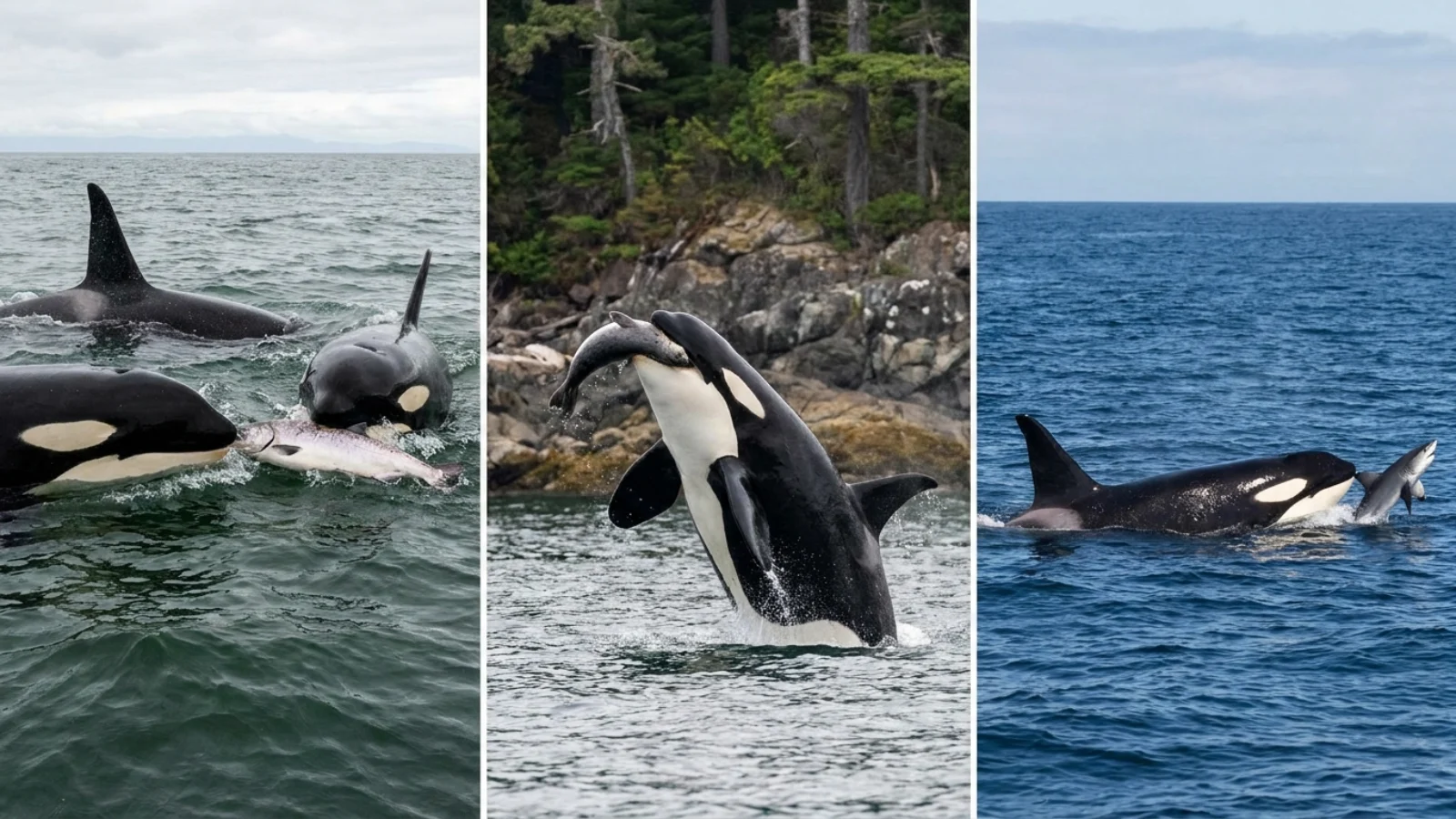
As a species, killer whales eat almost anything: about 30 species of fish, squid, sharks and rays, seals and sea lions, dolphins and porpoises, large whales, seabirds, penguins and sea turtles. As individuals, though, they are specialists. Each population, or ecotype, has its own menu and hunting culture passed down through families. Northeast Pacific residents eat mostly salmon, especially Chinook; Bigg’s (transient) orcas eat seals, sea lions, porpoises and whale calves; Norwegian orcas herd herring; Antarctic types specialise on minke whales, seals or toothfish. An average orca eats about 227 kg of food a day.
Killer whales as a species will eat almost anything, but any given orca family eats only what its grandmother taught it to.
What do killer whales eat?
Killer whales, or orcas, are apex predators with one of the broadest diets of any animal in the ocean. Across the species, recorded prey includes fish, cephalopods such as squid, sharks and rays, seals and sea lions, dolphins and porpoises, whales of almost every size, seabirds and penguins, sea turtles and, now and then, land mammals swimming between islands. Fish-eating orcas alone take around 30 species of fish. Nothing in the sea hunts orcas, which is why they are often called the wolves of the sea.
But that broad list hides an important fact. Killer whales are not generalists at the level of the individual or the family. Different populations, known as ecotypes, specialise on different prey, use different hunting techniques and even make different sounds. A family of fish-eating orcas may swim past a seal without a second glance, while a mammal-eating group a few kilometres away is stalking that same seal in silence. To answer “what do killer whales eat?” properly, you have to ask which killer whales.
How much does a killer whale eat?
A lot. On average, an orca eats about 227 kilograms of food a day, roughly 500 pounds. That is a sensible figure for an animal of this size: adult males typically measure 6 to 8 metres and weigh more than 6 tonnes, and the largest recorded individual was 9.8 metres and over 10 tonnes. Females are smaller, usually 5 to 7 metres and 3 to 4 tonnes. Orcas are warm-blooded, with a body temperature of 36 to 38 °C, and keeping that body warm in cold water burns energy fast.
How that daily intake is met depends on the menu. A salmon-eating orca needs to catch many fish every day. A mammal-eating orca can eat a single harbor seal or a share of a sea lion and be set for a while, but it may go a long time between kills. That difference shapes everything from group size to how much the whales vocalise.
Fish-eating orcas: the salmon specialists
The best-studied fish-eaters are the resident killer whales of the northeast Pacific, from Washington and British Columbia to Alaska. Their diet is extraordinarily narrow. Salmon make up 96 percent of what they eat, and 65 percent of their diet is the large, fatty Chinook salmon. They also eat chum salmon, but the smaller sockeye and pink salmon are not a significant part of their diet, even when those fish are abundant.
Residents usually hunt salmon alone or in small groups, chasing individual fish using echolocation, the clicks and echoes that let orcas detect the location and characteristics of prey. Salmon appear to be largely insensitive to orca calls, so residents can afford to be noisy. They are much more vocal than the mammal-eating orcas in the same waters. Some dolphins seem to recognise these fish-eaters as harmless and stay put when they pass. Resident orcas have never been observed eating marine mammals, although they occasionally harass and kill porpoises and seals for no apparent reason.
The salmon specialism comes at a price. When wild salmon stocks decline, residents cannot easily switch to seals. The southern resident community, three pods that live mostly in the Georgia and Haro Straits and Puget Sound, was listed as endangered under the US Endangered Species Act in 2005. Researchers writing in Ecology and Evolution in 2026 identified insufficient prey, inbreeding, disturbance and contaminants as the known risks to the population, and argued that competition with other orca populations for shared prey matters too.
Herring hunters: carousel feeding in Norway
On the other side of the world, some orcas in the Norwegian and Greenland seas specialise in Atlantic herring and follow the fish’s autumn migration to the Norwegian coast. They catch herring with a cooperative technique called carousel feeding. The whales circle a school, blowing bursts of bubbles and flashing their white bellies to force the fish into a tight ball near the surface. Then they slap the ball with their tail flukes, stunning or killing up to 15 fish at a time, and eat them one by one.
Carousel feeding has been documented only in the Norwegian orca population among killer whales, although some oceanic dolphins use similar methods. The fish-eating orcas off Norway also live in stable, resident-like family groups, and Norwegian and Icelandic herring-eaters appear to have different calls for different activities, including hunting.
Tuna, toothfish and fishing boats
Some orca populations have learned to take fish from people. In the Strait of Gibraltar, a small community of 39 killer whales was observed in spring and summer from 1999 to 2011 feeding on Atlantic bluefin tuna. A study in Biological Conservation by Esteban and colleagues in 2016 found that all of them hunted tuna actively and 18 also took tuna from a drop-line fishery. The fishery-raiding whales had higher survival and far higher calving rates, but none of their calves survived after 2005, when the drop-line catches declined.
Far to the south, at subantarctic Marion Island in the Indian Ocean, a 2023 study in Ecology and Evolution found that killer whale survival was positively correlated with the previous year’s Patagonian toothfish fishing effort, suggesting that fish taken from longlines have become an important food source. These cases show how flexible orca culture can be, and how dependent some populations have become on human fisheries.
Sharks and rays
Sharks and rays are important prey for some orcas, especially in New Zealand, where recorded prey includes eagle rays, stingrays, threshers, hammerheads, blue sharks, basking sharks and shortfin makos. Orcas herd sharks to the surface and strike them with their flukes, and pin rays against the seabed before carrying them up. In South Africa, Australia and California, a few orcas have learned to kill great white sharks and eat only their energy-rich livers. We cover these hunts in detail in our page on whether orcas eat sharks.
Mammal-eating orcas: Bigg’s killer whales
The mammal-eating orcas of the northeast Pacific were long called transients, because they seemed to roam more widely than the residents. Today they are usually called Bigg’s killer whales. Their prey is marine mammals, such as the harbor seals, California and Steller sea lions, harbor and Dall’s porpoises and Pacific white-sided dolphins of the region. Some researchers have found that killer whales in certain areas prefer harbor seals to sea lions and porpoises.
Hunting mammals requires a different style. Seals, sea lions and porpoises hear orca calls well, so Bigg’s orcas are typically silent while hunting, vocalising mainly after a kill. The prey is dangerous; a large sea lion can injure an orca, so the whales often disable their prey before killing it by ramming it, slapping it with their tails, throwing it into the air or breaching and landing on it.
Bigg’s and resident orcas share the same waters but eat completely different food and live largely separate lives. In 2024, Phillip Morin and colleagues argued in Royal Society Open Science that the two ecotypes are different enough to be separate species, proposing the names Orcinus rectipinnus for Bigg’s killer whales and Orcinus ater for residents. The proposal has not been universally adopted, but it shows how deeply diet has shaped these populations. A 2026 study of the West Coast Transient population, now increasingly abundant, found an average calving interval of about 4.9 years and the lowest calf mortality of the populations compared, a sign that mammal-eating orcas in the region are doing well while salmon-eaters struggle.
Whales: from minke calves to blue whales
Orcas prey on cetaceans from small dolphins to the largest animals on Earth. With dolphins and porpoises, such as common, bottlenose, dusky and Pacific white-sided dolphins and harbour and Dall’s porpoises, orcas usually chase the prey to exhaustion, trying to separate one individual from its group. In the Arctic, orcas attack belugas and narwhals trapped in pools enclosed by sea ice. Pilot whales are a notable exception: orcas appear to be wary of them, and pilot whales have been recorded mobbing and chasing orcas.
Larger whales on the menu include sperm whales, grey whales, humpback whales and minke whales, usually calves or juveniles. A hunt typically begins with a long chase and ends with a violent attack on an exhausted animal, and many large whales carry tooth rake marks from encounters with orcas. Prey fight back. Female sperm whales sometimes form a protective circle around their calves with their tails facing outwards, and humpback whales have been seen mobbing orcas that attack humpback calves or even other species.
The most spectacular records come from Australia. In 2019, orcas were recorded killing a blue whale on three separate occasions off the south coast of Western Australia, including an animal estimated at 18 to 22 metres long. The events were published in 2022 by John Totterdell and colleagues in Marine Mammal Science as the first three records of killer whales killing and eating blue whales.
Some scientists think great whales were once a much bigger part of orca diets. Before industrial whaling, large whales may have been a major food source. Whaling may at first have helped orcas, as harpoon blasts signalled food and inflated carcasses floated within reach, but the collapse of whale populations may have pushed some orcas to switch prey. One controversial hypothesis links that switch to later declines of seals, sea lions and then sea otters in the Aleutian Islands in the 1990s, although there is no direct evidence that orcas caused the otter decline.
Seals on beaches and ice floes
Some of the most remarkable orca hunting techniques target seals and sea lions. On the steep beaches of Península Valdés in Argentina and the Crozet Islands in the southern Indian Ocean, orcas deliberately strand themselves on the beach to grab sea lion and elephant seal pups in the surf, then wriggle back into the sea. Beaching is usually fatal for cetaceans and is not instinctive; young orcas can take years of practice to learn it, and adults sometimes release weakened prey near juveniles so they can practise. The orcas that hunt this way in Argentina and Crozet behave more like transients than residents.
In Antarctica, “wave-hunting” orcas spyhop to find seals resting on ice floes, then swim in a group towards the floe to create a wave that washes over the ice and knocks the seal into the water, where other members of the group are waiting. A 2025 review in Philosophical Transactions of the Royal Society B catalogued 190 cases of 36 distinct foraging tactics in 21 species of toothed whales and dolphins, and orcas are among the most inventive.
Antarctic killer whales: minke whales, seals and toothfish
Antarctica has its own orca types, distinguished by the size and angle of the white eye patch and whether they have a darker dorsal cape. In a description published in the Journal of Cetacean Research and Management, Robert Pitman and Paul Ensor described three forms. Type A, with a medium-sized eye patch and no cape, lives mainly offshore in ice-free water around the continent and apparently feeds mainly on Antarctic minke whales. Type B, with a much larger eye patch and a cape, lives inshore and often in the pack ice; it may also take minke and possibly humpback whales, but seals seem to be its most important prey. Type C, with a small, forward-slanted eye patch, lives mostly in the pack ice off East Antarctica and has been recorded feeding only on Antarctic toothfish.
Type C is the smallest known form of killer whale. A 2020 study of Type C orcas in McMurdo Sound recorded 28 call types, which may be related to their feeding ecology. A fourth form, Type D, has since been documented and a 2019 study found it distinct from other populations. Type B orcas also make surprising journeys: satellite tags showed some travelling from the Antarctic Peninsula to subtropical waters off Uruguay and Brazil, one completing a non-stop round trip of almost 9,400 kilometres in 42 days, apparently without feeding or calving, which the researchers suggested might be a periodic physiological maintenance migration to warmer water.
Birds, turtles, squid and deer
Orcas eat seabirds, but they more often kill them and leave them uneaten. Penguins recorded as prey in Antarctic and sub-Antarctic waters include gentoo, chinstrap, king and rockhopper penguins, and orcas in many areas take cormorants and gulls. One captive orca at Marineland of Canada discovered it could spit fish onto the surface to attract gulls, and then eat the birds; four other orcas learned to copy it.
Orcas also eat cephalopods and sea turtles. In tropical waters, where food is less productive, orcas appear to have more generalised diets than the specialists of cold seas. And they occasionally take land animals: orcas have been seen catching deer swimming between islands off the northwest coast of North America.
Do killer whales eat people?
No. Of the very few confirmed attacks on humans by wild orcas, none has been fatal. In one famous incident during the Terra Nova Expedition to Antarctica, orcas tried to tip ice floes on which a photographer and a dog team were standing, perhaps because the barking dogs sounded like seals. In the 1970s a surfer in California was bitten, and in 2005 a boy splashing in Alaskan waters frequented by harbour seals was bumped by an orca. People are simply not on the menu of any known orca population.
Why diet matters for orca conservation
Because each population is so specialised, its fortunes rise and fall with its prey. The International Union for Conservation of Nature lists the orca as Data Deficient, partly because several types may be separate species. Salmon-eating residents in the Pacific Northwest have suffered as wild salmon declined, and at their lowest the southern residents numbered only about 75 whales in the Puget Sound region. Orcas also sit at the top of the food chain, so pollutants such as PCBs build up in their blubber; off Washington, PCB levels in orcas have exceeded those that caused reproductive and immune problems in harbour seals.
The Exxon Valdez oil spill shows the risk of specialisation. A resident pod in Prince William Sound lost about half its members in the following year, and by 2009 the AT1 transient population had dwindled to seven individuals that had not reproduced since the spill.
So, what do killer whales eat?
Everything, and nothing in particular. The species eats fish, squid, sharks, seals, dolphins, whales, birds and turtles, about 227 kilograms a day. But each population has its own narrow menu and a hunting culture handed down through generations: Chinook salmon for northeast Pacific residents, seals and porpoises for Bigg’s whales, herring for Norwegian orcas, bluefin tuna in the Strait of Gibraltar, toothfish for Antarctic Type C, and minke whales or seals for Types A and B. That mix of species-wide flexibility and family-level tradition is what makes orcas the ocean’s most versatile predator. For the other side of the story, see what eats orcas and our profile of the orca. One of the most debated cases of orca diet change involves sea otters; see do killer whales eat sea otters?
| Population | Main prey | Signature technique |
|---|---|---|
| Northeast Pacific residents | Salmon (65% Chinook) | Solo or small-group chases, noisy |
| Bigg’s (transient) | Seals, sea lions, porpoises, dolphins | Silent stalking, ramming |
| Norway | Atlantic herring | Carousel feeding with bubbles and tail slaps |
| Strait of Gibraltar | Bluefin tuna | Active hunting and taking fish from lines |
| Península Valdés, Crozet | Sea lion and elephant seal pups | Intentional beaching |
| Antarctic Type A | Antarctic minke whales | Offshore pursuit |
| Antarctic Type B | Seals (pack ice) | Wave-washing seals off floes |
| Antarctic Type C | Antarctic toothfish | Fish-eating in pack ice |
What is a killer whale’s favourite food?
It depends on the population: Chinook salmon for Pacific residents, seals for Bigg’s orcas, herring in Norway.
How much does a killer whale eat a day?
About 227 kg (500 lb) on average.
Do killer whales eat great white sharks?
Yes. A few orcas in South Africa, Australia and California kill white sharks and eat the liver.
Do killer whales eat blue whales?
Yes. Orcas killed and ate blue whales three times off Western Australia in 2019.
Do killer whales eat penguins?
Yes, including gentoo, chinstrap, king and rockhopper penguins, though they often kill birds without eating them.
Do resident orcas eat seals?
No. Residents have never been seen eating marine mammals, though they sometimes harass them.
Do killer whales eat humans?
No. No fatal attack by a wild orca on a person has been confirmed.
Why do orcas beach themselves to hunt?
To grab seal and sea lion pups in the surf at places such as Península Valdés and Crozet.
- Morin, P.A. et al. (2024), “Revised taxonomy of eastern North Pacific killer whales: Bigg’s and resident ecotypes deserve species status”, Royal Society Open Science.
- Totterdell, J.A. et al. (2022), “The first three records of killer whales killing and eating blue whales”, Marine Mammal Science.
- Pitman, R.L. & Ensor, P. “Three forms of killer whales in Antarctic waters”, Journal of Cetacean Research and Management; Durban, J.W. & Pitman, R.L. (2011), Biology Letters.
- Esteban, R. et al. (2016), “Dynamics of killer whale, bluefin tuna and human fisheries in the Strait of Gibraltar”, Biological Conservation; Jordaan, R.K. et al. (2023), Ecology and Evolution.
- Hersh, T.A. et al. (2025), “Ecology and conservation of socially learned foraging tactics in odontocetes”, Phil. Trans. R. Soc. B.
Blane Perun has been exploring Earth’s oceans and marine life for over 25 years. Founder of TheSea.Org in 1999, underwater photographer, coral aquaculture pioneer, and explorer of 80+ countries.
About Blane Perun →