Ambergris — Why Sperm Whale ‘Floating Gold’ Sells for Thousands
Ambergris is a solid, waxy, flammable substance that forms in the intestines of sperm whales, usually around the sharp beaks of the squid they eat. It is passed out of the whale, floats, and can drift at sea for years or even centuries before washing ashore. Fresh ambergris smells faecal; aged ambergris develops a sweet, earthy, marine scent and contains ambrein, the source of the fragrance molecule ambroxide. Perfumers have prized it as a fixative for centuries, which is why a 9.5 kg lump found in a dead whale on La Palma in 2023 was valued at around half a million dollars. It is often called “whale vomit”, but most researchers describe it as closer to a faecal stone.
Ambergris is a sperm whale’s answer to a gut full of squid beaks, and perfumers have been paying a fortune for it for a thousand years.
What is ambergris?
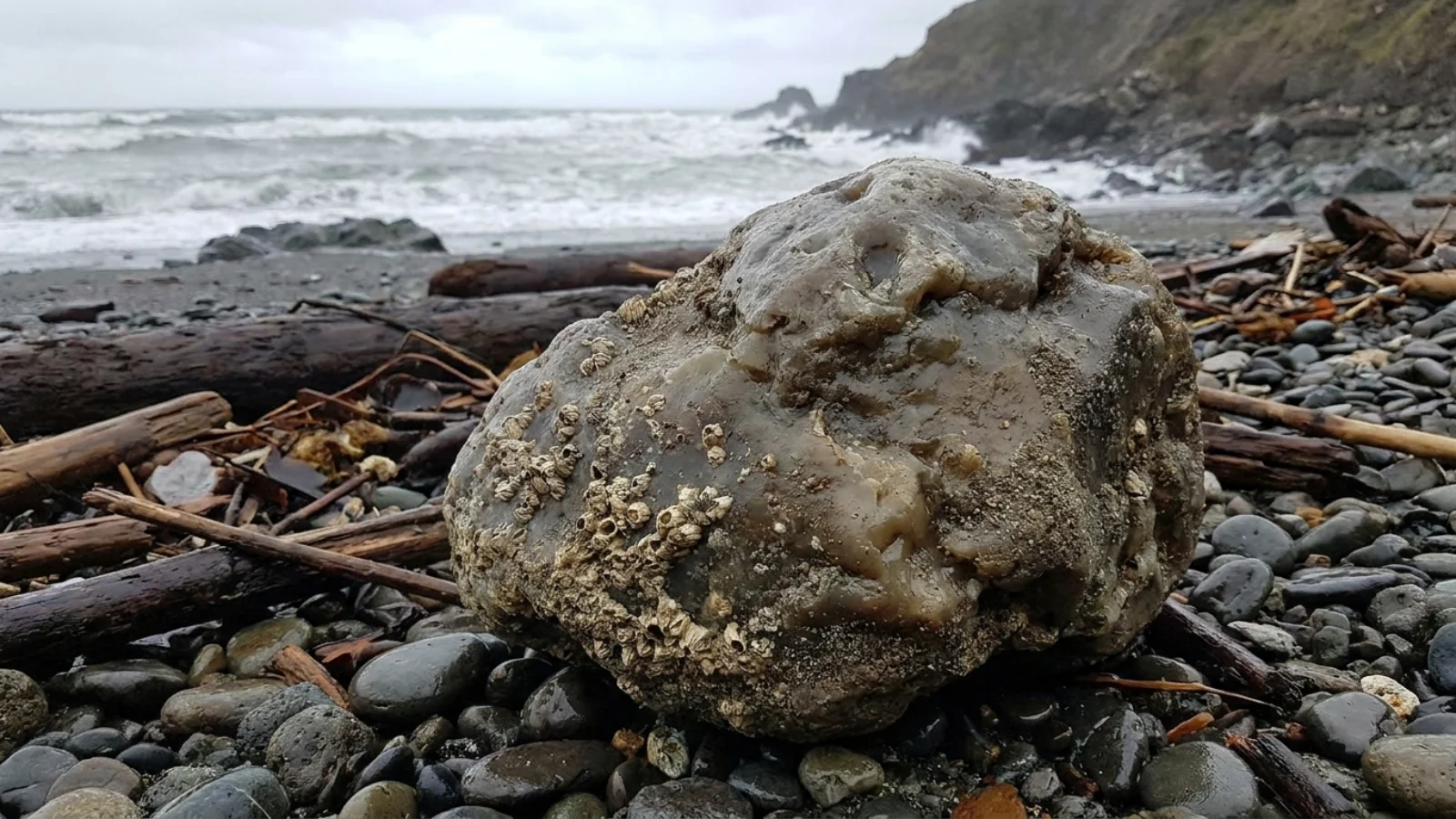
Ambergris is a solid, waxy and flammable substance, dull grey to blackish in colour, that is produced in the digestive system of sperm whales. It turns up in three ways: floating at sea, washed up on beaches, or occasionally inside the abdomen of a dead sperm whale. When it is fresh it is soft, pale and smells strongly of faeces. After months or years drifting in sunlight and seawater it hardens, darkens and develops a scent usually described as sweet, earthy, marine and animal all at once, a smell some compare to a smoother, richer version of rubbing alcohol without the sting.
That transformation is why ambergris has been valuable for so long. In perfumery it acts as a fixative, a substance that makes other scents last much longer on the skin, and for centuries it was one of the most expensive raw materials a perfumer could buy. Today most of the ambergris note in commercial perfume comes from a synthetic molecule called ambroxide, but the natural material still fetches high prices from collectors and niche perfumers, and every few years a lucky beachcomber or a whale pathologist makes headlines with a lump worth more than a house.
Is ambergris really whale vomit?
The nickname “whale vomit” is catchy, but it is probably wrong for most ambergris. The substance forms in the whale’s intestines, not its stomach, and the usual route out is the same as for any other faecal matter. Some researchers have speculated that a mass too large to pass through the gut may be expelled through the mouth, but that idea remains under debate. Chemists who study ambergris, such as Steven Rowland and Paul Sutton, routinely describe it as a coprolith, a hardened mass formed in the bowel, which puts it much closer to an intestinal stone than to a hairball.
The confusion comes partly from what sperm whales do with the rest of their indigestible food. A sperm whale has a four-chambered stomach. The first chamber has thick muscular walls that crush food, since whales cannot chew, and the second is where most digestion happens. Squid beaks, which are made of tough material that does not digest, collect in that second chamber, and as many as 18,000 have been found in a single dissected whale. Most of these beaks are vomited back up. The few that slip past into the intestine are the ones that seem to trigger ambergris. So sperm whales do vomit, and they do make ambergris, but the two are usually separate events.
How does ambergris form?
Sperm whales hunt in the deep ocean, and their main prey is squid. They eat roughly three percent of their body weight a day, and the global sperm whale population is estimated to eat about 91 million tonnes of prey a year. Squid have hard, parrot-like beaks, and a whale that eats thousands of squid is constantly passing sharp, indigestible objects through its gut. The sperm whale also has one of the longest intestinal systems of any animal, exceeding 300 metres in large individuals, so a beak that slips out of the stomach has a long way to travel.
The leading explanation is that ambergris begins as a secretion from the bile duct into the intestine, which coats and binds these hard fragments. Squid beaks are found embedded in lumps of ambergris, and that observation led scientists to suggest that the substance helps the whale pass hard, sharp objects safely, in a way loosely comparable to an oyster coating an irritant to form a pearl. Over time the mass grows in layers. Most estimates suggest ambergris takes years to form.
Not every whale manages to pass it. One theory holds that a large mass can block the colon, especially when combined with parasitic worms and squid remains, and that the blockage can kill the whale. The La Palma case described below appears to be exactly that: the ambergris ruptured the whale’s intestine. In that sense the most valuable ambergris is sometimes a sign of a fatal illness.
Which whales produce ambergris?
Only sperm whales. Christopher Kemp, author of Floating Gold: A Natural (and Unnatural) History of Ambergris, says it is produced only by sperm whales and only by about one percent of them; other estimates put the share of sperm whales found with ambergris at between one and five percent. The link to squid beaks helps explain the exclusivity. Other toothed whales eat squid, but the sperm whale’s combination of huge squid intake, an exceptionally long gut and a large body appears to be what allows a coprolith of this size and chemistry to build up.
Chemistry backs up the link to the sperm whale’s diet. In a 2025 study in Natural Product Research, Rowland and colleagues analysed a large piece of floating ambergris, more than 100 kilograms, found in the Atlantic in 2019. The metals in it were dominated by copper and zinc, a distribution similar to that of several squid species, and consistent with the squid beaks found inside it. Its carbon isotope ratio, about -22.5 per mil, was typical of ambergris taken directly from whale bodies.
The chemistry: ambrein, ambroxide and that smell
The main constituent of ambergris is ambrein, a triterpene alcohol. Ambrein itself is almost odourless. In 1946 the chemists Leopold Ružička and Fernand Lardon showed that white crystals of ambrein could be separated from ambergris by heating it in alcohol and letting the solution cool, and that the fragrance of ambergris depends on this compound. As ambergris floats in the sea and is exposed to air and sunlight, ambrein slowly oxidises into smaller, strongly scented molecules, chiefly ambroxide and ambrinol. That is why fresh ambergris smells of the gut and aged ambergris smells of perfume: the valuable aroma is a product of time and weathering.
Ambrein is built from squalene, a common triterpenoid precursor, and ambergris also contains steroids such as coprostanol, epicoprostanol and coprostanone. Rowland’s group has used mass spectrometry to measure the ratio of ambrein to these steroids, which helps confirm whether a sample is genuine and gives clues to how long it has weathered. Headspace analysis of beach samples, published in 2020, found that the main volatile compounds included the odorous gamma-dihydroionone and the odourless hydrocarbon pristane, and that the mix changed with colour and age, from a black, sticky sample from New Zealand that had probably been ejected recently to a white solid from a Chilean beach.
Physically, aged ambergris is lighter than water, with a specific gravity of about 0.78 to 0.93, which is why it floats. It melts at about 62 °C into a fatty, yellow, resin-like liquid and turns into white vapour at about 100 °C. It dissolves in ether and in oils, and it is relatively unreactive to acid.
How long does ambergris float at sea?
Much longer than anyone used to think. Stories had long suggested that ambergris might drift for decades before reaching a beach, but there was no reliable data. In a study published in Natural Product Research in 2019, Rowland, Sutton and Timothy Knowles gathered more than forty jetsam samples, many collected on known dates from known beaches around the world, and radiocarbon-dated some of them. The surprising result was that some ambergris had remained in the environment for about a thousand years. The Chilean sample in the volatile study was one of these, dated to about a millennium old.
Not every piece is ancient. The large Atlantic flotsam sample analysed in 2025 was radiocarbon-dated to after the 1950s, and the black, tacky New Zealand sample was probably fresh. Some ambergris has also survived in the fossil record: fossilised ambergris about 1.75 million years old has been found. Taken together, the evidence suggests that once a lump is free of the whale, it can circulate on ocean currents for anything from months to many centuries, slowly weathering into the grey, fragrant material collectors look for.
Why is ambergris so valuable?
Rarity, slow formation and a scent that perfumers have never fully replaced. A perfume fixative slows the evaporation of the more volatile notes in a fragrance, so a scent lasts longer and develops more smoothly on the skin. Ambergris did that job while adding its own rich, warm, marine-animal note. Because so few sperm whales produce it, and because a lump may drift for years before anyone finds it, supply has always been tiny and unpredictable.
Prices are rarely public and vary with quality. Pale, well-aged ambergris with a sweet scent is worth far more than dark, fresh, sticky material. Reporting on recent finds gives a sense of the scale. In 2021, fishermen off the coast of Yemen found a 127-kilogram piece valued at 1.5 million US dollars. In 2023, a 9.5-kilogram lump recovered from a dead whale in the Canary Islands was valued at around 500,000 to 550,000 dollars. Live Science reported that ambergris can sell for thousands of dollars per pound, which is why it is often called floating gold.
The La Palma whale: half a million dollars in a dead sperm whale
In 2023 a sperm whale washed up dead on a beach on La Palma, one of Spain’s Canary Islands. Antonio Fernández Rodríguez, an animal health researcher at the University of Las Palmas de Gran Canaria, examined the carcass to find out why it had died. Inside the intestine he found a lump of ambergris weighing about 9.5 kilograms. The mass appears to have ruptured the whale’s intestine, causing the death and the stranding.
The find was valued at around half a million dollars, and Fernández said he planned to sell it and give the money to victims of the 2021 volcanic eruption on La Palma, which caused an estimated 929 million dollars in damage. The story captured the strange economics of ambergris: one of the most expensive natural products in the world, recovered by a pathologist from an animal killed by the very thing that made it valuable.
Where is ambergris found?
Ambergris can wash up wherever sperm whales roam, which is most of the world’s deep oceans. Finds have been recorded in the Atlantic Ocean and on the coasts of South Africa, Brazil, Madagascar, the East Indies, the Maldives, China, Japan, India, Australia, New Zealand and the Molucca Islands. Most commercially collected ambergris has historically come from the Bahamas, particularly New Providence.
Beachcombers who hunt for it often walk the tide line after storms with onshore winds, and some use dogs, which are attracted to the smell. The difficulty is that many things on a beach look like weathered ambergris: lumps of fat, wax, rubber, oil residues and other organic jetsam. Rowland and Sutton have even published an analysis of miscellaneous non-ambergris organic jetsam submitted by hopeful finders. A genuine piece floats, has a waxy texture, melts at a fairly low temperature and has a distinctive smell, but the only reliable confirmation is a laboratory test for ambrein.
A thousand years of ambergris: perfume, food and medicine
The word itself tells part of the story. English “amber” comes from the Arabic ʿanbar, via Medieval Latin and French. Originally the word meant ambergris. From the late 13th century, Romance languages extended “amber” to the fossil tree resin from the Baltic, distinguishing white or yellow amber from ambre gris, grey amber. The resin eventually took over the word, leaving “ambergris” for the whale substance. The old spelling “ambergrease” came from people hearing the word and thinking of its waxy feel.
Ambergris has been burned as incense since ancient Egypt, and in modern Egypt it has been used to scent cigarettes. In China it was called “dragon’s spittle fragrance”. During the Black Death some Europeans carried balls of ambergris in the belief that it would ward off plague, because the scent masked the bad air then thought to spread disease. Medieval European physicians prescribed it for headaches, colds and epilepsy. A 2026 study in the Journal of the History of Medicine and Allied Sciences traced how ambergris and deer musk were prescribed as aphrodisiacs and fertility remedies in medieval Islamicate medicine and then in early-modern European sources from the 16th to 18th centuries, showing a direct exchange of medical ideas between the Middle East and Europe. Laboratory work has since shown that ambrein increases sexual behaviour in rats, giving the old reputation some limited support.
It was also eaten. Eggs with ambergris were reportedly the favourite dish of King Charles II of England. A nineteenth-century recipe for rum shrub called for a thread of ambergris with almonds, cloves, cassia and orange peel, and in 18th-century Europe it flavoured hot chocolate and coffee. In New Zealand, Māori chewed ambergris found on the shore as a kind of gum, known as mīmiha. Its use as incense even appears in art: John Singer Sargent’s painting Fumée d’Ambre Gris was made in Tangiers and Paris in 1880.
Synthetic ambergris: ambroxide and the search for substitutes
The rarity of ambergris, its unpredictable supply and the legal complications of whale products pushed perfumers towards synthetic alternatives. The key one is ambroxide, also known as ambrox, the main odour compound formed when ambrein oxidises. It is now produced synthetically and used widely in the perfume industry, and most “amber” notes in modern fragrances rely on it rather than on whale material.
Making it is still an active field. A 2025 review in Frontiers in Bioengineering and Biotechnology describes efforts to convert cis-abienol, a compound from tobacco leaf hairs, and sclareol into ambrox and related ambergris-like compounds, including by microbial and enzymatic routes. Chemists also continue to publish new total syntheses: a 2026 paper in The Journal of Organic Chemistry reported a ten-step route to racemic ambrox with an overall yield of about 21 percent. And a 2026 study in Applied and Environmental Microbiology found that the natural form of ambrox is readily broken down by Sphingomonas bacteria isolated from sewage sludge, which matters for a molecule used in vast quantities in consumer products.
Is ambergris legal?
It depends on where you are. Commercial whaling drove sperm whales and other great whales into steep decline; during the 18th and 19th centuries tens of thousands of whales were killed each year for oil, whalebone and ambergris, and the International Whaling Commission adopted a moratorium on commercial whaling in 1982. The sperm whale is listed as Vulnerable by the IUCN. Ambergris itself is not harvested from living whales, and under CITES, the international treaty on wildlife trade, naturally excreted waste such as faeces, urine and ambergris is not treated as a part or derivative of a protected species.
National laws are stricter in some places. In the United States, possession and trade of ambergris are prohibited under the Endangered Species Act of 1973. In Australia, the commercial export and import of ambergris are banned under the Environment Protection and Biodiversity Conservation Act 1999, and states and territories have their own additional rules. In India, sale or possession is illegal under the Wild Life (Protection) Act of 1972. By contrast, trade is legal in the United Kingdom, in member states of the European Union, in Switzerland and in the Maldives. Anyone who thinks they have found ambergris should check local law before trying to sell it.
So what is ambergris?
Ambergris is a waxy coprolith that forms in the intestines of a small fraction of sperm whales, probably to protect the gut from the sharp beaks of squid. It floats, can drift for centuries, and slowly weathers from a faecal-smelling lump into a fragrant material rich in ambrein. Its rarity and scent have made it one of the most prized natural substances in history, used in incense, medicine, food and especially perfume. Synthetic ambroxide now does most of its work, but the whale’s version still makes headlines whenever a lucky beachcomber, fisherman or pathologist finds a lump of floating gold.
Is ambergris whale vomit?
Mostly no. It forms in the intestine and usually leaves like faeces; whether large lumps are vomited is debated.
Which animal produces ambergris?
Only sperm whales, and only roughly 1 to 5 percent of them.
What does ambergris smell like?
Fresh ambergris smells faecal; aged pieces smell sweet, earthy, marine and animal.
How much is ambergris worth?
Prices vary with quality; a 9.5 kg lump in 2023 was valued at around $500,000.
How can you tell if something is ambergris?
Genuine ambergris floats, is waxy and melts near 62 °C, but only a lab test for ambrein confirms it.
Is it legal to sell ambergris?
It is legal in the UK, EU and Switzerland but banned in the US, Australia (commercial trade) and India.
How old can ambergris be?
Radiocarbon dating shows some beach ambergris has drifted for about 1,000 years.
What replaced ambergris in perfume?
Mostly synthetic ambroxide (ambrox), made from plant compounds such as sclareol.
- Rowland, S.J., Sutton, P.A. & Knowles, T.D.J. (2019), “The age of ambergris”, Natural Product Research.
- Rowland, S.J. et al. (2025), “Chemical analysis of flotsam ambergris”, Natural Product Research; Wilde, M.J. et al. (2020), “Volatile and semi-volatile components of jetsam ambergris”, Natural Product Research.
- Kemp, C. (2012), Floating Gold: A Natural (and Unnatural) History of Ambergris, University of Chicago Press; Clarke, R. (2006), “The origin of ambergris”, Latin American Journal of Aquatic Mammals.
- Wang, W. et al. (2025), “Cis-abienol from tobacco trichomes to ambergris-like compounds”, Frontiers in Bioengineering and Biotechnology; Haupt, T. et al. (2026), Applied and Environmental Microbiology.
- Live Science (12 July 2023), “$500,000 chunk of ‘floating gold’ found in dead whale”.
Blane Perun has been exploring Earth’s oceans and marine life for over 25 years. Founder of TheSea.Org in 1999, underwater photographer, coral aquaculture pioneer, and explorer of 80+ countries.
About Blane Perun →