How Do Whales Sleep? — Half-Brain Naps and Vertical Drifting
Whales sleep in short bouts, usually with only one half of the brain asleep at a time, so they can keep surfacing to breathe and stay alert. This is called unihemispheric slow-wave sleep, and it has been found in every cetacean examined so far. Whales are conscious breathers: unlike us, they cannot breathe automatically while unconscious, so they cannot afford to fall deeply asleep for long. Sperm whales have a striking alternative: they take short naps hanging motionless and vertical just below the surface, and in one tagging study they rested this way for only about 7 percent of the time.
Whales sleep one half of the brain at a time, or in short vertical naps near the surface, because they must stay aware enough to breathe.
How do whales sleep?
All mammals sleep, and whales are no exception. But a whale faces a problem no land mammal has to solve: it lives in water, it breathes air, and it has to decide to take every breath. Whales are conscious breathers. Unlike humans, whose breathing carries on automatically during sleep, whales cannot afford to become unconscious for long, because they could drown.
Their solution is to sleep differently. Toothed whales and dolphins studied in captivity sleep with only one side of the brain at a time, so that they can keep swimming, surface to breathe and stay alert to predators and to other members of their group while they rest. This is known as unihemispheric slow-wave sleep. Sperm whales, the largest toothed whales, have been caught doing something even stranger: taking short naps while hanging vertically in the water, head up or head down, just below the surface. Much less is known about baleen whales, but captive and field observations suggest they also rest in short bouts, often lying still at or near the surface.
Knowledge of sleep in wild whales is still limited. Measuring brain waves requires electrodes on the head, which is difficult with a dolphin in a pool and so far impossible with a free-swimming great whale. Most of what scientists know comes from captive dolphins and small whales, plus behavioural tags on wild animals.
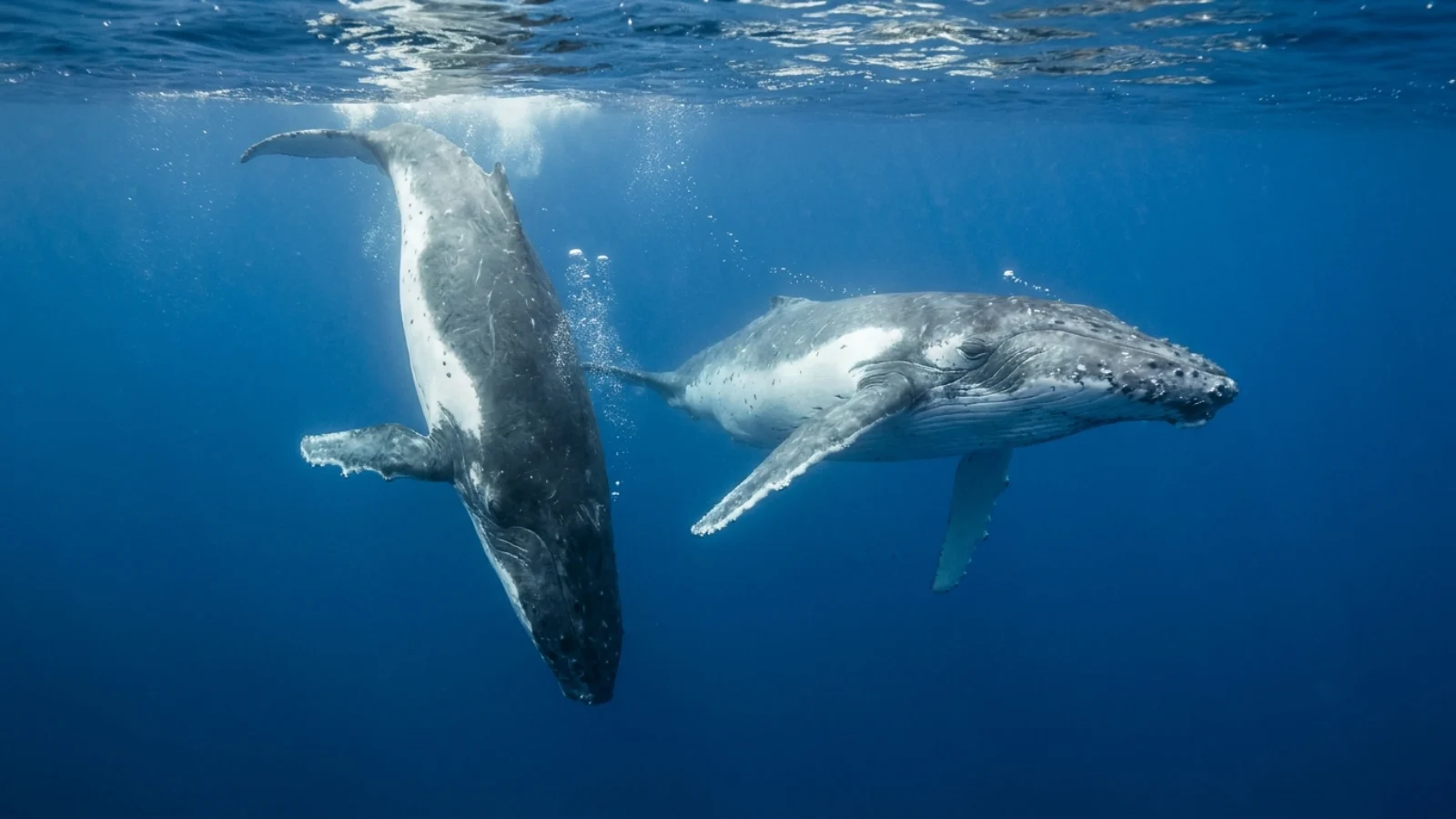
What is unihemispheric sleep?
In unihemispheric slow-wave sleep, one cerebral hemisphere shows the slow, high-amplitude brain waves of deep sleep while the other shows the patterns of wakefulness. After a while the two sides switch. A whale or dolphin in this state can keep swimming slowly, keep surfacing to breathe and keep one eye open.
In a 2008 review in Neuroscience and Biobehavioral Reviews, Oleg Lyamin, Paul Manger, Sam Ridgway, Lev Mukhametov and Jerome Siegel summarised what was known about this unusual form of sleep, which has been found in all members of the order Cetacea examined to date. They described cetacean sleep as having four main features: unihemispheric slow-wave sleep; a negligible amount, or complete absence, of rapid eye movement (REM) sleep, the dreaming stage of human sleep; a varying degree of movement during sleep linked to body size; and an asymmetrical eye state, with one eye open and the other closed.
The eye state is a useful clue: a resting dolphin often keeps one eye open, keeping watch while half of its brain sleeps. For more on this, see do dolphins sleep with one eye open?
Why do whales sleep with half a brain?
The obvious answer is breathing: if a whale must consciously surface to breathe, keeping half the brain awake lets it do so. Lyamin and colleagues discussed three possible functions of unihemispheric sleep: allowing the animal to keep moving, allowing more efficient processing of sensory information, such as watching for predators, and controlling breathing.
Their conclusion was more surprising. They suggested that the selection pressure that drove the evolution of cetacean sleep was most likely the need to offset heat loss to the water, from birth and throughout life. Water draws heat away from the body far faster than air, and a whale that stopped moving completely might lose heat dangerously, especially a small dolphin or a newborn calf. By keeping one hemisphere awake and the body moving, a whale keeps generating heat. In this view, staying alert for predators and keeping control of breathing are useful side benefits rather than the main reason this form of sleep evolved.
The genetic machinery is being worked out too. A 2024 study in Molecular Biology and Evolution by Yin and colleagues compared genes linked to the body clock across mammals and found signs of positive selection in cetaceans and eared seals, the two groups with unihemispheric sleep. Experiments suggested that changes in one gene, FBXL21, may help decouple the sleep-wake cycle from daily rhythms so the animal can keep swimming continuously. The researchers identified 73 rapidly evolving genes and 92 genes with unique amino acid changes in cetaceans, which sleep only unihemispherically.
Do whales dream?
Probably very little, if at all. REM sleep, the stage of sleep most associated with vivid dreaming in humans, is negligible or absent in cetaceans, according to the 2008 review. During REM sleep, land mammals lose most of their muscle tone, which would be risky for an animal that has to keep swimming and surface to breathe.
There are hints of something similar, though. A captive gray whale studied by Lyamin and colleagues in 2000 showed characteristic jerks of the head, neck and sometimes the whole body while resting. In two episodes, intense jerks followed each other continuously for 3 to 4 seconds, accompanied by eyelid movements, and the researchers noted that they resembled the twitches typical of paradoxical, or REM, sleep in land mammals. Whether whales experience anything like dreams remains unknown.
How do sperm whales sleep?
Sperm whales offered the first strong evidence of how a wild great whale sleeps. For some time, researchers had known that pods of sperm whales sometimes float motionless in a vertical position, heads just below or at the surface or pointing down. In 2008, Patrick Miller of the University of St Andrews and colleagues published a study in Current Biology showing how often this happens.
The team attached suction-cup tags to 59 wild sperm whales at several locations around the world and collected 562 hours of recordings. The whales made slow, passive “drift dives”, in which they hung vertically and drifted, for about 7.1 percent of the time. The researchers noted that this is less rest than any other mammal studied in the wild. Most of this resting happened between 6 p.m. and midnight, and because the behaviour appeared at every tagging location, the team considered it typical of the species.
A chance encounter supported the idea that this was true sleep. Off northern Chile, a team led by Luke Rendell filmed six sperm whales floating vertically and motionless with their heads at or just below the surface. Three were unusually unresponsive to the approaching boat, which accidentally touched one of the whales. That contact woke it. Reduced responsiveness that reverses with sufficient stimulation is one of the key tests of sleep, and Miller suggested that the study presented the first evidence that whales in the wild may sleep with both sides of the brain at the same time. Other sources describe the same drift dives as shallow and passive, with the whales not responding to passing vessels unless touched.
How do sperm whales stay put while they sleep?
A sleeping sperm whale needs to stay at a steady depth without effort. It rests just below the surface, away from the jostling of waves, but without paying the cost of swimming to deeper water. That creates a buoyancy problem. Sperm whales are breath-hold divers, and if a resting whale slowly drifts upward, the air in its lungs expands as the water pressure falls, following Boyle’s law, making the whale even more buoyant.
A 2026 study in the Journal of Experimental Biology by Noemie Freymond, Alec Burslem and Patrick Miller tackled this problem. They tagged 42 sperm whales off northern Norway and built a simulation based on tissue density, drag and the volume of gas the whales carried, matching it to the depth records of 10 whales that rested mainly by diving head-down. All of those whales released bubbles while resting, and the simulation confirmed that releasing bubbles regulated their buoyancy, letting them stay submerged while they rested. The results also suggested that sperm whales start resting dives with less air than they take down on deep foraging dives. The authors could not rule out that the bubbles also help the whales release excess carbon dioxide or nitrogen.
How do baleen whales sleep?
Baleen whales are the least understood. They are too large to keep in captivity for long and too difficult to fit with brain sensors at sea, so scientists rely on behaviour. Whale watchers often see humpback and right whales lying still at the surface, a behaviour often called logging because the whale looks like a floating log. Resting whales may stay there for long periods, breathing slowly, before diving again.
The best direct observations come from a rescued gray whale. In 2000, Lyamin and colleagues recorded a young female gray whale continuously on video for nine days at SeaWorld in San Diego, 14 months after she had been rescued. Over the first six days, she spent on average 37.9 percent of each 24 hours in active wakefulness, 17.4 percent in a transitional stage and 41.2 percent resting. During rest she either lay on the bottom of the pool, for about 13.2 percent of the day, or hung at the surface, for about 28 percent, staying almost motionless and moving only to breathe. During rest both eyes could be open, one open and one closed, or more rarely both closed.
These observations fit the pattern seen in toothed whales: short bouts of quiet rest, flexible eye states and the ability to move to breathe. Lyamin and colleagues noted that the amount of movement during sleep in cetaceans varies with body size, and large whales appear able to rest more completely, hanging still or lying on the bottom, than small dolphins, which tend to keep swimming slowly.
Do baby whales sleep?
One of the most surprising findings in cetacean sleep research concerns newborns. In land mammals studied previously, babies sleep or rest the most just after birth, and the amount gradually decreases as they grow up. In 2005, Lyamin and colleagues reported in Nature that killer whale and bottlenose dolphin newborns and their mothers show little or no typical sleep behaviour for the first month after birth. Mother and calf stay on the move 24 hours a day, avoiding obstacles and staying active.
Over the following months, the calves and their mothers gradually increased the time they spent resting to normal adult levels, but never exceeded those levels. The researchers concluded that either sleep may not have the developmental and life-sustaining functions usually attributed to it, or cetaceans have evolved alternative mechanisms. Constant movement may also help a newborn calf, with its thin blubber, keep warm, and it allows it to surface frequently to breathe.
Can whales go without sleep?
In some sense, yes, at least by the standards of land mammals. A 2006 study in the Journal of Experimental Biology led by Sam Ridgway tested two adult bottlenose dolphins, a male and a female, on a continuous listening task. Over five-day sessions of 120 hours, they had to detect rare 1.5-second target tones among frequent 0.5-second tones. Both kept very high detection rates, between 87 and 99 percent, with no signs of sleep deprivation in their behaviour or blood tests, and no marked sleep rebound in the 24 hours after the experiment. Their response time did not change between day 1 and day 5, but responses were slower at night, between 9 p.m. and 4 a.m., when the dolphins would normally have been resting.
Unihemispheric sleep explains much of this. If one half of the brain can rest while the other stays on duty, the animal never needs to switch off completely, and it can stay vigilant for days. Whether great whales can do the same is not known, but the sperm whale’s brief drift-dive naps suggest that at least some whales also sleep with both hemispheres, just for short periods.
Do whales sleep at the surface or underwater?
Both. Dolphins and small whales often sleep while swimming slowly near the surface, or resting at the surface between breaths. Sperm whales nap just below the surface in their vertical drift dives, in part to escape wave action. The captive gray whale rested both on the bottom of her pool and hanging at the surface. Large baleen whales are often seen logging at the surface.
Resting at or near the surface has a downside. Whales that are asleep or barely responsive may not react to an approaching vessel, which is one reason ship strikes are a threat to large whales in busy shipping lanes. The Chilean sperm whales that failed to respond until a boat touched one of them show how unaware a sleeping whale can be.
Do whales sleep at night?
It depends on the species and population. Sperm whales in the 2008 tagging study rested most often between 6 p.m. and midnight. The dolphins in the vigilance experiment responded more slowly at night, the time they would normally rest. But cetaceans are not strictly daytime animals; many feed at night, when prey migrates toward the surface, and rest at other times. The genetic work on body-clock genes suggests that cetaceans have, to some extent, loosened the link between sleep and the daily cycle of light and dark.
How whales compare with other marine mammals
Other marine mammals have found their own solutions. Eared seals, the group that includes sea lions and fur seals, can also sleep with one hemisphere at a time when they are in water, which is why the 2024 genetic study found shared changes in cetaceans and eared seals; see when do sea lions sleep? Sharks face a different challenge, since many need water flowing over their gills; see do sharks sleep? Whales are the only group in which unihemispheric sleep appears to be the dominant, and possibly only, form of slow-wave sleep.
So, how do whales sleep?
Carefully, and in pieces. Most whales and dolphins sleep with one half of the brain at a time, keeping the other half awake to breathe, stay warm and watch their surroundings, and they show little or no REM sleep. Sperm whales take short naps hanging vertically just below the surface, releasing bubbles to stay at a steady depth, and in one large tagging study they rested this way for only about 7 percent of the time, mostly in the evening. Baleen whales are less studied, but a captive gray whale rested for about 41 percent of the day, lying on the bottom or hanging at the surface. Newborn orca and dolphin calves and their mothers barely rest at all in the first month of life. For more on whale behaviour, visit our whales hub.
Do whales sleep?
Yes. They sleep in short bouts, usually with one half of the brain asleep at a time.
How do whales breathe while sleeping?
They keep one brain hemisphere awake, so they can surface and breathe consciously.
How do sperm whales sleep?
In short vertical drift dives just below the surface, head up or head down.
How long do whales sleep?
Sperm whales in one study rested about 7.1% of the time, mostly between 6 pm and midnight.
Do whales dream?
Probably very little: REM sleep is negligible or absent in cetaceans.
Do baby whales sleep?
Newborn orcas and dolphins and their mothers show little or no sleep for about a month.
Do whales close their eyes when they sleep?
Often one eye stays open; a captive gray whale rested with both, one or neither eye open.
Do whales sleep underwater?
Yes, some sleep just below the surface; others rest at the surface or on the bottom.
- Miller, P.J.O., Aoki, K., Rendell, L.E. & Amano, M. (2008), “Stereotypical resting behavior of the sperm whale”, Current Biology; University of St Andrews news release, “Drifting off to sleep” (2008).
- Freymond, N., Burslem, A. & Miller, P.J.O. (2026), “Buoyancy regulation through modulation of onboard gas volume by resting sperm whales”, Journal of Experimental Biology.
- Lyamin, O.I., Manger, P.R., Ridgway, S.H., Mukhametov, L.M. & Siegel, J.M. (2008), “Cetacean sleep: an unusual form of mammalian sleep”, Neuroscience and Biobehavioral Reviews.
- Lyamin, O. et al. (2005), “Continuous activity in cetaceans after birth”, Nature; Lyamin, O.I. et al. (2000), “Rest and activity states in a gray whale”, Journal of Sleep Research.
- Ridgway, S. et al. (2006), “Dolphin continuous auditory vigilance for five days”, Journal of Experimental Biology; Yin, D. et al. (2024), Molecular Biology and Evolution.
- Wikipedia contributors, “Whale”, “Cetacea” and “Sperm whale” (sleep sections, accessed November 2026).
Blane Perun has been exploring Earth’s oceans and marine life for over 25 years. Founder of TheSea.Org in 1999, underwater photographer, coral aquaculture pioneer, and explorer of 80+ countries.
About Blane Perun →