What Eats Orcas? — The Apex Predator With No Natural Predators
Nothing eats adult orcas. Killer whales (Orcinus orca) are apex predators with no natural predators. Up to about 9.8 m and 6 tonnes, travelling in family pods, they hunt great white sharks, seals and even blue whales. The only animal that has killed and eaten orcas in any numbers is humans, through whaling. In theory a newborn or sick calf could be taken by a very large shark, but no such case has been documented. After an orca dies, scavengers such as hagfish, sleeper sharks and crabs eat the carcass.
Do orcas have any predators?
No. An adult orca sits at the very top of every food web it lives in, from the Arctic to Antarctica.
Three things put orcas out of reach. They are big: males can reach nearly 10 m and 6 tonnes, and even females are 7–8 m. They are fast and armed, with roughly 40–56 interlocking conical teeth and burst speeds well above anything that might chase them. And they are social: orcas live in stable family pods led by older females, and they coordinate both their hunting and their defence. Nothing in the sea hunts animals like that. The orca species profile covers size, ecotypes and range in detail.
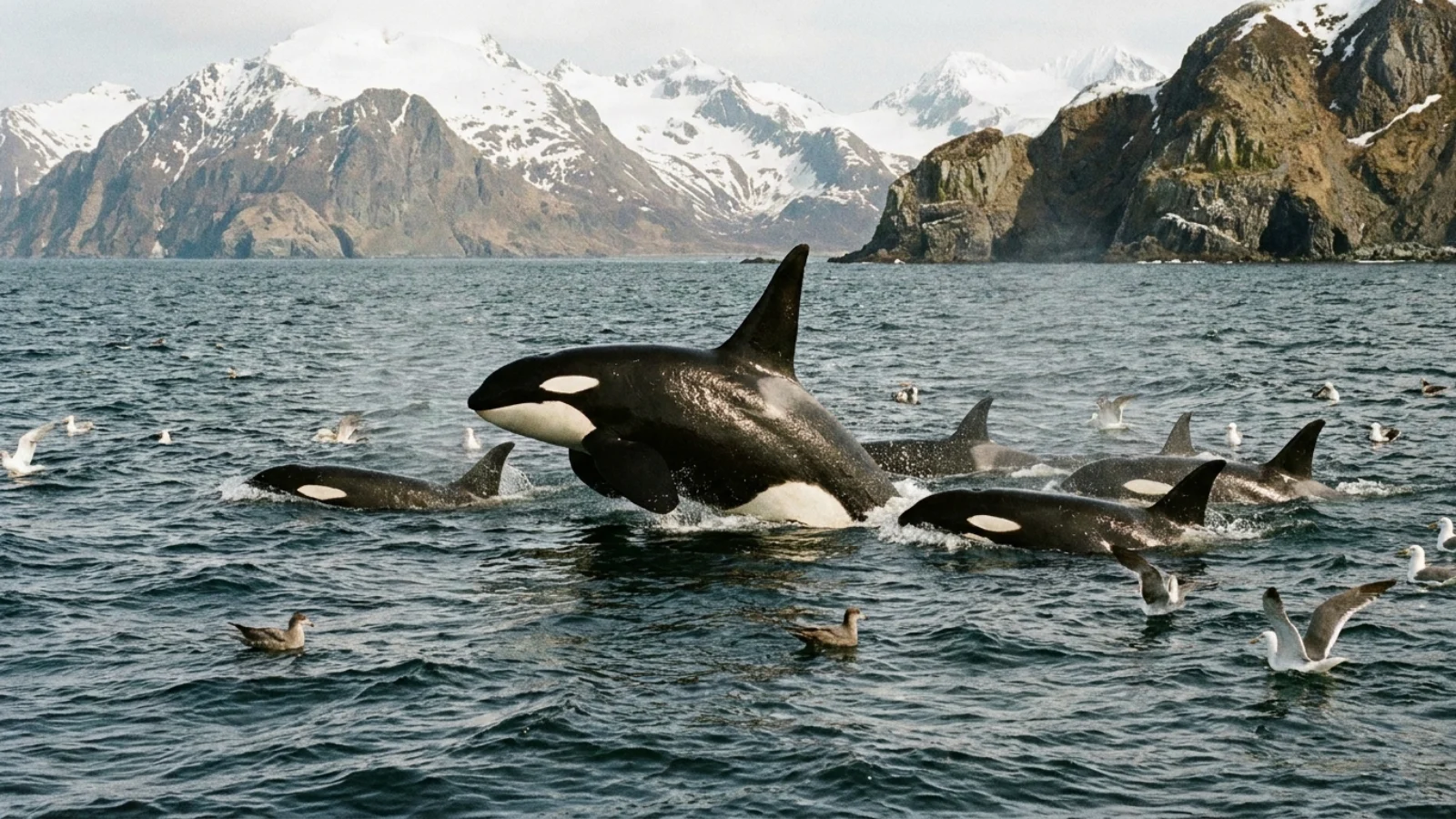
Can a shark eat an orca?
Not in practice. The relationship between orcas and big sharks is one-way: orcas eat sharks.
Great white sharks are the obvious candidate, and the research shows they get out of the way. At California’s Farallon Islands, tagged white sharks left within minutes when orcas appeared and stayed away until the next season. Off South Africa, two orcas named Port and Starboard have killed great whites since 2017 and eaten their oil-rich livers. Orcas have also been filmed killing whale sharks in the Gulf of California and sevengill sharks off South Africa. A very large tiger or white shark could conceivably take an orphaned or sick newborn orca, which is why you see that possibility mentioned in textbooks, but there is no confirmed case. See what attacks killer whales for the full evidence.
| Animal | Does it eat orcas? | What actually happens |
|---|---|---|
| Great white shark | No | Flees orcas; orcas kill white sharks for their livers |
| Tiger shark | No record | Possible threat only to a sick or orphaned calf |
| Other orcas | Very rarely kill | Infanticide recorded in Bigg’s orcas in British Columbia |
| Pilot whales | No | Orcas avoid them; pilot whales sometimes chase orcas off |
| Humpback whales | No | Charge in to disrupt orca hunts |
| Sperm whales | No | Form defensive circles; can injure attacking orcas |
| Humans | Yes | Whaling, drive hunts and live captures |
Do humans eat orcas?
Yes. Humans are the only species that has killed and eaten orcas in significant numbers.
Orcas were taken by commercial whalers in the 20th century, including Norwegian and Japanese coastal fleets and Soviet factory ships in the Antarctic. Small numbers are still taken today in Greenland, and occasionally by traditional whalers in Indonesia. Live capture for marine parks did lasting damage too: in the 1960s and 1970s captors killed at least 13 Southern Resident orcas in the Pacific Northwest and removed 45 more for aquariums, leaving 71 whales in 1974. That population is still endangered, at 74 whales in the July 2025 census, and its main problems today are human: too few Chinook salmon, PCB pollution and vessel noise.
What do orcas eat instead?
Almost anything, depending on the population. Each orca ecotype specialises, and the menus barely overlap.
Resident orcas in the North Pacific eat fish, above all Chinook salmon. Bigg’s (transient) orcas eat seals, sea lions, porpoises and whale calves. In the Antarctic, different types wash seals off ice floes or hunt penguins and fish. Off Western Australia, orcas have been documented killing adult and juvenile blue whales, the largest animals on Earth. That range, from herring to blue whales, is why the orca is called the ocean’s apex predator. It also explains why so many animals, from seals to great whites, treat an orca pod as the one thing worth fleeing.
What eats orcas?
Nothing preys on adult orcas; they are apex predators. Humans are the only animal that has hunted them in numbers.
Do orcas have natural predators?
No. Their size, speed, teeth and family pods leave no animal able to hunt them.
Can a great white shark kill an orca?
There is no record of it. Great whites flee from orcas, and orcas regularly kill great whites.
Do sharks eat baby orcas?
It has never been documented. A sick or orphaned newborn could be vulnerable to a very large shark, but calves are guarded closely by the pod.
Do orcas eat each other?
No. Orcas very rarely kill other orcas, and the recorded infanticide cases did not involve eating the calf as a food source.
What is the orca afraid of?
Orcas tend to avoid long-finned pilot whales and are disturbed by boat noise, but no animal hunts them.
Do people still hunt orcas?
In small numbers, in places such as Greenland. Commercial whaling of orcas largely ended in the 1980s.
Are orcas endangered?
The species overall is not well assessed, but some populations, like the Southern Residents (74 whales in 2025), are endangered.
- Pitman, R. L. et al. (2017). Humpback whales interfering when mammal-eating killer whales attack other species: mobbing behavior and interspecific altruism? Marine Mammal Science 33: 7–58.
- Towers, J. R. et al. (2018). Infanticide in a mammal-eating killer whale population. Scientific Reports 8: 4366.
- Jepson, P. D. et al. (2016). PCB pollution continues to impact populations of orcas and other dolphins in European waters. Scientific Reports 6: 18573.
- NOAA Fisheries. Species directory: whales, dolphins and porpoises. fisheries.noaa.gov.
Blane Perun has been exploring Earth’s oceans and marine life for over 25 years. Founder of TheSea.Org in 1999, underwater photographer, coral aquaculture pioneer, and explorer of 80+ countries.
About Blane Perun → More on Whales →