Why Is It Called a Sperm Whale? — The Spermaceti Mistake Explained
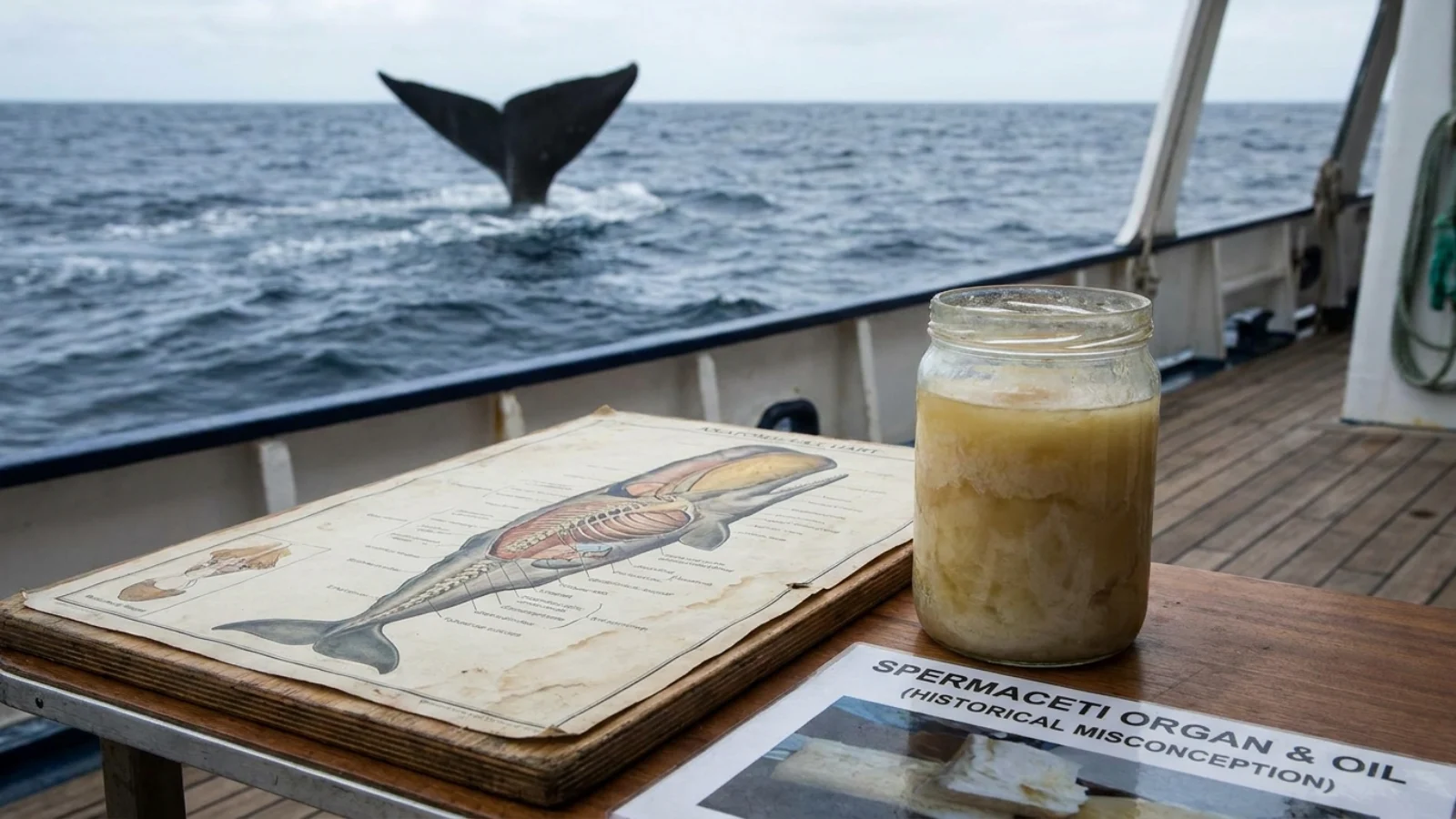
“Sperm whale” is short for “spermaceti whale”, named after spermaceti, the waxy liquid that fills a giant organ in the whale’s head. Spermaceti comes from Medieval Latin sperma ceti, roughly “sperm of a whale”, because when fresh the milky oil looks somewhat like semen and people long believed that is what it was. It is not: spermaceti is a mixture of wax esters and fats that helps the whale produce its powerful echolocation clicks. The short form “sperm whale” is first recorded in English in 1793. The species is also called the cachalot.
Sperm whales are named for spermaceti, the oil in their heads that early observers mistook for whale semen.
Why is it called a sperm whale?
The sperm whale gets its name from spermaceti, a semi-liquid, waxy substance found in a huge organ inside its head. “Sperm whale” is simply a clipped form of “spermaceti whale”. The longer name came first, and English speakers shortened it; the etymologist Douglas Harper’s Online Etymology Dictionary dates the first recorded use of “sperm whale” to 1793.
Spermaceti itself is a much older word. It comes from Medieval Latin sperma ceti, which means roughly “sperm of a whale”. Sperma means seed or semen, from the Greek for seed, and ceti is the genitive of cetus, a whale or large sea animal, the same root found in the word cetacean. The name stuck because, when fresh, the whitish oil from the whale’s head looks somewhat like semen, and for a long time people believed that is what it was.
They were wrong. Spermaceti has nothing to do with reproduction. It is found in both males and females, it sits in the forehead rather than anywhere near the reproductive organs, and it is a mixture of waxes and fats. But by the time anyone understood that, the name was fixed in the language, and the largest toothed predator on Earth has carried the mistake ever since.
Where the mistake came from
Spermaceti was known in Europe long before anyone studied the whale’s anatomy in detail. According to the Online Etymology Dictionary, the word first appears in English in the late 15th century as spermacete, and at first it referred to ambergris used as medicine. A 1471 alchemical text by Sir George Ripley recommends “Sperma Cete ana with redd Wyne”, that is, spermaceti in equal measure with red wine. Spermaceti was credited with medicinal properties and later burned as candle oil, and it appeared in corrupted popular forms such as parmacety.
The confusion with ambergris is a reminder of how little was known. Both substances came from the same species and both washed up on beaches or were found in stranded animals, but they are entirely different. Ambergris is a waxy material formed in the whale’s gut, thought to be a response to the irritation of hard squid beaks, and is still valued as a perfume fixative. Spermaceti is a liquid wax stored in the head. For the gut-born substance, see our guide to ambergris.
Once whalers began cutting into sperm whales and bailing oil out of their heads, the “seed of the whale” explanation must have seemed to fit. The oil was pale, it came from a mysterious and enormous animal, and it changed texture as it cooled. Folk anatomy did the rest.
What is spermaceti?
Spermaceti is an oily mixture of triglycerides and wax esters held inside the spermaceti organ, a structure on top of the whale’s skull that is like a large barrel of oil. The barrel’s wall, called the case, is extremely tough and fibrous, and the case can hold up to about 1,900 litres of spermaceti. The organ is proportionately larger in males.
The composition changes with age. The proportion of wax esters in the spermaceti organ is about 38 to 51 percent in calves, 58 to 87 percent in adult females and 71 to 94 percent in adult males. The spermaceti at the core of the organ has a higher wax content than the outer parts. When it cools, the wax solidifies, which is why whalers saw it turn from liquid to a whitish solid once it was removed from the head.
Below the spermaceti organ lies a second oil-filled structure that whalers called the junk. It consists of compartments of spermaceti separated by walls of connective tissue and is thought to correspond to the melon, the fatty forehead organ found in other toothed whales. Together, the spermaceti organ and the junk make up a forehead that is one of the strangest anatomical structures in the animal kingdom. According to a 2016 study in PeerJ, these two oil-filled compartments can make up as much as a quarter of the whale’s body mass and extend for a third of its total length.
Whalers distinguished spermaceti from sperm oil. Spermaceti came mainly from the head, while sperm oil came mainly from the blubber of the body. Both were valuable, and both helped make the sperm whale the most sought-after whale of the 18th and 19th centuries.
The sperm whale’s other names
In many languages the species is called the cachalot, a name that is still used in English. Its origin is uncertain. One explanation links it to an archaic French word for “tooth” or “big teeth”; the etymologist Joan Corominas suggested a Vulgar Latin word, cappula, meaning sword hilts; and another derivation runs through Spanish or Portuguese cachalote, perhaps from Galician or Portuguese cachola, “big head”. Any of these would suit the whale, which has a giant head and large, cone-shaped teeth in its lower jaw.
The scientific name tells a similar story. Physeter comes from the Greek physētēr, meaning a blowpipe or blowhole, and by extension a whale. The species name macrocephalus is Latinised from Greek for “big-headed”. An alternative species name, catodon, means “down-tooth”, because the whale has visible teeth only in its lower jaw.
Both names come from Carl Linnaeus, who described the sperm whale in the 10th edition of Systema Naturae in 1758 and recognised four species in the genus Physeter. Experts soon realised there is only one. Until 1974 the species was usually called Physeter catodon, but that year the Dutch zoologists Antonius Husson and Lipke Holthuis argued that, because Linnaeus published both names at the same time, the principle of the first reviser should apply and macrocephalus should be used. William Schevill disagreed in the 1980s, but most authors now accept Physeter macrocephalus. The sperm whale is the only living member of its genus and one of three living species in its family, with the much smaller pygmy and dwarf sperm whales.
What does spermaceti actually do?
The best-supported answer is sound. The spermaceti organ is part of the most powerful sound-producing system in the animal kingdom. The existence of sperm whale sounds was proven when Valentine Worthington and William Schevill made a recording from a research vessel in May 1959, and later work showed that sperm whales emit clicks with source levels as loud as 236 decibels (re 1 micropascal at 1 metre) underwater.
The anatomy works like an acoustic instrument. Air is forced through a single pair of phonic lips, sometimes called the “monkey lips” or museau de singe, at the front of the nose just below the blowhole. The sound travels backwards through the spermaceti organ to the frontal sac, a layer lining the concave front of the skull. Its back wall is covered in fluid-filled knobs about 4 to 13 millimetres across, separated by grooves that trap a film of air, making an excellent sound mirror. Most of the sound reflects forward into the junk, which focuses it like a lens into a beam of clicks.
Spermaceti is good at carrying sound. The speed of sound in spermaceti is about 2,684 metres per second at 40 kilohertz and 36 degrees Celsius, nearly twice as fast as in the oil of a dolphin’s melon. Air that has passed through the phonic lips is recycled through the nasal passages, which lets the whale keep clicking for as long as it stays underwater. Sperm whales use these clicks to echolocate squid in the dark, and use patterned sequences of 3 to 20 clicks, called codas, in social situations.
The buoyancy theory
For decades a popular idea held that sperm whales use spermaceti to control their buoyancy. The theory goes that before a dive, cold water enters the organ and the blood vessels around it constrict, cooling the wax so that it solidifies and shrinks. That would make the head denser, producing a downward force of about 392 newtons and helping the whale descend with less effort. During the hunt, heat from muscle activity and widening blood vessels would melt the wax again, making the whale more buoyant for the ascent.
More recent work has found many problems with this idea, including the lack of anatomical structures that could actually exchange heat in the way required. Another problem is that cooling and solidifying the spermaceti would presumably affect the whale’s echolocation just when it needs it most, while hunting in the depths. The buoyancy explanation is now considered doubtful.
The battering-ram theory
Herman Melville suggested in Moby-Dick that the case containing the spermaceti might serve as a battering ram in fights between males. The idea was inspired by real events. On 20 November 1820, a sperm whale claimed to be about 25.9 metres long rammed and sank the Nantucket whaleship Essex in the Pacific. Only 8 of the 21 sailors survived to be rescued. The whaleship Ann Alexander was also sunk by a sperm whale, and the attackers in such incidents were estimated to weigh only about a fifth as much as the ships.
In 2002, David Carrier and colleagues tested Melville’s idea in the Journal of Experimental Biology. They found that across cetaceans, the evolution of relative melon size is positively correlated with the evolution of sexual size dimorphism, and their model showed that a charging sperm whale’s spermaceti organ has enough momentum to seriously injure an opponent. They concluded that the observations are consistent with the spermaceti organ having evolved partly as a weapon in male-male fights. A 2016 engineering study by Olga Panagiotopoulou and colleagues in PeerJ found that the connective tissue partitions in the junk reduce stress across the skull during impacts, and that removing them raises skull stresses, especially in the upper jaw. Ramming remains the most controversial of the proposed functions, but the anatomy is at least compatible with it.
Why whalers wanted spermaceti
Spermaceti made the sperm whale the most valuable whale in the sea. Spermaceti and sperm oil found a remarkable range of uses: candles, soap, cosmetics, machine oil and other lubricants, lamp oil, pencils, crayons, leather waterproofing, rust-proofing materials and many pharmaceutical compounds.
Candles drove the early trade. In the first decades of offshore whaling, from 1709 to the 1730s, there are only a few records of sperm whales taken, and American sloops concentrated instead on right whales and bowheads. By the early 1740s, with the arrival of spermaceti candles before 1743, American vessels began to focus on sperm whales. The diary of the Nantucket whaler Benjamin Bangs records three other sloops flensing sperm whales off North Carolina in late May 1743. Sperm whaling spread to the Gulf Stream, the Grand Banks, West Africa in 1763, the Azores in 1765 and the South Atlantic in the 1770s. From 1770 to 1775 the ports of Massachusetts, New York, Connecticut and Rhode Island produced about 45,000 barrels of sperm oil a year, compared with 8,500 of ordinary whale oil.
Spermaceti candles burned brightly and cleanly, and they became a scientific standard. Under the United Kingdom’s Metropolitan Gas Act of 1860, one candlepower was defined as the light from a pure spermaceti candle weighing a sixth of a pound and burning at 120 grains an hour. The unit survives as candlepower, now defined as 0.981 candela. Spermaceti oil also lit public lighthouses in the United States until 1862, when it was replaced by lard oil and later petroleum, and it lubricated the machines of the Industrial Revolution, such as those in cotton mills.
The cost to sperm whales
Before commercial sperm whaling began in the early 18th century, the world’s sperm whale population is estimated to have been about 1,100,000. By 1880 it had declined by an estimated 29 percent. Between 184,000 and 236,000 sperm whales were killed in the 19th century, the era of open-boat whaling described in Moby-Dick. Sperm whaling declined in the second half of that century as petroleum came into wider use, and in that sense petroleum may have protected sperm whales from even greater slaughter.
The respite was temporary. Modern whaling with steam-powered ships and exploding harpoons focused at first on large baleen whales, but as those were depleted, sperm whaling increased. Norwegian expeditions took more than 3,000 sperm whales off Peru alone in each of the 1941-42 and 1942-43 seasons. After the Second World War, whaling continued to supply oil for cosmetics and high-performance machinery such as automobile transmissions. At least 770,000 sperm whales were taken in the 20th century, most of them between 1946 and 1980, and the population fell to about a third of its pre-whaling size.
Bans on whale oil use came in 1972, the International Whaling Commission gave the species full protection in 1985, and Japanese hunting in the North Pacific continued until 1988. Today the sperm whale is listed as Vulnerable by the International Union for Conservation of Nature.
The whale behind the name
The animal itself is as extraordinary as its oil. Mature males average about 16 metres long, and the head makes up as much as a third of the body. The sperm whale has the largest brain of any animal, living or extinct, averaging about 7.8 kilograms, more than five times heavier than a human brain. It dives to 2,250 metres, making it the third-deepest-diving mammal after the southern elephant seal and Cuvier’s beaked whale, and usually hunts at 300 to 800 metres, sometimes deeper, on dives that can last more than an hour.
Sperm whales eat around 3 percent of their body weight a day, mostly squid, including giant and colossal squid, along with octopuses and fish. Worldwide, sperm whales are estimated to eat about 91 million tonnes of prey a year. For the battles behind that diet, see giant squid vs sperm whale, and for the full species profile, see our sperm whale guide.
Is the name likely to change?
Probably not. Common names are not governed by formal rules the way scientific names are, and “sperm whale” has been standard in English for more than two centuries. Scientists, whale watchers and conservation agencies all use it, often alongside “cachalot” in other languages. The scientific name, Physeter macrocephalus, avoids the confusion entirely, but it is unlikely to replace the familiar English one.
So, why is it called a sperm whale?
Because of a centuries-old misunderstanding. The whale is named after spermaceti, the waxy oil in its head, and “sperm whale” is short for “spermaceti whale”. Spermaceti comes from Medieval Latin for “sperm of a whale”, because the fresh oil looked like semen and was long believed to be just that. In reality spermaceti is a mixture of wax esters and fats that helps the whale make some of the loudest sounds of any animal, and it may also play a role in fights between males. The oil that gave the whale its name also made it a prime target for whalers for more than two centuries.
Is spermaceti actually sperm?
No. It is a waxy mix of wax esters and fats stored in the head, found in both males and females.
What does spermaceti mean?
It comes from Medieval Latin sperma ceti, roughly “sperm of a whale”.
When was the name sperm whale first used?
The short form “sperm whale” is first recorded in English in 1793.
What is another name for the sperm whale?
Cachalot. Its scientific name is Physeter macrocephalus, “big-headed blower”.
How much spermaceti is in a sperm whale?
The spermaceti organ can hold up to about 1,900 litres.
What is spermaceti used for by the whale?
Mainly to help produce and focus its powerful echolocation clicks.
What was spermaceti used for by people?
Candles, lamp and machine oil, cosmetics, soap and medicines.
Is spermaceti the same as ambergris?
No. Ambergris forms in the gut; spermaceti is liquid wax in the head.
- Harper, D., Online Etymology Dictionary, “spermaceti” and “sperm whale” entries.
- Carrier, D.R., Deban, S.M. & Otterstrom, J. (2002), “The face that sank the Essex: potential function of the spermaceti organ in aggression”, Journal of Experimental Biology 205: 1755-1763.
- Panagiotopoulou, O. et al. (2016), “Architecture of the sperm whale forehead facilitates ramming combat”, PeerJ 4: e1895.
- Wikipedia contributors, “Sperm whale” (etymology, spermaceti organ, whaling and population sections) and “Candlepower” (accessed November 2026).
Blane Perun has been exploring Earth’s oceans and marine life for over 25 years. Founder of TheSea.Org in 1999, underwater photographer, coral aquaculture pioneer, and explorer of 80+ countries.
About Blane Perun →