Minke Whale — The Smallest Rorqual
The minke whale is the smallest of the rorquals, the family of baleen whales that includes the blue and fin whales. There are two species: the common (northern) minke whale, Balaenoptera acutorostrata, usually 7 to 9 m long, and the slightly larger Antarctic minke whale, Balaenoptera bonaerensis. A third, unnamed “dwarf” form lives in the Southern Hemisphere and is famous for approaching swimmers on the Great Barrier Reef. Common minkes are listed as Least Concern by the IUCN and Antarctic minkes as Near Threatened. Because they were too small to interest the early whaling industry, minkes stayed abundant, and that is exactly why they became the main target of whalers in Norway, Japan, Iceland and Greenland.
The origin of “minke” is uncertain, but the most quoted story, relayed by the American writer Richard Ellis from the Norwegian scientist Age Jonsgard, is that a man named Meincke, working for the harpoon-gun inventor Svend Foyn, once mistook a school of these small whales for blue whales. Norwegians came to use “minkie” as a joke name for any small whale.
Two species and a dwarf
For most of the twentieth century all minke whales were treated as one species. Otto Fabricius first described the animal from Greenland in 1780, noting its small size and white baleen, and in 1804 the French naturalist Lacepede gave it the name Balaenoptera acuto-rostrata, “sharp-snouted winged whale”, partly on the basis of a 4.26 m juvenile stranded near Cherbourg in 1791. In 1867 the German-Argentine zoologist Hermann Burmeister described a larger rorqual found floating in the Rio de la Plata near Buenos Aires as Balaenoptera bonaerensis, but his name was ignored for more than a century.
In the 1980s researchers working off South Africa and Australia recognised two quite different minke whales in the Southern Hemisphere: a larger, plain, dark-flippered whale, and a small one with bright white patches on its flippers and shoulders. Genetic studies in the 1990s confirmed that the dark-flippered southern whale was a separate species, the Antarctic minke whale, and that the small white-flippered whale belonged with the northern species. That small whale is the dwarf minke whale, still an unnamed subspecies of the common minke. The Northern Hemisphere has its own subspecies as well: B. a. acutorostrata in the North Atlantic and B. a. scammoni in the North Pacific.
DNA suggests the two species split in the Southern Hemisphere about 4.7 million years ago, during a warm phase of the early Pliocene that disrupted the Antarctic Circumpolar Current and broke whale populations into isolated pockets. Common minkes then spread rapidly into the Northern Hemisphere about 1.5 million years ago, during the cooling of the Pleistocene. The split is not complete: two hybrids between the species have been caught by Norwegian whalers off Spitsbergen. The first, taken in June 2007, had an Antarctic minke mother and a common minke father. The second, taken in July 2010, had the opposite parentage, and she was pregnant with a fetus fathered by a North Atlantic common minke, proof that hybrids can breed back into the parent species.
How big is a minke whale?
The common minke is the smallest rorqual and, after the pygmy right whale, the second-smallest baleen whale. Norwegian whalers in 1940 claimed animals up to 10.7 m, but those were probably judged by eye; the longest caught in later years were 9.4 to 10 m. Icelandic scientists measured nothing longer than an 8.7 m male and a 9 m female, and the longest taken by Japanese whalers in the western North Pacific was a 9.1 m female caught off Hokkaido in 1977. Larger figures reported by Soviet whalers in the Kuril Islands are thought to have been misreported sei whales.
At physical maturity, North Atlantic males average about 7.9 to 8.2 m and females 8.4 to 8.5 m; North Pacific animals are slightly smaller, at about 7.5 and 8 m. Western North Pacific males weighed whole on a truck scale averaged roughly 2.9 to 4.2 tonnes, and the heaviest female recorded was 8.35 tonnes. A newborn calf is about 2.5 to 2.8 m long and weighs 150 to 300 kg. The dwarf form is smaller again, with the longest on record a 7.62 m male and a 7.77 m female, both caught off South Africa.
The Antarctic minke is bigger. At physical maturity females average 8.9 m and males 8.6 m, and the largest caught off Brazil were an 11.9 m female in 1969 and an 11.27 m male in 1975. The heaviest weighed in the Antarctic was a 9 m female of 10.4 tonnes.
How to identify a minke whale
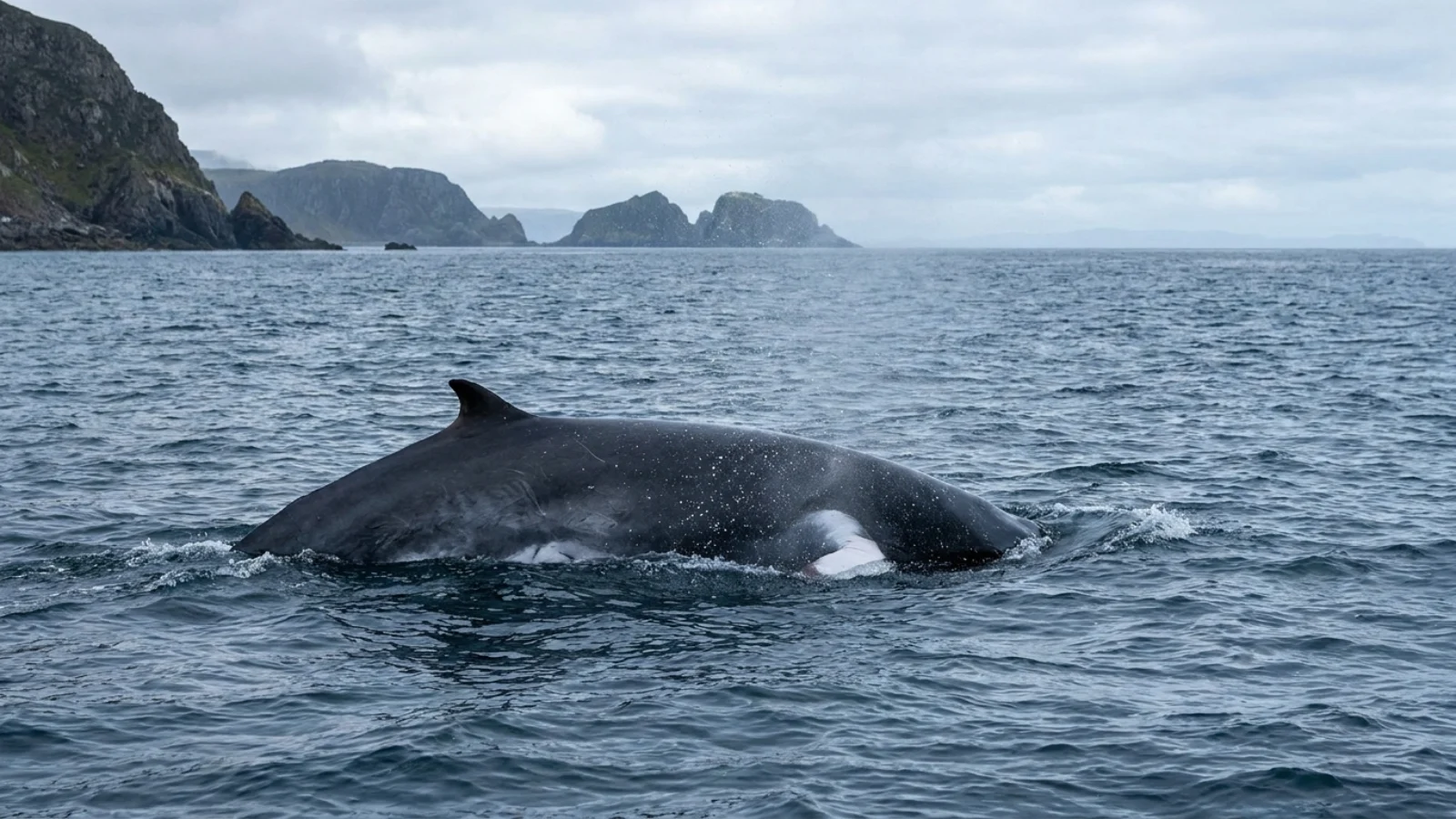
Minkes are compact for rorquals, with the body’s greatest depth about a fifth of its length. The head is a narrow, sharply pointed triangle, which gave rise to old names such as the “little piked whale” and “sharp-headed finner”. The back is dark grey and the belly clean white. A tall, hooked dorsal fin, averaging about 30 cm high, sits about two-thirds of the way along the back, and it often appears at the same time as the blow, which is low and usually hard to see.
The most useful field mark of the common minke is a bright white band across each dark flipper, present as a clear band in about 94 per cent of western North Pacific animals. The flippers themselves are small, averaging about 73 cm. Inside the mouth are 230 to 360 pairs of short, creamy-white baleen plates, and 50 to 70 throat pleats run back only about 47 per cent of the body length, among the shortest of any rorqual.
The dwarf minke has the most complex colouring of any baleen whale: alternating dark grey fields and pale blazes, a white shoulder blaze, a white patch over two-thirds of each flipper and a dark throat patch. Like the fin whale, it is asymmetrical, with a white blaze on the right lower jaw and usually a white eye blaze on the right side only. The shape of a thin pale line across its back, the nape streak, varies so much between individuals that researchers use it to recognise them. Antarctic minkes lack the bright white flipper band entirely; their flippers are plain light grey or two-toned, and their baleen is two-coloured, white at the front and dark grey at the back.
Where minke whales live
Common minke whales have a patchy distribution across both northern oceans. In the North Atlantic they reach Baffin Bay, Svalbard, Franz Josef Land and Novaya Zemlya in summer, and as far south as New Jersey and the central North Sea. They occur year-round off the Canary Islands and have been recorded in winter off Bermuda, the Bahamas, the Antilles and the US east coast south of 40°N; in the Gulf of Mexico and the Mediterranean they are only vagrants. In the North Pacific they range from Hawaii, the Mariana Islands and the seas around Japan north to the Okhotsk, Bering and Chukchi seas, and down the whole west coast of North America from Alaska to Baja California and the Gulf of California.
The dwarf minke has been recorded off Brazil, Uruguay, Argentina, southern Chile, South Africa, Australia, New Zealand, New Caledonia, Vanuatu and Fiji, and as far south as the Bellingshausen Sea. Antarctic minkes live mainly in the Southern Hemisphere, feeding near the ice edge in summer, although a genetically confirmed Antarctic minke was caught west of Jan Mayen in the North Atlantic in 1996.
Homebodies and long-distance travellers
Photo-identification studies show that many minkes are surprisingly loyal to small areas. In the San Juan Islands of Washington between 1980 and 1984, 14 of 18 identified whales were within their primary range on at least 94 per cent of sightings. In Monterey Bay, whales were seen turning back as they approached the edge of their usual range, which was split by the submarine canyon running into Carmel Bay. Around the Isle of Mull in Scotland, one minke was identified 27 times over ten years, and in the St Lawrence estuary 35 of 209 identified whales were regular visitors seen on at least 40 days in four to six different years.
Yet minkes also travel far. One whale tagged in Faxafloi Bay, Iceland, in August 2004 next appeared over the Mid-Atlantic Ridge west of Spain, then near the Azores, and its last signal came from the Canary Current about 1,000 km north-west of the Cape Verde Islands, some 3,700 km from where it was tagged, little more than 100 days later. Four dwarf minkes tagged off Lizard Island on the Great Barrier Reef in July 2013 all headed south along the coast; the last to keep transmitting passed through Bass Strait and had reached 54°23’S, about 6,000 km away, by October.
What do minke whales eat?
Minkes have been described as fish-eaters, but their diet varies by region, season and year. In the North Atlantic they take small schooling fish, bottom fish and krill. Off Spitsbergen they fed almost entirely on krill of the genus Thysanoessa, while off Bear Island and in the southern Barents Sea capelin made up about three-quarters of the diet. In the North Sea sandeel and Atlantic mackerel dominated, and off Iceland sandeel, haddock, herring, capelin and cod; in Iceland the share of sandeel in the south fell sharply over a few years in the mid-2000s as haddock rose. Of 172 minkes caught off Newfoundland between 1966 and 1972, 85 per cent had eaten only fish, mainly capelin.
In the North Pacific the menu shifts with geography: Pacific herring in the northern Sea of Okhotsk, Alaska pollock east of Sakhalin, krill around the western Aleutians, and sardine, anchovy and Pacific saury off Japan. In the San Juan Islands they are thought to feed on juvenile herring and sand lance, and in Monterey Bay they have been seen chasing baitfish, probably northern anchovy. In the Southern Ocean dwarf minkes eat mainly lanternfish, while Antarctic minkes feed mostly on Antarctic krill. Minkes generally hunt alone; even when several feed in the same area, they show none of the cooperative feeding seen in humpbacks.
Boings, bio-ducks and “Star Wars” calls
Minke whales are responsible for some of the strangest sounds in the ocean, and several of them were mysteries for decades. In the North Pacific, a call nicknamed the “boing” was first described in the mid-1960s from submarine recordings made off San Diego and Hawaii in the 1950s. It consists of a short pulse followed by a long, warbling call of about 2.2 seconds, with peak energy around 1.4 kHz. By the early 1980s it was thought to come from a whale, but nobody knew which. The answer came on 7 November 2002, when a research ship towing a hydrophone array off the north-western Hawaiian Islands tracked a boing to its source, then photographed and biopsied the whale: it was a minke. Boings are heard mainly in the tropical and warm-temperate North Pacific in winter and spring, and scientists distinguish a “central” type west of about 135°W from an “eastern” type east of 138°W.
The Southern Ocean has its own puzzle. The “bio-duck”, a series of rapid pulses at roughly 50 to 200 Hz first described in the 1960s, was named by sonar operators on Oberon-class submarines who thought it sounded like a quacking duck. It was attributed to the Antarctic minke whale in a paper published in 2014. The dwarf minke produces a complex, stereotyped call nicknamed “Star Wars”, described as “almost synthetic, metallic or mechanical”, which has been recorded in June and July on the northern Great Barrier Reef and off Queensland and New South Wales. In the North Atlantic, long series of low-frequency pulse trains attributed to minkes peak in late summer and autumn.
Life cycle
Common minkes reach sexual maturity at about six to eight years old. Females mate with more than one male, gestation lasts about ten months, and the single calf is about 2.6 m long at birth and weaned at around six months. Twins are rare: only one of 79 mature females in an Icelandic study carried two fetuses. Unusually, the calving interval can be just one year, so a female is often pregnant and nursing at the same time. Peak calving is in December in the North Atlantic and December to January in the North Pacific. Both sexes can live to about 50 years; in Iceland the oldest animals aged were a 42-year-old female and a 47-year-old male.
Minkes are usually seen alone or in pairs. Off Iceland 93 per cent of sightings were of single whales, and around Mull about two-thirds were. They breach occasionally, sometimes clearing the water completely, and one whale in Johnstone Strait, British Columbia, reacted to approaching killer whales by breaching eight times in rapid succession.
Killer whales and other predators
The main natural predator of the minke is the killer whale. Attacks have been recorded off Kamchatka, Alaska, British Columbia, Washington, California, the Gulf of St Lawrence, Greenland and Svalbard. A typical chase involves two to four killer whales and one minke, lasts about 30 minutes to an hour and can reach about 30 km/h, with both species porpoising out of the water in low leaps. In open water a minke can often outrun its pursuers; the danger comes when it is cornered in a bay, where it may be rammed and drowned or driven ashore. Minkes do not fight back. Twice, off Yakutat in 1977 and in Glacier Bay in 1996, fleeing minkes sheltered under a boat and were killed anyway. Killer whales often eat only the tongue, skin and some blubber. Scavengers follow: Greenland sharks have been seen eating blubber discarded during whaling off Svalbard, and great white and blue sharks feeding on a minke carcass off California. When a minke sinks, its skeleton can host a rich community; a new species of bone-eating worm, Osedax mucofloris, was discovered on a minke carcass placed on the North Sea floor at 125 m.
A thousand years of minke whaling
Minkes were hunted off Norway by about AD 1100. By the thirteenth century hunters were firing iron darts from crossbows, the points smeared with tissue from sheep that had died of a bacterial infection; the wounded whale weakened over a few days, and the hunters then returned to kill it. That method survived until the 1880s. Modern Norwegian minke whaling from small boats began off western Norway in the 1920s, spread to Svalbard and the Barents Sea by the late 1930s and peaked at 4,338 whales in 1958. More than 125,000 were taken by Norwegian commercial whaling from 1938 onward.
Iceland began catching minkes in 1914, Greenland in 1948 and Newfoundland in 1947, and Japanese coastal whalers took their first in 1930. In the Southern Ocean the industry ignored minkes until the larger species were exhausted; between 1950–51 and 1986–87 about 97,866 minkes, most of them probably Antarctic minkes, were taken there, mainly by Japanese and Soviet fleets, and a further 14,000 were caught off north-eastern Brazil. After the International Whaling Commission’s moratorium took effect in 1986, Japan continued to catch Antarctic minkes under research permits, starting with 273 in the 1987–88 season.
Minke whaling today
Minkes are still the most hunted great whale. Norway, which resumed commercial whaling in 1993, sets its own quotas: 1,406 minke whales for 2025 and 1,641 for 2026, according to Whale and Dolphin Conservation. Japan, which left the IWC in 2019, set a 2026 limit of 145 minke whales for its coastal whalers, alongside Bryde’s, sei and fin whales. Greenland takes minkes under an aboriginal subsistence quota, with recent averages of roughly 150 to 190 a year between 1985 and 2012. Whale and Dolphin Conservation, analysing Norway’s electronic reporting data for 2021 to 2025, says about 40 per cent of whales killed each year were pregnant.
How many minke whales are there?
Despite the hunting, minkes remain numerous. There are estimated to be more than 180,000 common minkes in the North Atlantic, including about 67,000 around Iceland, and estimates published in 2021 from Norwegian surveys suggest up to 150,000 in Norwegian waters, about 50 per cent more than earlier counts. North Pacific numbers are less well known, with surveys from 1989–90 estimating about 25,000 in the Sea of Okhotsk and the north-west Pacific. In 2012 the IWC Scientific Committee agreed a best estimate of 515,000 Antarctic minke whales, the most abundant baleen whale in the world. No population estimate exists for dwarf minkes, because surveys cannot reliably tell them apart from Antarctic minkes at sea. Other threats include entanglement in fishing gear and ship strikes.
Where to see minke whales
Minkes are regular sightings on whale-watching trips around Iceland, in Scotland’s Hebrides and Moray Firth, in the St Lawrence estuary in Quebec, in the San Juan Islands and in New England. They are not showy: look for a small, sharp head breaking the surface, a low, often invisible blow and a tall, curved fin that appears almost at once. The most famous minke encounter is on the outer Ribbon Reefs north of Port Douglas on the Great Barrier Reef, where dwarf minkes return to the same spots each June and July. Dwarf minkes were first recognised on the Reef in the 1980s, operators began advertising swims in the mid-1990s, and the Great Barrier Reef Marine Park Authority formally recognised a limited swim program in 2003. According to the IWC’s whale-watching handbook, permits are required and the number of operators is capped at nine, all based around Cairns and Port Douglas. Under the code of practice swimmers hold on to surface ropes no longer than 50 m, must not swim toward a whale, approach within 30 m or touch one, and may not use flash photography; since a 2006 agreement, operators do not swim with mothers and calves. Most encounters are started by the whales themselves and last on average more than two hours, and the Minke Whale Project at James Cook University has worked with the operators for more than 20 years. See our whales hub for the other rorquals, including the much larger fin whale.
How big is a minke whale?
Common minke whales are usually about 7 to 9 m long and weigh 2 to 4 tonnes; Antarctic minkes average about 8.6 to 8.9 m and can exceed 10 m.
Is the minke whale the smallest whale?
It is the smallest rorqual. Among baleen whales only the pygmy right whale is smaller; many toothed whales and dolphins are far smaller.
How many species of minke whale are there?
Two: the common minke and the Antarctic minke. The dwarf minke is a Southern Hemisphere subspecies of the common minke.
Are minke whales endangered?
No. The common minke is Least Concern and the Antarctic minke Near Threatened on the IUCN Red List.
What do minke whales eat?
Small schooling fish such as capelin, herring, sandeel, anchovy and sardine, plus krill; Antarctic minkes eat mainly krill.
What sound does a minke whale make?
North Pacific minkes make the “boing”, Antarctic minkes the “bio-duck” and dwarf minkes a metallic “Star Wars” call.
Are minke whales still hunted?
Yes. Norway set a quota of 1,641 for 2026, Japan a limit of 145, and Greenland hunts them for subsistence.
Where can you swim with minke whales?
On the Ribbon Reefs of the northern Great Barrier Reef in June and July, with one of a capped number of permitted operators.
- Wikipedia contributors, “Common minke whale” and “Antarctic minke whale” (2023 snapshot, accessed November 2026).
- Whale and Dolphin Conservation (31 March 2026), “How many whales will Norway hunt in 2026?”
- IWC Whale Watching Handbook, “Australia: Great Barrier Reef” case study (accessed November 2026).
- World Animal News (12 May 2026), Japan’s 2026 whaling season catch limits (Fisheries Agency figures).
Blane Perun has been exploring Earth’s oceans and marine life for over 25 years. Founder of TheSea.Org in 1999, underwater photographer, coral aquaculture pioneer, and explorer of 80+ countries.
About Blane Perun →