Are Killer Whales Dolphins? — Yes: The Largest One
Yes. Killer whales (orcas) are dolphins: they belong to Delphinidae, the oceanic dolphin family, and are its largest member. Orcas are more closely related to bottlenose and other oceanic dolphins than to whales such as blue whales or sperm whales. They are also toothed whales (Odontoceti), the group that contains every dolphin, porpoise, sperm whale and beaked whale, so calling them whales is not wrong either. Five other members of the dolphin family are also called whales: the false killer whale, pygmy killer whale, melon-headed whale and the two pilot whales.
Every orca is a dolphin and every dolphin is a toothed whale, so “killer whale” and “largest dolphin” are both true.
Are killer whales dolphins?
Yes. The killer whale, or orca, Orcinus orca, is a toothed whale belonging to the oceanic dolphin family, Delphinidae, and it is the largest member of that family. Scientifically it is more closely related to bottlenose dolphins, common dolphins and the other oceanic dolphins than to most animals people call whales. The name “killer whale” is a historical label, not a statement about where the animal sits on the tree of life.
It is easy to see why the confusion persists. Orcas are huge. Males typically measure 6 to 8 metres and weigh more than 6 tonnes, and the largest recorded individual was 9.8 metres long and more than 10 tonnes. Females are smaller, usually 5 to 7 metres and 3 to 4 tonnes. When the smallest dolphin in the world, Maui’s dolphin, measures about 1.7 metres and 50 kilograms, an animal over five times as long seems to belong to a different category altogether. But size is not what defines a dolphin; ancestry is.
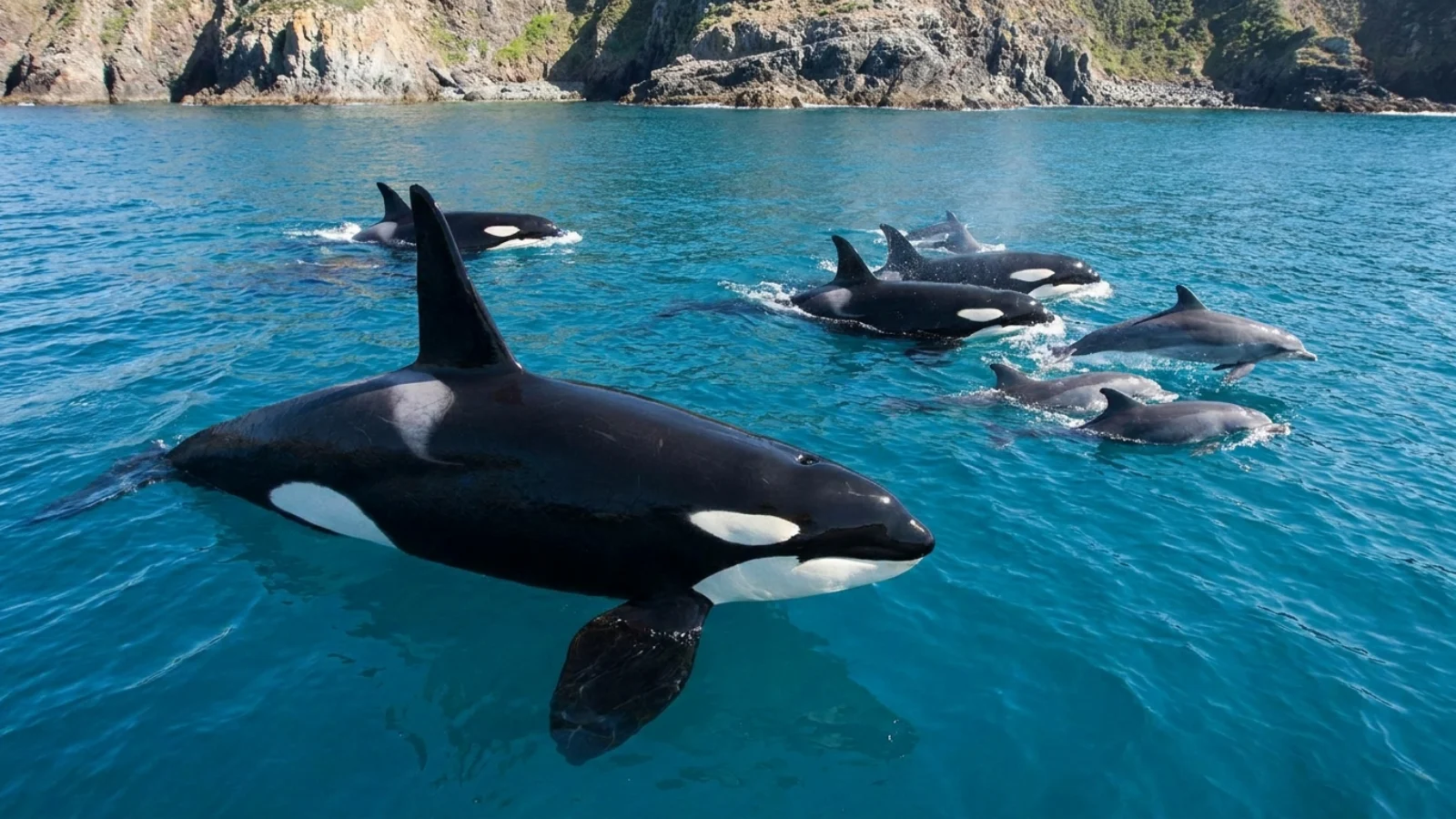
So is an orca a whale or a dolphin?
Both, depending on how you use the words. All whales, dolphins and porpoises are cetaceans, an infraorder of marine mammals with about 89 living species. Cetaceans are split into two big groups, called parvorders, that diverged about 34 million years ago. The baleen whales, or Mysticeti, include the blue, humpback and grey whales, and filter food through keratin plates instead of teeth. The toothed whales, or Odontoceti, include sperm whales, beaked whales, porpoises, belugas, narwhals and all the dolphins, including orcas.
In that scientific sense, every dolphin is a toothed whale. Orcas are whales because they are cetaceans in the toothed whale group, and they are dolphins because they belong to the oceanic dolphin family within that group. In everyday English, though, “whale” is usually reserved for the larger cetaceans, while smaller ones with a beak or longer nose are called dolphins. Orcas break that rule because they are big enough to be called whales but are, by family, dolphins.
A useful way to think about it is the analogy of cats. A tiger is a big cat and a house cat is a small cat, but both are cats. An orca is a big dolphin and a bottlenose dolphin is a medium-sized dolphin, but both are dolphins, and both are toothed whales.
What makes an animal a dolphin?
The word “dolphin” covers most species in the oceanic dolphin family, Delphinidae, plus a handful of river dolphins in separate families: the South American river dolphins (Iniidae), the La Plata dolphin (Pontoporiidae), the Ganges and Indus river dolphins (Platanistidae) and the probably extinct Yangtze river dolphin or baiji (Lipotidae). Around 40 living species are named as dolphins. The oceanic dolphin family itself contains close to forty species; sources put the number at 35 to about 40, depending on how some splits are counted.
Oceanic dolphins share a set of traits. They are purely carnivorous, with conical teeth for gripping fast prey, as opposed to the spade-shaped teeth of porpoises. Most have 100 to 200 teeth, though some species have far fewer. They have a single blowhole, as all toothed whales do, while baleen whales have two. They produce low-frequency whistles and high-frequency broadband clicks of 80 to 220 kilohertz used for echolocation. In their foreheads they have a melon, a mass of fatty tissue found in all toothed whales that focuses their sounds like an acoustic lens. Pregnancy lasts 10 to 18 months and produces a single calf. Many live in pods with complex social lives.
The orca fits this description closely. It has strong conical teeth in which the upper teeth fall into the gaps between the lower ones when the mouth closes. Its pregnancy lasts 15 to 18 months. It echolocates with clicks and communicates with whistles and pulsed calls. It lives in stable family groups. Its body is the dolphin plan scaled up: streamlined, with flippers, a dorsal fin and a powerful tail. The orca’s dorsal fin is extreme, though; in adult males it reaches about 1.8 metres tall, more than twice the height of a female’s fin.
Where does the orca sit in the dolphin family tree?
The oceanic dolphin family first appeared about 11 million years ago, and the orca lineage probably branched off shortly afterwards. Its exact position is still debated. The orca looks a lot like the false killer whale, the pygmy killer whale and the pilot whales, and was long grouped with them. A study of cytochrome b gene sequences instead suggested that its closest living relatives are the snubfin dolphins of the genus Orcaella, which includes the Irrawaddy dolphin. A 2018 study placed the orca as a sister group to a clade that includes Lagenorhynchus and Cephalorhynchus dolphins, and a 2019 study found the orca to be the second most basal member of the family, with only the Atlantic white-sided dolphin branching off earlier.
What all these analyses agree on is that the orca is inside the dolphin family, not outside it. The debate is about which dolphins are its nearest cousins, not about whether it is a dolphin.
The genus Orcinus also has a fossil record. Orcinus citoniensis, an extinct species in the same genus, is known from fossils such as a specimen displayed at the Museo Capellini in Bologna, Italy. Today Orcinus orca is the only recognised living species in the genus, although that may change. In 2024 a team led by Phillip Morin argued in Royal Society Open Science that the fish-eating resident orcas and the mammal-eating Bigg’s orcas of the eastern North Pacific deserve to be recognised as separate species, Orcinus ater and Orcinus rectipinnus. If that proposal is accepted, there will be more than one species of killer whale, but all of them will still be dolphins.
Which other “whales” are actually dolphins?
The orca is not alone. Six members of the oceanic dolphin family are commonly called whales, a group sometimes nicknamed blackfish: the orca, the melon-headed whale, the pygmy killer whale, the false killer whale, the long-finned pilot whale and the short-finned pilot whale. All six are dolphins by classification. Several of them belong to a subgroup sometimes called the round-headed whales, the Globicephalinae.
The pygmy killer whale, Feresa attenuata, gets its name from sharing some physical features with the orca, and it is the smallest cetacean with the word “whale” in its common name. The false killer whale, like the orca, sometimes eats other marine mammals. The pilot whales are notable for another reason: orcas appear to be wary of them, and pilot whales have been recorded mobbing and chasing orcas.
Other toothed whales are not dolphins, even though they are related. Belugas and narwhals belong to their own family, Monodontidae, and porpoises to Phocoenidae; both families sit with the oceanic dolphins in a larger group called Delphinoidea. Sperm whales and beaked whales are toothed whales in separate, older lineages. We explore one of these borderline cases in are beluga whales dolphins or whales?
Why is it called a killer whale?
The name reflects how people first encountered orcas: as large, fearsome hunters of other marine animals, including other whales. The usual explanation, repeated by sources such as PADI, is that early sailors and whalers who watched orcas attack larger whales called them “whale killers”, in Spanish asesina ballenas, and that the phrase was later reversed in English to “killer whale”.
Older names point the same way. The Roman naturalist Pliny the Elder gave the first written description of an orca around AD 70, calling it an enormous mass of savage flesh with teeth and the enemy of other kinds of whale. The ancient Romans used the word orca, possibly borrowed from the Greek óryx, a word that referred among other things to a kind of whale, perhaps a narwhal. The genus name Orcinus means “of the kingdom of the dead” or “belonging to Orcus”, the Roman god of the underworld. Carl Linnaeus formally described the species in 1758 in the tenth edition of Systema Naturae, originally as Delphinus orca, placing it in the same genus as the common dolphin. The first scientific description had come two centuries earlier, in 1558, when Konrad Gessner described a dead orca stranded in the Bay of Greifswald on the Baltic coast.
English speakers have also called orcas “blackfish” and “grampus”, though grampus is now seldom used and should not be confused with the genus Grampus, whose only member is Risso’s dolphin. Since the 1960s the name “orca” has steadily gained ground over “killer whale”. In the wild, no fatal attack on a human by an orca has ever been documented.
How are orcas different from other dolphins?
Apart from size, the orca’s most dolphin-unlike trait is its diet. Most oceanic dolphins eat mainly fish, with some squid and small crustaceans. Orcas eat fish too, but different populations also hunt seals, sea lions, other dolphins, porpoises, penguins, sharks and whales up to the size of blue whales. That makes them apex predators with no natural enemies, while most smaller dolphins face at least occasional predation from large sharks, and from orcas.
Orcas also have some of the most complex social systems in the dolphin family. Some populations live in highly stable family groups built around mothers, and orca populations differ so much in diet, calls and hunting techniques, passed down across generations, that they are often described in terms of culture. Their brains are the second heaviest among marine mammals, after those of sperm whales. These are differences of degree, though. A 2025 review in Philosophical Transactions of the Royal Society B catalogued 36 socially learned foraging tactics across 21 species of toothed whales and dolphins; orcas take the same dolphin toolkit to an extreme.
Their colour pattern is another giveaway. Orcas are sharply black and white: mostly black above and white below, with a white lower jaw, white oval patches above and behind the eyes and a grey or white saddle patch behind the dorsal fin. Newborns have yellow or orange where adults are white, and some Antarctic orcas look brownish because of diatoms on their skin. From a distance, juveniles can occasionally be confused with false killer whales or Risso’s dolphins, but adult orcas are seldom mistaken for anything else.
Do orcas eat other dolphins?
Yes, some do, which surprises people who learn that orcas are dolphins themselves. Mammal-eating orcas prey on smaller members of their own family, including common dolphins, bottlenose dolphins, Pacific white-sided dolphins and dusky dolphins, as well as harbour and Dall’s porpoises. Because these prey are fast and agile, orcas usually have to chase them to exhaustion, and with highly social species the pod tries to separate one individual from its group. Larger orca groups have a better chance of stopping the prey from escaping.
Other dolphins seem to know which orcas to fear. Fish-eating resident orcas in the northeast Pacific are not known to eat marine mammals, and some dolphins appear to recognise them as harmless and stay in the same area when they pass, while the mammal-eating orcas that share those waters hunt in silence because their prey can hear orca calls well. Within the dolphin family, in other words, the largest member is both a cousin and, for some populations, the main predator.
Does it matter whether orcas are called whales or dolphins?
For science, the name matters less than the relationships behind it. Calling orcas dolphins reminds us that their intelligence, social learning and echolocation are inherited from a dolphin ancestor, and that their closest relatives are other dolphins rather than baleen whales. Calling them whales is fine in the broad sense of toothed whales, and it is too well established to disappear.
The more pressing question is how many kinds of orca there are. The International Union for Conservation of Nature lists the orca as Data Deficient, partly because some populations may be separate species. Different orca types in the Antarctic and the North Pacific differ in size, colour pattern, diet and genetics, and complete mitochondrial genome studies suggest that at least some of them should be recognised as distinct species. Whether there turn out to be one, two or several species of orca, all of them will remain members of the dolphin family.
Orcas and dolphins in captivity and culture
The dolphin connection is visible in how people have treated orcas. Like bottlenose dolphins, the most common dolphin in captivity, orcas were captured for marine parks because of their intelligence, trainability and striking appearance. Recent estimates put the number of orcas in captivity at around 60, far fewer than captive bottlenose dolphins. In the Pacific Northwest, Indigenous cultures have long featured orcas in art and story; the Haida regarded them as the most powerful animals in the ocean, and told of orcas living in towns under the sea.
So, are killer whales dolphins?
Yes. The orca is the largest member of the oceanic dolphin family, Delphinidae, and is more closely related to bottlenose dolphins than to blue whales. It is also a toothed whale, like every other dolphin, so “killer whale” is not technically wrong, just old-fashioned and a little unfair. It shares the name “whale” with five other large dolphins, from the pilot whales to the pygmy killer whale. For more about the animal itself, see our orca profile, our guide to what killer whales eat and the wider whales hub.
| Group | Includes | Is the orca in it? |
|---|---|---|
| Cetacea (whales, dolphins, porpoises) | About 89 living species | Yes |
| Odontoceti (toothed whales) | Dolphins, porpoises, sperm, beaked whales, belugas | Yes |
| Mysticeti (baleen whales) | Blue, humpback, grey, minke whales | No |
| Delphinoidea | Oceanic dolphins, porpoises, belugas and narwhals | Yes |
| Delphinidae (oceanic dolphins) | Bottlenose, common, pilot whales, orca | Yes, largest member |
Are orcas dolphins or whales?
Both: orcas are in the oceanic dolphin family, and all dolphins are toothed whales.
What is the largest dolphin?
The orca, up to about 9.8 m and over 10 tonnes.
Why are orcas called killer whales?
The usual explanation is that sailors called them “whale killers” for attacking large whales, later reversed.
Are orcas more closely related to dolphins or whales?
To dolphins. They are closer to bottlenose dolphins than to baleen whales.
What other whales are dolphins?
Pilot whales, false killer whales, pygmy killer whales and melon-headed whales.
Is a beluga a dolphin?
No. Belugas are in a separate family, Monodontidae, with narwhals.
Are orcas porpoises?
No. Porpoises are a separate family with spade-shaped teeth.
Is there more than one species of orca?
Possibly. A 2024 study proposed two species in the North Pacific.
- Morin, P.A. et al. (2024), “Revised taxonomy of eastern North Pacific killer whales: Bigg’s and resident ecotypes deserve species status”, Royal Society Open Science.
- Wikipedia contributors, “Orca”, “Oceanic dolphin”, “Dolphin”, “Cetacea” and “Pygmy killer whale”, Wikipedia (accessed November 2026).
- Linnaeus, C. (1758), Systema Naturae, 10th edition; Gessner, K. (1558), Historia animalium.
- PADI Blog, “Orca: whale or dolphin?”.
Blane Perun has been exploring Earth’s oceans and marine life for over 25 years. Founder of TheSea.Org in 1999, underwater photographer, coral aquaculture pioneer, and explorer of 80+ countries.
About Blane Perun →