Sei Whale — The Elusive Third-Largest Rorqual
The sei whale (Balaenoptera borealis, pronounced “say”) is a baleen whale and the third-largest rorqual after the blue and fin whales, reaching up to about 19.5 m (64 ft) and roughly 28 tonnes. It lives in deep offshore waters of most oceans, avoids polar and tropical seas, and feeds mainly on copepods and krill that it skims near the surface. One of the fastest of all whales over short distances, it was hunted heavily once the larger species ran out: more than 255,000 were killed. The IUCN lists it as Endangered, and Japan still sets an annual catch limit for it.
Sei is the Norwegian word for the pollock, or coalfish. Sei whales appeared off the coast of Norway at the same time of year as the pollock, both arriving to feed on the same rich plankton.
A rorqual that was hard to pin down
The sei whale belongs to the rorquals, family Balaenopteridae, the baleen whales with long pleats running back from the throat. Its relatives include the blue whale, the fin whale, the humpback, Bryde’s whale and the minke whales. Its scientific story began with a 32 ft whale that stranded at Gromitz on the Baltic coast of Schleswig-Holstein on 21 February 1819. The naturalist Karl Rudolphi first identified it as a minke whale; Georges Cuvier later called it the “rorqual du Nord”, and in 1828 Rene Lesson translated that into Balaenoptera borealis, “northern winged whale”. Other names followed, including Balaenoptera laticeps from the British zoologist John Edward Gray, before the matter was settled.
Two subspecies are recognised: the northern sei whale, B. b. borealis, and the southern sei whale, B. b. schlegelii, the latter named from a specimen obtained off Java in 1865. In the Pacific the animal was once called the “Japan finner”, and in Japanese it is iwashi kujira, the “sardine whale”, a name that early whalers originally used for Bryde’s whale. It has also been called the lesser fin whale, because at sea it looks like a smaller version of its larger cousin.
How big is a sei whale?
Females are considerably larger than males. In the North Pacific adult males average about 13.7 m (45 ft) and females about 15 m (49 ft), weighing roughly 15 and 18.5 tonnes. North Atlantic animals are similar, at 14 and 14.5 m, and in the Southern Hemisphere they average 14.5 and 15 m. In the Northern Hemisphere males reach up to 17.1 m and females 18.6 m, while in the Southern Hemisphere males reach 18.6 m and females 19.5 m. An alleged 22 m female caught north-west of St Kilda in 1911 is doubted.
Adults usually weigh 15 to 20 tonnes. The heaviest on record, a 16.4 m pregnant female caught off Natal in 1966, weighed 37.75 tonnes, not counting fluids lost during flensing. At birth a calf is typically about 4.4 to 4.5 m long. Size puts the sei whale third among the rorquals, close to the humpback and well behind the blue and fin whales.
How to identify a sei whale
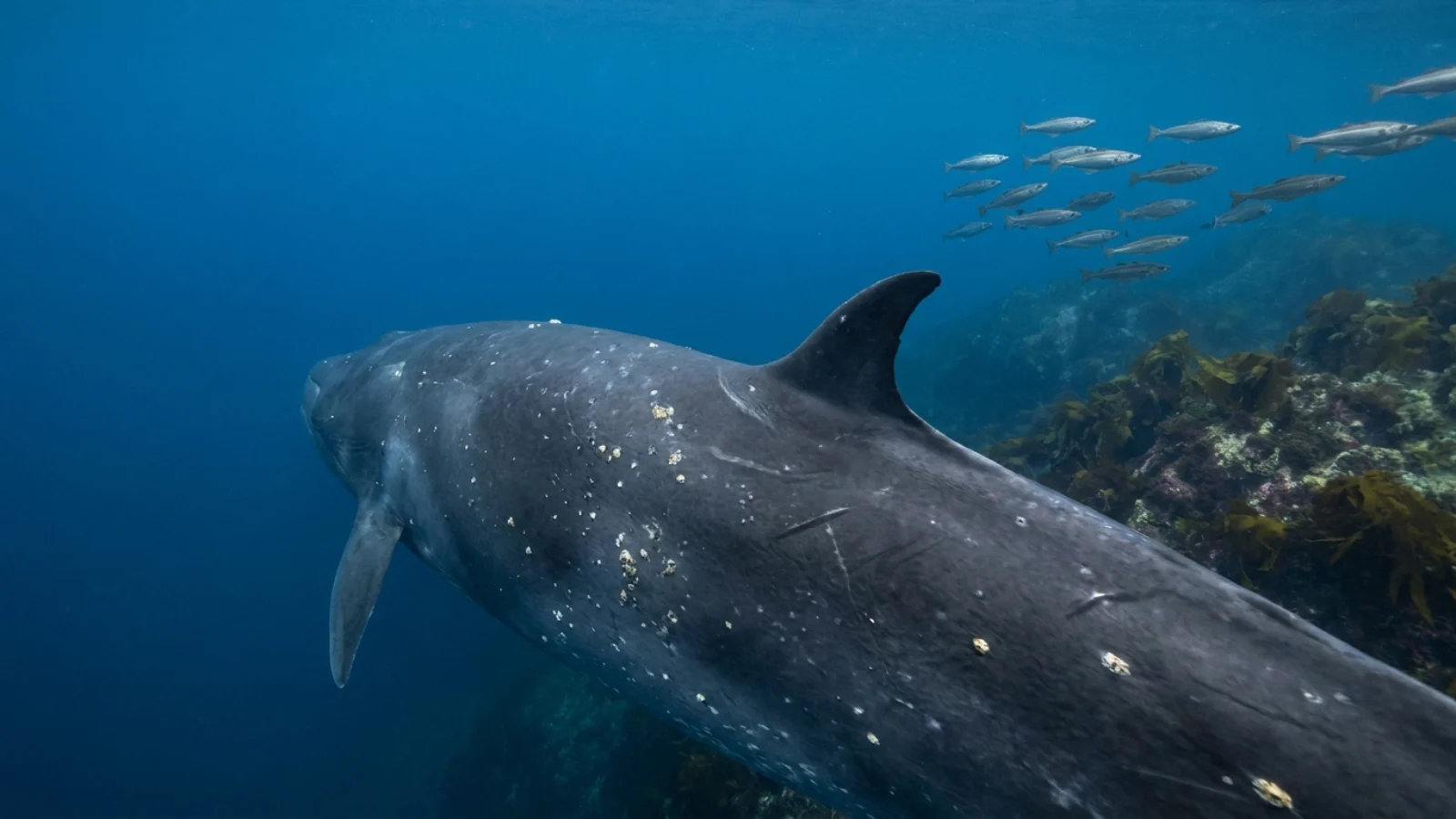
The sei whale is dark steel grey with irregular pale grey to white markings underneath, and its skin is often pocked with small oval scars. These were long a mystery; they are now known to be bites from cookiecutter sharks, and every sei whale sampled off California, South Africa and South Georgia carried them. The head has a single ridge running from the tip of the snout to the blowholes, and from the side the snout looks slightly arched, especially at the tip, whereas fin and Bryde’s whales have flatter heads.
Its tall, sickle-shaped dorsal fin, averaging 53 to 56 cm and up to 90 cm high, sits about two-thirds of the way along the back, and it is the best clue at sea. When a sei whale surfaces, the blowholes and the dorsal fin often appear above the water almost at the same moment. Unlike the fin whale it does not arch high before diving; it simply sinks below the surface, and it almost never lifts its tail flukes. It rarely breaches.
Telling a sei from its close relatives is notoriously difficult. Bryde’s whales look very similar but have three parallel ridges on top of the head instead of one. Large sei whales can be confused with fin whales unless the fin whale’s lopsided head colouring, white on the right lower jaw and grey on the left, can be seen. The surest anatomical difference is inside the mouth: each side holds 300 to 380 ashy-black baleen plates up to 80 cm long, fringed with extremely fine, curly, wool-like white bristles about 0.1 mm thick, the finest of any rorqual. The throat pleats are short, only 32 to 60 of them, ending about halfway between the flippers and the navel, which limits how far the mouth can expand.
The cheetah of the whales
The sei whale is among the fastest cetaceans, reaching up to about 50 km/h (31 mph) over short distances. The American naturalist Roy Chapman Andrews compared it to the cheetah, writing that it could swim at great speed “for a few hundred yards” but “soon tires if the chase is long” and lacks “the strength and staying power of its larger relatives”. It is not a remarkable diver, usually staying down for 5 to 15 minutes at relatively shallow depths. Between dives it stays near the surface for a few minutes, blowing about once a minute.
Sei whales usually travel alone or in groups of up to six, though larger numbers gather where food is abundant. Very little is known about their social life. During an influx into the southern Gulf of Maine in 1986, groups of three or more were seen “milling”: swimming in random directions, rolling and staying at the surface for more than ten minutes, after which one whale always left the group.
A skimmer of tiny prey
Most large rorquals lunge, gulping a single enormous mouthful. The sei whale more often skims, swimming on its side through swarms of prey near the surface with its mouth open and straining the water through its fine baleen. That technique, and the fine bristles, suit its unusually small prey. An adult eats an average of about 900 kg of food a day, and its preferred foods sit low in the food chain.
In the North Atlantic it feeds primarily on calanoid copepods, especially Calanus finmarchicus, with krill such as Meganyctiphanes norvegica and Thysanoessa inermis as a second choice. That puts it in competition with herring, basking sharks and right whales, which also eat copepods. In the North Pacific it takes similar zooplankton but also larger prey, including Japanese flying squid and small fish such as anchovies, sardines, Pacific saury, mackerel, jack mackerel and juvenile rockfish. Off central California sei whales ate mainly anchovies between June and August and krill in September and October. In the Southern Hemisphere the menu includes copepods, Antarctic krill and the pelagic amphipod Themisto gaudichaudii. Modern researchers also study diet by collecting the whales’ faeces, which appear as a dilute brown cloud, and identifying prey DNA.
Life cycle and lifespan
Sei whales mate in temperate and subtropical seas in winter. Gestation is estimated at between about 10.75 months and a year, depending on the model of fetal growth used; because almost all reproductive data came from whales killed by whalers, nobody has observed a full pregnancy. A calf is weaned at six to nine months, when it is 8 to 9 m long, so weaning happens on the summer or autumn feeding grounds. Females usually give birth to a single calf every two to three years. Both sexes mature at an average of 8 to 10 years old, at about 12.8 to 14 m long, and sei whales can live to about 65 years or more; some sources give 70.
Sounds of the sei whale
Relatively little is known about sei whale calls. Off the Antarctic Peninsula in 2003, observers recorded calls of about half a second in the 240 to 625 Hz range, some multi-part, along with “growls” and “whooshes”, with a maximum source level of about 156 decibels. Off Maui in November 2002, scientists recorded downswept calls from about 39 Hz to 21 Hz in the presence of sei whales, which closely matched mysterious pulses from seafloor recordings off Oahu that had previously been blamed on fin whales. Between 2005 and 2007, low-frequency downswept calls averaging 82 Hz down to 34 Hz, recorded in the Great South Channel east of Cape Cod, were linked specifically to sei whales; the same call has since been reported from the Gulf of Maine, the mid-Atlantic and Davis Strait, and it probably works as a contact call.
Where sei whales live
Sei whales live in all oceans but rarely in polar or tropical waters, preferring deep water over the continental slope, in basins between banks and around submarine canyons. They avoid semi-enclosed seas such as the Gulf of Mexico, the Gulf of St Lawrence, the North Sea and the Mediterranean. In the North Atlantic the range runs from north-west Africa and southern Europe to Norway, and from the southern United States to Greenland. In the North Pacific they winter at about 20 to 23°N and summer at 35 to 50°N. In the Southern Hemisphere whaling records place them in summer at about 40 to 50°S in the South Atlantic and Indian oceans and 45 to 60°S in the South Pacific. A small population lives in the coastal waters of the eastern Falkland Islands, where, unusually, the whales come into large bays, giving scientists a rare chance to study an otherwise oceanic species.
The species is famously unpredictable. Sei whales migrate from subpolar summer feeding grounds to temperate and subtropical waters in winter, and in the north-west Atlantic they arrive around Georges Bank and Browns Bank by mid- to late June. But exact routes are poorly known, and scientists cannot reliably predict where groups will turn up from one year to the next. Off northern Norway, where they had once been hunted in large numbers, they were said to be scarce in the 1960s and early 1970s, possibly because of overhunting or a crash in copepod stocks. Satellite tags have helped: one whale tagged off Faial in the Azores travelled more than 4,000 km to the Labrador Sea between April and June 2005, apparently riding the currents and feeding along the way at the Charlie-Gibbs Fracture Zone, and seven more tagged off Faial and Pico in 2008 and 2009 also headed for the Labrador Sea.
The whaling era
At first the sei whale’s speed and elusiveness, and later its relatively small yield of oil, protected it. Once right, blue, fin and humpback whales had been depleted, whalers turned to sei whales in earnest, particularly between 1950 and 1980. Their meat was popular in Norway, and in 1885 alone more than 700 were caught off Finnmark. Iceland’s Hvalfjordur station processed 2,574 between 1948 and 1985.
The totals are large. In the North Atlantic 14,295 were taken between 1885 and 1984. In the North Pacific the reported commercial catch was 72,215 between 1910 and 1975, with catches averaging 3,643 a year from 1963 to 1974, until the whales became scarce and commercial sei whaling there ended in 1975. In the Southern Hemisphere 152,233 were taken between 1910 and 1979, peaking at more than 20,000 in the 1964–65 season as the fin whale catch collapsed. Soviet misreporting means the true North Pacific figures are uncertain. A former South Georgia whaler, Roddy Morrison, told the BBC that sei whales “used to make a noise, like a crying noise” when they were harpooned.
Protection, and the hunts that continue
Sei whales had no meaningful international protection until 1970, when the International Whaling Commission first set species quotas in the North Pacific. Full protection came there in 1976, North Atlantic quotas began in 1977, and Southern Hemisphere stocks were protected in 1979, before the general moratorium on commercial whaling took effect in 1986. Iceland took up to 40 a year under scientific permits between 1986 and 1989, and Japan caught sei whales in the North Pacific under research permits for years, claiming the western North Pacific held more than 28,000, a figure contested by many scientists. Japan, now outside the IWC, set a 2026 commercial catch limit of 56 sei whales, according to figures from its Fisheries Agency reported in May 2026.
How many sei whales are left?
Population figures are uncertain, partly because sei whales are so easily confused with Bryde’s and fin whales. A widely cited global estimate is about 80,000, less than a third of the pre-whaling number. In the North Pacific there may have been about 42,000 before whaling and only 7,260 to 12,620 by its end, and in the Southern Hemisphere estimates fell from about 65,000 to roughly 10,000. More recent surveys suggest recovery: a 2010–2012 survey estimated about 29,600 sei whales in the central and eastern North Pacific, and US surveys of the California Current produced rising estimates between 1991 and 2014. NOAA’s 2023 stock assessment, however, still relies on a 2014 estimate of 864 animals for the eastern North Pacific stock off California, Oregon and Washington. In western Canada, five sei whales seen together in 2017 were the first such sighting in more than 50 years.
The IUCN lists the sei whale as Endangered, and it is listed as endangered under the US Endangered Species Act. Threats considered by NOAA include ship strikes and entanglement in fishing gear, though none was documented off the US west coast between 2017 and 2021, and the species is also prone to mass mortality events. In June 2015 scientists flying over southern Chile counted 337 dead sei whales in what has been called the largest mass stranding ever documented; toxic algal blooms linked to an unusually warm Pacific were suspected.
Where to see sei whales
Because they prefer deep, offshore water, sei whales are less often seen than humpbacks or fin whales. Good places to look include the waters off New England, where the Great South Channel east of Cape Cod is a known sei whale area, the Azores in spring, when tagged whales have set off from Faial and Pico toward the Labrador Sea, and the eastern Falkland Islands, where the whales come unusually close to shore. Look for a long, dark back with a tall, hooked fin appearing at almost the same moment as the blow, and a whale that slips beneath the surface without arching its back or raising its flukes. More rorqual profiles are in our whales hub.
How big is a sei whale?
Adults usually measure about 13.7 to 15 m and weigh 15 to 20 tonnes; the largest reach about 19.5 m.
How do you pronounce sei whale?
“Say”. The name comes from the Norwegian word for pollock.
How fast can a sei whale swim?
Up to about 50 km/h over short distances, making it one of the fastest whales, though it tires quickly.
What do sei whales eat?
Mainly copepods and krill, plus squid and small fish such as anchovies and sardines in the North Pacific.
Are sei whales endangered?
Yes. The IUCN lists them as Endangered, and they are endangered under the US Endangered Species Act.
How many sei whales are left?
A commonly cited global estimate is about 80,000, under a third of the pre-whaling population.
How do you tell a sei whale from a fin whale?
The sei’s fin and blowholes show almost at the same time, it does not arch when diving, and it lacks the fin whale’s white right jaw.
Are sei whales still hunted?
Japan set a commercial catch limit of 56 sei whales for 2026.
- Wikipedia contributors, “Sei whale” (2023 snapshot, accessed November 2026).
- NOAA Fisheries, Sei Whale (Balaenoptera borealis borealis): Eastern North Pacific Stock, 2023 Stock Assessment Report (published December 2024).
- World Animal News (12 May 2026), Japan’s 2026 whaling season catch limits (Fisheries Agency figures).
Blane Perun has been exploring Earth’s oceans and marine life for over 25 years. Founder of TheSea.Org in 1999, underwater photographer, coral aquaculture pioneer, and explorer of 80+ countries.
About Blane Perun →