Reef Eels — Morays, Garden Eels and Snake Eels: the Long, Hidden Hunters of the Coral Reef
True bony fish with long, snake-like bodies, no pelvic fins and usually no scales. The order contains roughly 1,000 species in about 20 families. On coral reefs the main groups are morays (Muraenidae, ~200 species), snake and worm eels (Ophichthidae, ~300 species), and congers and garden eels (Congridae). All start life as transparent, leaf-shaped leptocephalus larvae that drift in the open ocean for weeks to months.
What kinds of eels live on coral reefs?
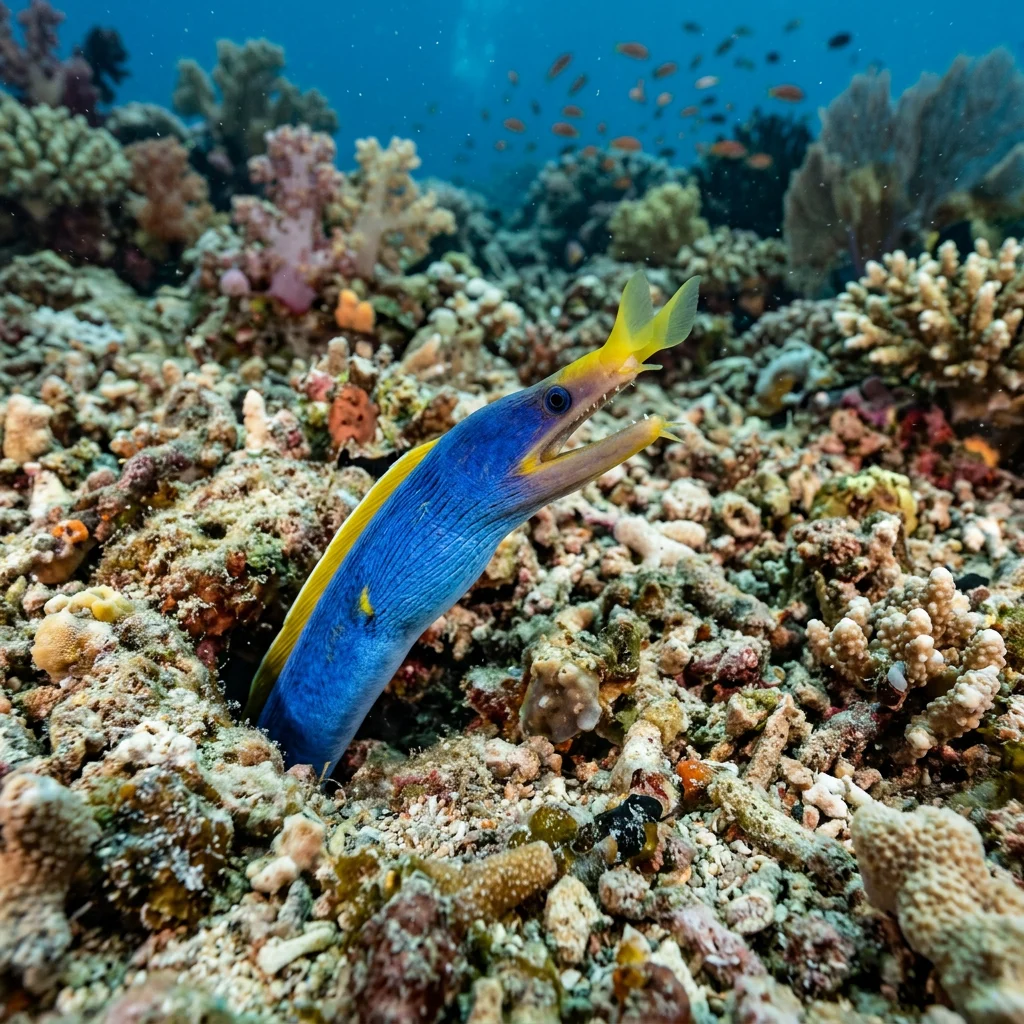
Four families account for nearly every eel a diver meets.
| Group | Family | Size | Where you see them | Example species |
|---|---|---|---|---|
| Moray eels | Muraenidae | 20 cm–3 m | Heads poking from reef holes | Giant moray, zebra moray, spotted moray |
| Garden eels | Congridae (Heterocongrinae) | 30–120 cm | Colonies rising from sand slopes | Spotted garden eel, splendid garden eel |
| Snake & worm eels | Ophichthidae | 20 cm–2.5 m | Buried in sand, only the head showing | Spotted snake eel, banded snake eel |
| Conger eels | Congridae | to ~3 m | Wrecks and rocky reefs, night dives | European conger, Hawaiian conger |
The ribbon eel (Rhinomuraena quaesita), a moray with flared nostrils, is a favourite with photographers; see blue ribbon eel. For a deep dive into moray diversity, read types of moray eels.
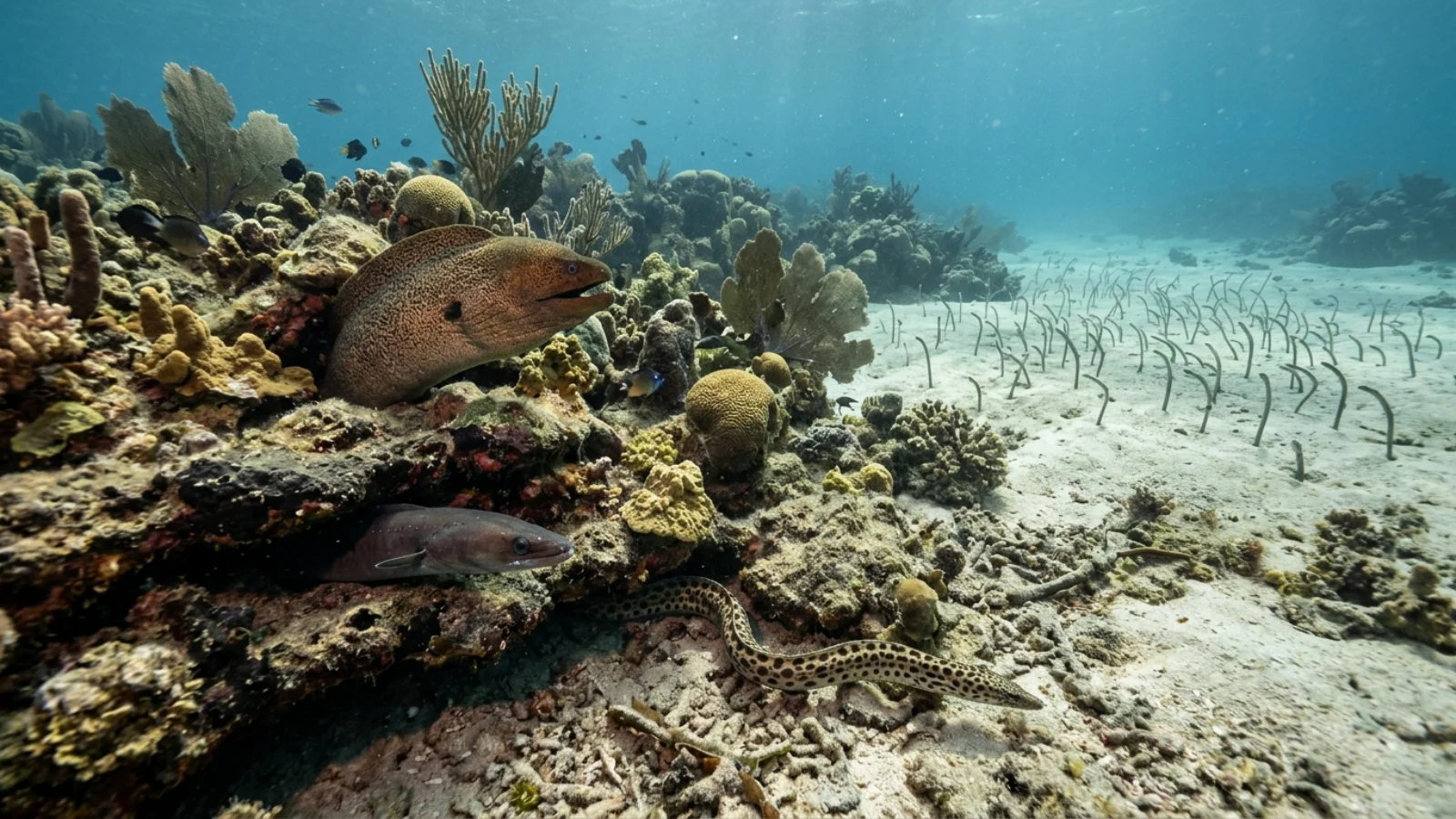
Are eels fish or snakes?
Fish, through and through.
Eels have gills, fins (a long continuous dorsal-caudal-anal fin), a swim bladder and a fish skeleton. Snakes are reptiles that breathe air with lungs. The confusion is understandable, and some snake eels even mimic sea snakes with banded colours. Our separate answers cover are eels related to snakes, is an eel a reptile and do eels have scales.
How do moray eels eat?
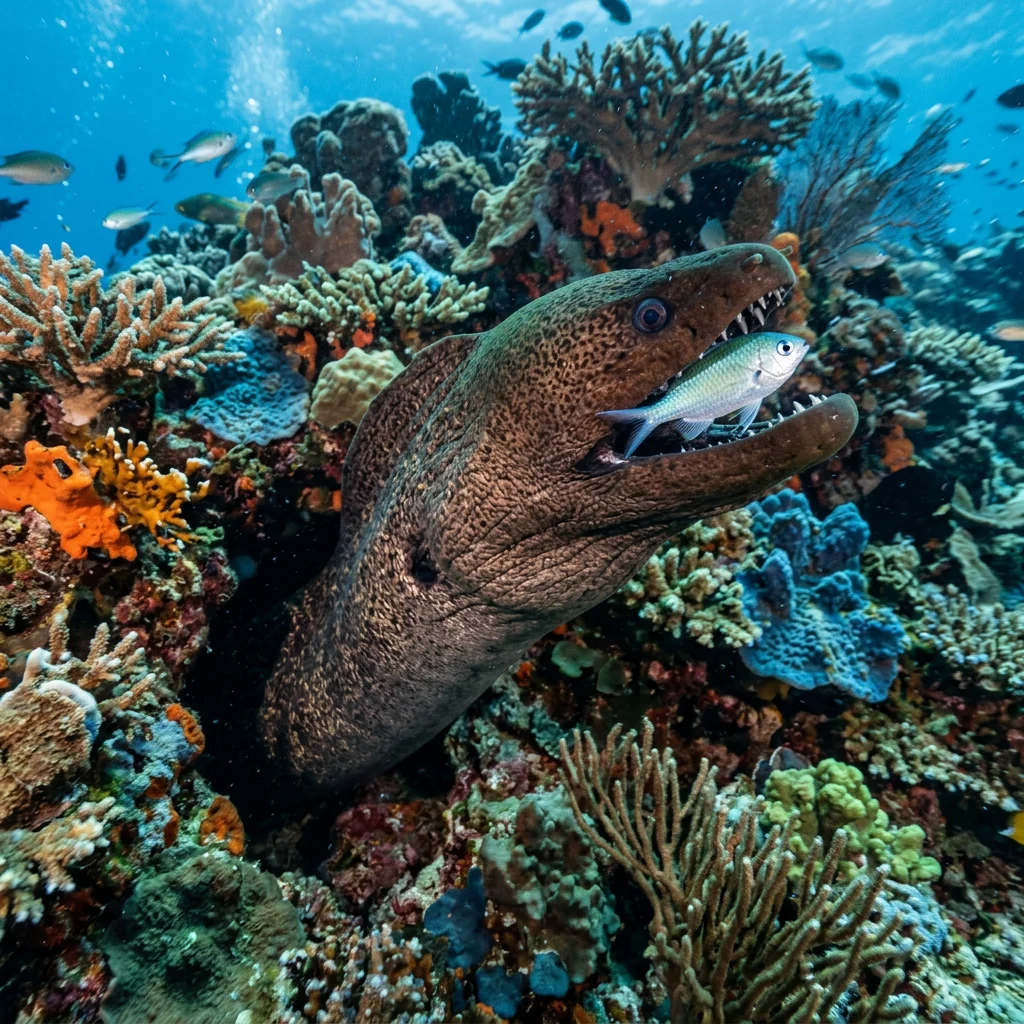
With a second set of jaws that shoots out of the throat.
In 2007 researchers filmed what had only been guessed: morays launch a second set of jaws, the pharyngeal jaws, forward from the throat into the mouth, grab prey that the front teeth are holding, and drag it down the gullet. This lets them swallow large prey inside tight crevices where they cannot use suction, as most fish do. The front teeth are long and often backward-curved; some morays that eat crabs and snails have blunt, molar-like teeth instead.
Morays also hunt cooperatively with other predators. Roving coral groupers in the Red Sea signal to giant morays with a head-shake, then the eel flushes fish out of holes while the grouper catches anything that escapes into open water. Both species benefit. More on that partnership in groupers and snappers.
Why do moray eels open and close their mouths?
They are breathing, not threatening.
Morays have small, round gill openings and must pump water over their gills by gaping rhythmically. It looks menacing, especially with the teeth on show, but it is just respiration. Their skin is covered in protective mucus, which in some species is mildly toxic, and they have poor eyesight but an excellent sense of smell through tubular nostrils.
How do garden eels and snake eels live?
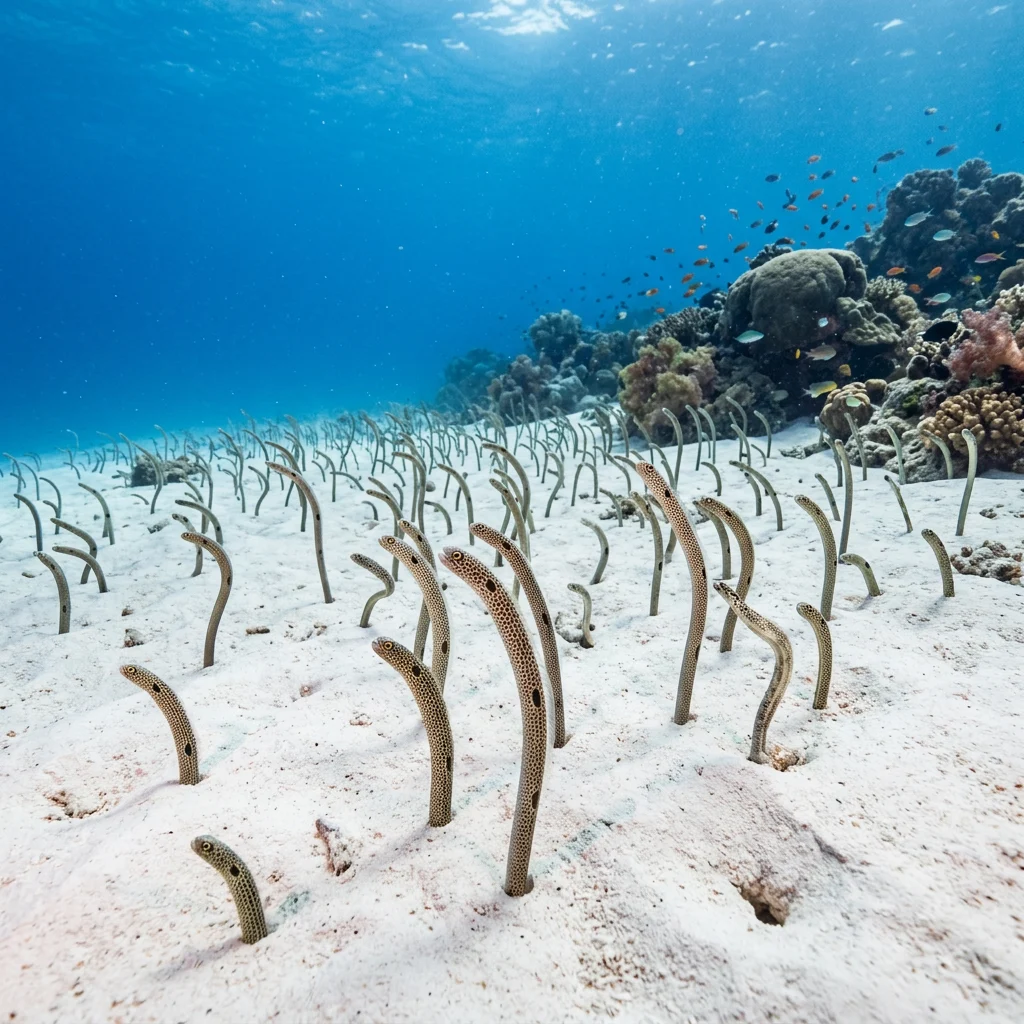
Two very different ways of living in sand.
Garden eels live in colonies of hundreds to thousands on current-swept sand slopes. Each eel stays in its own mucus-lined burrow, rising like a stalk to pick plankton from the passing current and sinking instantly when a diver approaches. Colonies look like fields of grass waving in the current. See garden eels out of sand.
Snake eels bury themselves tail-first (or head-first, then turn) in sand, leaving only the head exposed, and ambush small fish and crustaceans. Their hard, pointed tails let them burrow backward rapidly. Some are active hunters on the move at night across sand flats.
How do eels reproduce?
Out in open water, with a famously strange larva.
Most reef eels spawn in pairs at night, releasing eggs that hatch into leptocephali, flat, transparent larvae that drift for weeks to months before shrinking and transforming into juvenile eels. Ribbon eels are protandrous hermaphrodites: they start as black juveniles, become blue-and-yellow males, then may become all-yellow females. Some morays can change sex or are simultaneous hermaphrodites.
Are reef eels dangerous to humans?
Rarely, and only when provoked.
- Bites: moray bites can be deep and prone to infection because of the backward-curved teeth and bacteria. Seek medical care.
- Ciguatera: large morays (especially giant morays) can accumulate ciguatoxin from the reef food chain and should not be eaten.
- Toxic mucus: handling some species can irritate skin.
Where are the best places to see reef eels?
Almost any tropical reef, but some sites are famous for them.
| Destination | Eels to look for |
|---|---|
| Red Sea | Giant morays hunting with groupers; huge garden-eel fields on sand slopes |
| Indonesia and the Philippines | Ribbon eels, snake eels and dozens of moray species on muck dives |
| Hawaii | Endemic morays such as the dragon moray, plus Hawaiian snake eels |
| Caribbean (Bonaire, Cozumel) | Green morays, spotted morays, goldentail morays and garden eels |
| Maldives | Large giant-moray populations and cleaning stations |
Look in holes at the base of coral heads by day, and on open reef and sand at night, when many morays leave their dens to hunt. Cleaning stations are good bets: morays often sit with mouths open while cleaner shrimp and cleaner wrasse pick parasites from their teeth. See cleaner shrimp.
What makes a moray a moray?
Morays (family Muraenidae) are the reef eels most people picture: about 200 species in 15 genera, almost all marine, with no pectoral fins, thick mucus-coated skin, tubular nostrils and a mouth that reaches far back past the eyes.
Most morays have no pectoral or pelvic fins at all. The single fin running along the back joins the tail and anal fins to form one continuous frill. The eyes are small, and morays find food mainly by smell, through two pairs of nostrils. The front pair sit on short tubes at the tip of the snout, which are flared into elaborate leaf shapes in the ribbon eel. The skin has no scales but is unusually thick and packed with mucus-secreting goblet cells. That mucus protects against abrasion and parasites, contains toxins in some species, and sand-dwelling morays use it to cement the walls of their burrows. It can even change how a moray looks. The Caribbean green moray (Gymnothorax funebris), at up to about 2.5 m the largest moray in the tropical Atlantic, owes its colour to a yellowish mucus layer over darker skin. Preserved specimens lose the green.
Teeth vary with diet. Fish-eating species such as the giant moray (G. javanicus) have long, needle-like, backward-pointing fangs that hold slippery prey. Crab and snail specialists such as the zebra moray (Gymnomuraena zebra) and the snowflake moray (Echidna nebulosa) have blunt, pebble-like teeth for crushing shells. The longest moray is not the heavyweight giant moray but the slender giant moray (Strophidon sathete) of Indo-Pacific muddy bays and estuaries, a whip-thin fish that can reach around 4 m. Groupers, barracudas and sea snakes are among the few predators of morays, and large morays are effectively apex predators on many reefs.
The moray’s second jaws and other hunting tricks
Most fish swallow by sucking prey in. Morays can’t do that well in a narrow crevice, so they evolved a mechanical alternative.
Rita Mehta and Peter Wainwright, then at the University of California, Davis, used high-speed video and X-ray imaging to show that morays fire their pharyngeal jaws forward from the throat into the mouth cavity. All bony fishes have pharyngeal jaws, a second set of toothed bones in the throat used for processing food. In morays these bones are unusually mobile and carried by elongated muscles. When the front teeth have hold of a fish, the pharyngeal jaws shoot forward, bite into the prey and pull it back into the gullet. Then the front jaws grab again and the cycle repeats. The study, published in Nature in 2007, concluded that morays are the only animals known to use pharyngeal jaws to actively capture and restrain prey in this way. Their long mouth opening helps as well: when a moray strikes, water escapes out of the back of the gape instead of pushing the prey away.
When prey is too large to swallow, morays can tie their bodies into a knot and slide the knot down toward the head. That gives them leverage to tear chunks off a carcass or pull prey out of a hole. A spotted moray has even been seen eating a lionfish without apparent harm. Some of the most remarkable moray behaviour, though, involves other species. In the Red Sea, Redouan Bshary and colleagues filmed roving coral groupers (Plectropomus pessuliferus) swimming to a giant moray’s den and shaking their heads to invite it to hunt. The moray then followed the grouper across the reef, flushing fish out of crevices that the grouper could not enter. Prey that bolted into open water was taken by the grouper. Later work by Alexander Vail and colleagues, published in Nature Communications in 2013, showed that coral trout also do a headstand over prey hidden in a crevice, a gesture that signals its location to a partner moray or octopus. Gestures like this had previously been documented only in humans, great apes and ravens.
Garden eels: life in a burrow
Garden eels (subfamily Heterocongrinae, about 36 species) are small congers that spend almost their entire adult lives with their tails anchored in a burrow, feeding on plankton carried by the current.
Each garden eel digs a vertical burrow in sand or fine rubble and lines it with mucus to keep it from collapsing. It rises out of the burrow to face into the current, picking zooplankton such as copepods and fish eggs from the water one item at a time. Because food arrives on the current, colonies form on slopes where the flow is reliable, and they can number from dozens to many thousands. Garden eels are extremely wary. A diver’s silhouette or a pressure wave from a fin can send a whole field of eels back down their holes in a ripple. Divers who want to see them up close have to approach slowly and low, and wait. Breeding happens between neighbours. Males and females stretch out of adjacent burrows and twine together without fully leaving home, and the eggs and larvae drift away in the plankton.
Their shyness made headlines in 2020. When Tokyo’s Sumida Aquarium closed to visitors from 1 March because of the COVID-19 pandemic, its hundreds of spotted garden eels began hiding in the sand whenever staff approached, which made it hard to check their health. The aquarium held a three-day “face-showing festival” from 3 May, inviting the public to video-call the eels from phones and tablets in five-minute sessions and wave at them gently, to get the eels used to human faces again.
Snake eels: burrowers that can escape a predator’s stomach
Snake eels and worm eels (family Ophichthidae) range from about 5 cm to more than 2.3 m. They spend most of their time buried in sand or mud with only the head showing.
Many snake eels have lost most of their fins, and they have a hard, sharply pointed tail tip that they use to dig backward into the sediment with remarkable speed. Many are boldly banded or spotted. In some, the pattern closely resembles that of venomous sea snakes, which may deter predators. They hunt small fish and crustaceans, either by ambush from the burrow or by moving across sand flats at night, probing holes with the snout. Storms often wash them ashore, which is how many species were first collected.
That pointed tail has a grimmer use. In 2020, Queensland Museum researchers reported seven species of snake eel found inside the body cavities of 11 species of predatory fish in Australian waters. The eels had been swallowed whole and alive, and then tried to escape by driving the hard tail tip through the predator’s stomach wall. Many made it out of the stomach but could not get through the outer body wall, so they died trapped in the predator’s body cavity and were effectively mummified there. The predators seemed to survive the experience. The study, in the Memoirs of the Queensland Museum – Nature, was the first record of the phenomenon in Australian waters.
Conger eels: the heavyweights
The European conger (Conger conger) averages about 1.5 m. Large specimens reach well over 2 m, and the heaviest have weighed around 72 kg, making it the heaviest eel in the world.
Congers have scaleless skin, pectoral fins, and a big mouth with an overbite. They live on rocky ground, breakwaters and especially wrecks from Norway and Iceland to Senegal, and through the Mediterranean, usually in water shallower than 500 m. They are mostly active at night. Their life cycle ends dramatically. Somewhere between 5 and 15 years old, a conger stops feeding as its gonads swell, its skeleton loses mineral and its teeth fall out. It then migrates to deep-water spawning grounds in the Atlantic or the Mediterranean to spawn once and die. Many temperate wreck divers know the sight of a huge conger head filling a porthole. Like morays, congers bite defensively if someone puts a hand into their hole.
The leptocephalus: an eel’s glass-leaf childhood
All eels start life as leptocephali: flat, transparent, leaf-shaped larvae so unlike adults that they were once classified as a separate kind of fish.
A leptocephalus is mostly a pouch of clear, jelly-like material wrapped in a thin layer of muscle, with a tiny head, small organs and a simple tube for a gut. It has no red blood cells and carries long, forward-pointing teeth. It lives mainly in the top 100 m of the ocean at night, going a little deeper by day, and feeds on marine snow, the drifting particles of organic debris, rather than on live plankton. Leptocephali grow unusually large for fish larvae, typically 5 to 10 cm and sometimes about 30 cm, and the larval stage lasts from about three months to more than a year. During that time the ocean carries them across great distances, which is why the same reef eel species can occur across the whole Indo-Pacific. At metamorphosis the larva shrinks in length, loses its larval teeth, becomes rounded and gains pigment and blood, before settling as a juvenile. The leptocephalus is shared by the whole superorder Elopomorpha, about 800 species including tarpons, bonefish and the deep-sea pelican eel, which suggests the larval design is at least as old as the Cretaceous.
Morays and people, from Roman fishponds to ciguatera
People have kept, eaten and feared morays for more than 2,000 years.
Wealthy Romans kept Mediterranean morays (Muraena helena) in seaside fishponds. Pliny the Elder recorded that the orator Lucius Licinius Crassus decorated a favourite moray with jewelled earrings and mourned it when it died. He also told the notorious story of Vedius Pollio, who was said to have thrown slaves who displeased him into his moray pond. Today morays are eaten in many places, but large reef species, especially the giant moray, sit at the top of food chains that can concentrate ciguatoxins, produced by microalgae and passed up through herbivores and predators. Ciguatera poisoning causes gastrointestinal, neurological and sometimes cardiac symptoms, and cooking or freezing does not destroy the toxin. Several tropical regions advise against eating large morays at all.
Leptocephalus, glass eel, elver, yellow and silver eel.
20 surprising things about eels.
Moray bite wounds, risks and first aid.
From silver to electric blue.
Spawning in the Sargasso Sea.
Diets of morays, congers and freshwater eels.
The invasive swamp eel in Florida.
Record congers, morays and freshwater giants.
How big moray eels get, species by species.
Gills, fins, slime and organs explained.
The Pacific wolffish that isn’t an eel.
Raw eel, moray eel and safety.
Hunting with shocks.
The Polynesian legend of the first coconut.
From morays to 85-year eels.
Fangs, crushers and second jaws.
Allergies and seafood labels.
Life cycle, range and are they dangerous?
Foam nests and guarding fathers.
The jawless fish that aren’t eels.
Numbfish, tremblers and poraquê.
Types, ranges and Florida species.
Two very different “eels”.
What eels live on coral reefs?
Mainly moray eels, garden eels, snake eels and conger eels.
How many species of eels are there?
About 1,000 in the order Anguilliformes, including roughly 200 morays.
What is the largest reef eel?
The giant moray, which reaches about 3 m and 30 kg.
Do moray eels have two sets of jaws?
Yes. Their pharyngeal jaws shoot forward from the throat to drag prey down.
Are moray eels aggressive?
No. They bite defensively, usually when fed or provoked.
Why do moray eels open their mouths?
To pump water over their gills to breathe.
Can you eat moray eels?
Large morays can carry ciguatera toxin, so eating them is risky.
What do garden eels eat?
Zooplankton picked from the current while anchored in their burrows.
- Mehta, R. S. & Wainwright, P. C. (2007). Raptorial jaws in the throat help moray eels swallow large prey. Nature 449: 79–82.
- Bshary, R. et al. (2006). Interspecific communicative and coordinated hunting between groupers and giant moray eels in the Red Sea. PLoS Biology 4: e431.
- Froese, R. & Pauly, D. (eds.). FishBase. www.fishbase.org.
- Nelson, J. S., Grande, T. C. & Wilson, M. V. H. (2016). Fishes of the World, 5th ed. Wiley.
- Vail, A. L., Manica, A. & Bshary, R. (2013). Referential gestures in fish collaborative hunting. Nature Communications 4: 1765.
- Queensland Museum (2020). Snake eels found mummified in the body cavities of predatory fishes. Memoirs of the Queensland Museum – Nature; reported by Australian Geographic, June 2020.
- Sumida Aquarium, Tokyo, “face-showing festival” for spotted garden eels, May 2020 (Quartz, 1 May 2020).
- Wikipedia, “Moray eel”, “Green moray”, “European conger”, “Garden eel”, “Ophichthidae” and “Leptocephalus”.
- Pliny the Elder, Natural History, Book IX (Crassus’s moray; Vedius Pollio).
Blane Perun has been exploring Earth’s oceans and marine life for over 25 years. Founder of TheSea.Org in 1999, underwater photographer, coral aquaculture pioneer, and explorer of 80+ countries.
About Blane Perun → More on Coral Reef Fish →