Sergeant Major Fish — Five Bars, a Bold Attitude and a Nest-Guarding Father
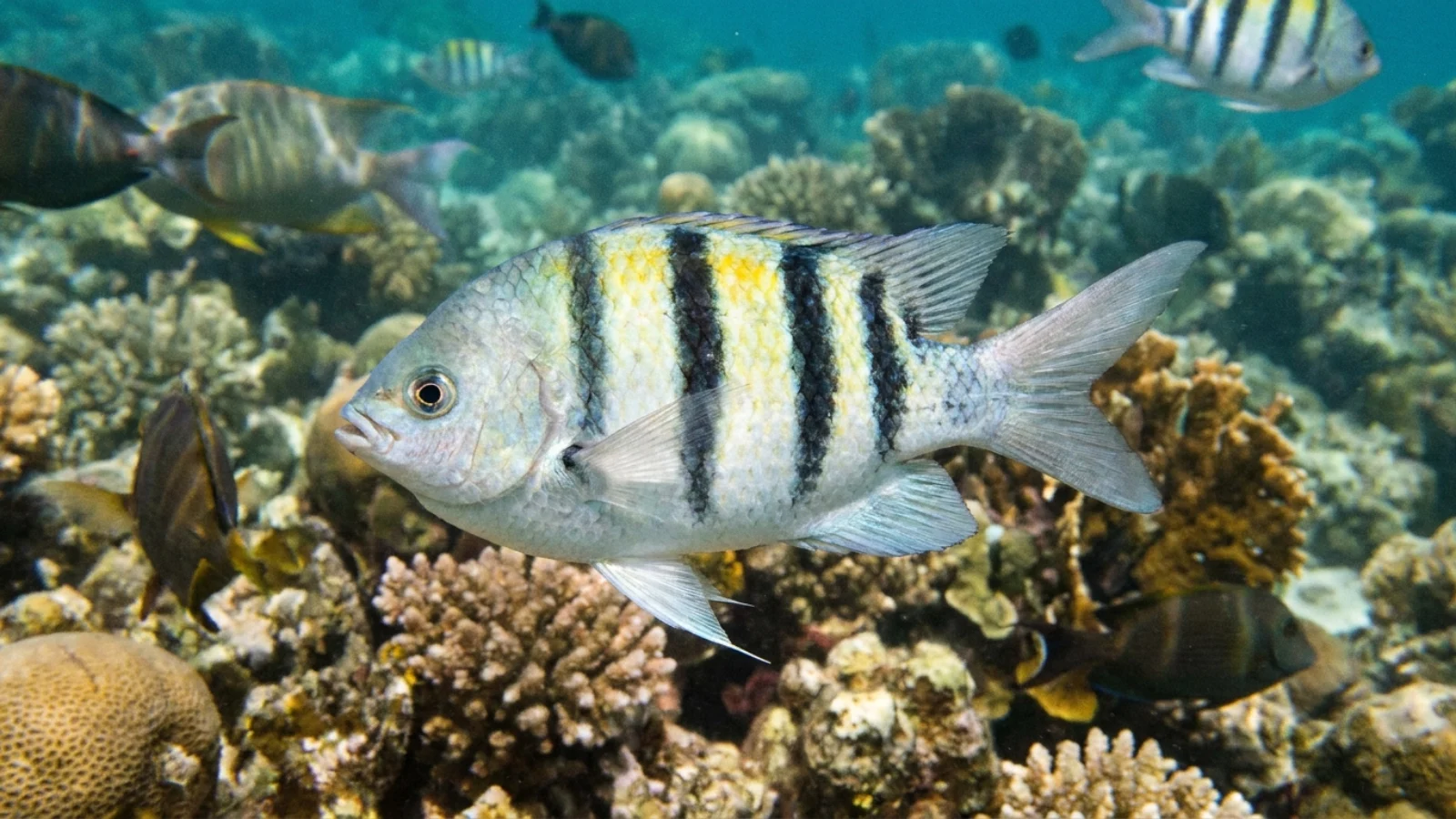
The sergeant major (Abudefduf saxatilis) is a damselfish of the Atlantic Ocean, named for the five dark vertical bars on its silvery-white and yellow body, like a military sergeant major’s stripes. It grows to about 23 cm, ranges from Canada to Uruguay in the western Atlantic and along tropical West Africa, and is one of the most abundant fish on Caribbean reefs. Males guard nests of eggs and turn bluish while they do it.
Step off the beach at almost any Caribbean reef with a snorkel and the first fish to greet you will probably be a sergeant major. Bold, curious and always hungry, they swarm anyone who looks like they might drop food. They are so common that many snorkellers stop seeing them. That is a shame, because the sergeant major has one of the most interesting home lives on the reef.
Why is it called a sergeant major?
Because its five dark vertical bars look like the stripes on a military sergeant major’s insignia.
The bars are black or dark blue on a silvery-white body, usually with a yellow wash across the back. They give the fish its common name; the scientific name saxatilis means “living among rocks”. It is a damselfish, family Pomacentridae, the same family as clownfish and chromis. See the damselfish family guide and the small oval fish group guide.
How big do sergeant majors get?
Up to about 23 cm (9 in) and 200 g, though most are about 15 cm.
Where do sergeant major fish live?
Throughout the tropical and subtropical Atlantic: from Canada and Rhode Island to Uruguay in the west, around mid-Atlantic islands and Cape Verde, and along West Africa to Angola.
FishBase stresses that this is strictly an Atlantic species, abundant on Caribbean reefs. In the Indo-Pacific its place is taken by a close relative, the Indo-Pacific sergeant, Abudefduf vaigiensis. Juveniles are common in tide pools and young fish use mangroves; adults gather over shallow reef tops, rocky shores, jetties, pilings and shipwrecks. See Caribbean coral reefs and the Florida Keys for places where they are everywhere.
What do sergeant major fish eat?
Almost anything small: algae, small crustaceans and fish, plankton and the larvae of invertebrates.
Adults often gather in feeding aggregations of several hundred fish, picking plankton from the water column above the reef. They are opportunists. At the Fernando de Noronha archipelago off Brazil, researchers have documented sergeant majors feeding on the faeces and vomit of spinner dolphins, a simple switch from plankton picking to picking up drifting scraps. That opportunism is also why they mob snorkellers.
How do sergeant majors reproduce?
Males prepare nests on rocks, reefs, wrecks or pilings, court females, and then guard the eggs alone for about a week, turning bluish as they do.
The male clears a patch of hard surface, then chases and courts females. Each female lays a mass of about 200,000 small oval eggs, attached to the substrate by fine filaments. The eggs turn greenish after a few days. The male stays on the nest the whole time, fanning water over the eggs and attacking anything that approaches, including much larger fish and divers. During this period his colour darkens to a blue tone and the bars become less obvious.
| Stage | What happens |
|---|---|
| Nest preparation | Male cleans a patch of rock, coral or wreck |
| Courtship | Male chases and displays to females |
| Spawning | Female lays about 200,000 eggs attached by filaments |
| Guarding | Male fans and defends eggs for about a week, turning bluish |
| Hatching | Larvae drift in the plankton before settling |
Do sergeant majors clean other animals?
Juveniles sometimes do. At Fernando de Noronha, young sergeant majors join doctorfish and blue tangs at cleaning stations that groom green sea turtles.
The juveniles graze algae from the turtles’ shells and pick off molted skin and parasites, especially from the flippers. It is the same cleaning behaviour that makes the cleaner wrasse famous, though in sergeant majors it is occasional rather than a lifestyle. See green sea turtles.
How do you tell a sergeant major from look-alikes?
Count the bars and check the location: an Atlantic fish with five dark bars and a yellow back is almost always a sergeant major.
In the Indo-Pacific, the Indo-Pacific sergeant replaces it, and FishBase notes the two are often confused. Juvenile Atlantic spadefish and some butterflyfish also carry vertical bars, but their deep, disc-shaped bodies are quite different.
How is the sergeant major different from the Indo-Pacific sergeant?
They are look-alike sister species on opposite sides of the world: the sergeant major is strictly Atlantic, the Indo-Pacific sergeant lives from the Red Sea to the central Pacific.
| Feature | Sergeant major | Indo-Pacific sergeant |
|---|---|---|
| Scientific name | Abudefduf saxatilis | Abudefduf vaigiensis |
| Max length | 22.9 cm | 20 cm |
| Depth | 0–20 m | 0–15 m |
| Range | Atlantic: Canada to Uruguay, West Africa to Angola | Red Sea and East Africa to the Line and Tuamotu islands; Japan to Australia |
| Juveniles | Tide pools, mangroves | Often with drifting seaweed |
| Diet | Algae, crustaceans, small fish, larvae | Zooplankton, benthic algae, small invertebrates |
| IUCN | Least Concern | Least Concern |
If you photograph a five-barred damselfish in Hawaii, Bali or the Red Sea, it is not a sergeant major, however much it looks like one. The Indo-Pacific sergeant gathers in large numbers at spawning sites timed to big tides, which carry its larvae far offshore.
How do you identify a sergeant major up close?
FishBase describes the body as greenish yellow above, shading to white below, with five prominent vertical black bars that narrow toward the belly. A faint sixth bar sometimes shows on the narrow base of the tail, and there is a black spot at the upper base of the pectoral fin. That spot is a handy check when a fish is turned side-on in poor light. Adult males in breeding condition turn dark bluish, so the bars become much less obvious, which is why a nest-guarding male can look like a different species from the bright fish in the feeding school above him.
For counting, FishBase gives 13 dorsal spines with 12 or 13 soft rays, and 2 anal spines with 10 to 12 soft rays. The Indo-Pacific sergeant has almost the same counts, with 12 to 14 soft dorsal rays and 11 to 13 soft anal rays, so fin counts do little to separate the two. FishBase gives a length at first maturity of about 15 cm for the sergeant major, close to its common adult size, and about 12 cm for its Indo-Pacific relative.
When and where do sergeant majors feed during the day?
A 2023 study in Neotropical Ichthyology by L. T. Nunes, C. C. Leão, A. A. Floyd, I. Sazima and C. E. L. Ferreira followed sergeant majors on two subtropical reefs in the south-western Atlantic to see what they bit and when. The team tracked 2,703 individual fish until their first bite and recorded which of seven types of surface each fish chose. They also analysed the stomach contents of five fish from each site.
They found no significant difference in substrate use between times of day, although both populations tended to feed near the surface in the morning and on the bottom in the afternoon. Size made a clearer difference. Smaller fish fed mostly in the water column, while larger fish used all substrates, probably because of their different energy needs. The stomachs held 12 types of food from both the bottom and the plankton, confirming an omnivorous, generalist diet. The authors put the lack of a daily pattern down to the species’ opportunistic behaviour, the same trait that brings it swarming around snorkellers.
Do sergeant majors eat each other’s eggs?
Yes, and they do it in gangs. A short report in Coral Reefs by K. L. Cheney, published online in 2007, documented non-kin egg cannibalism and group nest-raiding in Caribbean sergeant majors: groups of fish raiding the nests of guarding males and eating eggs that are not their own. It shows why the male’s week of guarding is so demanding. The biggest threat to a nest is often not a large predator but a crowd of the fish’s own species.
Guarding has other rewards. A 2020 meta-analysis of paternal care across fish species, published in the Proceedings of the Royal Society B, found that females tend to prefer males that are already caring for a brood, and that this preference is strongest in species where males work harder to care for larger broods. The same analysis found no evidence that providing care harms a male’s condition, and only limited evidence that male care evolved mainly to improve offspring survival. For a male sergeant major, a nest full of eggs may therefore be an advertisement as well as a burden.
The timing of spawning has also been studied. In 1987 S. A. Foster compared the daily and lunar patterns of reproduction of the Caribbean sergeant major and its eastern Pacific twin, the Panamic sergeant major, in the journal Marine Biology. FishBase notes that the related Indo-Pacific sergeant gathers in large numbers at spawning sites timed to large tides, which carry its pelagic young far offshore.
Which animals clean, and eat, sergeant majors?
Sergeant majors sit on both sides of the reef’s cleaning business. As clients, they are cleaned of parasites by gobies of the genus Gobiosoma, the Spanish hogfish (Bodianus rufus), the barber goby Elacatinus figaro and the Noronha wrasse (Thalassoma noronhanum). As cleaners, juveniles groom green sea turtles at Fernando de Noronha, and FishBase notes that their cleaning begins with a characteristic inspection, usually followed by feeding nips on the turtle’s skin.
Being abundant, small and active in the open water makes them a staple prey fish. Recorded Atlantic predators include the bluehead wrasse, graysby, Nassau grouper, yellowfin grouper and cobia.
How did the sergeant majors evolve?
The sergeant major belongs to the genus Abudefduf, a group of about 20 species found in tropical seas around the world. A 2018 study in PeerJ by M. A. Campbell, D. R. Robertson and colleagues used sequence data from 500 genetic loci in 20 species to reconstruct the family tree. They found three main lineages. The ancestral diet appears to have been feeding on the bottom, which is still the habit of six species in two lineages, while at least 15 species belong to a single clade of plankton feeders.
The genus appeared about 24 million years ago, but most of its species arose in the last 10 million years. The authors link much of that speciation to the closing of land barriers, such as the rise of the Central American isthmus between the Atlantic and Pacific, and to repeated rises and falls in sea level. Diversification was concentrated in the plankton feeders, whose post-larval young can raft long distances on floating debris.
The sergeant major and the Panamic sergeant major, Abudefduf troschelii, are a classic geminate pair: closely related species split when the isthmus closed. A 2025 preprint by C. B. Tracy and colleagues, which had not been peer reviewed when this page was written, presented near-chromosome-level genome assemblies for both. It reported large structural differences between them, including an inversion of about 9 million base pairs, and changes in gene families linked to vision and to egg provisioning, both of which may reflect differences between the two oceans.
Has the sergeant major reached the Mediterranean?
Possibly. Wikipedia’s account says the species’ distribution in the Mediterranean remains unclear because it can be confused with the Indo-Pacific sergeant and the Panamic sergeant major, both of which look very similar. In 2014 A. Deidun and L. Castriota reported the first sighting of a sergeant major from Maltese waters in the journal BioInvasions Records. Six or seven fish were photographed in the field but not collected, and the authors named them Abudefduf cfr. saxatilis, meaning “compare with” the sergeant major. Their colour pattern matched the Atlantic species, but without specimens the identification cannot be confirmed.
In the eastern Atlantic, Wikipedia lists the species from Portugal, the Azores, the Canary Islands, Cape Verde and western Africa, while FishBase describes it along the tropical coast of western Africa south to Angola. Depth figures also differ: FishBase gives 0 to 20 m, usually above 10 m, while Wikipedia gives 0 to 40 m.
West Africa has its own look-alike. The African sergeant, Abudefduf hoefleri, lives on rocky reefs from Senegal to Benin, including Cape Verde and São Tomé, and reaches about 20 cm. Its fin counts overlap those of the sergeant major, with 13 dorsal spines, about 14 soft dorsal rays and 13 soft anal rays, so a five-barred damselfish photographed on a West African reef needs a careful look before it is labelled. The 2018 Campbell study included genetic samples of both species when it rebuilt the sergeant-major family tree.
Is the sergeant major fished or at risk?
Not seriously. FishBase lists it as a minor commercial fishery species and as part of the commercial aquarium trade, and classes it as harmless to people. The IUCN Red List assessed it as Least Concern on 15 November 2010. That assessment is now old, but nothing in the sources reviewed here suggests a decline: the species is described as abundant on Caribbean reefs, it uses a wide range of habitats from tide pools and mangroves to jetties, pilings and shipwrecks, and it eats almost anything.
That flexibility is the sergeant major’s real strength. A fish that can switch from plankton to algae to dolphin scraps, raise its young on artificial structures and thrive in water only a few metres deep is well placed on coasts that people have changed.
How do sergeant majors change as they grow?
Juveniles live in tide pools and mangroves; adults move out over shallow reef tops and gather in big aggregations.
Young sergeant majors are tiny, brightly barred fish that hide in rocky tide pools and among mangrove roots, where predators are fewer. As they grow they shift to the reef, where adults frequently form feeding schools of several hundred fish in the water column. This move from nursery habitat to reef is shared by many Caribbean fish, including grunts and snappers, which is one reason healthy mangroves and seagrass matter for reefs.
Are sergeant majors aggressive?
Toward intruders at the nest, yes. Otherwise they are bold rather than dangerous.
Nesting males will charge and nip at divers’ masks and hands, but they are harmless to people. FishBase classes the species as harmless and lists it in the commercial aquarium trade; Wikipedia notes that it is regarded as difficult to breed in captivity.
Why is it called a sergeant major fish?
Because its five dark vertical bars resemble a sergeant major’s stripes.
How big do sergeant major fish get?
Up to about 23 cm (9 in) and 200 g, usually around 15 cm.
Are sergeant major fish aggressive?
Males guarding eggs will charge and nip at intruders, including divers, but they are harmless to people.
What do sergeant major fish eat?
Algae, plankton, small crustaceans, small fish and invertebrate larvae.
Where do sergeant major fish live?
In the Atlantic, from Canada to Uruguay, around mid-Atlantic islands and along West Africa to Angola.
Why do male sergeant majors turn blue?
Males take on a bluish colour while guarding their eggs, which lasts about a week.
Is a sergeant major a damselfish?
Yes. It belongs to the damselfish family, Pomacentridae.
Are sergeant major fish good to eat?
They are fished in minor commercial numbers but are small and rarely targeted for food.
- Froese, R. & Pauly, D. (eds.). Abudefduf saxatilis, Sergeant-major. FishBase.
- IUCN Red List. Abudefduf saxatilis: Least Concern (assessed 2010).
- Wikipedia contributors. Sergeant major (fish): reproduction and etymology.
- Froese, R. & Pauly, D. (eds.). Abudefduf vaigiensis, Indo-Pacific sergeant. FishBase.
- Humann, P. & DeLoach, N. Reef Fish Identification: Florida, Caribbean, Bahamas. New World Publications.
- Nunes, L. T., Leão, C. C., Floyd, A. A., Sazima, I. & Ferreira, C. E. L. (2023). Diel feeding activity of Abudefduf saxatilis on southwestern Atlantic reefs. Neotropical Ichthyology 21. doi:10.1590/1982-0224-2022-0119
- Cheney, K. L. (2008). Non-kin egg cannibalism and group nest-raiding by Caribbean sergeant major damselfish (Abudefduf saxatilis). Coral Reefs 27: 115. doi:10.1007/s00338-007-0324-9
- Foster, S. A. (1987). Diel and lunar patterns of reproduction in the Caribbean and Pacific sergeant major damselfishes Abudefduf saxatilis and A. troschelii. Marine Biology 95: 333–343. doi:10.1007/BF00409563
- Goldberg, R. L., Downing, P. A., Griffin, A. S. & Green, J. P. (2020). The costs and benefits of paternal care in fish: a meta-analysis. Proceedings of the Royal Society B. doi:10.1098/rspb.2020.1759
- Campbell, M. A., Robertson, D. R., Vargas, M. I., Allen, G. R. & McMillan, W. O. (2018). Multilocus molecular systematics of the circumtropical reef-fish genus Abudefduf (Pomacentridae). PeerJ 6: e5357. doi:10.7717/peerj.5357
- Tracy, C. B. et al. (2025). Comparative genomics of transisthmian damselfishes (Abudefduf saxatilis and A. troschelii). bioRxiv preprint, not peer reviewed. doi:10.1101/2025.07.17.665425
- Deidun, A. & Castriota, L. (2014). First record of Abudefduf cfr saxatilis from the Maltese Islands (Central Mediterranean). BioInvasions Records 3: 53–56. doi:10.3391/bir.2014.3.1.10
Blane Perun has been exploring Earth’s oceans and marine life for over 25 years. Founder of TheSea.Org in 1999, underwater photographer, coral aquaculture pioneer, and explorer of 80+ countries.
About Blane Perun → More on Reef Fish →