Eel Life Cycle — From a Glass Leaf in the Sargasso Sea to a Silver Eel Heading Home to Die
A freshwater eel passes through six stages: a floating egg, a transparent, leaf-shaped larva called a leptocephalus, a see-through glass eel, a pigmented elver, a long-lived yellow eel that grows in rivers and estuaries, and finally a silver eel that swims thousands of kilometres back to sea to spawn once and die.
Of all the animals I’ve written about on TheSea.Org, the eel has the strangest childhood. It starts life as something that looks nothing like an eel, drifts across an ocean, changes shape twice, spends years or decades in a river or a salt marsh, and then reverses the whole journey to breed in a patch of open sea that no human has ever seen it spawn in. Aristotle thought eels came out of mud. Sigmund Freud, as a young researcher in Trieste, dissected hundreds of them looking for testes and never found any. The full story was only pieced together over the last 130 years, and parts of it are still missing.
This page walks through each stage of the life cycle using the freshwater eels of the genus Anguilla, which include the European, American and Japanese eels, because they are the ones science knows best. At the end I’ll compare them with the reef eels most divers meet, the moray eels and conger eels, which share the same larva but skip the freshwater chapter.
The six stages at a glance
Each stage has its own name because, for a long time, people didn’t realise they were the same animal.
| Stage | What it looks like | Where it lives | How long |
|---|---|---|---|
| Egg | Tiny, buoyant, transparent | Open ocean spawning area | A few days |
| Leptocephalus | Flat, clear, willow-leaf larva with a small head | Surface currents of the open ocean | Months, sometimes over a year |
| Glass eel | Eel-shaped but still transparent | Continental shelf, river mouths | Weeks to months |
| Elver | Small, darkening, pigmented eel | Estuaries and the lower reaches of rivers | About a year |
| Yellow eel | Olive-brown back, yellowish belly | Rivers, lakes, marshes, estuaries, coastal bays | Several years to decades |
| Silver eel | Dark back, silver belly, enlarged eyes | Migrating back out to sea | Final months of life |
Stage 1: eggs in the open ocean
Freshwater eels spawn far out at sea, and nobody has ever watched Atlantic eels do it.
For the European eel (Anguilla anguilla) and the American eel (Anguilla rostrata), the spawning ground is the Sargasso Sea, the calm, seaweed-strewn region of the western North Atlantic bounded by ocean currents rather than coastlines. The evidence for that came from the Danish biologist Johannes Schmidt, who spent the early 20th century towing plankton nets across the Atlantic and found that the eel larvae got smaller and smaller the closer he came to the Sargasso. The smallest ones, just days old, turned up there and nowhere else.
What Schmidt never found were adult eels spawning or freshly laid Atlantic eel eggs, and those still haven’t been collected in the wild. Satellite tags attached to migrating European eels have tracked a handful of them all the way into the Sargasso, which was a big step, but the act itself remains unobserved. The Japanese eel (Anguilla japonica) is better documented: in 2009 a Japanese research team collected its eggs in the open Pacific near the West Mariana Ridge, west of Guam, settling a question that had been open for decades. Eel eggs are buoyant and hatch within days into larvae only a few millimetres long.
Stage 2: the leptocephalus, a glass leaf adrift
The eel larva is so different from the adult that it was described as a separate species of fish.
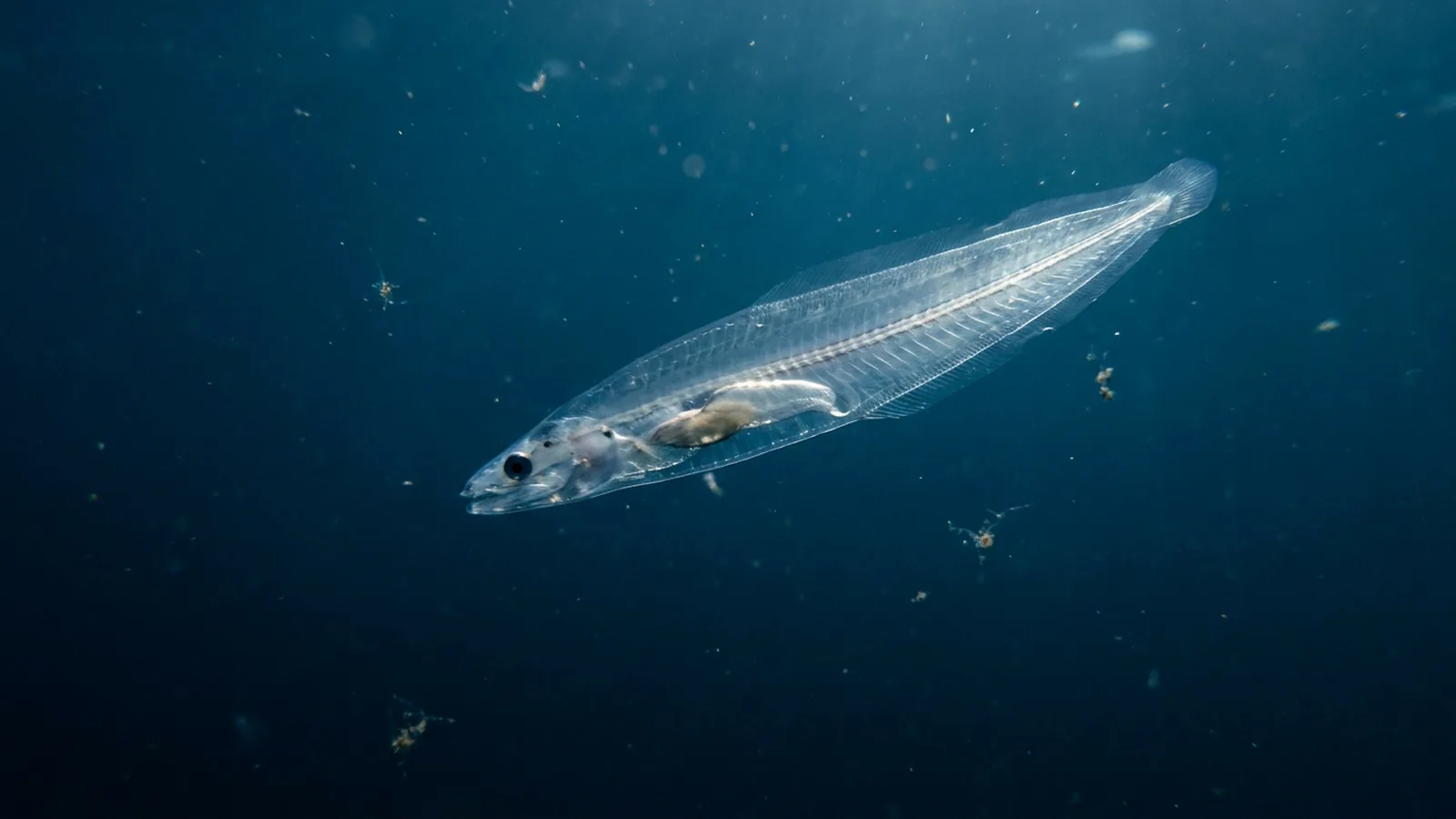
A leptocephalus (the word means “slender head”) is flat, completely transparent and shaped like a willow leaf, with a tiny head, a set of long forward-pointing teeth and very little in the way of internal organs. Most of its body is a clear, jelly-like material. It has no red blood cells, which is part of why it is so hard to see. In 1856 one of these larvae was formally named Leptocephalus brevirostris as if it were its own kind of fish. Only in the 1890s did the Italian zoologists Giovanni Battista Grassi and Salvatore Calandruccio watch leptocephali in tanks transform into young eels and show they were the same animal.
Leptocephali drift and swim weakly in the upper layers of the ocean, and current systems do most of the travelling for them. For European eel larvae, the Gulf Stream and North Atlantic Drift carry them toward Europe and North Africa, a trip that research suggests takes many months and possibly more than a year. American eel larvae have a shorter trip to the coasts of North America. Leptocephali don’t seem to hunt live plankton the way most fish larvae do. Studies of their gut contents point to marine snow, the drifting particles of organic debris that sink through the ocean, as their main food.
The leptocephalus is shared by more than eels. Tarpon, bonefish and ladyfish, all members of the larger group Elopomorpha, have the same kind of larva, which tells biologists that this design is very old. If you want to see what other eels’ larvae grow into, our guide to reef eels covers the families that live on coral reefs.
Stage 3: the glass eel
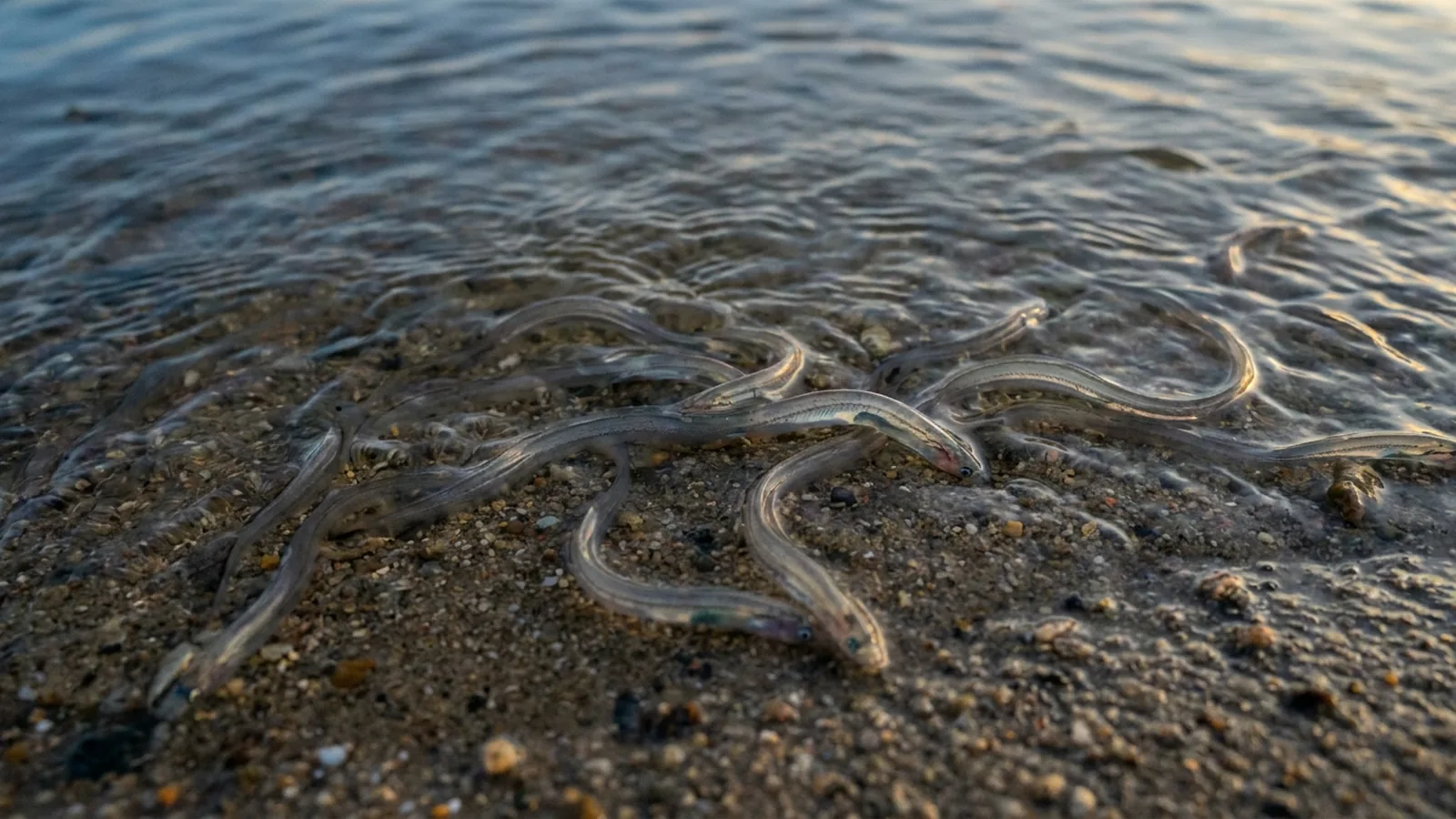
Near the continental shelf the leaf shrinks into a tube, and the larva becomes a see-through miniature eel.
When a leptocephalus reaches the edge of the continental shelf it goes through metamorphosis. It actually gets shorter as it changes, its body turns from a flat leaf into a rounded cylinder, it loses its larval teeth and it stops feeding for a while. What comes out is a glass eel: shaped like an adult, a few centimetres long, and still so transparent that you can see its spine and organs through its body. In my view this is the most beautiful stage of the cycle, and it’s the one most people have never heard of.
Glass eels gather at river mouths in late winter and spring and move in on rising tides, using a mix of smell, salinity and possibly magnetic and tidal cues to find fresh water. This is also the stage that people catch in the largest numbers. In Europe and in the US state of Maine, glass eels are fished with fine nets and sold, mostly to supply eel farms in Asia, because eels still can’t be bred in commercial numbers. A Japanese lab managed to raise eels through a complete generation in captivity around 2010, but nearly all farmed eel still begins as a wild-caught glass eel. That is one of the main reasons wild populations are under so much pressure.
Stage 4: elvers move upstream
Once it gains colour, a glass eel becomes an elver and starts climbing.
Within weeks of entering brackish water a glass eel develops pigment, darkens and starts feeding properly. At that point it is called an elver. Elvers are famous for their persistence. They wriggle up weirs, wet rocks and damp grass, and in places where dams block rivers, managers build “eel ladders” lined with bristles or mesh so the young eels can climb past. Not every eel heads all the way upstream. Some stay in estuaries, coastal lagoons or even in salt water for their whole growth phase, which is one reason eels are found in such a wide range of habitats.
Elvers eat small invertebrates: insect larvae, worms and small crustaceans. They are eaten in turn by herons, larger fish and other predators, and only a small fraction of the glass eels that arrive at the coast survive to grow up. For more on what eels eat at each size, see our guide to what eels eat.
Stage 5: the yellow eel, the long middle of life
This is the eel most anglers and fishmongers know, and it’s where an eel spends almost all of its life.
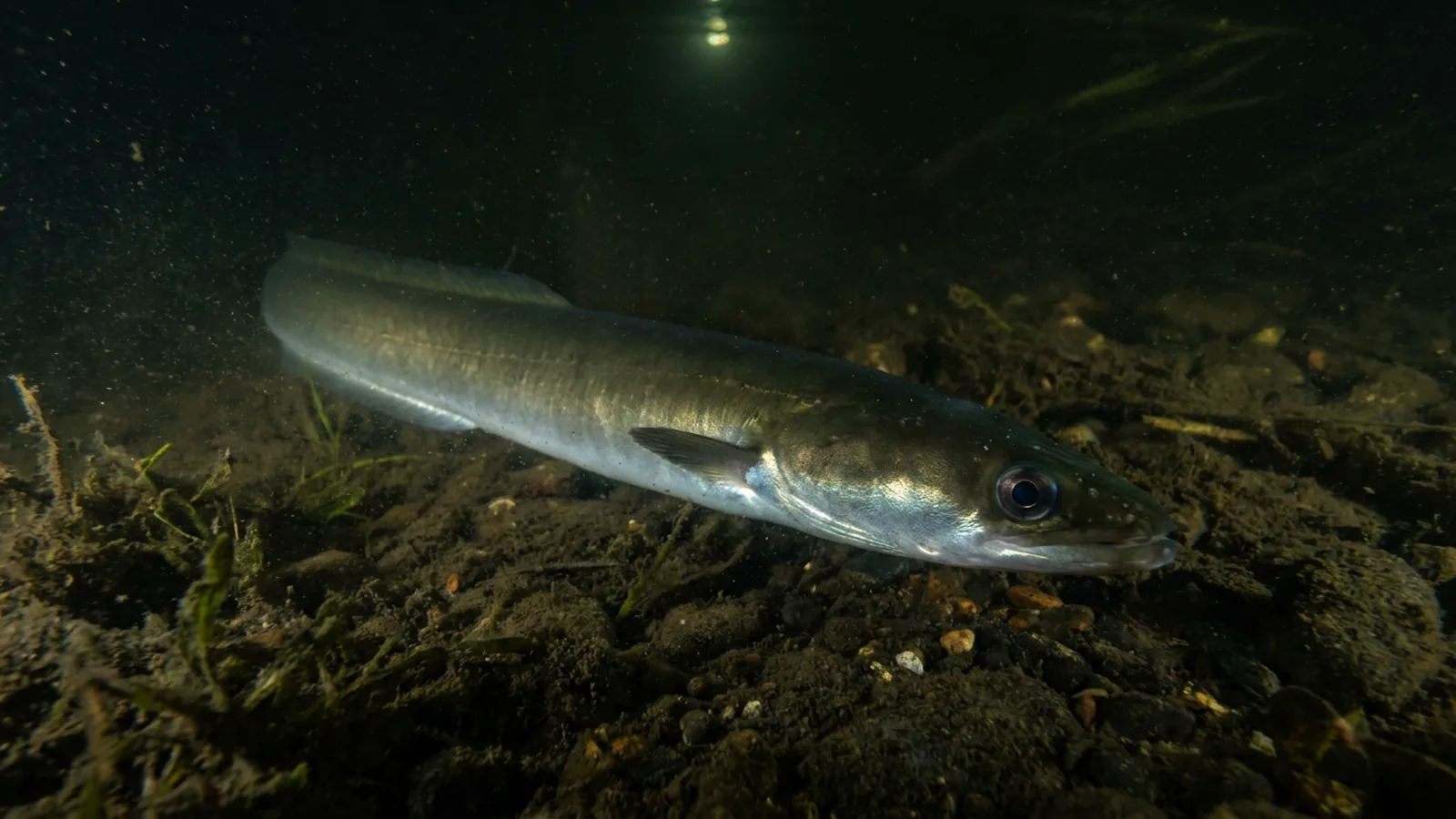
The yellow eel stage is named for the yellowish or brassy belly that many eels have during this time; the back is usually olive or brown. It is purely a growth phase. Yellow eels feed, mostly at night, on fish, crayfish, worms, snails, insect larvae and carrion, and they can live in almost any water body that connects to the sea, from big rivers to farm ponds. They can survive out of water for a while if the air is damp, and they’re known to cross wet grass to reach isolated ponds.
How long this lasts varies hugely. Eels in warm, productive water may mature in a few years, while eels in cold northern lakes may stay yellow eels for decades. In captivity eels have lived far longer, and European eels kept in a Swedish well were reported to have lived for many decades, though those stories are hard to verify. Sex is also decided during this period, and it seems to depend largely on conditions rather than genes alone: crowded populations tend to produce more males, which stay smaller, and sparse populations more females, which grow much larger. Our page on how long eels live goes into the lifespan question in more detail.
Stage 6: the silver eel and the last migration
When an eel is ready to breed, its body rebuilds itself for a one-way trip.
The change from yellow to silver eel is a second metamorphosis, and it’s as dramatic as the first. The belly turns silvery white and the back darkens, which is classic open-ocean camouflage. The eyes get much larger and their light-sensitive pigments shift toward the blue light of deep water. The pectoral fins lengthen. The skin thickens, and the gut shrinks because a silver eel stops feeding. It will cross an ocean on stored fat alone. The gonads begin to develop, but they don’t fully mature until the eel is out at sea, which is part of why early naturalists like Freud could never find them.
Silver eels leave rivers in autumn, often on dark, rainy nights when water levels rise. Once at sea, tagged European eels have been tracked making daily vertical migrations, swimming deep during the day and rising at night, possibly to avoid predators and to manage the timing of their sexual maturation with cooler water. The journey to the Sargasso Sea from Europe is roughly 5,000 to 7,000 km. As far as anyone knows, the adults spawn once and die. No spent adult eel has ever been found returning.
How reef eels differ: morays and congers
Every true eel starts as a leptocephalus, but most never go near fresh water.
Morays, congers, garden eels and snake eels all hatch into leptocephali that drift in the plankton for weeks to months. That long drifting stage is why the same moray species can turn up across an entire ocean basin. But when a moray larva metamorphoses, it settles directly onto a reef as a juvenile and spends its whole life in salt water. There’s no glass eel run into a river and no silver eel migration. Morays also spawn more than once, and some species change sex or are hermaphrodites. Conger eels, on the other hand, are more like freshwater eels in one respect: they stop feeding, migrate to deep water to spawn once, and die.
When I look at the dive sites in my own logbook, the eels I’ve written about there are all marine. Green morays are regulars at Molasses Reef in Key Largo and on the Santa Rosa Wall in Cozumel, and giant morays are common in the Red Sea. Every one of those animals spent its first weeks as a glass leaf drifting in the open water above the reef. I find that a good thing to keep in mind when one is staring back at you from a hole in the coral.
| Feature | Freshwater eels (Anguilla) | Moray eels | Conger eels |
|---|---|---|---|
| Larva | Leptocephalus | Leptocephalus | Leptocephalus |
| Fresh water phase | Yes, usually | No | No |
| Spawning | Once, far offshore | Repeatedly, near reefs | Once, deep offshore |
| Dies after spawning | Yes (as far as known) | No | Yes |
Why the eel life cycle matters for conservation
An animal that breeds once, far away, after years of growing up somewhere else, is hard to protect.
The numbers of glass eels arriving on European coasts fell steeply from the late 1970s onward, and the European eel is now listed as Critically Endangered by the IUCN. The American and Japanese eels are listed as Endangered. The life cycle explains why recovery is so hard. Any damage at any stage, from overfishing of glass eels to dams that block elvers, polluted rivers that weaken yellow eels and hydropower turbines that kill silver eels on their way to sea, cuts into a population that only gets one chance to breed. Changes in ocean currents may also affect how many larvae reach the coast. The European Union now regulates eel fishing and trade, and the species is listed under CITES Appendix II.
My own take is that the eel is a good example of why marine conservation can’t stop at the shoreline. A healthy eel population needs open ocean, coastal water, rivers and the passages between them. If you live near a river with an eel ladder, it’s worth a visit in spring, when elvers are moving. For the spawning side of the story, see how eels reproduce.
What are the stages of an eel’s life cycle?
Egg, leptocephalus (larva), glass eel, elver, yellow eel and silver eel. The yellow eel is the long growth phase; the silver eel is the mature stage that migrates to sea to spawn.
What is an eel larva called?
A leptocephalus. It is flat, transparent and leaf-shaped, and it drifts in ocean currents for months before turning into a glass eel.
What is a silver eel?
A sexually maturing eel that has stopped feeding and changed colour, eye size and fin length to prepare for its migration back to the open ocean to breed.
What is the difference between a glass eel and an elver?
A glass eel is still transparent. Once it gains pigment and starts feeding in fresh or brackish water, it is called an elver.
Where do eels go to breed?
European and American eels breed in the Sargasso Sea in the western North Atlantic. Japanese eels breed in the Pacific west of the Mariana Islands.
Do eels die after spawning?
Freshwater eels and conger eels are believed to spawn once and die. Moray eels can spawn many times.
Why are there transparent eels?
Transparent eels are baby eels: leptocephali and glass eels. Transparency hides them from predators in open water.
- Schmidt, J. (1923). The breeding places of the eel. Philosophical Transactions of the Royal Society B 211: 179–208.
- Tsukamoto, K. et al. (2011). Oceanic spawning ecology of freshwater eels in the western North Pacific. Nature Communications 2: 179.
- Wright, R. M. et al. (2022). First direct evidence of adult European eels migrating to their breeding place in the Sargasso Sea. Scientific Reports 12: 15362.
- IUCN Red List assessments: Anguilla anguilla, A. rostrata, A. japonica.
- U.S. Fish and Wildlife Service, American eel species profile.
- Atlantic States Marine Fisheries Commission, American eel management.
Blane Perun has been exploring Earth’s oceans and marine life for over 25 years. Founder of TheSea.Org in 1999, underwater photographer, coral aquaculture pioneer, and explorer of 80+ countries.
About Blane Perun → More on Eels →