Moray Eel vs Electric Eel — A Reef Predator With Two Jaws vs a River Fish With 860 Volts
A moray eel is a true eel: a marine bony fish of coral and rocky reefs that breathes with gills, hunts by smell and grabs prey with fangs and a second set of throat jaws. An electric eel isn’t an eel at all; it’s a South American freshwater knifefish that breathes air and stuns prey with discharges of up to about 860 volts. Morays aren’t electric.
Put a moray eel and an electric eel side by side and most people would assume they’re close cousins. Both are long, smooth and snake-like, both have “eel” in their name, and both have a reputation for being dangerous. But they belong to completely different branches of the fish family tree, live in different worlds, and use completely different weapons. One is a true eel of tropical reefs; the other is a freshwater fish more closely related to catfish. Here’s a full comparison, and the answer to a common question: are moray eels electric?
Are moray eels electric?
No. Morays have no electric organs.
Moray eels can’t produce electric shocks. They have no electric organs, and they don’t generate the electric fields that knifefish use to sense their surroundings. Like other fish, morays have a lateral line that detects vibrations, but they rely above all on their excellent sense of smell to find prey. The only “shock” a moray can give you is a bite, and that only happens if you provoke it. The electric eel, on the other hand, has three electric organs that take up about 80% of its body. If someone has told you about a moray giving them a shock, they’ve most likely confused it with a torpedo ray or an electric eel.
Different family trees
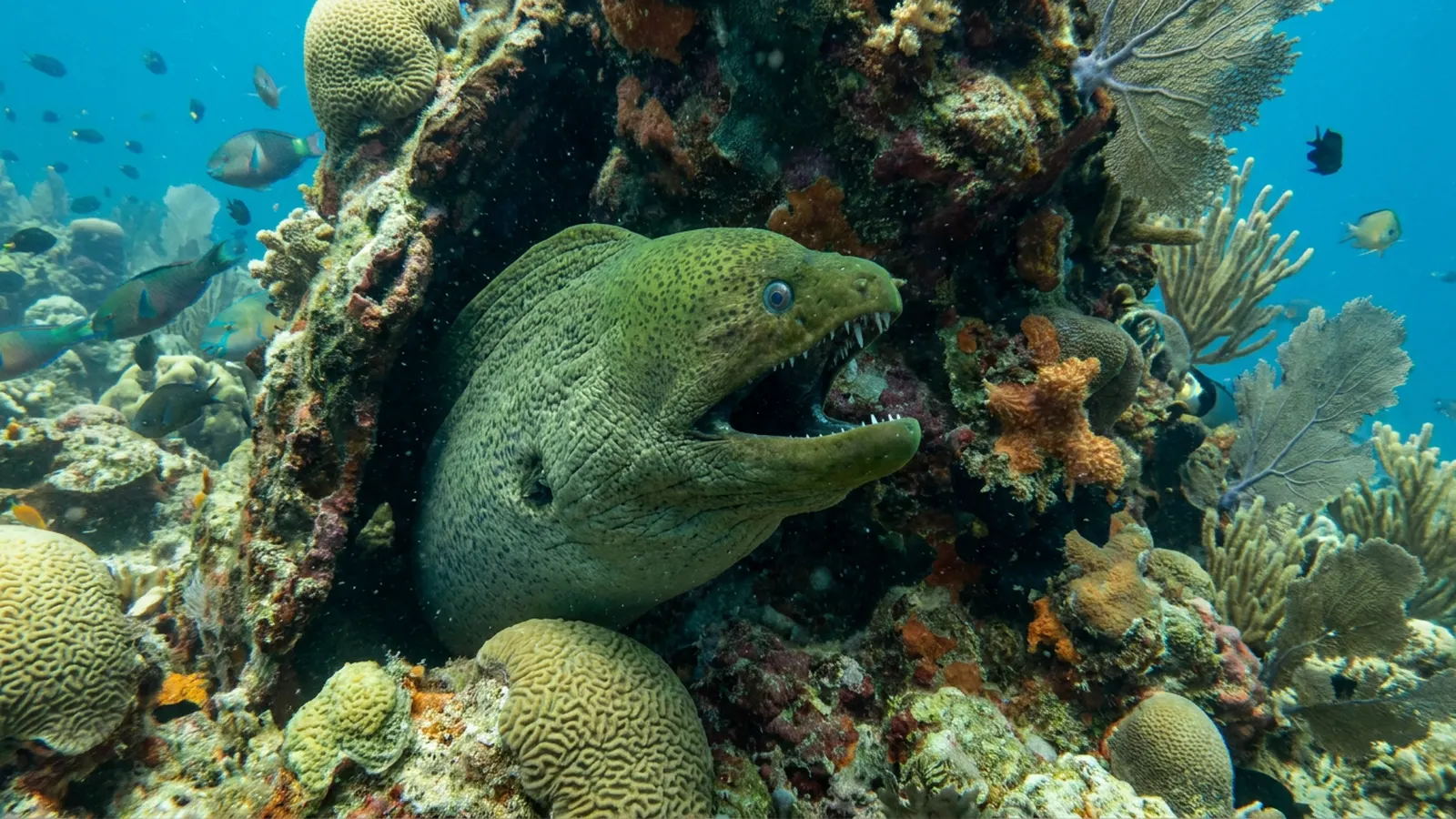
Convergent evolution gave them the same shape.
Morays belong to the family Muraenidae within the order Anguilliformes, the true eels, alongside congers, garden eels, snake eels and freshwater eels. The electric eel belongs to the order Gymnotiformes, the South American knifefishes, which are part of a large group of mostly freshwater fish that also includes catfish, carp and characins. The last common ancestor of morays and electric eels lived more than 100 million years ago. Their similar body shapes are a case of convergent evolution: a long, flexible body is useful for moving through tight spaces, whether a coral crevice or a tangle of flooded roots. See are eels related to snakes for another example of convergence.
| Feature | Moray eel | Electric eel |
|---|---|---|
| True eel? | Yes | No (knifefish) |
| Water | Salt water, tropical and warm-temperate reefs | Fresh water, Amazon, Orinoco, Guianas |
| Breathing | Gills; gapes to pump water | Gulps air at the surface |
| Fins | One continuous fin along back and tail; no pectoral fins | No dorsal fin; long anal fin along belly; small pectoral fins |
| Main sense | Smell | Electrolocation |
| Weapon | Fangs and mobile pharyngeal jaws | High-voltage discharges |
| Diet | Fish, octopus, crabs | Fish, crustaceans, frogs |
| Max size | Giant moray ~3 m, 30 kg; slender giant moray ~4 m | About 2.5 m, ~20 kg |
| Reproduction | Spawns in open water; no care | Foam nest; male guards young |
| Larva | Leptocephalus | Small, eel-like |
Where they live
One is a diver’s eel, the other a river fish.
Morays are marine. About 200 species live on coral reefs, rocky reefs, wrecks and in seagrass and mangrove areas in tropical and warm-temperate seas worldwide, with a handful entering brackish river mouths. Divers see them almost everywhere in the tropics. Green morays are regulars on the reefs in several of my dive guides, from Molasses Reef in Key Largo to the Santa Rosa Wall in Cozumel, and giant morays are common in the Red Sea.
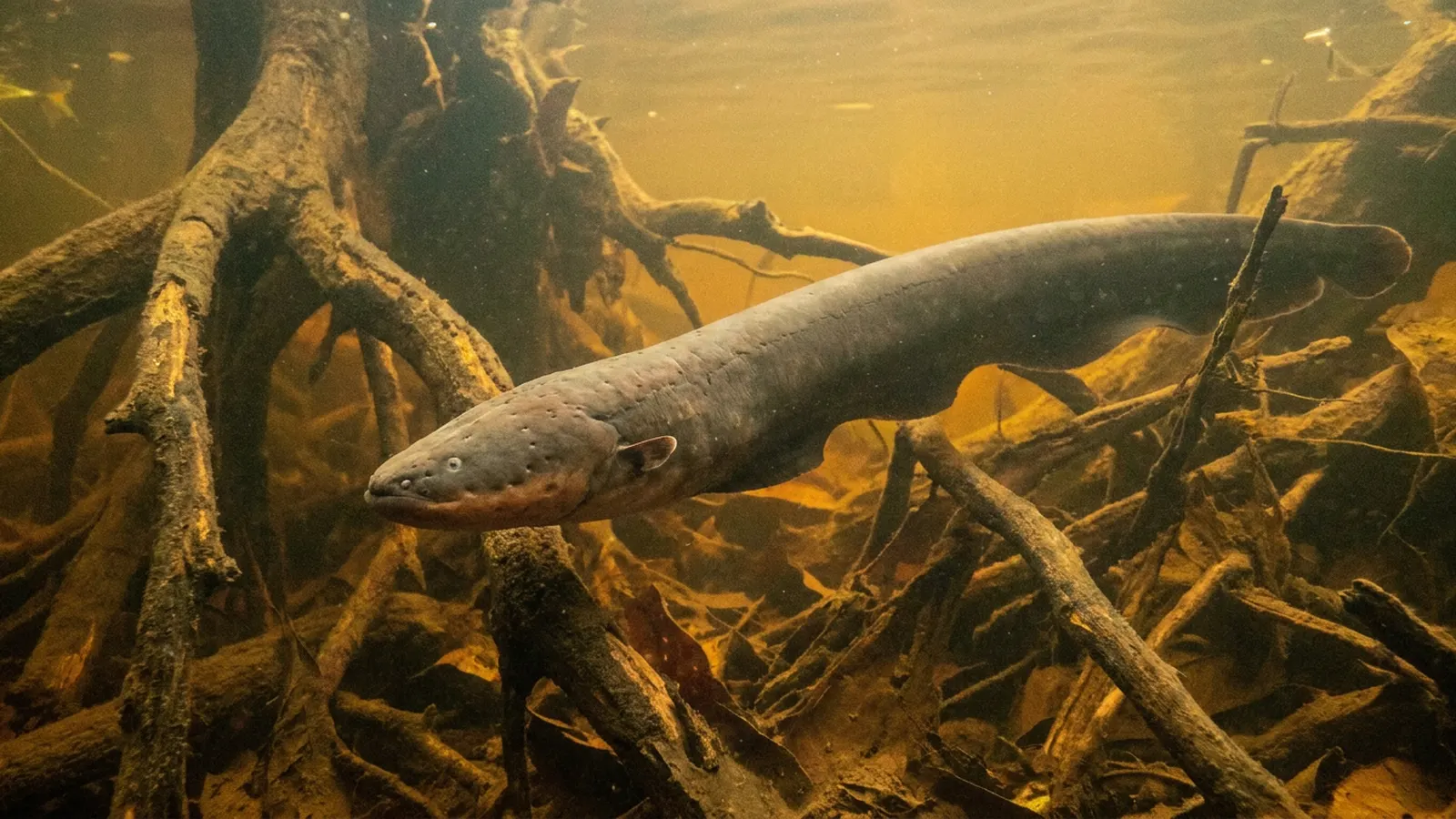
Electric eels live only in fresh water in northern South America: slow, muddy rivers, creeks, swamps and seasonally flooded forests in the Amazon and Orinoco basins and the Guianas. The water is often dark and low in oxygen, which is why the electric eel evolved to breathe air and to sense its world electrically. You won’t meet one on a dive trip; you’d see one in a public aquarium or on a river expedition.
How they hunt
Teeth and smell vs electricity.
A moray hunts mostly at night, tracking prey by smell through the reef’s holes and crevices. It strikes with long, backward-curved teeth, then uses its mobile pharyngeal jaws to drag prey down its throat, a mechanism unique among animals. Some morays even hunt cooperatively with groupers. Our moray eel guide covers the details.
An electric eel hunts in murky water using weak electric pulses to sense objects around it. When it finds prey, it fires high-voltage volleys that make the prey’s muscles lock up, then swallows it whole. It can also fire short pulses that make hidden prey twitch and give away its location, curl its body to concentrate its field, and, in one species, hunt in large coordinated groups. See what electric eels eat.
Which is more dangerous?
Both are defensive, not aggressive.
A moray bite can cause deep lacerations and infections, usually when someone hand-feeds a moray or reaches into its hole. Deaths are essentially unheard of. Large morays can also cause ciguatera poisoning if eaten. See eel bites for first aid.
An electric eel’s shock is painful and can be dangerous, particularly in water, where a stunned person might drown, and repeated shocks can affect the heart and breathing. Electric eels also leap out of the water to shock threats, as Alexander von Humboldt described in 1800 and researchers confirmed in 2016. In practice, both animals are only dangerous to people who approach, handle or corner them.
Life cycles compared
Ocean drifters vs foam-nest families.
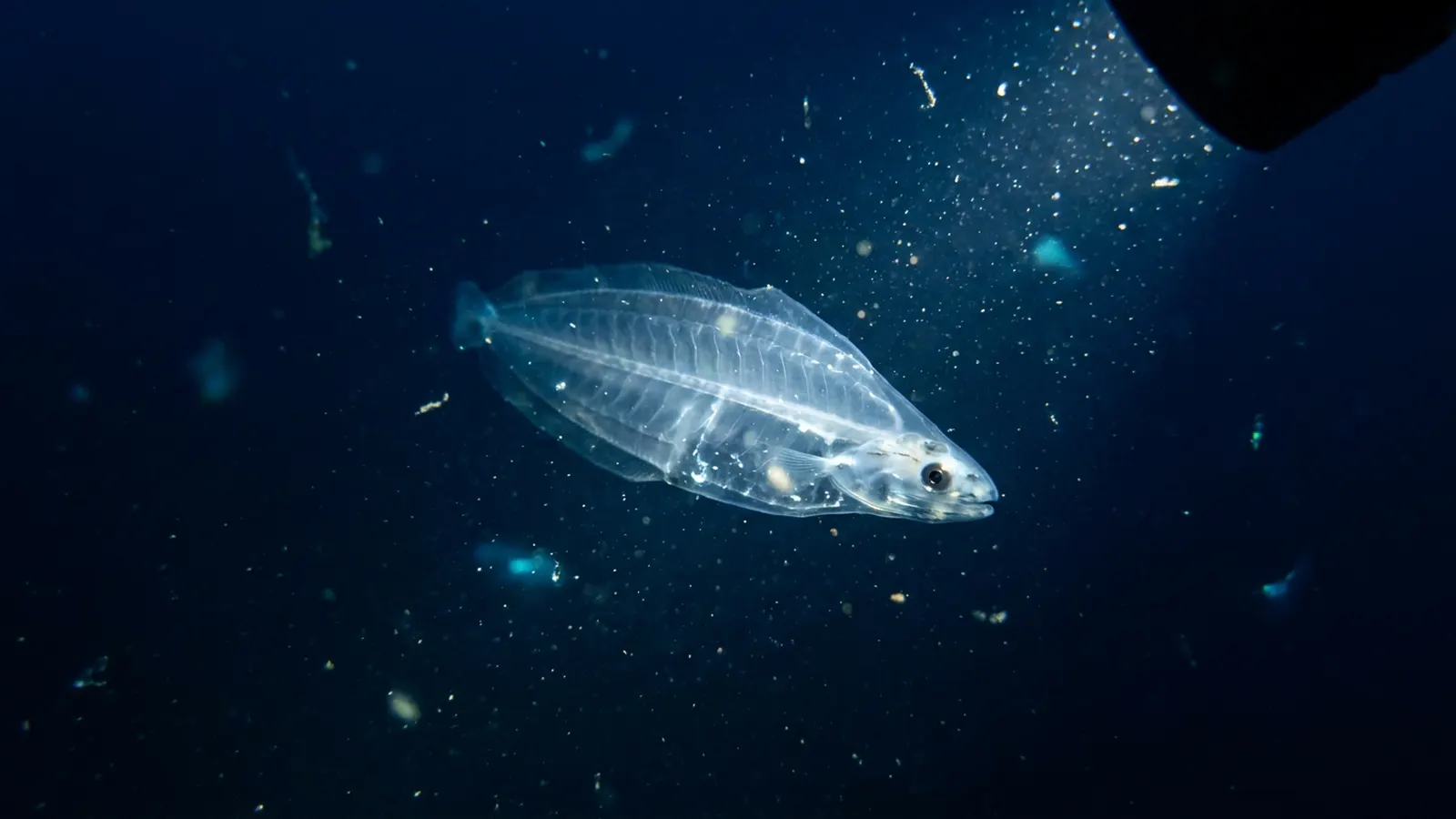
Morays, like all true eels, spawn in open water, and their eggs hatch into leptocephali, flat transparent larvae that drift in the plankton for weeks or months before settling on a reef. There’s no parental care. Electric eels build floating foam nests in the dry season, and the male guards the eggs and young for weeks. The two life cycles couldn’t be more different; compare how eels reproduce with how electric eels reproduce.
Which would win in a fight?
They’d never meet.
It’s a question people ask, so I’ll answer it: a moray and an electric eel would never meet in the wild, because one lives in the ocean and the other in fresh water. Neither would survive long in the other’s habitat. In an imaginary meeting, an adult electric eel’s discharge would almost certainly incapacitate a moray before it could bite, but the more interesting point is how two such different animals arrived at the same body shape. To me, that’s the real story of the moray vs electric eel comparison: evolution solving similar problems in very different ways. For the history of the electric eel’s name, see what electric eels were called before electricity.
How to tell them apart at a glance
Fins, face and habitat give it away immediately.
If you’re looking at a photo and can’t tell whether it shows a moray or an electric eel, start with the back. A moray has a fin running along the top of its body, from just behind the head all the way to the tail, where it joins the fin underneath. An electric eel has no fin on its back at all; instead, a long fin runs along its belly from just behind the head to the tip of the tail, and it ripples that fin to swim.
Then look at the face. A moray has a long mouth that reaches well behind the eyes, usually held open to show its teeth, and small tube-shaped nostrils at the tip of the snout. Many morays are boldly patterned, spotted or brightly coloured. An electric eel has a broad, flattened, rather blunt head, a wide mouth, tiny eyes and a uniform grey-brown or olive body, often with an orange or yellowish throat. Finally, consider where the photo was taken. A coral reef, a wreck or a tide pool means a moray. A muddy river, a flooded forest or a freshwater aquarium display means an electric eel.
Morays and electric eels in aquariums
Both are popular exhibits, for different reasons.
Public aquariums love both animals. Morays are easy to display on reef exhibits, where they sit in caves with their heads out, often alongside cleaner shrimp. Electric eels are star attractions in rainforest galleries, and some aquariums connect voltmeters or lights to their tanks so visitors can see the eel’s discharges in real time.
In home aquariums, both are specialist animals. Smaller morays, such as the zebra moray or snowflake moray, are kept by experienced marine hobbyists, though many popular species grow much larger than buyers expect, as we explain in how big moray eels get. Electric eels are almost never kept at home because of their size and the real risk of a dangerous shock during tank maintenance. After decades of running my own reef systems, I’d say the same thing about both: admire them in a big public display or in the wild, and leave the giants to the professionals.
Conservation status
Neither is in serious trouble, but both depend on healthy habitats.
Most moray species are listed as Least Concern by the IUCN, though they depend on healthy reefs, and reef decline from warming and pollution affects them along with everything else that lives there. The three electric eel species aren’t considered threatened either, but dams, deforestation and mining in the Amazon basin are changing the rivers and floodplains they need to breed. Protecting coral reefs and tropical rivers protects both of these remarkable animals.
Are moray eels electric?
No. Morays have no electric organs. They hunt by smell and bite with their teeth.
Is an electric eel a type of moray?
No. The electric eel is a South American knifefish, not a true eel.
What’s the difference between an eel and an electric eel?
True eels are bony fish of the order Anguilliformes that breathe with gills. Electric eels are knifefish that breathe air and produce electricity.
Do moray eels live in fresh water?
Almost all are marine. A few species enter brackish river mouths.
Which is bigger, a moray or an electric eel?
The largest morays (about 3–4 m) are longer than the largest electric eels (about 2.5 m).
Which is more dangerous?
Both are defensive. Moray bites can cause serious wounds; electric eel shocks can incapacitate a person in water.
- Mehta, R. S. & Wainwright, P. C. (2007). Raptorial jaws in the throat help moray eels swallow large prey. Nature 449: 79–82.
- Catania, K. (2014). The shocking predatory strike of the electric eel. Science 346: 1231–1234.
- de Santana, C. D. et al. (2019). Unexpected species diversity in electric eels. Nature Communications 10: 4000.
- Nelson, J. S., Grande, T. C. & Wilson, M. V. H. (2016). Fishes of the World, 5th ed. Wiley.
Blane Perun has been exploring Earth’s oceans and marine life for over 25 years. Founder of TheSea.Org in 1999, underwater photographer, coral aquaculture pioneer, and explorer of 80+ countries.
About Blane Perun → More on Eels →