How Do Eels Reproduce? — Eggs, Ocean Spawning and the Sargasso Sea Mystery
Eels reproduce by spawning: females release eggs and males release sperm into open water, where fertilisation happens. Freshwater eels from Europe and North America swim thousands of kilometres to the Sargasso Sea to spawn once and die. Morays and garden eels spawn in pairs near their reefs. Every eel lays eggs that hatch into transparent leptocephalus larvae.
For more than two thousand years, the reproduction of eels was one of the great unsolved puzzles in natural history. Nobody had ever found an eel egg, a pregnant eel or a male with recognisable testes. Aristotle concluded that eels arose spontaneously from mud and rotting seaweed. Later writers suggested they came from horse hairs dropped in water or from dew. The answer turned out to be stranger than any of those guesses, and part of it is still unknown. Here’s what we do know about how eels breed.
Do eels lay eggs?
Yes. All true eels are egg-layers, and none of them look after their young.
True eels (order Anguilliformes) reproduce by broadcast spawning. A female releases eggs into the water at the same moment a male releases sperm, and fertilisation happens outside the body. There’s no internal mating, no nest and no parental care. The eggs are small, buoyant and transparent, and they drift with the water while the embryo develops. They hatch within a few days into larvae a few millimetres long.
The number of eggs can be enormous. A large female freshwater eel or conger carries millions of eggs, because almost all of them will be eaten or lost before the larvae reach adulthood. That strategy, lots of eggs and no care, is common in ocean fish, and it’s the opposite of what the electric eel does. The electric eel isn’t a true eel, and its males guard nests of eggs in foam, which we explain in how electric eels reproduce.

The Sargasso Sea: where Atlantic eels spawn
European and American eels share a spawning ground in the middle of the western Atlantic.
The Sargasso Sea is a vast oval of warm, clear, slowly circulating water in the western North Atlantic, surrounded by the Gulf Stream and other currents rather than land. It’s named for the floating Sargassum seaweed that collects there, and it overlaps much of the area popularly called the Bermuda Triangle.
The link between eels and the Sargasso was made by the Danish biologist Johannes Schmidt. Starting in 1904 and continuing for nearly two decades, he collected eel larvae across the Atlantic with plankton nets, measured them, and mapped where they were found. The larvae got smaller the further west and south he went, and the very smallest, newly hatched ones were found only in the southern Sargasso Sea. He concluded that this was where both the European eel (Anguilla anguilla) and the American eel (Anguilla rostrata) spawn. The two species’ spawning areas overlap, with the American eel’s slightly further west, and their larvae ride the Gulf Stream to opposite sides of the ocean.
Spawning seems to happen in late winter and spring, based on where and when the smallest larvae appear. Biologists think the eels may use the sharp temperature fronts that form in the southern Sargasso at that time of year as a meeting point, but that’s still a hypothesis.
The journey to spawn
A freshwater eel prepares for years, then makes one trip and doesn’t come back.
A freshwater eel spends most of its life as a “yellow eel”, growing in a river, lake or estuary for anywhere from a few years to a few decades. When it’s ready to breed it changes into a “silver eel”: the belly turns silver, the eyes enlarge, the gut shrinks and it stops eating. It leaves fresh water in autumn, often on dark, rainy nights, and swims out to sea.
The eel’s gonads are undeveloped when it leaves. They mature during the ocean crossing, fuelled entirely by fat stored during the yellow-eel years. Tagged eels have been tracked diving deep by day and rising at night, a pattern that may help them avoid predators and control the pace of sexual development. From western Europe the journey to the Sargasso Sea is roughly 5,000 to 7,000 km, and it may take months. After spawning, the adults are believed to die. No adult eel has ever been recorded returning from the spawning grounds. Our eel life cycle guide follows the whole sequence from egg to silver eel.
The Japanese eel: the one we’ve caught in the act
In the Pacific, scientists have found the eggs.
The Japanese eel (Anguilla japonica) gave scientists their best look at freshwater-eel spawning. A team led by Katsumi Tsukamoto of the University of Tokyo spent decades narrowing down the spawning area, eventually focusing on the West Mariana Ridge, a chain of seamounts west of Guam. In 2009 they collected newly fertilised Japanese eel eggs there, and they later caught spawning-condition adults in the same area. Their work showed that the eels spawn during the summer months around the time of the new moon, in water roughly 150 to 200 m deep. It remains the clearest picture we have of how any freshwater eel reproduces in the wild.
How moray eels and garden eels mate
Reef eels spawn closer to home, in pairs.
Morays don’t migrate across oceans. Most species are thought to spawn in pairs at night, close to the reef. Divers and aquarium researchers have described pairs of morays twisting their bodies around each other in open water or at the entrance to a hole, then releasing eggs and sperm. The fertilised eggs drift away and hatch into leptocephali that live in the plankton for weeks or months before settling on a reef. Unlike freshwater eels, morays can spawn many times over a lifetime.
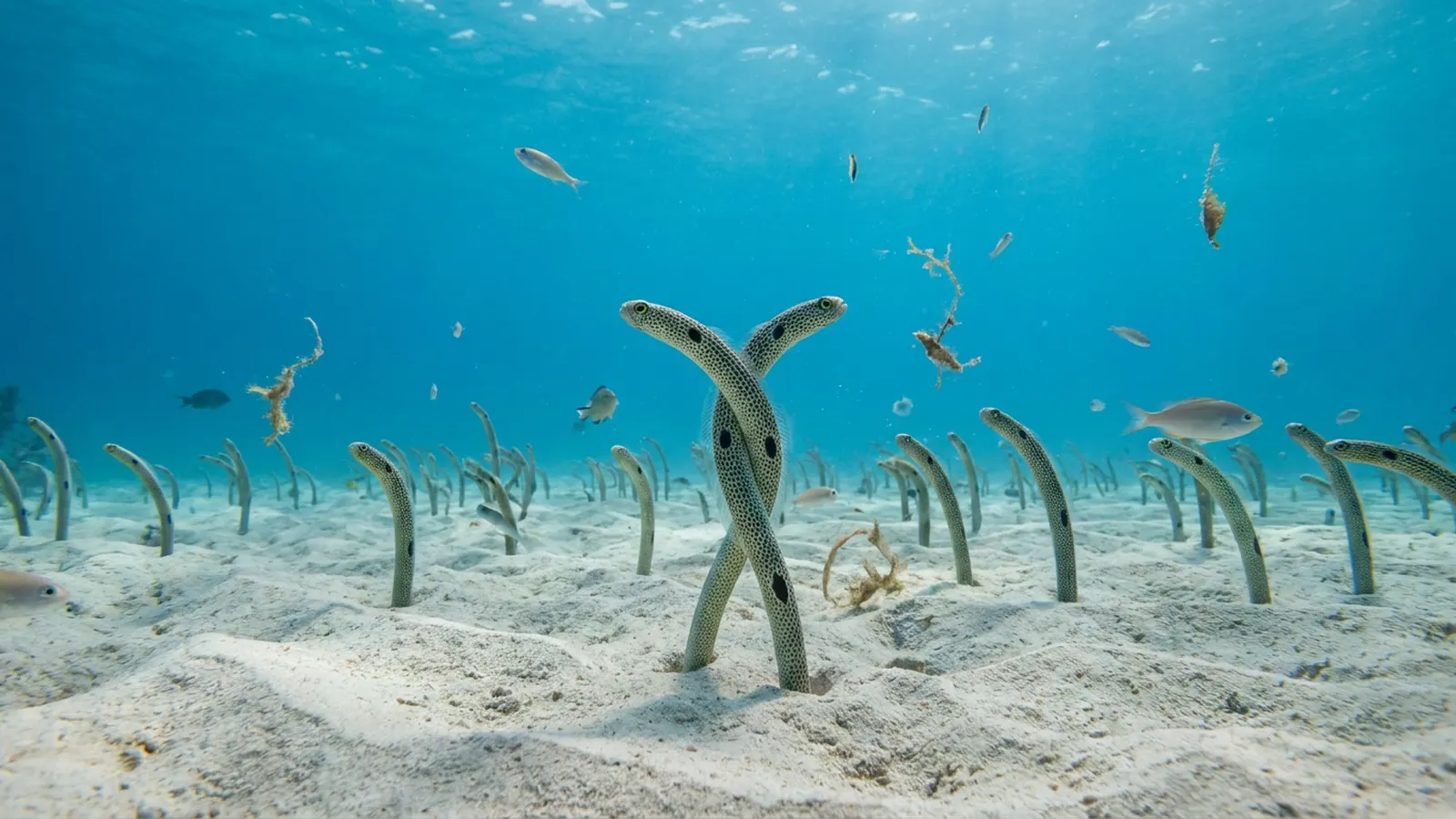
Morays also have some unusual sex lives. Some species are hermaphrodites, and the ribbon eel changes from male to female as it grows, changing colour from blue to yellow at the same time; see our blue ribbon eel page. Garden eels, which never fully leave their burrows, mate with the neighbour. A male and female stretch out of adjacent burrows and twine their bodies together while keeping their tails anchored, and the eggs go out into the current. You can read more in our page on garden eels.
Conger eels: one deep spawn
Congers end their lives much like freshwater eels.
The European conger (Conger conger) lives on rocky reefs and wrecks for years, then stops feeding as it matures. Its skeleton loses minerals, its teeth fall out, and it migrates to deep water to spawn. Female congers produce several million eggs. Like freshwater eels, congers are thought to spawn once and die. Their spawning areas are believed to lie in deep water in the Atlantic and the Mediterranean. Details are on our conger eel page.
| Eel | Where it spawns | How often | Notes |
|---|---|---|---|
| European eel | Sargasso Sea | Once, then dies | Never observed spawning |
| American eel | Sargasso Sea (slightly west) | Once, then dies | Larvae reach North America faster |
| Japanese eel | West Mariana Ridge | Once, then dies | Eggs collected in 2009 |
| Moray eels | Near reefs, at night | Many times | Some species change sex |
| Garden eels | From neighbouring burrows | Many times | Pairs intertwine |
| Conger eel | Deep offshore water | Once, then dies | Several million eggs |
Why eels are so hard to breed in captivity
Eels don’t mature on their own in a tank.
Because the sex organs of freshwater eels develop only during their ocean migration, eels kept in tanks normally never become ready to spawn. Researchers can trigger maturation with repeated hormone injections, and Japanese scientists completed the full life cycle of the Japanese eel in captivity around 2010. But raising the delicate leptocephalus larvae in large numbers is still extremely difficult, and nearly all farmed eel still comes from wild-caught glass eels. That puts enormous pressure on wild populations, which is a big part of why the European eel is now listed as Critically Endangered.
Having spent years running reef systems and a coral farm, I have a lot of respect for how hard it is to reproduce an ocean in a tank, and eels are an extreme case. Their reproduction depends on an ocean crossing, deep water, temperature fronts and currents that no aquarium can provide. That, to me, is the strongest argument for protecting eels in the wild rather than hoping we can farm our way out of their decline.
Male or female? How an eel’s sex is decided
For freshwater eels, the environment has a big say.
Young freshwater eels are not clearly male or female. Their sex is settled during the yellow-eel years, and research on European and American eels shows that conditions matter a great deal. Where eels are crowded, more of them become males, which mature at a smaller size and leave for the sea earlier. Where eels are scarce, more become females, which grow much larger and stay longer, building up the fat and eggs they’ll need for the journey. That flexibility may help the species make the most of whatever habitat a young eel happens to end up in, but it also means that as populations fall, the balance of males and females in a river can shift.

Do eels lay eggs or give live birth?
True eels lay eggs. Females release eggs into the water and males fertilise them externally. No true eel gives live birth.
Where do eels reproduce?
European and American eels spawn in the Sargasso Sea. Japanese eels spawn near the West Mariana Ridge in the Pacific. Morays and garden eels spawn near their home reefs.
How do eels mate?
Pairs or groups release eggs and sperm into open water at the same time. Morays and garden eels often twine their bodies together while spawning.
Why do eels go to the Sargasso Sea?
No one knows for sure. The currents there carry larvae toward Europe and North America, and seasonal temperature fronts may help adults find each other.
Do eels die after mating?
Freshwater eels and conger eels are believed to spawn once and die. Morays spawn repeatedly.
Has anyone seen eels spawn?
Not European or American eels in the wild. Japanese eel eggs and spawning-ready adults have been collected in the Pacific.
How many eggs does an eel lay?
Large freshwater eels and congers produce millions of eggs. Smaller reef eels produce fewer.
- Schmidt, J. (1923). The breeding places of the eel. Philosophical Transactions of the Royal Society B 211: 179–208.
- Tsukamoto, K. et al. (2011). Oceanic spawning ecology of freshwater eels in the western North Pacific. Nature Communications 2: 179.
- Wright, R. M. et al. (2022). First direct evidence of adult European eels migrating to their breeding place in the Sargasso Sea. Scientific Reports 12: 15362.
- Tesch, F.-W. (2003). The Eel, 3rd ed. Blackwell.
- Froese, R. & Pauly, D. (eds.). FishBase: Conger conger, Muraenidae.
Blane Perun has been exploring Earth’s oceans and marine life for over 25 years. Founder of TheSea.Org in 1999, underwater photographer, coral aquaculture pioneer, and explorer of 80+ countries.
About Blane Perun → More on Eels →