Lamprey Eels — The 360-Million-Year-Old Jawless Fish With a Sucker for a Mouth
No. Lampreys, often called lamprey eels, are jawless fish in their own ancient group, Petromyzontiformes. Instead of jaws they have a round, sucker-like mouth lined with horny teeth. Many live in fresh water their whole lives, while others, like the sea lamprey, grow up in rivers, feed at sea or in large lakes, and return to streams to spawn and die.
Lampreys look like eels, live in the same rivers as eels and are often called lamprey eels, but they’re one of the most distantly related fish to eels you could find. They have no jaws, no paired fins, no bones in the usual sense and a skeleton made of cartilage. Their ancestors were swimming in the oceans more than 360 million years ago, long before the first true eel. Some lampreys are parasites that latch onto fish and feed on their blood, which has given them a fearsome reputation. Here’s what a lamprey really is, how freshwater lampreys live, and why the sea lamprey became one of the most damaging invasive species in North America.
Why a lamprey isn’t an eel
Lampreys are jawless fish, a branch that split off before jaws evolved.
True eels (order Anguilliformes) are bony fish with jaws, gills under a gill cover, paired pectoral fins in many species and a skeleton of bone. Lampreys belong to an ancient lineage of jawless vertebrates that also includes the hagfish. They have a skeleton of cartilage, no paired fins, a single nostril on top of the head, and seven separate round gill openings in a row along each side of the head instead of a single gill slit. Their mouth is a round sucking disc rather than a hinged jaw.
The resemblance to eels is skin-deep: both have long, slimy bodies suited to wriggling through mud and water. That’s the same convergent evolution that gave the electric eel, the wolf eel and the rice field eel their eel-like shapes. We list the true eels and their look-alikes in our eel facts page.

The lamprey mouth
A sucker, rows of teeth and a tongue like a file.
A lamprey’s mouth is the feature everyone remembers. It’s a round disc ringed with soft fringes and lined with concentric rows of sharp, horny teeth made of keratin, the same protein as fingernails. In the centre is a tongue-like structure also covered in teeth. A parasitic lamprey presses its disc against a fish, creates suction, and uses the tongue to rasp a hole through the scales and skin. Its saliva contains substances that stop the host’s blood from clotting, and it feeds on blood and body fluids, sometimes for days. Lampreys also use the sucker to hold on to rocks in fast currents and to move stones when building nests, which is where the name Petromyzon, “stone sucker”, comes from.
Freshwater lamprey eels
Many lampreys never leave fresh water, and many never feed as adults.
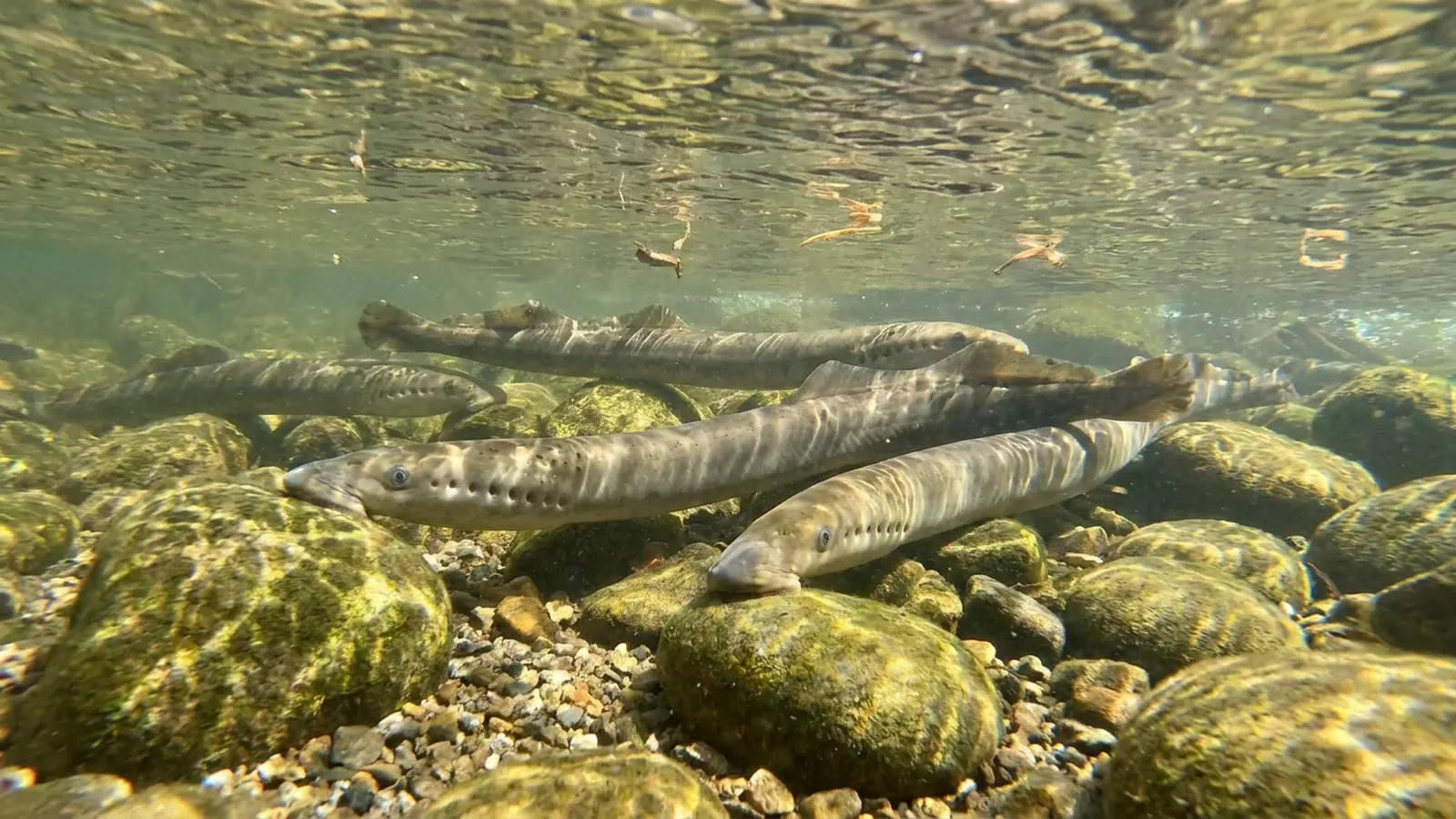
About half of the world’s roughly 40 lamprey species live entirely in fresh water. These include the brook lampreys, small species usually under 20 cm that are non-parasitic: after years as larvae, they metamorphose into adults that don’t eat at all, spawn within months and die. In North America, examples include the American brook lamprey and the least brook lamprey. Other freshwater species, such as the silver lamprey and chestnut lamprey of the Mississippi and Great Lakes basins, are parasitic on fish but rarely kill their hosts in their native ranges. In Europe, the river lamprey (Lampetra fluviatilis) migrates between rivers and the sea, while the brook lamprey (Lampetra planeri) stays in streams.
All lampreys spend most of their lives as larvae called ammocoetes. These are blind, toothless, worm-like animals that burrow into soft mud and sand in streams and filter tiny particles of food from the water. The larval stage typically lasts three to seven years, and sometimes longer. It’s so different from the adult that ammocoetes were once classified as a separate animal, just as eel larvae were.
| Feature | Lamprey | True eel |
|---|---|---|
| Jaws | None; round sucking disc | Hinged jaws with teeth |
| Skeleton | Cartilage | Bone |
| Gill openings | Seven round pores per side | One opening per side |
| Paired fins | None | Pectoral fins in many species |
| Nostril | Single, on top of head | Two pairs |
| Larva | Ammocoete, buried in stream mud | Leptocephalus, drifting at sea |
| Feeding as adult | Parasitic or non-feeding | Predator or scavenger |
The sea lamprey: the “giant lamprey eel”
The largest lamprey, and the most notorious.
The sea lamprey (Petromyzon marinus) is the biggest lamprey, reaching about 1.2 m, and it’s the species most people mean by a “giant lamprey eel”. In its native range on both sides of the North Atlantic, it hatches in rivers, spends years as a larva, then migrates to the sea to feed on fish such as cod, salmon, shad and even sharks and whales, before returning to rivers to spawn. Adults build nests by moving stones with their mouths, spawn and die.
In its native range, the sea lamprey is a normal part of the ecosystem, and fish there have evolved alongside it. That isn’t the case in the upper Great Lakes, which it reached in the 20th century.
Sea lampreys in the Great Lakes
An invasion that collapsed a fishery.
Niagara Falls historically blocked sea lampreys from moving from Lake Ontario into the upper Great Lakes. Shipping canals, particularly the improved Welland Canal around the falls, opened a route. Sea lampreys were recorded in Lake Erie in the early 1920s and had spread through Lakes Huron, Michigan and Superior by the late 1930s and 1940s. With abundant fish and no shortage of spawning streams, they adapted to living entirely in fresh water, using the lakes as their “ocean”.
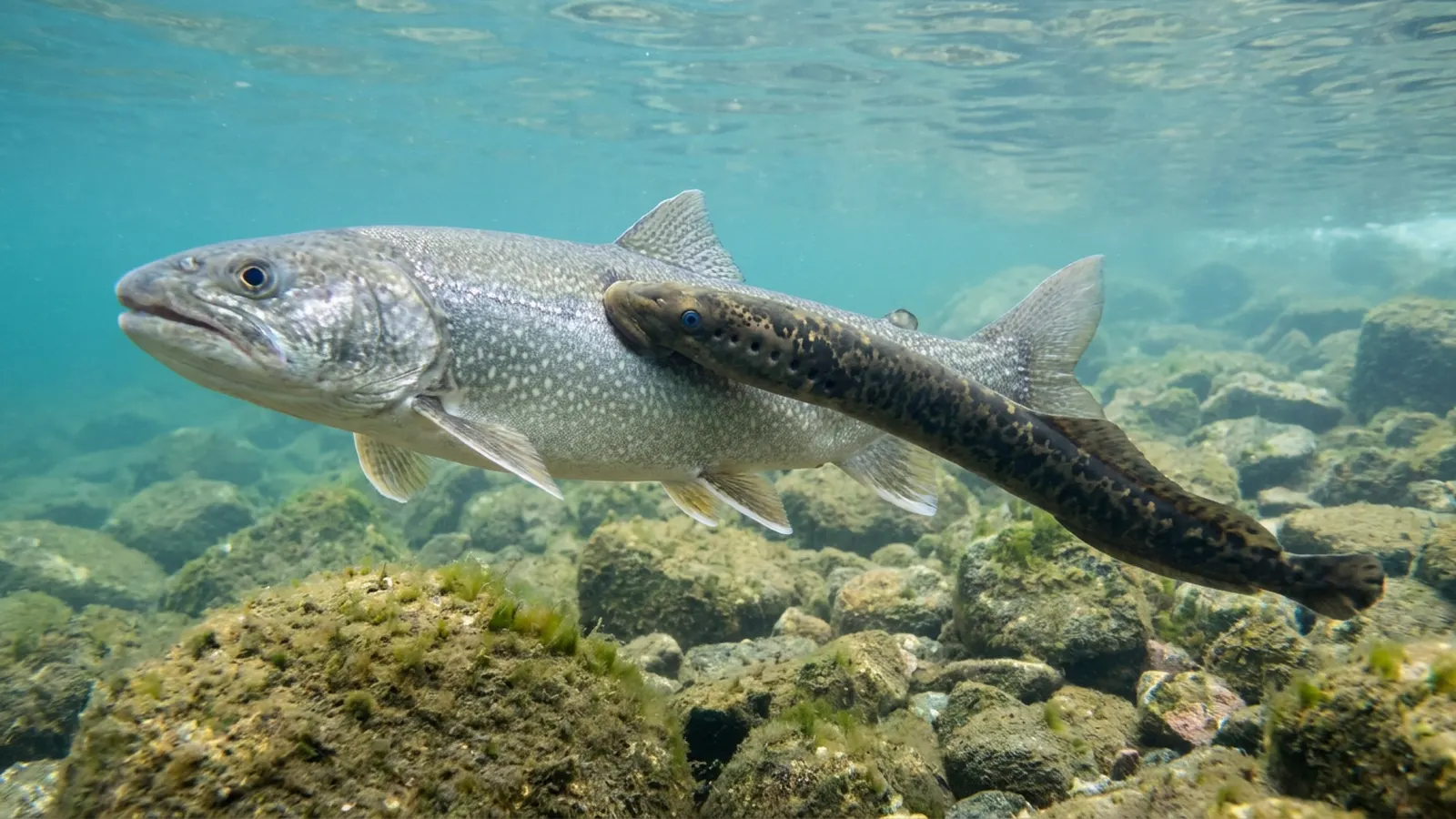
The results were devastating. Combined with heavy fishing, sea lampreys helped drive the collapse of lake trout and other large fish in the upper lakes by the 1950s. In response, Canada and the United States created the Great Lakes Fishery Commission in 1955. Since the late 1950s, its control programme has used a lampricide called TFM, which targets lamprey larvae in streams with relatively little harm to most other species, along with barriers and traps. Sea lamprey numbers have been cut dramatically, though control has to continue every year.
Are lamprey eels dangerous to people?
Unsettling, but not dangerous.
Lampreys don’t hunt humans, and attachments to swimmers are rare. When they happen, it’s usually a lamprey mistaking a person for a fish in a lake or river where lampreys are common, and the lamprey typically lets go quickly once it realises its mistake. A lamprey that does attach can leave a small, round wound that should be cleaned like any other. Lampreys don’t carry venom. The real danger they pose is to fish, especially in the Great Lakes.
Lampreys on the menu
A medieval delicacy with a royal reputation.
Lampreys were a luxury food in medieval Europe. King Henry I of England is famously said to have died in 1135 after eating “a surfeit of lampreys”, against his doctors’ advice. The city of Gloucester traditionally sent a lamprey pie to the monarch, a custom revived for some coronations and jubilees. Lampreys are still eaten in parts of Portugal, Spain, France and the Baltic, often stewed in their own blood and wine. As with eels, they should be cooked thoroughly. For eating true eels, see can you eat eel.
Living fossils
Lampreys have changed remarkably little in 360 million years.
A fossil lamprey called Priscomyzon, found in South Africa and dating to about 360 million years ago, already had the round sucking mouth of modern lampreys. That makes lampreys one of the oldest surviving lineages of vertebrates, and studying them helps scientists understand how jaws, eyes, brains and immune systems evolved. Lampreys even have their own version of an adaptive immune system, built from different molecules than ours. When I think about animals that make the ocean seem old, lampreys are high on the list, right alongside the eels whose name they borrow. For more on how true eels are built, see eel anatomy.
Native lampreys in trouble
Not every lamprey is a pest. Many are declining.
The sea lamprey’s reputation in the Great Lakes hides the fact that many lampreys are native species in need of protection. The Pacific lamprey (Entosphenus tridentatus), which migrates between the ocean and rivers from California to Alaska, has declined sharply as dams blocked its spawning runs. It is culturally important to many Indigenous peoples of the Columbia River basin, who have harvested it for food and medicine for thousands of years, and tribal and agency programmes are now working to restore it. In Europe, river and sea lampreys are protected in many places, and dam removals and fish passes have helped some populations return to rivers they had disappeared from.
Lamprey larvae also play a useful role in streams, filtering fine organic material from the water and sediment, and spawning adults that die after breeding return nutrients from the sea or lakes to headwater streams, much like salmon. As with freshwater eels, lampreys need connected rivers to complete their life cycle, which makes river connectivity one of the most important conservation issues for both groups.
Are lamprey eels real eels?
No. Lampreys are jawless fish with cartilage skeletons. True eels are bony fish with jaws.
Are there freshwater lampreys?
Yes. About half of lamprey species live only in fresh water, including the non-parasitic brook lampreys.
Are lampreys dangerous to humans?
No. Attachments to people are rare and usually brief. Lampreys are a threat to fish, not people.
What is the biggest lamprey?
The sea lamprey, which reaches about 1.2 m.
How did sea lampreys get into the Great Lakes?
Through shipping canals, especially the Welland Canal, which bypassed Niagara Falls. They spread through the upper lakes by the 1940s.
What do lampreys eat?
Larvae filter-feed on tiny particles. Parasitic adults feed on the blood and body fluids of fish. Brook lamprey adults don’t eat.
Do lampreys have teeth?
Yes, horny teeth made of keratin on their sucking disc and tongue, but no jaws.
- Great Lakes Fishery Commission, sea lamprey control programme.
- Gess, R. W., Coates, M. I. & Rubidge, B. S. (2006). A lamprey from the Devonian period of South Africa. Nature 443: 981–984.
- U.S. Fish and Wildlife Service, sea lamprey and native lamprey profiles.
- Froese, R. & Pauly, D. (eds.). FishBase: Petromyzon marinus, Lampetra fluviatilis.
Blane Perun has been exploring Earth’s oceans and marine life for over 25 years. Founder of TheSea.Org in 1999, underwater photographer, coral aquaculture pioneer, and explorer of 80+ countries.
About Blane Perun → More on Eels →