Sina and the Eel — The Polynesian Legend Behind the Face on Every Coconut
Sina and the eel is a Polynesian legend, best known from Samoa, about a young woman named Sina and an eel that loves her and follows her everywhere. When the eel is to be killed, it asks Sina to bury its head. From the grave grows the first coconut tree, and the three marks on a coconut are said to be the eel’s eyes and mouth.
Every time someone in the Pacific cracks open a coconut, there’s a story looking back at them. Turn a husked coconut over and you’ll see three dark spots at one end, two “eyes” and a “mouth”. Across Polynesia, those spots are explained by a legend about a woman and an eel. In Samoa she is Sina; further east she is Hina or Ina, and the eel is Tuna. The details change from island to island, but the ending is always the same: the eel dies, its head is buried, and the coconut tree, the most useful plant in the Pacific, grows from the grave.
I’ve always found this one of the most touching sea legends, partly because it’s about an eel, an animal most people find unlovable. Here’s how the story is usually told, how it varies across the islands, and how it connects to the real eels that live in Pacific streams.
The Samoan story of Sina and the eel
A pet eel that grows too big, and a love that turns into a gift.
In one widely told Samoan version, Sina is a beautiful young woman, often the daughter of a high chief. She finds a tiny eel and keeps it in a coconut shell or a bowl of water, caring for it as a pet. The eel grows, and she moves it to a pool, then to a larger pool, and still it grows. Eventually it becomes huge, and it begins to follow Sina, appearing wherever she bathes or fetches water. In some tellings the eel is really a chief from Fiji who has taken the form of an eel to follow the woman he loves.
The eel’s devotion frightens Sina, and she flees from village to village with the eel following through rivers and the sea. The villagers decide that the eel must be killed. Knowing what is coming, the eel speaks to Sina. It asks her to bury its head after it dies and to watch over the place. From the grave, it promises, a tree will grow that will give her food, drink, shelter and everything she needs. Sina does as she is asked, and a coconut palm sprouts from the eel’s head.
The eel leaves one last message. When Sina drinks from the coconut, she will be pressing her lips to the eel’s face, and so they will kiss forever. That’s why, people say, the three marks on the end of a coconut look like a face, and why you drink from the “mouth”.
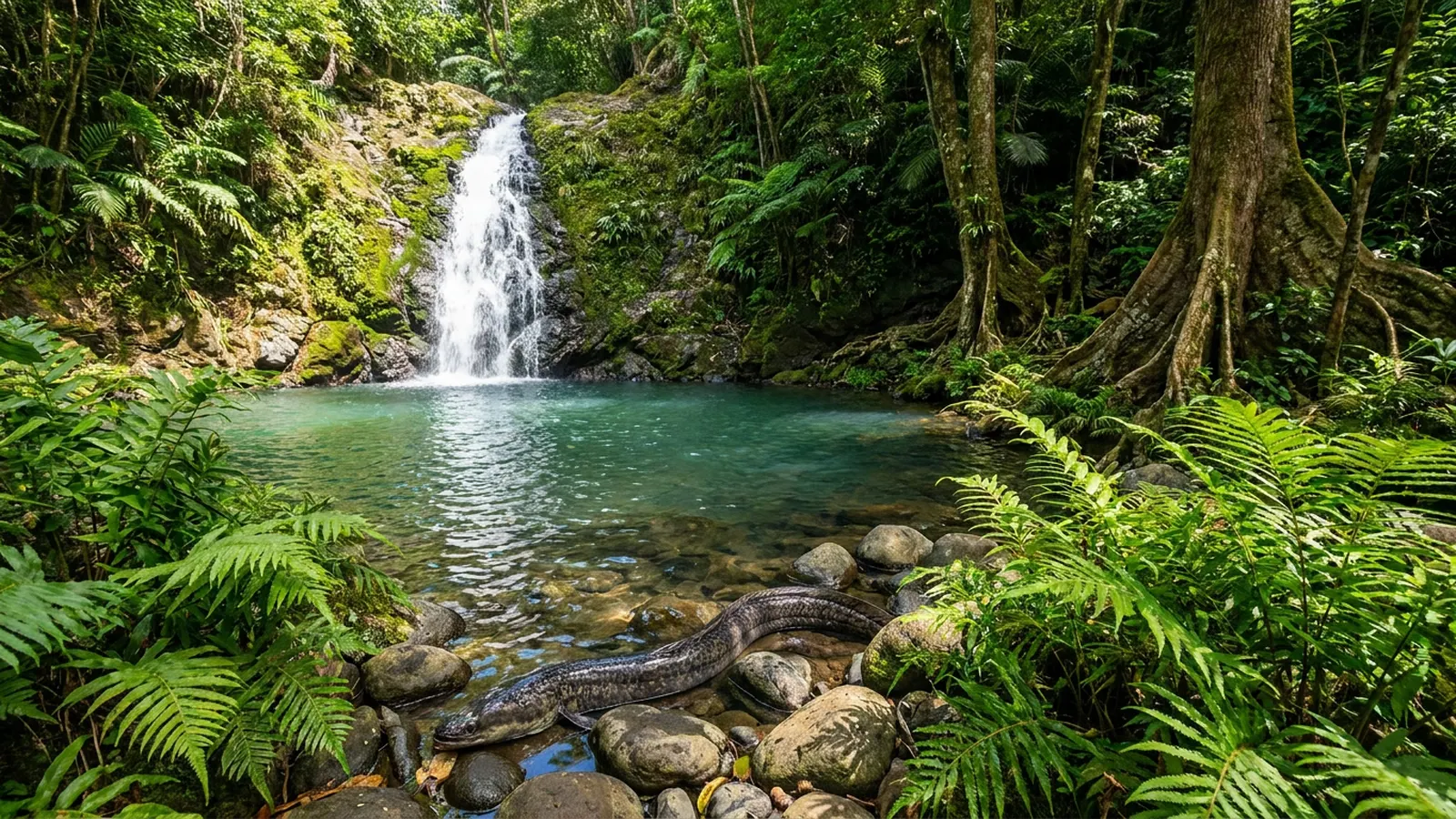
Hina and Tuna: the eastern Polynesian versions
The same story, with Maui and a darker twist.
In Tahiti, the Cook Islands and among the Māori of Aotearoa New Zealand, the woman is Hina (or Ina), and the eel is Tuna, the ordinary Polynesian word for eel. Tuna is often a powerful eel chief who becomes Hina’s lover. In several versions, Tuna becomes a rival or threat, and the demigod Maui, who in some versions is Hina’s husband or brother, kills him. Before dying, or as his head is cut off, Tuna instructs Hina to plant his head, and the coconut grows from it.
In the Mangaian version from the Cook Islands, Ina bathes in a pool where an eel brushes against her, then turns into a handsome young man, Tuna, who becomes her lover. When a flood is coming, Tuna tells Ina that he must die, and that she must bury his head, from which coconuts will grow. These versions keep the central images, the eel lover, the buried head and the coconut face, while tying the story into the wider cycle of Maui legends.
How the legend varies across Polynesia
Many islands, one core story.
| Region | Names | Distinctive details |
|---|---|---|
| Samoa | Sina and the Eel | Pet eel grows huge and follows Sina; sometimes a Fijian chief in eel form |
| Tahiti and the Society Islands | Hina and Tuna | Eel lover; Maui kills Tuna |
| Cook Islands (Mangaia) | Ina and Tuna | Eel becomes a young man; dies before a flood |
| Aotearoa New Zealand | Hina and Tuna | Maui kills Tuna; Tuna’s body becomes eels, vines and other things in some tellings |
| Tonga, Tokelau, Fiji, Hawaii | Local variants | Eel and woman, buried head, coconut |
Collectors writing down these stories in the 19th and 20th centuries recorded many versions, and storytellers today continue to adapt them in books, songs, dance and film. There’s no single “correct” version, which is part of what keeps the legend alive.
Why an eel? The real eels of Polynesia
Eels were part of daily life on Pacific islands.
The story’s eel is based on a real animal. Freshwater eels of the genus Anguilla live in the streams, pools and lakes of high Pacific islands, and the giant mottled eel (Anguilla marmorata) can grow to about 2 m. These eels often live for many years in the same pool, and in some villages across the Pacific and Southeast Asia, large eels became local celebrities, fed by villagers and treated as guardians or sacred animals. You can read about them in our giant mottled eel profile.
That background explains a lot about the legend. A pet eel kept in a pool and growing to enormous size is entirely realistic. So is an eel that seems to follow people, because eels that are regularly fed quickly learn to come to anyone at the water’s edge. Moray eels on the reef were also familiar to Polynesian fishers, and they turn up in other stories, but it’s the freshwater eel of the village pool that became Sina’s companion.

Why the coconut matters
A story about the most important plant in the Pacific.
For island peoples, the coconut palm provided drinking water, food, oil, rope from husk fibre, mats and roofing from leaves, timber and containers. In the story, the eel’s promise lists those gifts: food, drink, shelter, and the means to live. Turning the death of a loved creature into the origin of the tree of life is a powerful way to explain why the coconut is precious and should be treated with respect.
The face on the coconut makes the story memorable. The three germination pores on the end of the shell, one of which is soft enough for the sprout to push through, really do look like two eyes and a mouth. Anyone who’s heard the legend never looks at a coconut the same way again.
Eels in myth around the world
Sina’s eel has relatives in other cultures.
Eels appear in myth wherever people lived alongside them. In Japan, eels are linked to certain shrines and sometimes regarded as messengers of the gods, and some communities avoid eating them. In parts of Melanesia and Micronesia, eel spirits are ancestors or guardians. Europeans, who couldn’t work out where eels came from, invented their own legends, from Aristotle’s idea that eels grew out of mud to medieval claims that they came from horse hairs. The real answer, a spawning ground in the open ocean, turned out to be at least as strange; see how eels reproduce. For more legends of the ocean, explore our sea myths and legends section.
What makes Sina’s story special to me is its kindness. Most sea legends warn people about monsters. This one asks you to see an eel as loyal, loving and generous, and to remember it every time you drink from a coconut. As someone who has spent decades trying to get people to look at the ocean’s less glamorous animals with fresh eyes, I think that’s a lesson worth passing on.
Sina and the eel today
An old story that’s still told, taught and performed.
The legend is far from a museum piece. In Samoa and across the Pacific, it’s told to children, taught in schools, retold in picture books and performed in dance and song. Samoan siapo (bark cloth) and other art forms show Sina with her eel, and contemporary Pacific writers and artists continue to reinterpret the story, sometimes focusing on Sina’s fear and choices, sometimes on the eel’s devotion. Because it explains something everyone can see and touch, the face on a coconut, it’s an easy story to pass from one generation to the next.
For visitors to the islands, the legend is a good reminder that Pacific landscapes are full of stories. A pool, a reef passage or a stand of coconut palms may be tied to a particular ancestor or event, and local guides are often happy to share them. Asking about the stories behind a place is one of the best ways I know to understand it, and to treat it with the respect it deserves.
Eels as protected and sacred animals
In some places, the legend’s respect for eels carries into real life.
In parts of the Pacific and Southeast Asia, large freshwater eels living in particular pools or streams are protected by custom and fed by villagers, sometimes for generations. Visitors are taken to see them, and people avoid harming them. These traditions echo the Sina story: an eel that is cared for, that lives close to people, and that is treated as more than an ordinary animal. At a time when freshwater eels worldwide are in decline, those customs have helped keep some local populations of big eels alive.

What is the moral of Sina and the eel?
Common readings include love and sacrifice, and that even something feared can be a source of life. The story also teaches respect for the coconut as a gift.
Where does the story of Sina and the eel come from?
It is best known from Samoa, with related versions throughout Polynesia, including Tahiti, the Cook Islands, Tonga, Hawaii and New Zealand.
Why does a coconut have a face?
The three pores at one end look like eyes and a mouth. In the legend, they are the face of the eel whose head was buried to grow the first coconut tree.
Who is Tuna in Polynesian mythology?
Tuna is the eel lover of Hina (or Ina) in eastern Polynesian versions. His buried head becomes the first coconut tree.
Is the eel in the legend a real animal?
It’s based on freshwater eels such as the giant mottled eel, which live in island streams and can grow very large.
Is Sina the same as Hina?
Yes. They are regional forms of the same name, and Sina/Hina appears in many Polynesian stories.
- Gill, W. W. (1876). Myths and Songs from the South Pacific. London: Henry S. King & Co. (Mangaian story of Ina and Tuna).
- Beckwith, M. (1940). Hawaiian Mythology. Yale University Press.
- Krämer, A. (1902–1903). Die Samoa-Inseln (English trans. The Samoa Islands, University of Hawaiʻi Press, 1994).
- Te Ara – The Encyclopedia of New Zealand: Tuna (eels) in Māori tradition.
Blane Perun has been exploring Earth’s oceans and marine life for over 25 years. Founder of TheSea.Org in 1999, underwater photographer, coral aquaculture pioneer, and explorer of 80+ countries.
About Blane Perun → More on Eels →