Zebra Moray Eel — The Striped Crab-Crusher With Teeth Like Pebbles
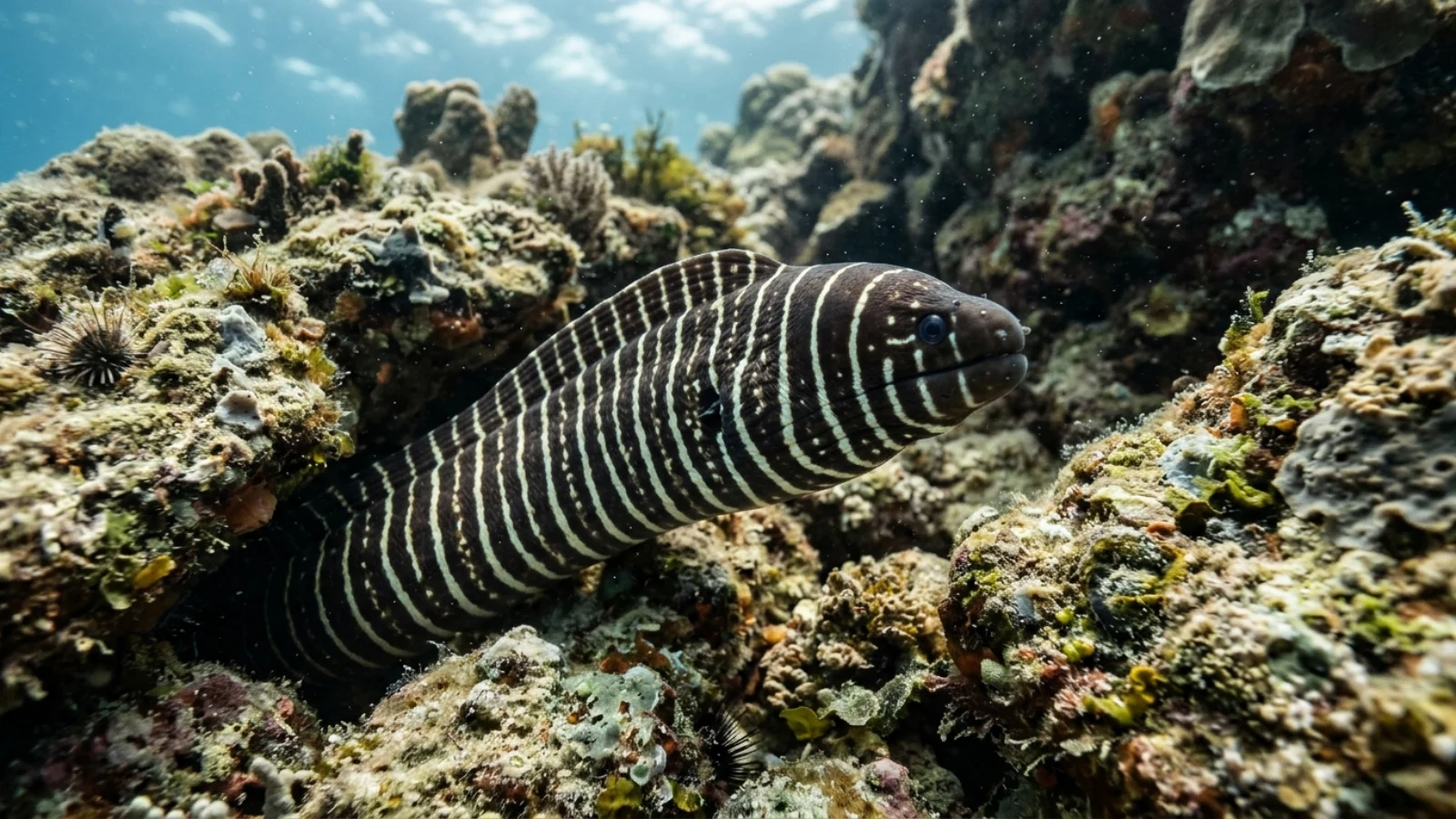
The zebra moray (Gymnomuraena zebra) is a moray eel with dark brown-to-black skin ringed by dozens of narrow white bands. It lives on reefs from the Red Sea and East Africa to Hawaii and across to the Pacific coast of the Americas, grows to about 1.5 m, and is unusual among morays because it has blunt, pebble-like crushing teeth instead of fangs, used to crack xanthid crabs, molluscs and sea urchins. It is secretive and harmless to people, and it is traded commercially for aquariums.
The zebra moray has no fangs at all. Its mouth holds close-set, pebble-like teeth built for crushing, and it spends its life hunting animals that cannot run away fast but are hard to break into: crabs, snails, clams and sea urchins.
What does a zebra moray look like?
A thick-bodied moray, dark chocolate to black, with dozens of thin white or yellowish rings from head to tail.
The rings vary between individuals and may be complete or broken. The snout is short and rounded, the eyes small. It is the only species in its genus, Gymnomuraena, although its bands mean it is sometimes confused with the banded sea krait (a venomous sea snake) and with the banded snake eel, which has a pointed tail and dark rings on a pale body, the reverse pattern.
Descriptions of the pattern vary in a way that can confuse readers. FishBase describes close-set narrow dark bands, while other sources describe narrow white or yellowish rings on a dark body. Both describe the same animal: the eel is dark with numerous thin pale rings, so whether the rings or the gaps are called the bands is a matter of wording. Feeding in the zebra moray has also been studied directly: a 1989 paper in Copeia by Miller compared the feeding behaviour of the zebra moray with that of two very different relatives, the snowflake moray and the fish-eating dragon moray, Enchelycore pardalis.
Where do zebra morays live?
This is one of the most widespread morays: the Red Sea, Persian Gulf and East Africa east through the Indian Ocean and western Pacific to the Society Islands, north to the Ryukyus and Hawaii, south to the Great Barrier Reef, and in the eastern Pacific from southern Baja California to Colombia and the Galapagos. It lives in crevices and under ledges on seaward reefs and on sandy-rocky bottoms, mostly at 1–39 m.
What do zebra morays eat?
Mainly xanthid (mud and pebble) crabs, plus other crustaceans, snails, clams and sea urchins.
Its crushing dentition is a specialisation for durophagy, the eating of hard-shelled prey. A zebra moray probes holes in the reef with its snout, seizes a crab and crunches it, shell and all. It is most active at dusk and night. Because it feeds this way it ignores most fish, which is why aquarists find it one of the few morays that can share a tank with medium-sized fish.
Name and classification
The zebra moray was described by Shaw in 1797, and Lacépède created the genus Gymnomuraena for it in 1803. It is the only species in that genus, although some authors have placed it in Echidna, the genus of the snowflake moray and other shell-crushers, and it appears in older literature as Echidna zebra. Its complete mitochondrial genome, sequenced in 2015, is 16,576 base pairs long and about 80 percent identical to that of the kidako moray, Gymnothorax kidako.
Moray eels make up the family Muraenidae. A 2012 world checklist by D. G. Smith recognised 197 valid species in 15 genera and two subfamilies: the true morays (Muraeninae), which include the zebra moray, and the snake morays (Uropterygiinae). The zebra moray has 132 to 137 vertebrae, one of the characters used to separate moray species when colour patterns are ambiguous.
Anatomy of a shell-crusher
Most morays are built for catching fish and octopus: long jaws, a narrow head and long, curved teeth. Durophagous morays, the ones that eat hard-shelled prey, are built differently. A 2009 study by R. S. Mehta compared the jaws of ten moray species and found that the fish-eaters and the shell-crushers fall into two distinct groups. The crushers have shorter jaws, deeper lower jawbones and short, blunt teeth. Their jaw-closing muscles are enlarged and their jaw levers are arranged to transmit force rather than speed. They also process prey in the mouth, cracking it before swallowing, rather than gulping it whole.
FishBase describes the zebra moray’s teeth as close-set and pebble-like, used for crushing hard-shelled prey. Mehta’s study found a further surprise deeper in the throat. Like all morays, the zebra moray has a second set of jaws, the pharyngeal jaws. In the zebra moray, which Mehta classed as a molluscivore, the upper pharyngeal tooth plates carried more teeth than in any other moray examined, and these teeth were long and thin compared with those of fish-eating species.
How moray throat jaws work
The pharyngeal jaws of morays are one of the most remarkable feeding mechanisms known in fishes. Most bony fishes use suction to draw prey into the mouth and then rely on water flow to carry it back to the throat. Morays are poor at suction feeding. In a 2007 paper in Nature, R. S. Mehta and P. C. Wainwright showed that the moray Muraena retifera overcomes this by launching its pharyngeal jaws forward out of the throat into the mouth, where they grab the prey and pull it back into the oesophagus. It was the first described case of a vertebrate using a second set of jaws to both restrain and transport prey, and the authors compared the ratcheting motion with the way snakes swallow.
In morays the pharyngeal jaws act only to move food from the mouth into the oesophagus; they no longer chew. That is why shell-crushing morays such as the zebra moray do their crushing with the front teeth. The mobility of the throat jaws comes from elongated muscles and a reduction of nearby gill-arch structures. Separately, morays have small, round gill openings and keep the mouth slightly open to move water over the gills, which is why they seem to gape at divers.
Shell-crushing evolved more than once
For a long time the zebra moray and the Echidna morays were thought to be close relatives because they share blunt crushing teeth. Molecular work has overturned that view. A 2010 study by J. S. Reece, B. W. Bowen, D. G. Smith and A. Larson built a family tree of 44 moray species using mitochondrial and nuclear DNA. They rejected a grouping of Gymnomuraena with Echidna, showing that the crushing jaws and dentition evolved independently, once in an ancestor of the zebra moray and at least three more times within Echidna.
A follow-up study in The American Naturalist in 2014 by D. C. Collar and colleagues found ten separate transitions to durophagy across the moray family, producing fifteen shell-eating species. Each time, the skull moved toward a new region of shape space suited to crushing hard prey, but the different lineages got there by changing different combinations of traits. The authors called this “imperfect convergence”: shared demands of a hard diet led to similar but not identical solutions, and the shell-crushers ended up more varied in shape than their fish-eating ancestors. The zebra moray, with its unique combination of features, is one of the clearest examples.
Habitat and behaviour
FishBase describes the zebra moray as a secretive inhabitant of sandy and rocky bottoms and of crevices and ledges on seaward reefs. It is benthic, usually reported from 1 to 39 metres, with an overall depth range of about 3 to 50 metres in one dataset; other summaries describe it on coastal reefs to about 40 metres. It is active at night, when it leaves cover to hunt actively, and it is listed as harmless to people.
Its diet is the most specialised of any common moray. Xanthid crabs, the stout, heavy-clawed crabs that hide in reef crevices and rubble, are the main prey, followed by other crustaceans, molluscs and sea urchins. Some summaries state that, unlike most other morays, it feeds exclusively on such hard-shelled prey. Because these animals are slow and armoured rather than fast, a moray that can break shells has access to food that few fish-eaters compete for.
One of the widest ranges of any moray
The zebra moray occurs from the Red Sea, Persian Gulf and East Africa to the Society Islands, north to the Ryukyu and Hawaiian Islands and south to the Great Barrier Reef. Unusually, it also lives in the eastern Pacific, from southern Baja California and from Guatemala to northern Colombia, including the Galapagos. FishBase gives its latitudinal range as about 30 degrees north to 24 degrees south.
Few reef fishes span both the Indo-West Pacific and the eastern Pacific, because a wide stretch of open ocean with no shallow reefs separates them. Moray larvae help explain how the zebra moray manages it. Like all eels, morays begin life as leptocephali, flat, transparent larvae that drift in the open ocean for about three months to more than a year, long enough to be carried across large distances. Reece’s 2010 study also showed that morays have crossed between ocean basins several times, with multiple invasions of the Atlantic from the Indo-Pacific, one shortly before the Isthmus of Panama closed about 2.8 million years ago.
Zebra moray or snowflake moray?
The moray most often compared with the zebra moray is the snowflake moray, Echidna nebulosa, the other well-known crusher. The two share a great deal. Both have blunt teeth suited to a diet of crustaceans, both reach a common length of about 50 centimetres, both are suspected but unconfirmed protogynous hermaphrodites, and both occur across the Indo-Pacific to Hawaii and again in the eastern Pacific from southern Baja California to northern Colombia. Yet, as the DNA studies show, their crushing jaws evolved separately.
They are easy to tell apart. The snowflake moray has a blunt white snout and a pale body speckled with yellowish, brown and black blotches, with yellow tubular nostrils on the snout. The zebra moray is dark chocolate to black with close-set narrow pale rings and no blotches. The snowflake is also smaller, reaching about 1 metre against 1.5 metres for the zebra moray, and it often lives in very shallow places such as reef flats, rubble-strewn seagrass beds and tide pools. In Hawaii the snowflake is known as puhi kāpā.
Does the zebra moray change sex?
Possibly. FishBase notes it may be a protogynous hermaphrodite (starting life as female and later becoming male), as has been suggested for several morays, but this has not been confirmed. Moray reproduction in the wild is rarely observed; like all eels, zebra morays produce leptocephalus larvae that drift in the plankton for months. Sex change has been suggested in the opposite direction for another moray, the ribbon eel, which is generally considered to change from male to female on the basis of its colour changes, but that too is unconfirmed.
Are zebra morays good aquarium fish?
They are among the best morays for a large fish-only or robust reef tank: hardy, slow, and usually peaceful towards fish. But they still need plenty of space for an animal that can top a metre, a sealed lid, and a diet of shellfish such as thawed crab, clam, shrimp and squid. They will eat ornamental crabs, shrimps and snails, since these are their natural prey.
| Care factor | Guideline |
|---|---|
| Adult size | Commonly about 50 cm; up to 150 cm |
| Diet | Crab, shrimp, clam, mussel, squid |
| Tankmates | Medium to large fish; no crabs or shrimps |
| Reef safe? | With corals yes; with crustaceans no |
| Temperament | Placid, often shy by day |
Fisheries, the aquarium trade and conservation
FishBase lists the zebra moray as of minor commercial importance in fisheries and as a commercial aquarium species. The IUCN assessed it as Least Concern on 16 August 2011, in an assessment by D. G. Smith, J. E. McCosker and K. Tighe, reflecting its very large range.
That global status does not mean the aquarium trade has no impact. A 2026 study in Ecological Applications by Baillargeon and colleagues assessed the vulnerability to overfishing of 306 marine fish species actively traded for aquariums. It found that 81.4 percent fell into the least or moderately vulnerable classes, but that eels and elasmobranchs had the highest vulnerability scores of any groups. The authors also argued that the standard FishBase vulnerability tool can be poorly suited to non-food fishes with little data. For buyers, the practical lesson is to choose animals from suppliers who can say where and how they were collected.
Is the zebra moray dangerous to divers?
No. It is listed as harmless and is shy, typically retreating when approached. For a comparison with fanged, fish-eating morays see the dragon moray and the honeycomb moray, or read about the whole family in moray eels.
Are zebra morays aggressive?
No. They are among the most peaceful morays and usually retreat from divers. In aquariums they ignore most fish.
What do zebra moray eels eat?
Crabs, especially xanthid crabs, plus other crustaceans, molluscs and sea urchins, which they crush with flat teeth.
How big do zebra morays get?
Up to 1.5 m; about 50 cm is a common length.
Do zebra morays have teeth?
Yes, but they are flat, rounded crushing teeth rather than fangs.
Where do zebra morays live?
On reefs from the Red Sea and East Africa to Hawaii and the Pacific coast of Central and South America, including the Galapagos.
Is a zebra moray a sea snake?
No. It is a fish. The banded sea krait is a venomous reptile with a flattened, paddle-shaped tail and scales.
- FishBase (Froese & Pauly, eds.), species summaries, version 2025.
- Smith, D.G. (2012). A checklist of the moray eels of the world (Teleostei: Anguilliformes: Muraenidae). Zootaxa 3474: 1–64.
- Mehta, R.S. & Wainwright, P.C. (2007). Raptorial jaws in the throat help moray eels swallow large prey. Nature 449: 79–82.
- IUCN Red List. Smith, D.G., McCosker, J. & Tighe, K. Gymnomuraena zebra. Assessed 16 August 2011.
- Miller (1989). Feeding behavior of Echidna nebulosa, Enchelycore pardalis, and Gymnomuraena zebra. Copeia. doi:10.2307/1445493
- Mehta, R.S. (2009). Ecomorphology of the moray bite: relationship between dietary extremes and morphological diversity. Physiological and Biochemical Zoology. doi:10.1086/594381
- Reece, J.S., Bowen, B.W., Smith, D.G. & Larson, A. (2010). Molecular phylogenetics of moray eels demonstrates multiple origins of a shell-crushing jaw. Molecular Phylogenetics and Evolution. doi:10.1016/j.ympev.2010.07.013
- Collar, D.C., Reece, J.S., Alfaro, M.E., Wainwright, P.C. & Mehta, R.S. (2014). Imperfect morphological convergence. The American Naturalist. doi:10.1086/675810
- Loh, K.H. et al. (2016). Complete mitochondrial genome of the zebra moray. Mitochondrial DNA Part A. doi:10.3109/19401736.2015.1022754
- Baillargeon, G.A. et al. (2026). Productivity-susceptibility analysis for marine aquarium fish. Ecological Applications. doi:10.1002/eap.70272
Blane Perun has been exploring Earth’s oceans and marine life for over 25 years. Founder of TheSea.Org in 1999, underwater photographer, coral aquaculture pioneer, and explorer of 80+ countries.
About Blane Perun →More on Eels →