What Color Are Eels? — From Silver and Olive to Electric Blue, Zebra Stripes and Glass
Most eels are brown, olive, grey or mottled, colours that hide them in mud, sand and reef holes. Freshwater eels turn yellow-bellied while they grow and silver when they migrate. Reef eels add bright exceptions: the green moray (really yellow slime over blue-grey skin), the electric-blue ribbon eel, yellow morays and zebra-striped species. Baby eels are transparent.
Ask most people what colour an eel is and they’ll say something like “dark and slimy”. That’s fair for the eel in a river or the conger in a wreck, but it misses a whole rainbow. Eels come in electric blue, lemon yellow, black-and-white stripes, leopard spots and, at the start of life, no colour at all. Colour in eels is mostly about hiding, sometimes about pretending to be something dangerous, and in one famous case it’s about slime. Here’s how it breaks down.
The basic eel colours: brown, olive and grey
The default eel is built to disappear against mud, rock and shadow.
The majority of the roughly 1,000 species of true eel are some shade of brown, olive, grey or dull mottled tan. That makes sense for animals that spend their days in holes, under rocks, in mud or buried in sand. A conger in the dark interior of a wreck, a freshwater eel under a riverbank and a snake eel buried up to its eyes in sand all benefit from looking like the background. Many have a darker back and a paler belly, the classic countershading pattern that makes a fish harder to see from above and below.
The deep-sea eels are often uniformly black or dark brown. Below the reach of sunlight, red and blue light are both absent, and dark bodies reflect almost nothing. The gulper eel is a good example.
Transparent eels: leptocephali and glass eels
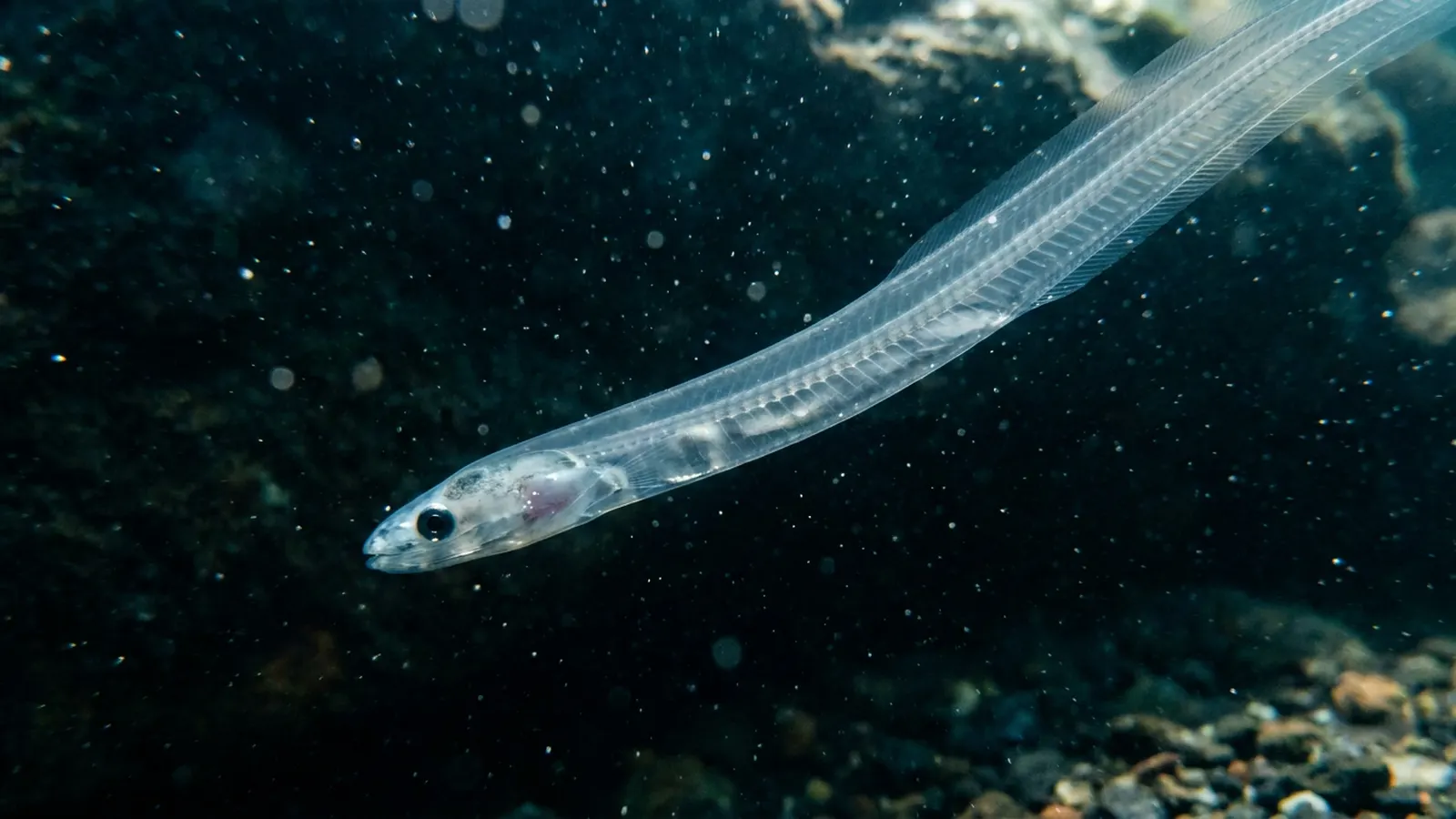
Every eel starts life almost invisible.
Eel larvae, called leptocephali, are flat, leaf-shaped and nearly as clear as glass. They have no red blood cells and very little pigment. When they reach the coast they turn into glass eels, which are eel-shaped but still transparent, so you can see the spine and organs through the body. For a small animal drifting in open water with nowhere to hide, being see-through is the best camouflage available. Glass eels gain colour as they move into brackish and fresh water and become elvers. The stages are explained in our eel life cycle guide.
Yellow eels and silver eels
Freshwater eels change colour twice as adults, and the stages are named after it.
During its long growing years in rivers and estuaries, a freshwater eel such as the European or American eel is called a yellow eel. Its back is olive, brown or greenish and its belly is yellowish or brassy. When it reaches maturity and gets ready to migrate to the ocean, it becomes a silver eel. The belly turns bright silvery white and the back darkens toward black or bronze. The eyes also get much bigger. That silver-and-dark pattern is standard camouflage for open-ocean fish: from below, a silver belly blends with the bright surface, and from above, a dark back blends with the deep water. Some freshwater eels are mottled instead; the giant mottled eel is marbled in brown and yellow.
Why the green moray isn’t really green
Its colour comes from a coat of yellow mucus over darker skin.
The green moray (Gymnothorax funebris) of the tropical western Atlantic is the moray most Caribbean divers see first, and it really does look green underwater. But its skin is a dark bluish-grey or brown. Over that skin lies a thick layer of mucus tinted yellow, and the combination reads as green. Preserved specimens lose the mucus and with it the green. That slime layer also protects the eel from abrasion and parasites as it slides in and out of coral.
Green morays are common on the reefs in several of my dive guides, including Hol Chan in Belize, Molasses Reef in Key Largo and the Santa Rosa Wall in Cozumel. If you see a big, uniformly green eel in the Caribbean, that’s almost certainly the one.
Blue eels and yellow eels
The ribbon eel changes colour as it changes sex.
The ribbon eel (Rhinomuraena quaesita) of the Indo-Pacific is the eel most people mean when they search for a “blue eel”. It’s a slender moray with leaf-like flared nostrils, and its colour tells you its life stage. Juveniles are black with a yellow dorsal fin. Males are electric blue with a bright yellow jaw and fins. Some later become females that are almost entirely yellow. It’s one of the most photographed eels in the world, and there’s more about it in our blue ribbon eel profile.
Several other morays are yellow, including the yellow moray (Gymnothorax prasinus) of Australia and New Zealand, which ranges from yellow-brown to bright yellow, and the yellowmargin moray, whose fins have a yellow edge. See our page on the yellow moray eel for how to tell them apart.
Stripes, spots and honeycombs
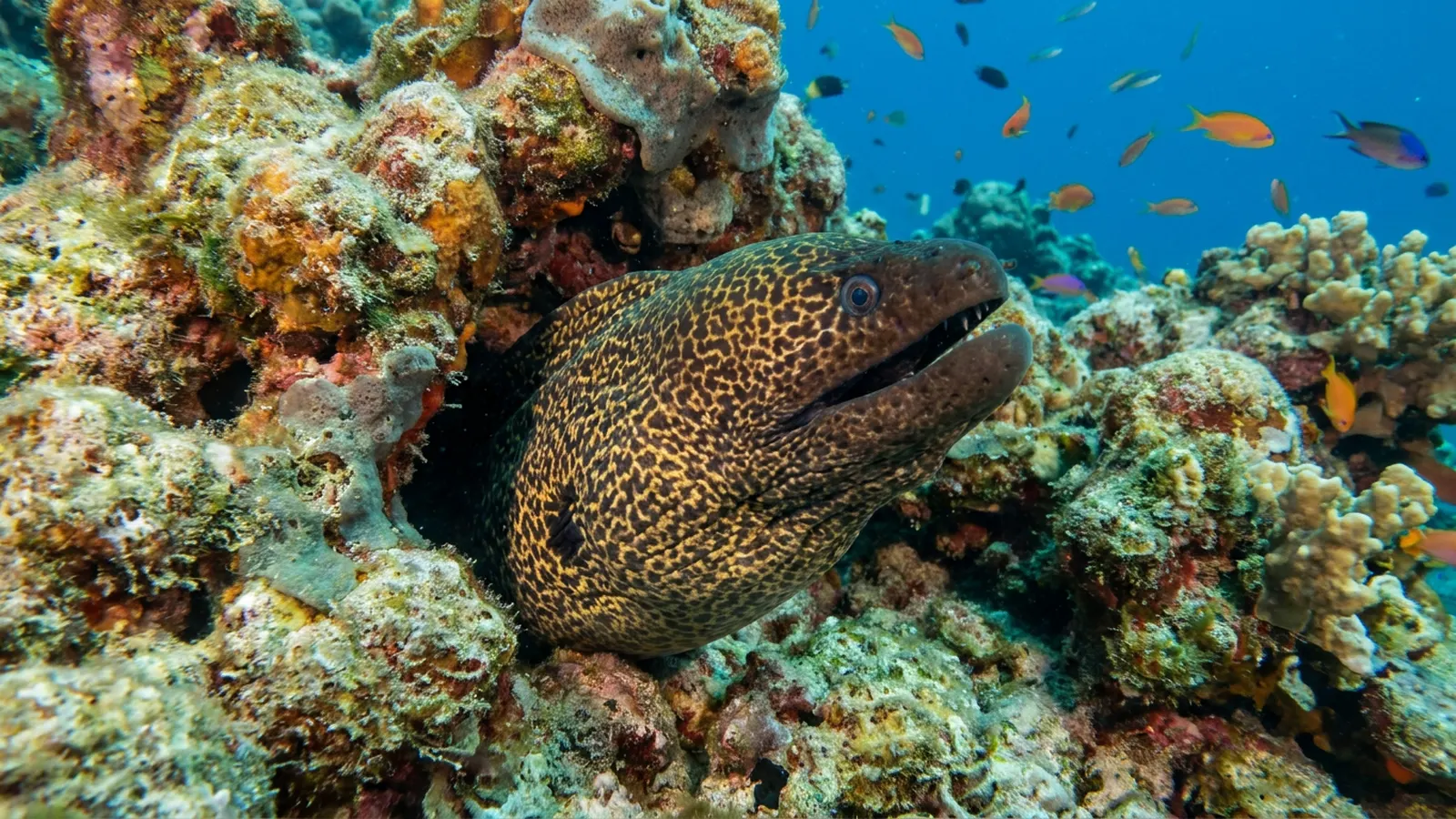
Patterned eels break up their outline or advertise that they might be dangerous.
| Eel | Colour and pattern | Region |
|---|---|---|
| Zebra moray | Dark brown with thin white or yellowish rings | Indo-Pacific |
| Honeycomb moray | White or yellowish with a black honeycomb net | Indo-Pacific |
| Snowflake moray | White with black blotches dotted with yellow | Indo-Pacific |
| Dragon moray | Orange-red with white spots and dark edges | Indo-Pacific, Hawaii, Japan |
| Spotted moray | Pale with dense dark spots | Western Atlantic |
| Goldentail moray | Dark brown with yellow spots and a yellowish tail | Caribbean |
| Banded snake eel | White with black bands | Indo-Pacific |
| Spotted garden eel | White with small black spots | Indo-Pacific |
Spots and blotches work like camouflage on a busy reef full of shadows, holes and coral textures. The banded snake eel is a different case. Its black-and-white rings look remarkably like those of a sea krait, a venomous sea snake that shares its habitat, and biologists think that resemblance helps keep predators away. Our spotted eel ID guide helps sort out the many eels with spots.
“Eels” with colours of their own
Several animals called eels aren’t true eels, and they have their own colour schemes.
The electric eel is a South American knifefish, dark grey-brown or olive above with an orange or yellow tint on the throat and belly in mature fish. The fire eel, popular in freshwater aquariums, is a spiny eel from Southeast Asia: dark grey with bright red stripes and spots along its sides, covered on our full-grown fire eel page. The wolf eel of the North Pacific is a wolffish, grey or brownish with darker spots, and older males turn pale grey with a heavy, lumpy face. Lampreys, which are jawless fish rather than eels, are mostly brown or grey and mottled.
Can eels change colour?
Slowly, and within limits.
Eels can’t flash colours the way an octopus can, but many can lighten or darken their skin over minutes to hours to better match their surroundings, and lots of species change colour as they grow. Freshwater eels make two big colour shifts as they go from glass eel to yellow eel to silver eel. Ribbon eels change colour with sex. Several morays look quite different as juveniles than as adults. Colour can also vary between individuals of the same species depending on habitat, which is one reason identifying eels from photos is harder than it looks.
My advice for identifying an eel is not to rely on colour alone. Look at the pattern, the shape of the head and nostrils, whether it has pectoral fins and where in the world you saw it. Then compare it with our species pages, starting with the moray eel species guide.
Colour by habitat
You can often guess where an eel lives from how it looks.
There’s a rough pattern to eel colours once you sort them by where they live. Eels of rivers, lakes and muddy estuaries are almost always plain: olive, brown or grey above and paler below, because there’s nothing to gain from bright colour in murky water. Eels that live buried in sand, such as many snake eels and garden eels, tend to be sandy, speckled or white with small spots, so that the part of the body that shows above the sand blends with the grains around it.
Coral-reef eels are where the colours get bold. A reef is a patchwork of light and shadow, holes, sponges and coral of every colour, and patterns of spots, rings and blotches break up the outline of an eel lying half out of a hole. Bright yellows and blues, as in the ribbon eel, are less about hiding and may help members of the same species recognise each other. Deep-sea eels, at the other end of the scale, are dark and plain because there’s no sunlight to reflect.
Seeing eel colours underwater
The colour you see depends on depth, light and timing.
Underwater, sunlight loses its red wavelengths within the first few metres, then orange and yellow. That’s why a red or orange eel can look dull brown on a dive at 15 or 20 m and then blaze with colour in a photograph taken with a strobe. If you want to see eels in their true colours, carry a dive light and use it on the eel’s body rather than its eyes. Night dives are good for this, because many morays are out of their holes hunting and the only light is your own.
Photographers also learn that eel skin is shiny with mucus, so a strobe aimed straight on can create hot spots. Angling the light slightly from the side usually gives a more natural look. And remember that the same species can look different from one reef to the next, so a single photograph isn’t always enough to identify an eel by colour.

What color is a normal eel?
Most eels are brown, olive, grey or mottled. Freshwater eels are olive-backed with a yellowish belly during their growth years and turn silver when they migrate.
Are there blue eels?
Yes. Male ribbon eels are electric blue with yellow jaws and fins. They live on Indo-Pacific reefs.
Why is the green moray green?
Its skin is dark bluish-grey or brown, covered by yellow-tinted mucus. Together they look green.
Are baby eels see-through?
Yes. Eel larvae (leptocephali) and glass eels are transparent, which hides them in open water.
What color is an electric eel?
Dark grey-brown or olive above, often with an orange or yellow throat and belly. It isn’t a true eel.
What eel is yellow?
Yellow morays, female ribbon eels and several other morays are yellow. The yellow moray Gymnothorax prasinus lives around Australia and New Zealand.
- Froese, R. & Pauly, D. (eds.). FishBase species accounts: Gymnothorax funebris, Rhinomuraena quaesita, Gymnomuraena zebra, Myrichthys colubrinus.
- Smithsonian Tropical Research Institute, Shorefishes of the Greater Caribbean.
- Florida Museum of Natural History, Discover Fishes: green moray.
- Tesch, F.-W. (2003). The Eel, 3rd ed. Blackwell.
Blane Perun has been exploring Earth’s oceans and marine life for over 25 years. Founder of TheSea.Org in 1999, underwater photographer, coral aquaculture pioneer, and explorer of 80+ countries.
About Blane Perun → More on Eels →