Best Snorkeling Destinations — Where a Diver Goes With Just a Mask
The best snorkeling in the world is where healthy reef sits in less than about 15 ft (5 m) of calm, clear water you can reach from shore. By that test the standouts are Bonaire, Raja Ampat, the Red Sea coast of Egypt, Belize’s Hol Chan, the Great Barrier Reef’s outer cays, and, closer to home, Hawaii and the Florida Keys. This hub links every snorkeling guide on TheSea.Org: destination by destination, plus gear, full face masks and beginner technique.
How to pick a snorkel spot — the five tests
- Depth: Most of the reef within 3–15 ft (1–5 m), so you see colour without diving down
- Entry: A sand beach, steps or a ladder; no surf break to cross
- Shelter: A bay, lagoon, reef crest or lee shore that blocks the trade-wind swell
- Visibility: 30 ft (9 m) or better on a normal day
- Protection: A marine park or no-take zone, which is where the fish are big and unafraid
- Depth that matters: Water absorbs red light first; by about 15 ft (5 m) reds are already muted, which is why shallow reefs look brightest to snorkelers
- Fees are normal: Most marine parks charge: Hanauma Bay is $25 for non-residents, Bonaire’s nature fee is US$40 per calendar year, Hol Chan is about US$15 and Great Barrier Reef tour passengers pay A$8.50 a day
- Sunscreen laws: Hawaii banned oxybenzone and octinoxate sunscreens from January 2021; Maui County went further, mineral-only, from October 1, 2022
- Biggest risk: Hawaii averaged about 45 visitor ocean drownings a year in 2019–2023, and snorkeling was the most common activity at the time
Oahu, Maui, Kauai and the Big Island compared.
The Keys reef, springs and the Gulf coast.
Bonaire, Belize, the Virgin Islands and more.
Cozumel, the Riviera Maya and Cancun.
What makes a place the best snorkeling in the world?
Shallow, healthy coral you can reach from the beach, in calm and clear water, inside a protected area. Everything else (fish counts, turtles, rays) follows from those four things.
The top few meters of a reef are where sunlight is strongest, so that is where colour is brightest and where many grazing fish feed. The places on this list share a profile: a sheltered shoreline, a reef crest or lagoon that breaks the swell, and a marine reserve that keeps fishing pressure off. Bonaire protected its entire coastal sea, down to 60 m, as a marine park in 1979. On Oahu, Hanauma Bay gained Marine Life Conservation District status in 1967. In the Florida Keys, Key Largo’s Pennekamp park opened to the public in 1963 as the country’s first undersea park.
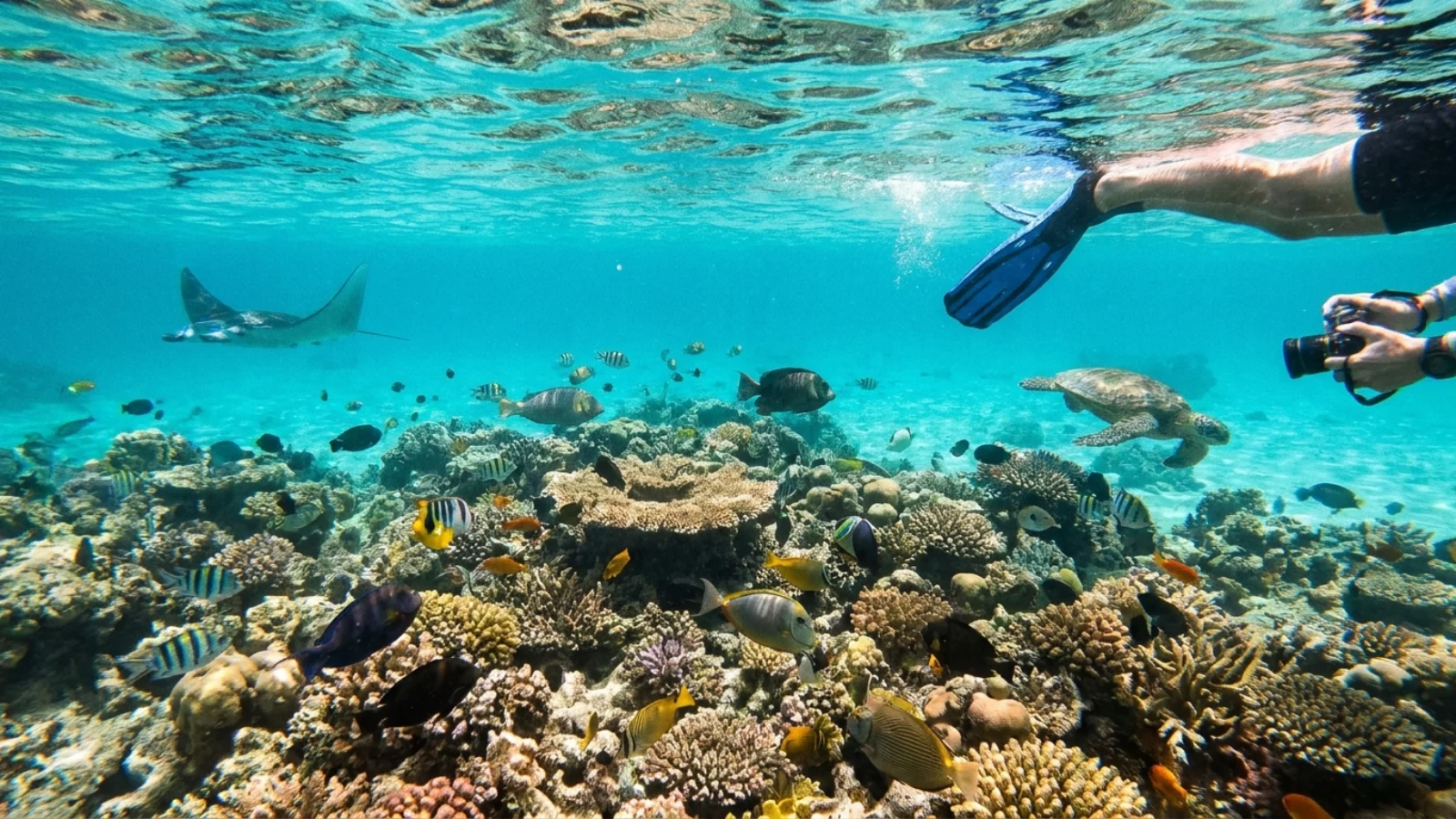
Where is the best snorkeling in the world?
For reef quality reached from shore, Bonaire and Raja Ampat lead. For accessibility and value from the U.S., Hawaii, the Florida Keys, Cozumel and Belize are the realistic best.
| Destination | Why snorkelers go | Best season | Guide |
|---|---|---|---|
| Hawaii | Green turtles, endemic reef fish, volcanic coves | Summer for north shores; year-round on lee coasts | Big Island |
| Florida Keys | North America’s only living barrier reef, shallow spur-and-groove | May–September (calmest seas) | Florida Keys |
| Cozumel | Drift snorkeling over Palancar-area reefs; very clear water | March–June | Cozumel |
| Belize | Hol Chan and Shark Ray Alley on the Belize Barrier Reef | March–June | Belize |
| Bonaire | Shore entries along a fully protected coastline | Year-round; outside the hurricane belt | Bonaire |
| Turks & Caicos | Grace Bay barrier reef, Smith’s Reef, Bight Reef | April–July | Turks & Caicos |
| Raja Ampat | The highest recorded reef-fish and coral diversity | October–April | Raja Ampat |
Which snorkeling destinations are best for beginners and kids?
Pick a lagoon with a sand entry and no current: Hanauma Bay, Bight Reef in Turks and Caicos, Bahia Honda or Sombrero Beach in the Florida Keys, and Akumal or Puerto Morelos in Mexico all fit.
Beginners do best where they can stand up on sand, where a lifeguard is on duty and where the reef starts a few feet from the beach. Kids should wear a snorkel vest regardless of swimming ability. The beginners guide linked above covers clearing a snorkel, defogging a mask and finning without kicking up sand.
Where is the best snorkeling in Florida?
The Florida Keys reef, from Key Largo to Key West and out to the Dry Tortugas, plus two unusual shore dives: the Blue Heron Bridge in Palm Beach County and the springs of Crystal River, where you can snorkel with manatees in winter.
The Florida regional guide covers the Keys reef park by park, then the state’s two oddities get their own pages: the Blue Heron Bridge, a muck-diving shore site snorkeled around high tide, and Crystal River, where manatees gather in warm spring water from November to March. The Southwest Florida coast around Naples, Marco Island and Sanibel has no shallow coral, so snorkeling there means jetties, seagrass and hard-bottom ledges rather than reef.
How do the world’s top snorkeling regions compare?
The shortlist changes with what you value. Raja Ampat, in Indonesia’s West Papua region, is the benchmark for sheer variety. Reef scientist Mark Erdmann puts the count at about 75% of the world’s known hard coral species and more than 1,700 species of fish. The reefs grow right up to the waterline around limestone islets, so a snorkeler floating over a shallow reef top can see much of what divers see deeper down. The catch is distance and cost: it is a long chain of flights and boat transfers from almost anywhere, and most visitors stay on liveaboards or in small homestays and resorts.
The northern Red Sea is the most accessible world-class option for travellers from Europe. Ras Mohammed, at the southern tip of the Sinai, became Egypt’s first protected area in 1983 and covers about 480 km², roughly 345 km² of it sea. More than 220 coral species and over 1,000 fish species have been recorded there. Fringing reefs drop from the shoreline into very clear water, which means snorkelers get dramatic walls and big schools rather than the flat lagoons of the Caribbean.
The Great Barrier Reef is the largest reef system on Earth, but snorkeling it usually means a boat day to an outer reef or a stay on a coral cay such as Lady Elliot or Heron Island. The mainland beaches of north Queensland are not good snorkel entries. Every reef tour passenger pays the Reef Authority’s environmental management charge, collected by the operator: A$8.50 for a full day or A$4.25 for a part day, rising to A$9.00 and A$4.50 from 1 April 2027.
Bonaire is the counterweight to all three. It has neither Raja Ampat’s diversity nor the Great Barrier Reef’s scale, but its whole coastline is a marine park, the reef starts a few meters from the rocks, and yellow-painted stones along the coast road mark the shore entries. For a snorkeler with a rental truck and a mask, few places in the world are easier.
When is the best time of year to snorkel?
Wind and swell matter more than water temperature. In the Caribbean and Mexico, the trade winds blow hardest in winter and early spring, which can chop up exposed coasts, while the Atlantic hurricane season runs from 1 June to 30 November, with the greatest risk from August to October. That leaves late spring and early summer as the sweet spot for much of the region: calm seas, warm water and fewer storms. The Florida Keys follow a similar pattern, with the flattest water usually from May to September.
Hawaii works differently because each island has shores facing every direction. Big winter swells from the North Pacific close north-facing spots such as Shark’s Cove on Oahu and Tunnels on Kauai, while south and west shores stay usable; in summer the pattern flips and south shores take the swell. A good Hawaii trip therefore picks the coast, not just the island.
In the Southern Hemisphere and the tropics the variables change again. Tropical north Queensland has a marine stinger season, roughly November to May, when operators supply full-body lycra suits because box jellyfish and irukandji may be present close to shore. Raja Ampat is usually calmest from October to April, outside the stronger southeast monsoon winds. The Red Sea is snorkelable all year, though winter water is noticeably cooler and a thin wetsuit helps.
What do snorkeling fees cost in 2026, and what do they pay for?
Fees are now the norm at the best sites, and they are one reason those sites are still good. At Hanauma Bay, non-residents pay $25 and must reserve two days ahead; children 12 and under are free, and the bay closes on Mondays and Tuesdays so the reef gets a rest. Bonaire charges a US$40 nature fee per calendar year for visitors aged 13 and older, or US$10 a day for cruise passengers, and the money helps fund management of the island’s marine park, which is run by the STINAPA foundation. Belize’s Hol Chan Marine Reserve charges about US$15, Cozumel visitors pay a daily federal marine park fee (MX$217.32 in the 2025 schedule), and Trunk Bay’s underwater trail on St. John costs $5 for visitors 16 and over. Florida’s Keys state parks charge per vehicle, about $8 in 2026, plus a small county surcharge per person.
Raja Ampat shows why it is worth checking fees close to your trip. Its regency entry fee and the separate marine park charge were both revised in 2025 and 2026, and published figures disagree: a 2026 press report cited 700,000 rupiah, while a resort guide checked in September 2026 cited 1,000,000 rupiah for international visitors under a 2025 regency regulation, plus a separate provincial charge. Treat any figure older than a season as a guide only.
How do you snorkel without damaging the reef?
Most reef damage from snorkelers comes from feet and fins. Enter over sand or from steps, float horizontally with your fins behind you rather than below you, and never stand on coral, even dead-looking rubble, which is often recolonising. If you need to rest, roll onto your back or hold a float rather than putting a foot down. Boats in protected areas tie to mooring buoys rather than dropping anchor, and snorkelers should not grab the buoy line or coral to steady themselves.
Sunscreen is the other issue. Hawaii banned the sale of sunscreens containing oxybenzone and octinoxate from 1 January 2021, and Maui County went further on 1 October 2022, allowing only mineral sunscreens based on zinc oxide or titanium dioxide. Elsewhere the rules are mostly park-level. The simplest approach on any reef is a long-sleeved rash guard, which cuts sunscreen use and protects the back of the neck and the backs of the legs, the places snorkelers burn most often.
Feeding fish is banned in most marine reserves. It changes fish behaviour, crowds aggressive species around snorkelers and spreads food that does not belong on a reef. Sea turtles and Hawaiian monk seals are protected in U.S. waters, and the usual guidance is to stay at least 10 ft (3 m) from turtles and much farther from seals.
How is this section organised?
The section is built as a set of regional guides with deeper pages underneath. The Hawaii guide compares all four main islands and leads to separate pages for Oahu, Maui, Kauai and the Big Island, plus Hanauma Bay and Molokini Crater. The Florida guide covers the Keys reef, Key West, John Pennekamp, the springs and the Gulf coast. The Caribbean guide leads to Puerto Rico, St. Thomas, Aruba, the Bahamas, Turks and Caicos and Belize, and the Mexico guide covers Cozumel, the Riviera Maya and Cancun. Gear, full face masks, beginner technique and the choice between snorkeling and scuba each have their own page, so the destination guides can stay focused on where to go.
What gear do you need to snorkel?
Three pieces do the work: a mask that seals, a snorkel and a pair of fins. In cooler water or strong sun, add a rash guard or thin wetsuit. Add a snorkel vest for kids and nervous swimmers.
A low-volume mask, one with a small air space between lens and face, seals more easily, clears with a single exhale and doubles as a scuba mask if you take up diving later. The full face mask page summarises the lab testing and the March 2026 U.S. Consumer Product Safety Commission warning on one brand before you decide whether that design is worth it. The snorkeling versus scuba page helps if you are weighing whether to learn to dive as well.
Is snorkeling dangerous?
For most people it is a low-risk activity, but it is not risk-free. Hawaii recorded about 45 visitor ocean drownings a year from 2019 to 2023, and snorkeling was the activity most often involved.
The pattern is consistent: people go out alone, in conditions they do not recognise, often with an undiagnosed heart or lung problem. A Hawaii snorkel safety study flagged two mechanisms for further study: inhaling water by accident, and fluid in the lungs (negative-pressure pulmonary edema) from straining to breathe against resistance. Snorkel with a buddy, at a lifeguarded beach on your first day, and if you feel short of breath, lift your head, pull off the mask and float on your back.
A large share of the reefs in this section can be reached by swimming from the beach: Hanauma’s reef flat, Bonaire’s shore sites and the shallows around Cozumel’s piers. A boat earns its fare when it reaches a reef shore snorkelers cannot, such as Molokini Crater off Maui or the outer reefs of the Florida Keys.
- Honolulu Department of Parks & Recreation, Hanauma Bay Nature Preserve; Florida State Parks, John Pennekamp Coral Reef State Park; STINAPA Bonaire, Nature Fee; Civil Beat, “Health officials are perplexed by Hawaiʻi snorkeling deaths” (May 2026); Hawaii Department of Health, EMSIPSB, non-resident ocean drownings 2019–2023; Hawaii Snorkel Safety Study (reported by Undercurrent, April 2026); County of Maui, Mineral-Only Sunscreen ordinance; Hawaii Act 104 (SB2571, 2018)
- Great Barrier Reef Marine Park Authority, “What are the charges” (environmental management charge, current rates and 1 April 2027 increase)
- The Star / Asia News Network, “A marine Eden at a tipping point” (2 May 2026): Raja Ampat coral and fish counts quoted from Mark Erdmann, nickel-mining concessions, 700,000-rupiah park fee
- Raja Ampat Biodiversity resort guide, “Update on official fees in Raja Ampat” (reviewed 17 September 2026; commercial source): IDR 1,000,000 regency fee
- Wikipedia, “Ras Muhammad National Park”: 1983 protection, area, coral and fish species counts
- Bonaire.com, Nature Fee (updated October 2026); San Pedro Sun, Hol Chan park fee (August 2024); Mexico Ley Federal de Derechos 2025 schedule (Cozumel); National Park Service, Trunk Bay fees; Florida State Parks fees (2026)
- NOAA Fisheries Pacific Islands, viewing guidelines for sea turtles and Hawaiian monk seals; NOAA National Hurricane Center, Atlantic hurricane season dates
Where is the best snorkeling in the world?
For reef health reached from shore, Bonaire and Raja Ampat are usually ranked at the top, followed by the Red Sea, the Great Barrier Reef’s cays and Belize. From the U.S., Hawaii and the Florida Keys are the best easy options.
Where is the best snorkeling in the U.S.?
Hawaii (Hanauma Bay, Molokini, Kahaluu, Two Step) and the Florida Keys (Key Largo’s reefs, Looe Key, Dry Tortugas) are the strongest. The U.S. Virgin Islands are also excellent.
What is the best month for snorkeling?
It depends on the place. In the Florida Keys and Caribbean, May to September is calmest; in Hawaii, summer is best for north-facing shores and winter for south-facing ones.
Is snorkeling good for non-swimmers?
Only with flotation. A snorkel vest or a float lets non-swimmers stay at the surface, but they should stay in shallow, calm water with a guide or a strong swimmer.
Do I need to bring my own snorkel gear?
Not always, since rentals are everywhere, but your own mask fits better and is cleaner. Many travellers bring a mask and snorkel and rent fins.
How deep is the water when snorkeling?
Most good snorkel reefs sit 3 to 15 ft (1 to 5 m) deep. Deeper than about 20 ft, you see less colour and need to free-dive to get close.
Are full face snorkel masks safe?
Some designs performed poorly in a 2022 lab study and many Hawaii tour operators ban them. A traditional mask and snorkel is the safer default.
Is reef-safe sunscreen required?
In Hawaii, sunscreens with oxybenzone or octinoxate have been banned since 2021, and Maui County allows only mineral sunscreens. Elsewhere it is often a park rule rather than a law.
8 shore spots beyond Molokini and when to go.
Hanauma Bay and 7 Free Alternatives.
Tunnels, Ke’e, Anini and Poipu by Season.
Reef Trips, Fort Zach and the Dry Tortugas.
Tours, Christ of the Deep and Honest Tips.
Naples, Marco Island, Sanibel and Venice Honestly Rated.
Culebra, Rincon, Vieques and San Juan.
Coki, Secret Harbour, Brewers Bay and a St. John Day Trip.
Boca Catalina, Mangel Halto, Baby Beach and the Antilla Wreck.
Exumas, Thunderball Grotto, Andros and Bimini.
MUSA, Isla Mujeres, Puerto Morelos and Day Trips.
Snorkeling With Humpback Whales in the Dominican Republic.
Blane Perun has been exploring Earth’s oceans and marine life for over 25 years. Founder of TheSea.Org in 1999, underwater photographer, coral aquaculture pioneer, and explorer of 80+ countries.
About Blane Perun →