Best Snorkeling on the Big Island — Kona Coast Reefs & Night Mantas
The best snorkeling on the Big Island is on the sheltered, dry Kona coast. The top three are Kealakekua Bay (the Captain Cook Monument at Kaʻawaloa, a 315-acre Marine Life Conservation District reached by boat, a guided tour with a permitted kayak vendor or the steep Kaʻawaloa Trail), Two Step at Hōnaunau Bay beside Puʻuhonua o Hōnaunau, and Kahaluʻu Beach Park, a shallow, turtle-filled lagoon near Kailua-Kona. At night, the Kona manta ray snorkel is one of the world’s great wildlife encounters. A federal rule bans approaching spinner dolphins within 50 yards.
Big Island — at a glance
- Best coast: Kona (west): dry, sheltered from the trade winds
- Kealakekua Bay: 315-acre MLCD; every vessel needs a State Parks permit; Kaʻawaloa Flats by trail or a permitted guided tour
- Two Step: Outside the national park at the Hōnaunau boat ramp; do not enter at the park’s Keoneʻele Cove
- Kahaluu: Shallow lagoon, sand and rock entry, lifeguarded, many turtles
- Spinner dolphins: Stay at least 50 yards away (federal rule)
- Sunscreen: Oxybenzone and octinoxate banned statewide; NPS lists seven ingredients to avoid
- Visibility: The young lava coast sheds little sediment, so Kona water is usually very clear
- Captain Cook: Cook arrived in January 1779 and was killed at Kaʻawaloa the next month; a 27-ft monument (1878) marks the site
- Kealakekua hike: The historic Kaʻawaloa Trail is steep, with no restrooms; pack out all trash
- Mantas: Manta rays feed on plankton drawn by lights off Kona at night, year-round
Where is the best snorkeling on the Big Island?
Kealakekua Bay is the best, followed by Two Step at Hōnaunau Bay and Kahaluʻu Beach Park. All three are on the Kona coast, which is dry, calm in the mornings and very clear.
Young lava shorelines shed little sediment, so the water off Kona is some of the clearest in Hawaii. The coast is mostly rock, so entries are trickier than on Maui; booties are worth packing. Mornings are calmest before the afternoon sea breeze.
| Spot | Access | Depth | Best for | Notes |
|---|---|---|---|---|
| — | — | — | — | — |
| Kealakekua Bay (Kaʻawaloa) | Boat, guided kayak tour with a permitted vendor, or Kaʻawaloa Trail | 5 ft to deep drop-off | Coral, fish, clarity | MLCD; every vessel needs a State Parks permit |
| Two Step (Hōnaunau) | Lava ledge “steps” into the water | Shallow ledge to 30 ft+ | Coral and turtles | Park outside the NPS gate |
| Kahaluʻu Beach Park | Sand and rock | 3–10 ft | Beginners, turtles | Lifeguard; crowded midday |
| Kona manta night snorkel | Boat only | Surface, over 30–40 ft | Manta rays | Evening tours |
| Mauna Kea Beach / Beach 69 | Sand beaches, Kohala coast | Shallow | Calm summer days | Winter swell can hit |
Is Kealakekua Bay worth it?
Yes. It is one of Hawaii’s best snorkels: a 315-acre Marine Life Conservation District with healthy coral, huge fish numbers and often outstanding visibility at Kaʻawaloa, below the Captain Cook Monument.
Getting there is the challenge. State Parks requires a permit for every vessel that transits the bay, from kayaks and canoes to stand-up paddleboards and inflatables. Visitors can reach Kaʻawaloa Flats on foot by the historic Kaʻawaloa Trail from the uplands, or on a guided kayak tour with a permitted commercial vendor; other permitted vessels may not land at Kaʻawaloa or launch from the Nāpōʻopoʻo wharf. Snorkel boats from Kona are the other common option. Taking or feeding marine life is banned throughout the district. Spinner dolphins rest in the bay by day: stay at least 50 yards from them.
How do you snorkel Two Step?
Enter from the flat lava ledge next to the Hōnaunau boat ramp, where two natural steps lead into the water. The reef starts immediately, with coral and fish in shallow water and a drop-off further out.
Two Step is outside Puʻuhonua o Hōnaunau National Historical Park, on county land at the boat ramp. The park asks snorkelers to park outside its gate and not to enter the water at Keoneʻele Cove inside the park, a sacred site where turtles rest. Watch for boats using the ramp, and avoid the sunscreen chemicals the park lists, including oxybenzone and octinoxate (see below).
What should you know about Kealakekua Bay before you go?
Kealakekua Bay is two protected areas in one. The water is a Marine Life Conservation District. DLNR’s Division of Aquatic Resources gives its size as 315 acres and its date of establishment as 1969, and it runs from the high-water mark to a line between Cook Point and Manini Beach Point. A line from Cook Point to the north end of Nāpōʻopoʻo Beach divides it into two subzones. In the northern Subzone A, which includes Kaʻawaloa Cove, anchoring is prohibited. In Subzone B to the south, the only fishing allowed is for finfish with hook and line or thrownet, and anchors may only be dropped on sand or placed so they avoid coral. Fish feeding is banned throughout, as is taking or damaging any marine life or geological feature.
The shore is Kealakekua Bay State Historical Park. State Parks describes it as the site of the first extensive contact between Hawaiians and Westerners, with the arrival of Captain Cook in 1779. On the Nāpōʻopoʻo side stands Hikiau Heiau, a traditional religious site that has been restored several times after tsunami and high-surf damage; it remains sacred to Hawaiians, and visitors are asked not to walk on it. The park is open daily from 7 a.m. to 8 p.m., charges no entrance fee, and has restrooms only in the Nāpōʻopoʻo section. Storm surf has covered the once-sandy beach at Nāpōʻopoʻo with boulders.
In the water, DLNR describes the diversity of coral and fish as exceptional and the fish as quite tame. Kaʻawaloa Cove drops from about 5 ft to about 120 ft, so you can snorkel over a shallow reef that falls away into blue water. Off Nāpōʻopoʻo, encrusting coral, caves, crevices and ledges reach about 30 ft. There are no lifeguards, and DLNR warns that the bay becomes dangerous during high surf and southerly kona storms. Spinner dolphins are commonly seen inside the bay, usually resting.
A practical plan for the bay is to decide first how you will reach Kaʻawaloa. A guided kayak tour handles the permit question and the landing for you; a snorkel boat from Kona gives the easiest access to the cove without a paddle; and the trail suits fit hikers who are prepared for heat and no facilities. Whichever you choose, go early, when the water is usually calmest, carry plenty of drinking water, and leave the dolphins and the reef exactly as you found them.
Cook’s story explains the white monument. He arrived in the bay in January 1779 and was killed the following month in a skirmish on the shore of Kaʻawaloa Cove. A 27-ft monument was put up near the site in 1878. It is a landmark to snorkel by, but the most important history of the bay is Hawaiian, and the remains of the village at Kaʻawaloa and the heiau on the opposite shore are a reminder that this is a cultural landscape as well as a reef.
How should you snorkel at Two Step and visit the place of refuge?
The National Park Service is clear about one point that many guidebooks get wrong: Two Step is not in Puʻuhonua o Hōnaunau National Historical Park. It is just outside, at the Hōnaunau Bay boat ramp, and access to the water there is managed by the County of Hawaiʻi. A one-way public road leads to the snorkeling area, with a coastal access sign before the park entrance. The park’s small car park tends to fill by midday, so the NPS asks people who are only going to snorkel or sunbathe to park outside the park gate and leave the spaces for park visitors. Snorkelers are also asked not to use the park’s restrooms to change or rinse off.
Inside the park, Keoneʻele Cove is closed to snorkelers; the NPS describes it as an important cultural site. The fee collected at the park kiosk is an entrance fee for visiting the sacred grounds of the puʻuhonua, the place of refuge, so a visit to the park itself is a separate and worthwhile part of the trip rather than a parking charge for the snorkel.
In the water, the main hazards are the entry and the boats. Two Step is primarily a working boat ramp, so look out for boat traffic, and time your entry and exit with the waves rather than stepping down blindly. The NPS advises checking ocean conditions before getting in, snorkeling with a buddy, checking your gear first, not touching or standing on coral, and keeping a safe distance from all marine wildlife. On sunscreen, it notes that Hawaii was the first state to ban the sale of sunscreens with chemicals harmful to corals, from January 1, 2021, and asks visitors to avoid products containing oxybenzone, avobenzone, homosalate, octinoxate, octisalate, octocrylene and nanoparticles.
Where should beginners snorkel on the Big Island?
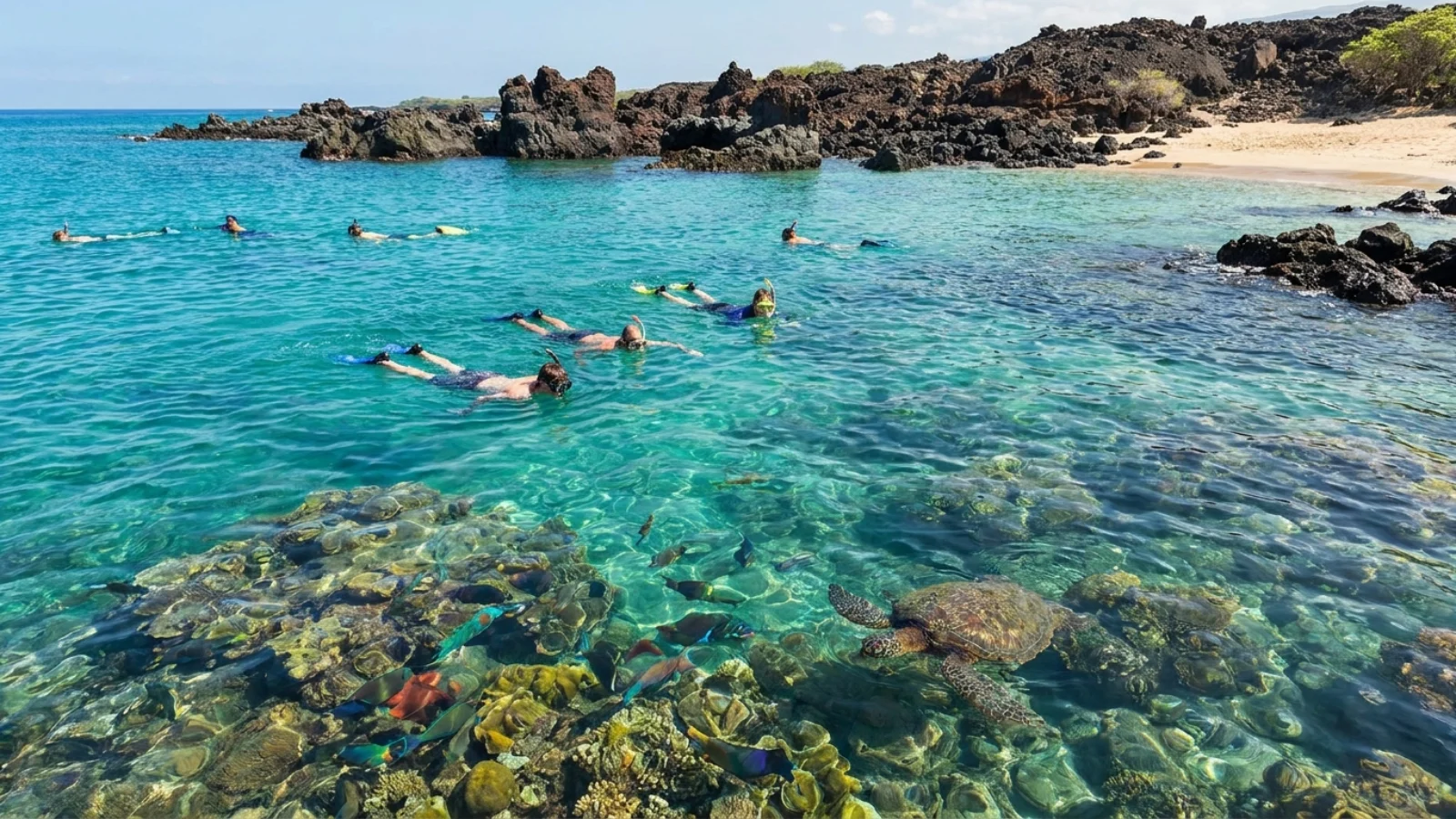
Kahaluʻu Beach Park, just south of Kailua-Kona. A breakwater built in ancient times shelters a shallow lagoon full of tangs, wrasses, parrotfish and green sea turtles, and it has a lifeguard.
Go early, before the crowds, and never stand on the coral. Our snorkeling for beginners guide covers the basics.
Is the manta ray night snorkel worth it?
Absolutely, for most people. Boats from Kona anchor off the coast after dark and shine lights that attract plankton; manta rays swoop and barrel-roll beneath snorkelers holding a lighted float.
You float at the surface the whole time and never touch the mantas. We cover the experience in detail in manta ray night snorkel Hawaii.
What is the history of Kahaluʻu Bay?
Kahaluʻu is more than a beginner’s snorkel spot. The area has been inhabited for about 500 years and in the 18th and 19th centuries was an important royal residence. Its best-known feature is Pā o ka menehune, a breakwater built in ancient Hawaii that may once have enclosed the whole bay, and the bay is unusual for the concentration of about ten heiau built around it with dry-stacked stone. The district, about 700 acres, was added to the U.S. National Register of Historic Places on December 27, 1974. The south end of the bay became Kahaluʻu Beach County Park in 1953.
The same features that make the bay historically important also make it good for snorkelers. The old breakwater and the reef take the energy out of most waves, leaving a shallow, sheltered area where green turtles graze on algae and reef fish gather in large numbers. Because it is so shallow and so popular, it is also one of the places where trampling is most likely to damage coral. The Kohala Center runs a volunteer programme called ReefTeach at the bay to explain to visitors how to snorkel without harming the reef. The beach itself is rocky with some grey sand, so reef shoes help.
How does the Kona manta ray night snorkel work?
The manta snorkel depends on a simple chain of events. Lights attract plankton, and plankton attracts manta rays. On a night trip, divers on the bottom shine their lights upwards while snorkelers at the surface hold a lit float and shine lights downwards, creating a column of light full of plankton. The mantas swim through it with their mouths open to filter-feed, often turning back on themselves in slow loops just below the snorkelers.
The number of mantas varies with the amount of plankton: on some nights none appear, while on nights with a lot of plankton there can be a dozen or more. Trips run year-round rather than in a particular season. For decades, people watched mantas from hotels and restaurants along the coast, including the Kona Surf Hotel, which closed in 2002. Dive operators began taking divers to see them in 1992, and the trips gradually became an almost nightly business. Today the main sites are off the Sheraton at Keauhou Bay, known as Manta Village, and at Garden Eel Cove near Kona International Airport, also called Manta Heaven; there is also a site between Kawaihae Harbor and the Kohala resorts. Most boats leave from Honokōhau Harbor.
Guidelines for the encounter were drawn up by the Ocean Recreation Council of Hawaii and PADI’s Project AWARE, and responsible operators enforce them. The key rules for snorkelers are to stay at the surface, keep your legs up and still, and never try to touch a manta. The guidelines exist because mantas are easily harmed by contact, so the rule is hands off even if a manta passes within inches of your mask.
Why can’t you swim with the dolphins in Kealakekua and Hōnaunau?
Kealakekua and Hōnaunau bays are classic daytime resting places for Hawaiian spinner dolphins, and for years swimming out to them was sold as a highlight of a Kona trip. That changed with a NOAA Fisheries rule that took effect on October 28, 2021. Within 2 nautical miles of shore around the main Hawaiian Islands, it is now illegal to swim with, approach or remain within 50 yards of a spinner dolphin, or to put a person, a vessel or an object in a dolphin’s path so that it ends up within 50 yards.
The reason is behaviour. Spinner dolphins hunt in deep water at night and come into sheltered bays to rest during the day. NOAA explains that disturbing them while they rest keeps them alert, makes them use energy moving away, and can push them out of the shallow bays that protect them from predators, leaving less energy for feeding and raising calves. If dolphins approach you while you are snorkeling, you are not breaking the rule as long as you do not follow them and move away. Watching from a respectful distance, from the shore or the surface, is the right way to enjoy them.
How safe is snorkeling on the Kona coast?
The Kona coast is often calm, but its lava shoreline and lack of lifeguards at several top spots call for care. Across Hawaii, the state Department of Health found that snorkeling was the most common activity in non-resident ocean drownings in 2019 to 2023, accounting for 87 of 202 victims (about 43%), and that snorkelers who died were on average 58 years old. A 2022 study in the Hawaiʻi Journal of Health & Social Welfare by P. R. Foti, C. M. Wilcox and R. S. Goto identified two drowning mechanisms in snorkelers that need further study: accidental inhalation of water, and hypoxia caused by rapid-onset negative-pressure pulmonary oedema.
The practical lessons are the same on every island. Snorkel with a partner; choose Kahaluʻu, which has lifeguards for limited hours, if you are unsure of your ability; check the surf before you go, since south and west swells can make Kona entries dangerous; and if you feel short of breath, stop, lift your head, remove the mask and float on your back. On lava entries such as Two Step, sit down and slide in rather than jumping, and get out where you got in.
One weird Big Island fact
The “Two Step” ledge is a natural lava formation, not man-made: two flat shelves at just the right heights to step down into the water.- Hawaii DLNR Division of Aquatic Resources: Kealakekua Bay MLCD (HAR 13-29)
- Hawaii DLNR Division of State Parks: Kealakekua Bay State Historical Park (permits, vendors, access)
- National Park Service: Puʻuhonua o Hōnaunau, snorkeling
- Wikipedia: Kahaluʻu Bay; Manta ray night dive (secondary summaries, 2023 snapshot)
- NOAA Fisheries: new regulation protects Hawaiian spinner dolphins against disturbance (2021)
- Hawaii Department of Health, EMSIPSB: non-resident ocean drownings 2019–2023 (August 2024); Foti, Wilcox & Goto, Hawaiʻi Journal of Health & Social Welfare (2022)
- Hawaii Act 104 sunscreen law (SB2571, 2018)
Where is the best snorkeling on the Big Island?
Kealakekua Bay at the Captain Cook Monument, Two Step at Hōnaunau Bay, and Kahaluʻu Beach Park, all on the Kona coast.
Can you kayak to the Captain Cook Monument?
Every vessel in the bay needs a State Parks permit. To reach Kaʻawaloa Flats by water, book a guided kayak tour with one of the permitted commercial vendors; other permitted kayaks may not land there.
Is Two Step good for beginners?
Confident beginners can manage it on a calm day, but the entry is off a lava ledge into deeper water. Kahaluʻu is easier.
Where can you snorkel with turtles on the Big Island?
Kahaluʻu Beach Park and Two Step are reliable. Keep at least 10 ft away.
Can you swim with dolphins in Kealakekua Bay?
No. Federal rules prohibit approaching Hawaiian spinner dolphins within 50 yards, including by swimming.
Is the manta ray night snorkel safe?
Yes with a reputable operator. You float at the surface holding a lit board; mantas have no stinger.
When is the best time to snorkel on the Big Island?
Mornings year-round on the Kona coast. Summer brings occasional south swell; winter can bring north-west swell to the Kohala coast.
Blane Perun has been exploring Earth’s oceans and marine life for over 25 years. Founder of TheSea.Org in 1999, underwater photographer, coral aquaculture pioneer, and explorer of 80+ countries.
About Blane Perun → All snorkeling destinations →