Best Snorkeling in Oahu — Hanauma Bay & 7 Free Alternatives
The best snorkeling in Oahu is at Hanauma Bay, a protected crater reef ($25 for non-residents, reserve two days ahead, closed Mondays and Tuesdays). The best free alternatives are Shark’s Cove in the Pupukea Marine Life Conservation District (summer only), Kuilima Cove at Turtle Bay, the four Ko Olina lagoons, Queen’s Beach and Sans Souci in Waikiki, Kaiona Beach Park in Waimanalo and, for strong swimmers only, Electric Beach at Kahe Point. North Shore spots are for summer; winter swells make them dangerous.
Oahu snorkeling — at a glance
- Best overall: Hanauma Bay (fee, reservation, lifeguards)
- Best free, summer: Shark’s Cove, Pupukea (no lifeguards)
- Best for kids: Ko Olina lagoons, Kuilima Cove, Hanauma’s inner reef
- Strong swimmers: Electric Beach: long swim to the reef, currents, no lifeguard
- Best season: Summer for North Shore; South and West shores calmer in winter
- Sunscreen: Oxybenzone and octinoxate banned statewide since 2021
- Hanauma Bay: $25 non-residents, free for 12 and under; $3 parking, cash
- Pupukea: One of Oahu’s Marine Life Conservation Districts; take of marine life is restricted
- Ko Olina: Four man-made lagoons; 111 free public parking stalls under a 2020 agreement with the city
- Ocean safety: Check the state’s Hawaii Ocean Safety site for daily surf and hazard reports
Where is the best snorkeling in Oahu?
Hanauma Bay is the best and easiest. If you cannot get a reservation, go to Shark’s Cove in summer, Kuilima Cove or the Ko Olina lagoons year-round, or Queen’s Beach in Waikiki on a calm morning.
Oahu’s reefs are more fished and more crowded than Maui’s or the Big Island’s, so the protected areas stand out. Hanauma Bay has been a Marine Life Conservation District since 1967, and the Pupukea MLCD on the North Shore covers Shark’s Cove and Three Tables. Outside those, choose sheltered coves where the reef breaks the swell.
| Spot | Shore | Entry | Fee | Best for | Season |
|---|---|---|---|---|---|
| — | — | — | — | — | — |
| Hanauma Bay | Southeast | Sand beach | $25 + $3 parking | Everyone | Year-round |
| Shark’s Cove | North | Lava rock, booties | Free | Fish, tide pools | Summer only |
| Kuilima Cove | North (Turtle Bay) | Sand beach, sheltered | Free | Families | Calm days |
| Ko Olina lagoons | West | Sand, man-made coves | Free | Kids | Year-round |
| Electric Beach (Kahe) | West | Swim past shore break | Free | Strong swimmers | Calm days |
| Queen’s / Sans Souci | Waikiki | Sand, reef wall | Free | Convenience | Calm mornings |
| Kaiona Beach Park | Windward | Reef close to shore | Free | Turtles | Calm days |
| Lanikai | Windward | Public paths to sand | Free | Shallow lagoon | Early morning |
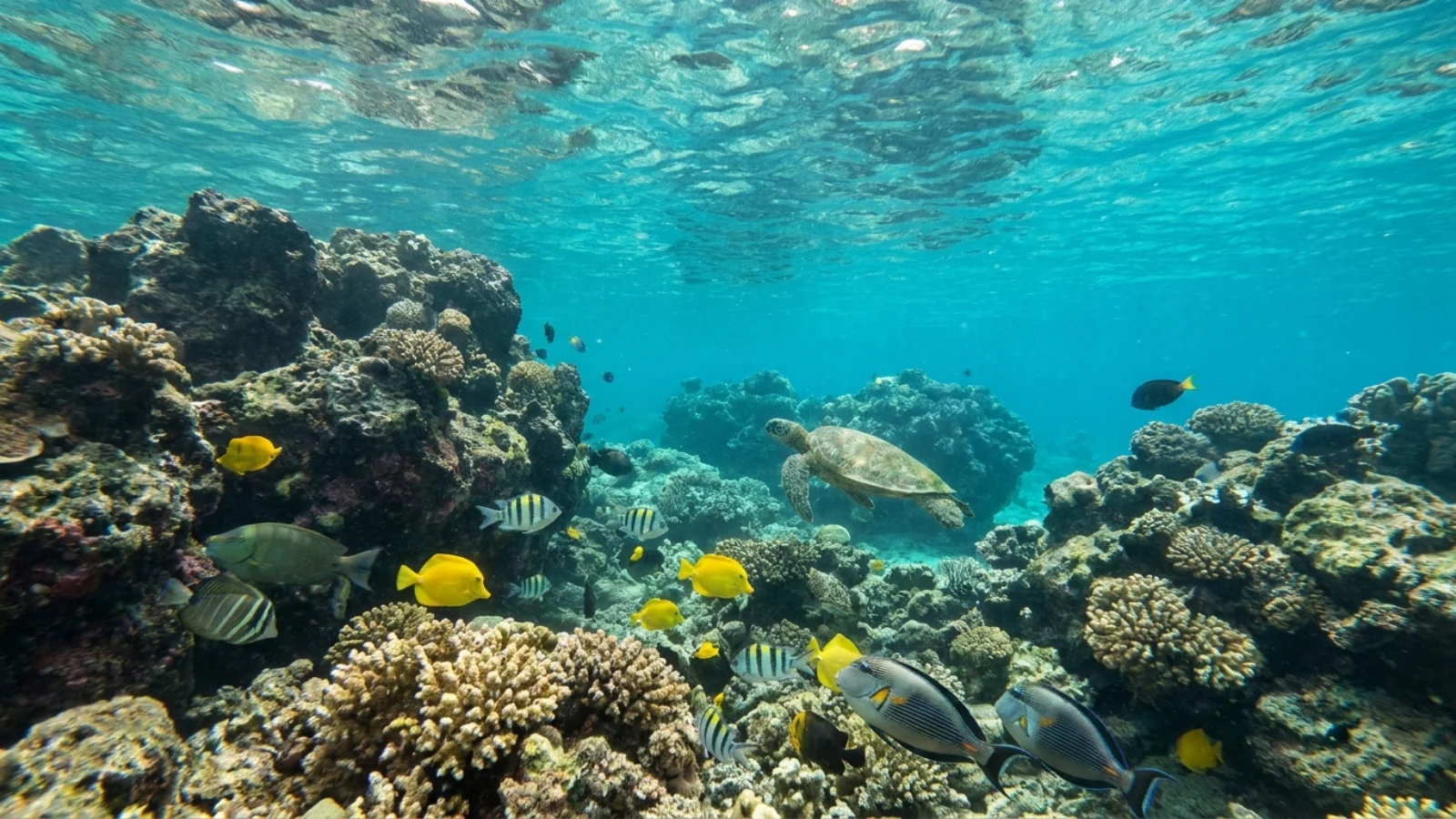
Is Shark’s Cove good for snorkeling?
Yes, in summer. Its lava pools and reef inside the Pupukea Marine Life Conservation District are full of fish when the sea is flat, which DLNR says is generally about May through October. In winter big North Shore swells make it dangerous, and there are no lifeguards.
Wear booties, as the entry is over sharp lava, and stay inside the cove. Despite the name, it is not known as a shark hotspot. Arrive early on weekends; parking fills quickly along Kamehameha Highway.
Where is the best snorkeling in Oahu for kids?
The Ko Olina lagoons on the west side and Kuilima Cove at Turtle Bay. Both are sheltered by rock barriers, have sand entries and calm water, and are free.
The Ko Olina lagoon beaches are public, but the free public parking stalls are limited, so go early. At Kuilima, stay inside the natural barrier; the current is strong outside it. Neither has a lifeguard, so put children in a snorkel vest.
Is Electric Beach safe?
Only for strong swimmers in calm conditions. The reef around the power plant’s warm-water outflow is a long swim offshore, there are no lifeguards and currents can be strong.
The warm-water discharge attracts fish and sometimes spinner dolphins, which is why it is popular. Do not attempt it in surf, and swim with a buddy.
How do Oahu’s four coasts change through the year?
Oahu is easiest to understand as four coasts that take turns being calm. The North Shore faces the swells generated by winter storms in the North Pacific, which is why Waimea Bay and Sunset Beach are famous for big-wave surfing between roughly November and March. The same coast is often flat in summer. The south shore, from Ala Moana through Waikiki to Diamond Head, works the other way: it is sheltered from the winter swells but picks up long-period south swells from the Southern Hemisphere in summer, so a Waikiki snorkel that is easy in January can be bumpy in July. In practice the reef flats inside Waikiki and the lagoons of the west side stay usable for much of the year, while the open points do not.
The windward (east) coast, from Kaneohe to Waimanalo, faces the northeast trade winds. Those winds blow most days, strongest in the afternoon, and push a light chop onto beaches such as Kailua, Lanikai and Kaiona. The leeward (west) coast, from Kapolei to Makaha, sits in the island’s rain shadow. It is dry and sunny, the water is often very clear, and it is sheltered from the trades, but it is exposed to both north and south swells wrapping around the island, and the currents off the points can be strong. A sensible way to plan an Oahu snorkel day is to decide on the coast first, using the day’s surf forecast, and only then choose a beach.
What makes the Pupukea Marine Life Conservation District worth the drive?
The Pupukea MLCD is the North Shore’s protected reef and the main reason Shark’s Cove and Three Tables are so full of fish. The state created it in 1983 under Hawaii Administrative Rules chapter 13-34, and after public hearings in 2002 and 2003 it was substantially enlarged and its rules rewritten. According to the community group Malama Pupukea-Waimea, which helps manage it, the district now covers more than 180 acres of ocean, a larger area than the Hanauma Bay district. It runs offshore of Pupukea and Waimea Bay beach parks, from the high-water mark out 100 yards, between Kulalua Point in the north and the Wananapaoa Islets off Waimea Bay in the south. A 2021 rule revision formally brought the tide pools beside Shark’s Cove into the district and added a ban on feeding any marine life.
Inside the district, the Division of Aquatic Resources (DAR) prohibits fishing for, taking, injuring or removing any marine life, including eggs and shells, and taking or altering rocks and other geological features. Two small exceptions remain: a person may hand-pick up to two pounds of two native seaweeds, limu kohu and limu lipe’epe’e, leaving the holdfast in place, and limited shore fishing and seasonal net fishing for opelu and akule are allowed in Waimea Bay only. Carrying a spear or other fishing gear in the water at Shark’s Cove or Three Tables is itself a violation.
DAR’s site notes describe Shark’s Cove as fairly shallow, with depths up to about 20 ft at the mouth and a bottom outside that slopes to about 45 ft. Visibility inside the cove is often poor, but improves quickly once you swim out of it, and the outer area has caves that make it a popular night dive. Three Tables, at the southern end, is named after flat sections of reef that are exposed at low tide; the water near the tables averages about 15 ft, and the best diving is at 30 to 45 ft, among ledges, arches and lava tubes. DAR warns that currents and waves become extremely dangerous throughout the district in winter, including in the tide pools, and that calmer conditions generally prevail from about May through October, although surges can still occur in summer.
What is the Waikiki Marine Life Conservation District?
Most visitors to Waikiki do not realise that part of the beach in front of them is a protected reef. The Waikiki MLCD, established in 1988, covers about 76 acres between the groin at the end of Kapahulu Avenue and the western wall of the War Memorial Natatorium. It extends 500 yards out from the high-water mark or to the edge of the fringing reef, whichever is greater. This is the stretch of shoreline that includes Queen’s Beach and the water off Kapiolani Park, and it is the reason those spots have more fish than the rest of Waikiki.
DAR is candid about what the reef is like. The reef flat is mostly rubble and coralline algae, with a layer of sediment, and the water over it is generally less than 3 to 4 ft deep; a dredged channel runs to about 8 ft. The richest life is at the outer reef edge, where the bottom drops to roughly 15 to 20 ft and there are arches and crevices full of fish. That outer edge is a longer swim and is exposed to summer south swells, so the reef flat is the realistic target for most snorkelers. Lifeguards are on duty year-round at the Waikiki end. In April 2026 DLNR announced the first coral outplanting inside the district: DAR’s Hawaii Coral Restoration Nursery, working with the Waikiki Aquarium, planted nursery-grown corals on the reef flat between the aquarium and the Natatorium, an effort the state described as showing that restoration is already under way.
How do you snorkel Oahu’s west side?
The west side has the island’s calmest man-made option and one of its most demanding natural ones. The four lagoons at Ko Olina were cut into the shoreline as part of the resort development, and rock barriers at their mouths keep the water inside quiet. The beaches are public, but access depends on the resort’s public parking lots, and that arrangement has been tested. In 2020, after a pandemic closure, the resort reopened its beaches but kept public lots shut, and in October of that year Honolulu’s Department of Planning and Permitting issued it a notice of violation. Under a subsequent agreement with the city, Ko Olina made 111 stalls available across four free public lots, and in February 2021 it announced that all of its lagoon parking would reopen. The lots still fill early on weekends and holidays.
The snorkeling inside the lagoons is gentle rather than spectacular: small reef fish around the boulders of the breakwaters, occasional turtles, and sand bottoms where young children can stand. The outer edges of the rock barriers are where the fish are thickest, and that is also where the water meets the open ocean, so children should stay well inside.
Electric Beach, at Kahe Point Beach Park a few minutes north, is a different proposition. Warm water from the Kahe power plant’s cooling system is released offshore, and the outflow attracts large schools of fish and sometimes spinner dolphins. The reef is a long swim from the beach across water that can carry strong currents, the entry crosses a shore break, and there is no lifeguard. It suits experienced, fit snorkelers on a flat day; on any other day the lagoons are the better choice. If spinner dolphins appear, the federal rule that keeps people 50 yards away applies here as everywhere else within 2 nautical miles of the main islands.
What should you know about the windward side and Kaneohe Bay?
Kaneohe Bay is the largest sheltered body of water in Hawaii, and it is a good example of both reef damage and reef repair. Two seaweeds introduced in the early 1970s for aquaculture trials, Gracilaria salicornia (known locally as gorilla ogo) and a group of Kappaphycus and Eucheuma species, spread across the bay and began smothering coral. In 2005, DAR, The Nature Conservancy and the University of Hawaii built the first “Super Sucker”, a barge-mounted vacuum that divers fed with algae at a rate of 600 to 1,000 lb an hour. Between October 2012 and August 2013 alone, crews removed about 250,000 lb of invasive algae from 20 acres of reef.
Vacuuming could clear a patch but not stop regrowth, so the state turned to a native herbivore, the collector urchin Tripneustes gratilla. DAR’s hatchery has produced about 5,000 juvenile urchins a month for release on cleared reefs, and it outplanted its millionth collector urchin by 2023. Research suggests about two urchins per square metre are needed to keep the seaweed in check; DAR’s stated goal is to hold invasive algae cover below 5%, and by 2016 manual removal was no longer needed. The bay’s earlier history also matters: sewage once discharged into the southern bay was diverted out of it in the late 1970s, and the coral community’s recovery after that change became one of the best-documented cases in Hawaii. For snorkelers, most of the bay’s reefs are reached by boat, and the water is often murky, so it is more interesting as a story than as a casual snorkel stop.
Further south, the shallow lagoon at Lanikai and the beach at Kaiona in Waimanalo are the windward side’s more practical snorkels, best early in the day before the trades build. The twin islets off Lanikai, Na Mokulua, are state wildlife sanctuaries under a 1932 executive order that set them aside for the protection of bird, animal and plant life. They are a popular kayak destination, but in June 2024 a Hawaiian monk seal gave birth on Mokulua Nui, and the state’s forestry and wildlife division suspended commercial landing permits for the islets while the pup was nursing. Landing rules there can change at short notice, so check DLNR notices before paddling out.
Where do turtles and monk seals show up on Oahu?
Green sea turtles feed on the seaweed that grows on almost every rocky shoreline around Oahu, so snorkelers can meet them in Hanauma Bay, at Kuilima Cove, off Waimanalo, along the Ko Olina breakwaters and on the North Shore. Laniakea Beach, between Haleiwa and Waimea, became so well known for turtles basking on the sand that volunteers now rope off resting animals and talk to the crowds; it is a place to watch turtles on land rather than a snorkel site, and parking along the highway there is a long-standing safety concern. NOAA’s viewing guidance of at least 10 ft applies in the water as well as on the beach.
Hawaiian monk seals are much rarer, with about 1,600 in total and only around 400 in the main islands, but Oahu has a surprising number of sightings because so many people are on its beaches. Seals haul out to rest and sometimes give birth on busy shorelines, including spots near Waikiki and on the windward coast, and NOAA and volunteer groups then set up a temporary resting area with signs and rope. A nursing mother can be dangerous to approach in the water as well as on land. If one appears while you are snorkeling, move calmly away and leave the area to the seal.
When are Oahu’s jellyfish days?
Oahu has a predictable jellyfish calendar that is worth checking before a south-shore snorkel. The Hawaiian box jellyfish, Alatina alata, comes inshore to spawn about 8 to 10 days after each full moon, and the south-facing beaches, including Waikiki, Ala Moana and Hanauma Bay, are where it is most often reported. Lifeguards post warning signs on those days, and the sting is painful enough to end a holiday afternoon. Portuguese man-of-war are a different problem: they are blown onto windward beaches such as Kailua and Waimanalo by strong onshore winds, regardless of the moon. A quick look at the lunar calendar and the lifeguard boards prevents most encounters; our page on jellyfish in Hawaii explains first aid.
How should you choose between Hanauma Bay and the free spots?
Hanauma Bay is the safe choice when you can get a reservation and want a guarded beach, a sheltered reef and an educational briefing in one package. Its limits are the fee, the closed days, the booking window and the crowds; our separate Hanauma Bay guide covers the preserve’s rules, history and reef science in detail. The free spots demand more judgement but reward it. In summer, a calm-morning visit to Shark’s Cove or Three Tables gives you a protected reef with as many fish as Hanauma and far fewer people. Year-round, Kuilima Cove and the Ko Olina lagoons are the gentle options for families, and the Waikiki MLCD is the obvious choice for anyone staying in Waikiki who wants to snorkel before breakfast.
Whatever the choice, the order of decisions is the same: surf forecast first, then coast, then beach, then arrival time. Hawaii Ocean Safety, the state and county site that collects lifeguard reports, lists each guarded beach’s current hazards, including high surf, strong currents and jellyfish. Beaches without towers, which include most of the coves on this page, have no one watching, so stay with a buddy, stay inside the reef and leave when the waves pick up.
What will you see snorkeling on Oahu?
Green sea turtles, yellow and convict tangs, butterflyfish, parrotfish, Moorish idols and the state fish, the humuhumunukunukuapuaa.
See humuhumunukunukuapuaa, Moorish idol and yellow tang for fish ID, and Hawaiian sea turtle for how to behave around the honu. Our Coral Reefs Hawaii page explains the reef itself.
One weird Oahu fact
Electric Beach gets its name from the Kahe Point power plant: its cooling-water outflow warms the water over the reef, and the fish gather around the pipes.- City and County of Honolulu, Department of Parks and Recreation: Hanauma Bay Nature Preserve (fees, hours, reservations)
- Hawaii DLNR Division of Aquatic Resources: Pupukea MLCD (HAR 13-34) and Waikiki MLCD (HAR 13-36) site and rules pages
- Malama Pupukea-Waimea: History of the Pupukea MLCD (community management group)
- DLNR news release: First coral outplanting in Waikiki conservation district (April 16, 2026)
- Hawaii News Now: All of Ko Olina’s lagoon parking stalls to open (February 1, 2021); Honolulu Star-Advertiser coverage of the 2020 Ko Olina access agreement
- Reef Resilience Network: Invasive algae removal and urchin biocontrol in Kaneohe Bay (case study)
- DLNR news release: Monk seal born on Mokulua Nui delivers first pup on the islet (June 24, 2024)
- NOAA Fisheries: Hawaiian spinner dolphin rule (2021) and marine life viewing guidelines
- Hawaii Ocean Safety (hioceansafety.com); Hawaii Act 104 sunscreen law
Where is the best snorkeling on Oahu?
Hanauma Bay. The best free alternatives are Shark’s Cove in summer, Kuilima Cove, the Ko Olina lagoons and Queen’s Beach in Waikiki.
Where can I snorkel on Oahu without a reservation?
Everywhere except Hanauma Bay. Shark’s Cove, Kuilima Cove, Ko Olina, Waikiki and Kaiona Beach Park are free and need no reservation.
Can you snorkel in Waikiki?
Yes. Queen’s Beach and Sans Souci at the Diamond Head end of Waikiki have reef close to shore; go on a calm morning.
When is the best time to snorkel on Oahu?
Summer for the North Shore. The south and west shores are often calmer in winter. Mornings are best year-round.
Is Shark’s Cove dangerous?
In winter, yes, when large swells and currents hit the North Shore. In calm summer conditions it is one of Oahu’s best snorkels.
Where can you snorkel with turtles on Oahu?
Hanauma Bay, Kaiona Beach Park in Waimanalo, Kuilima Cove and the Ko Olina area are reliable turtle spots.
Is Electric Beach good for beginners?
No. The reef is a long swim out, with currents and no lifeguard; it is for strong, experienced swimmers.
Blane Perun has been exploring Earth’s oceans and marine life for over 25 years. Founder of TheSea.Org in 1999, underwater photographer, coral aquaculture pioneer, and explorer of 80+ countries.
About Blane Perun → All snorkeling destinations →