Best Snorkeling in Florida — 10 Spots, Keys to Panhandle
The best snorkeling in Florida is on the Florida Keys reef, especially Looe Key, Key Largo’s reefs in and around John Pennekamp, and the Dry Tortugas. Off the reef, Florida has three snorkels you will not find anywhere else: the Blue Heron Bridge in Palm Beach County, one of the world’s best shallow “muck” sites; Crystal River, the only place in North America where you can legally swim with wild manatees in winter; and the clear spring runs of central Florida. On the Gulf coast, the St. Andrews State Park jetty is the Panhandle’s best, and Southwest Florida offers jetties, hard-bottom ledges and fossil shark teeth rather than coral.
Florida snorkeling — at a glance
- Coral reef: Florida Keys only; 3–8 mi offshore, 5–15 ft on the inner reefs
- Best reef season: May–September (calmest seas)
- Manatee season: November 15–March 31 in Crystal River
- Blue Heron Bridge: Snorkel the hour around high tide; 5–20 ft deep
- Dive flag: Required by Florida law when snorkeling where boats operate
- Typical park fee: $8 per vehicle at Bahia Honda, Pennekamp and St. Andrews (2026); Keys parks add a $0.50-per-person Monroe County surcharge
- Only living barrier reef: The Florida Reef is the continental U.S.’s only living coral barrier reef
- First underwater park: John Pennekamp Coral Reef State Park opened in 1963
- Reef length: Florida’s Coral Reef runs about 350 miles, from the Dry Tortugas to the St. Lucie Inlet in Martin County
- Gulf coast: No shallow coral reefs; snorkeling is over jetties, seagrass, hard-bottom and artificial reefs
Where is the best snorkeling in Florida?
The Florida Keys reef for coral and fish; the Dry Tortugas for the healthiest reef; Blue Heron Bridge for small, strange animals; and Crystal River for manatees.
| # | Spot | Region | What you see | Best season |
|---|---|---|---|---|
| 1 | Looe Key | Lower Keys | Spur-and-groove reef, big schools | May–Sep |
| 2 | Key Largo Dry Rocks & Grecian Rocks | Upper Keys | Christ of the Deep statue, reef fish | May–Sep |
| 3 | Dry Tortugas | 70 mi west of Key West | Coral around Fort Jefferson | Apr–Sep |
| 4 | Sombrero Reef | Marathon | Lighthouse reef | May–Sep |
| 5 | Blue Heron Bridge | Palm Beach County | Seahorses, frogfish, octopus, batfish | Year-round; spring best |
| 6 | Crystal River / Three Sisters | Nature Coast | Wild manatees in spring water | Nov 15–Mar 31 |
| 7 | Biscayne National Park | Miami | Patch reefs and shipwreck trail | Summer |
| 8 | Bahia Honda State Park | Lower Keys | Seagrass, conch, lobster from shore | Year-round |
| 9 | St. Andrews State Park jetty | Panama City Beach | Rays, angelfish, octopus, sheepshead | Summer |
| 10 | Southwest Florida | Naples to Venice | Jetties, ledges, fossil shark teeth | Spring and summer |
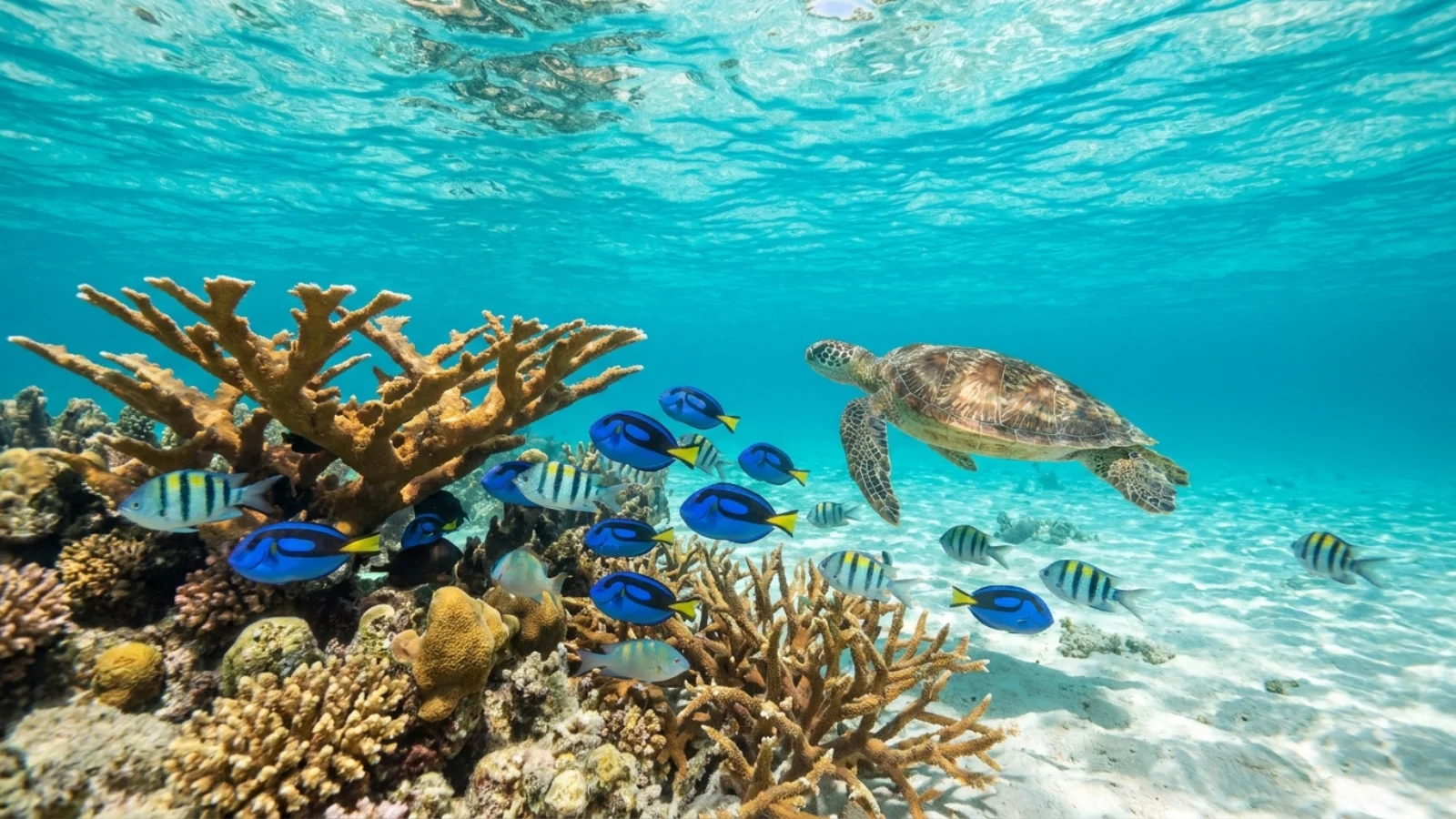
Where is the best snorkeling in Florida from shore?
Blue Heron Bridge, the St. Andrews State Park jetty, Bahia Honda State Park and Fort Zachary Taylor in Key West. The coral reef itself needs a boat.
The Blue Heron Bridge at Phil Foster Park in Riviera Beach is the standout: an Intracoastal Waterway site 5 to 20 ft deep with a two-acre snorkel trail of limestone boulders. Time it for slack high tide, when clear Atlantic water floods in. In the Panhandle, the rock jetty at St. Andrews State Park in Panama City Beach was built to protect a shipping channel and is now one of the best snorkel spots in West Florida, with rays, angelfish, octopus and visiting dolphins. A protected “kiddie pool” behind the jetty is ideal for children.
Where can you snorkel with manatees in Florida?
Crystal River on the Nature Coast. Kings Bay there is widely described as the only place in the United States where people can legally swim with wild manatees in their natural habitat. The season runs November 15 to March 31, when hundreds of manatees shelter in springs that hold about 72°F.
The rule is passive observation: float at the surface, and do not touch, chase, corner or feed the animals. Most visitors go with a licensed tour boat that supplies wetsuits; prices vary by operator, so compare them directly. Our Crystal River manatee snorkeling guide covers the federal rules, the Three Sisters Springs closures and the manatees themselves in detail.
Is there good snorkeling in Southwest Florida?
It is different rather than bad. There are no shallow coral reefs on the Gulf coast, but there are jetties and passes full of fish, hard-bottom ledges and artificial reefs offshore, and fossil shark teeth off Venice.
Delnor-Wiggins Pass State Park in North Naples ($6 per vehicle) has a hard-bottom area and rocks near the pass; stay well clear of the channel and its current. Visibility on this coast depends on wind, rain and runoff, and it is usually best on calm days in late spring and early summer. The full regional picture, from Naples and Marco Island to Sanibel and Venice, is in our guide to snorkeling in Southwest Florida.
Why does Florida only have coral reefs in the Keys?
Florida’s Coral Reef, as the Florida Department of Environmental Protection calls it, stretches about 350 miles from the Dry Tortugas to the St. Lucie Inlet in Martin County, and roughly two-thirds of it lies inside the Florida Keys National Marine Sanctuary. In 2024 the Florida Legislature designated the northern third, off Miami-Dade, Broward, Palm Beach and Martin counties, as the Kristin Jacobs Coral Aquatic Preserve. So coral does reach the mainland’s Atlantic coast, but north of Miami it grows as lower, patchier reef lines rather than the classic shallow spur-and-groove reef that snorkelers picture.
The true barrier reef, the part most guidebooks mean by “the Florida Reef,” runs about 168 miles (270 km) from Fowey Rocks off Key Biscayne to just south of the Marquesas Keys, a few miles seaward of the island chain. It contains more than 6,000 individual reefs and is only 5,000 to 7,000 years old, having grown since sea levels rose at the end of the last glaciation. More than 45 species of stony coral and 35 species of octocoral live on it.
The reef is not uniform. The densest reefs and clearest water lie off Key Largo and Elliott Key, where long islands shield the reef from the murky, variable water of Florida Bay and Biscayne Bay. In the Middle Keys, wide channels between the islands let bay water, with its lower salinity, higher turbidity and bigger temperature swings, spill onto the reef and limit its growth. That is one reason the Upper and Lower Keys usually beat the Middle Keys for snorkeling.
The Gulf coast is a different world. Its shallow water cools sharply in winter, rivers and mangrove estuaries carry tannins and sediment, and the shelf slopes so gently that clear blue water lies far offshore. Instead of coral, Gulf snorkelers find rock jetties, limestone ledges, seagrass beds and artificial reefs, which can hold surprising numbers of fish but look nothing like a Keys reef.
What condition is the Florida Keys reef in now?
It is important to set expectations honestly. As of the late 2010s, NOAA scientists estimated that only about 2% of the reef’s original coral cover remained after decades of disease, pollution, overfishing and warming. Stony coral tissue loss disease, first detected off Virginia Key in Miami-Dade County in late 2014, then spread along the reef tract and killed large numbers of brain, star and pillar corals.
The heaviest recent blow came in summer 2023, when record-breaking early and rapid warming caused mass bleaching. A 2025 study in Science found that the heat wave killed 98 to 100% of the elkhorn and staghorn corals in the Florida Keys and Dry Tortugas, leaving both species functionally extinct on the reef. Those were the branching corals that once formed the shallow thickets at sites like Looe Key and Key Largo Dry Rocks.
What remains is still worth seeing. Sea fans, sea rods and other octocorals sway over the spurs, sponges and boulder corals persist, and the fish life can be dense: blue tangs, parrotfish, sergeant majors, grunts, snappers, angelfish and barracuda are routine. Restoration is under way. NOAA’s Mission: Iconic Reefs aims to restore about three million square feet of coral habitat at seven sites in the sanctuary by 2040, and in 2025 large-scale planting of nursery-grown corals began in the Keys. Snorkelers can help simply by never standing on or touching coral, and by choosing operators that use mooring buoys rather than anchors.
How do the Upper, Middle and Lower Keys compare for snorkeling?
The Upper Keys, centred on Key Largo, are the easiest coral snorkeling in Florida from a big city. Boats from John Pennekamp Coral Reef State Park and nearby marinas run to shallow reefs a few miles out, and the bronze Christ of the Deep statue at Key Largo Dry Rocks is the most famous single sight. The sanctuary’s protected zones here are busy, so mornings are quieter. Our John Pennekamp snorkeling guide covers the boats, fees and reefs in detail.
The Middle Keys around Marathon are better known for fishing than snorkeling, but Sombrero Reef is the exception. It is marked by the Sombrero Key Light, an iron skeleton lighthouse put in service in 1858 and deactivated in 2015, and its spurs and grooves attract big schools of fish. Shore snorkeling in the Middle Keys is mostly seagrass and rubble.
The Lower Keys hold Looe Key, a reef inside a Sanctuary Preservation Area south of Big Pine Key, named after the British frigate HMS Looe, which ran aground and sank there in 1744. Bahia Honda State Park’s concession runs snorkel trips there daily at 9:30 a.m. and 1:30 p.m., weather permitting, and the park describes depths of 5 to 70 ft. Bahia Honda itself charges $8 per vehicle plus the $0.50-per-person Monroe County surcharge, and its beach offers easy seagrass and hard-bottom snorkeling where spiny lobster and queen conch turn up.
Beyond Key West, Dry Tortugas National Park lies about 68 to 70 miles west and can be reached only by ferry, seaplane or private boat. The National Park Service charges $15 per person for a pass valid seven days (under-16s are free), and ferry tickets include it. The park averaged about 63,000 visitors a year between 2008 and 2017, so its reefs and the shallow water around Fort Jefferson see far less traffic than the main Keys reefs. The Florida Keys snorkeling guide ranks the individual reefs.
Where can you snorkel on Florida’s Atlantic coast north of the Keys?
Biscayne National Park, just south of Miami, protects 172,971 acres, of which only about 9,075 acres are land; the rest is bay, reef and open water. Its Maritime Heritage Trail is the only underwater archaeological trail in the National Park Service system. The trail links the wrecks of the Arratoon Apcar (1878), Erl King (1891), Alicia (1905), Lugano (1913) and Mandalay (1966), an unknown 19th-century wreck and the Fowey Rocks Lighthouse, and the shallow Mandalay is especially popular with snorkelers. The park has no entrance fee; the cost is the boat trip, run by the Biscayne National Park Institute and licensed concessionaires.
Broward County has the best-known beach snorkeling on the mainland coast. Lauderdale-by-the-Sea, recognised by the Florida Legislature in 2016 as “Florida’s Beach Diving Capital,” has a reef line about 100 yards offshore, popular just south of Anglin’s Fishing Pier. Nearby lies the SS Copenhagen, a British steamship that struck the reef in May 1900 and now sits in about 25 ft of water as a state underwater archaeological preserve. Swimming out to these reefs means crossing open water used by boats, so a flag and calm seas are essential.
Farther north, Palm Beach County’s Blue Heron Bridge at Phil Foster Park is a world-class shallow site for small animals such as seahorses, frogfish and batfish, timed to the high slack tide. North of the St. Lucie Inlet, the Atlantic coast offers little snorkeling: the water is cooler, the surf heavier and the reefs give way to sand and scattered rock.
Can you snorkel in Florida’s freshwater springs?
Yes, and for many visitors the springs are the most unexpected snorkeling in the state. North and central Florida sit on the Floridan aquifer, and where it reaches the surface it produces springs with clear water that stays around 72°F all year. Snorkeling them is about visibility, limestone, eelgrass and freshwater fish such as bass, mullet and gar rather than coral.
Rainbow Springs State Park near Dunnellon is the classic example. Its first-magnitude spring is a cluster of vents that together discharge roughly 400 to 600 million gallons a day, feeding the 5.7-mile Rainbow River. The headspring swimming area averages 10 to 18 ft deep. Florida State Parks allows snorkeling there only inside the buoyed swimming area, says snorkelers must display dive flags, bans all inflatables at the headspring and has no lifeguard on duty. Since April 29, 2026, all visitors have needed a day-use reservation to enter the park. Tubing on the river is handled from a separate entrance.
Ginnie Springs, on the Santa Fe River near High Springs, is privately owned and better known for cave and cavern diving. Snorkelers can float over its clear basins, but the caves themselves are for trained cave divers only; the owners placed an iron grate over the most dangerous section after a series of diver deaths. Treat any spring cave as off limits without cave training.
Crystal River’s Kings Bay is fed by dozens of springs; published counts range from about 50 to 70 depending on how vents are grouped. Its winter manatee gatherings make it the state’s most famous spring snorkel, covered above.
Where is the best snorkeling in the Florida Panhandle?
The Panhandle’s emerald water can be startlingly clear in summer, but there is no natural coral reef to swim over. The best snorkeling is on structure built by people.
St. Andrews State Park, a 1,200-acre park three miles east of Panama City Beach, is the top pick. Its rock jetty was built to protect a shipping channel and has become an artificial reef where Florida State Parks lists rays, angelfish, redfish, sheepshead, octopus, sponges and several corals, with dolphins sometimes feeding nearby. Admission is $8 per vehicle for two to eight people in 2026, and the park opens from 8 a.m. until sundown. A sheltered pool area at the north end of the jetty suits children; the inlet side has strong currents, so snorkel there only at slack tide and well away from the channel.
Navarre Beach, between Pensacola and Fort Walton Beach, has a purpose-built snorkel reef inside the Navarre Beach Marine Sanctuary. About 2,000 ft east of the Navarre Beach Pier, just past the second sandbar, nearly 80 pilings support concrete discs cased in Florida limestone to mimic natural reef. Snapper, triggerfish, octopus and urchins live on it, and sea turtles sometimes pass through. The swim crosses open Gulf water, so go only in calm conditions.
Panhandle water is cold in winter, and the season for comfortable snorkeling runs roughly from late spring through early autumn.
When is the best time of year to snorkel in Florida?
There is no single best month, because Florida’s sites peak at different times. For the Keys reef, late spring and summer usually bring the lightest winds and flattest seas, which matter more than anything else: a strong easterly breeze stirs up sand and makes the outer reefs rough and cloudy. The trade-offs are afternoon thunderstorms with lightning and the Atlantic hurricane season, which runs from June 1 to November 30.
Winter cold fronts bring the windiest weeks to the Keys, but they also bring the best of the springs. Manatees crowd Kings Bay from November 15 to March 31, and the constant 72°F of the spring runs feels warm on a cold morning. The Gulf coast and Panhandle are best in late spring and summer, when the water is warm and calm days are common, although summer rain can reduce visibility near river mouths and passes.
Crowds are part of the calculation too. Spring break, holiday weekends and the two-day spiny lobster sport season in late July fill Keys marinas and boat ramps. Weekday mornings are calmer almost everywhere, and Blue Heron Bridge and the springs both reward an early start before parking fills.
What rules and safety precautions apply to snorkeling in Florida?
Florida’s divers-down law, section 327.331 of the Florida Statutes, counts snorkelers as divers. You must display a divers-down flag or buoy where you are snorkeling, except in areas customarily used only for swimming. In rivers, inlets and navigation channels, divers should stay within 100 ft of their flag and boats should keep 100 ft away; in open water the distance is 300 ft. A flag on a float towed behind you keeps you visible.
In the Florida Keys National Marine Sanctuary, designated in 1990 and covering about 2,900 square nautical miles, it is illegal to damage coral, and Sanctuary Preservation Areas such as Looe Key are no-take zones. Florida state parks and county parks have their own rules, from no inflatables at Rainbow Springs to no collecting at many beach parks. Do not feed fish or wildlife, and keep a respectful distance from sea turtles and manatees.
The biggest real hazards are boats, currents and weather rather than sharks. Jetties and inlets can produce strong tidal currents, so snorkel them at slack tide and never in the channel. Wear a vest if you are not a confident swimmer, check the marine forecast before you go, get out of the water at the first sign of lightning, and use a rash guard and mineral sunscreen to limit both sunburn and chemicals in the water. For beach conditions and rip currents, see our Florida beach safety guide.
One weird Florida fact
The Blue Heron Bridge is famous among underwater photographers not for coral but for the tiny animals living on its rubble and pilings, in water you can stand up in at its edges.- Florida Department of Environmental Protection, “Florida’s Coral Reef” (350-mile extent; Kristin Jacobs Coral Aquatic Preserve, 2024) (accessed November 2026)
- Florida State Parks: Bahia Honda hours and fees and “Snorkeling at Bahia Honda”; St. Andrews hours and fees and “Snorkeling at St. Andrews State Park”; Rainbow Springs experiences and amenities (snorkeling, dive flags, day-use reservations from April 29, 2026) (accessed November 2026)
- National Park Service, Dry Tortugas National Park fees; Biscayne National Park, Maritime Heritage Trail snorkel program (2011 archive)
- Wikipedia: Florida Reef (extent, bleaching history, 2025 Science study on the 2023 heat wave, Mission: Iconic Reefs); Stony coral tissue loss disease; Florida Keys National Marine Sanctuary; Looe Key; Sombrero Key Light; Biscayne National Park; Dry Tortugas National Park; Lauderdale-by-the-Sea; Rainbow River; Ginnie Springs; Crystal River; St. Andrews State Park
- FloridaPanhandle.com, Navarre Beach Gulf snorkel reef; Beachhunter, Snorkeling the St. Andrews State Park jetty
- Florida Statutes 2025, section 327.331 (divers-down warning devices)
Where is the best snorkeling in Florida?
The Florida Keys reef (Looe Key, Key Largo, Sombrero Reef) and the Dry Tortugas, plus Blue Heron Bridge and Crystal River for unique experiences.
Where can you snorkel in Florida without a boat?
Blue Heron Bridge in Riviera Beach, the reef off Lauderdale-by-the-Sea, St. Andrews State Park jetty, the Navarre Beach snorkel reef, Bahia Honda State Park and Fort Zachary Taylor in Key West.
When is the best time to snorkel in Florida?
May to September for the Keys reef; November 15 to March 31 for manatees in Crystal River; spring for Blue Heron Bridge.
Does Florida have coral reefs?
Yes. The Florida Reef along the Keys is the only living coral barrier reef in the continental United States.
Can you snorkel in Naples, Florida?
Yes, but not over coral. Snorkelers use jetties, the rocks near Wiggins Pass, offshore artificial reefs and ledges, usually by boat.
Do you need a dive flag to snorkel in Florida?
Florida law requires a divers-down flag when you snorkel or dive in areas open to boating.
Can you snorkel in Florida springs?
Yes. Spring runs such as Rainbow Springs stay around 72°F all year. At Rainbow Springs State Park snorkeling is allowed only in the buoyed swim area, with a dive flag, and day-use reservations are required.
Where can kids snorkel in Florida?
The kiddie pool at St. Andrews State Park, Bahia Honda’s beach and calm-day boat trips to Pennekamp’s shallow inner reefs.
Blane Perun has been exploring Earth’s oceans and marine life for over 25 years. Founder of TheSea.Org in 1999, underwater photographer, coral aquaculture pioneer, and explorer of 80+ countries.
About Blane Perun → All snorkeling destinations →