Snorkeling for Beginners — 12 Tips From a Diver
Snorkeling is easy to learn in one session if you start in calm, shallow water you can stand up in. Fit a mask that seals without the strap, breathe slowly through your mouth, float face-down with your arms relaxed, and kick gently from the hips with straight legs. Practise clearing the snorkel with a sharp puff. Wear a snorkel vest if you are nervous, never snorkel alone, and if you feel short of breath, stop, lift your head, take the mask off and float on your back. Good first spots include Hanauma Bay, Kapalua Bay, Bight Reef in Turks and Caicos and the shallow Florida Keys reefs by boat.
First snorkel — the checklist
- Water: Calm, clear, waist to chest deep, sand entry, lifeguard on duty
- Gear: Mask that seals without the strap; semi-dry snorkel; short fins; vest if unsure
- Breathing: Slow, deep breaths through the mouth; exhale fully
- Body position: Face down, arms by your side or folded, legs near the surface
- Buddy: Always; agree a signal for “I’m going in”
- Time: 30–45 minutes for a first session
- Most common problem: A leaking or fogging mask, usually from hair under the skirt or a factory film on the lens
- Biggest risk: Over-exertion; in Hawaii about half of visitors who drown were snorkeling
- Rest without standing: Float on your back or move to sand; standing on coral kills it
- Hand signals: Thumb and finger “OK” or a hand on the head means “I’m OK”; a waving arm means help
How do beginners learn to snorkel?
Start standing in waist-deep water. Put the mask and snorkel on, bend forward until your face is in the water, and just breathe through the snorkel for a minute. When that feels normal, lie forward, float and kick gently.
Many people feel at ease within the first quarter of an hour. The trick is to slow everything down: slow breaths, slow kicks, slow head movements. The surface is where all the action is anyway; in shallow water the reef is often only a few feet below you.
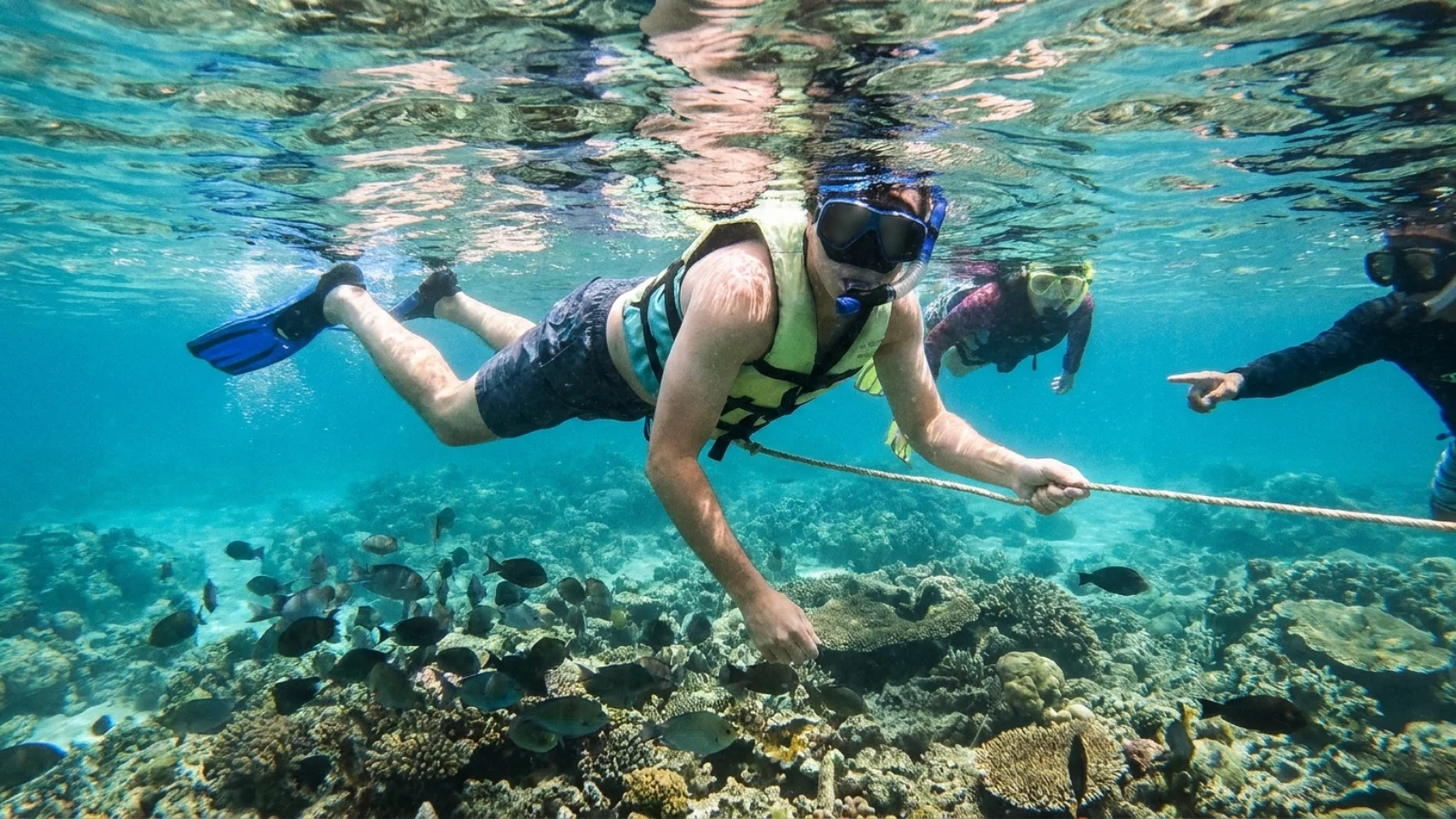
12 snorkeling tips for beginners
These are the habits that separate a relaxing first snorkel from a stressful one.
| # | Tip | Why |
|---|---|---|
| — | — | — |
| 1 | Fit the mask without the strap | If it holds with a gentle sniff, it will seal in the water |
| 2 | Push hair out of the skirt | One strand under the seal causes most leaks |
| 3 | Defog right before you get in | Spit, gel or baby shampoo on the inside of the lens, then rinse |
| 4 | Breathe through your mouth only | Nose breathing fogs the mask and breaks the seal |
| 5 | Breathe slowly and fully | Short, fast breaths build up CO2 and feel like panic |
| 6 | Keep your face down | Lifting your head sinks your legs and floods the snorkel |
| 7 | Kick from the hips | Bicycle kicks stir up sand and tire you out |
| 8 | Keep fins off the bottom | Kicking coral damages it and can cut you |
| 9 | Go with the current | Enter up-current and drift back; never fight it |
| 10 | Check where you are | Look up every minute to see the beach and your buddy |
| 11 | Wear a rash guard | Your back and legs burn fast while you float |
| 12 | Get out before you are tired | The swim back is part of the snorkel |
How do you breathe through a snorkel without panicking?
Breathe slowly and deeply through your mouth, with a full exhale. If you feel anxious, stop swimming, lift your head, take the snorkel out and breathe normally, then try again.
Many beginners take short, fast breaths, which leaves stale air in the tube and makes them feel short of breath. A slow, deep rhythm is the cure. If water gets in, give one sharp puff, as if saying “too!”, to blow it out the top. A semi-dry snorkel with a purge valve makes this easier; see our snorkel gear guide.
Is snorkeling safe for non-swimmers?
Only with a snorkel vest or flotation, in shallow, calm water, with a strong swimmer or guide alongside. Many tour boats provide vests and flotation noodles.
Older beginners, and anyone with heart or lung conditions, should take extra care: Hawaii’s research links many snorkel deaths to rapid-onset pulmonary edema, with exertion and breathing resistance as triggers. Start slowly, avoid swimming hard against current, and if you feel breathless or tight-chested, stop, remove the mask, float on your back and signal for help. We explain why we steer beginners away from full face snorkel masks.
How should a snorkel mask fit, and why does it fog?
A mask works by trapping a pocket of air in front of your eyes. Water has almost the same refractive index as the cornea, about 1.33, so when bare eyes are in water the cornea stops focusing and everything blurs. The air space inside the mask restores normal focus, which is why a good seal matters more than any other feature.
The standard fit test needs no water at all. Hold the mask against your face without the strap, inhale gently through your nose and let go. If it stays in place, the silicone skirt is touching your skin all the way round. If it drops, air is getting in somewhere and water will too. Check that no hair runs under the skirt, especially at the forehead, because water that leaks in at the top runs straight into your eyes. Leaks along the bottom edge near a moustache are easier to live with, because a small exhale through the nose pushes that water out.
Comfort counts as well. The nose pocket should leave room for your nose, the hard frame should not press on the bridge of your nose, and your eyelashes should not brush the glass when you blink. Set the strap high on the back of your head and only snug enough to hold the mask, since a strap pulled tight distorts the skirt and causes leaks rather than stopping them.
Fog forms when warm, moist air from your face condenses into droplets on the cooler glass. The old diver’s fix is still the standard: spit into the dry mask, spread it over the inside of the lens and rinse lightly. The thin residue makes condensation spread as an even film instead of beading. Commercial anti-fog gels do the same job and often last longer. Breathing out through your nose adds moisture inside the mask, so mouth-only breathing also cuts fogging.
After each day, rinse the mask, snorkel and fins in fresh water and let them dry out of direct sun. Ultraviolet light breaks down silicone and plastic over time. The strap is the part under most stress and the usual first failure, so look it over for cracks before every trip. A well-kept mask lasts years.
Expect things to look bigger. A flat faceplate magnifies what you see, but by how much depends on how far the object is from the glass and how far your eye is behind it. The theoretical maximum equals the refractive index of water, about 1.33, so fish and coral can look up to a third larger, and seem closer, than they really are. That is worth remembering before you reach for something you think is out of range, and when judging the depth of coral beneath you.
Which snorkel is best for a beginner?
A simple, short tube with a comfortable mouthpiece is the safest choice for most beginners. The tube is dead space: each time you breathe in, you first get back some of the air you just breathed out. The bigger the tube, and the shallower your breaths, the more stale air you re-breathe and the more carbon dioxide builds up. Slow, deep breathing reduces the problem, which is the physical reason behind the advice to breathe slowly.
Length is limited for a reason. The European standard for snorkels, EN 1972 (2015 edition), caps tubes at 38 cm and 230 cc of internal volume for users with larger lung capacity, and 35 cm and 150 cc for users with smaller lungs such as children. A much longer tube would not let you breathe from deeper in the water. Even a little depth puts pressure on your chest that your breathing muscles cannot overcome, and the pressure difference across the lung tissue raises the risk of fluid leaking into the lungs.
Features change how a snorkel handles. A purge valve in a sump at the bottom lets water drain out when you breathe out, so clearing takes less effort. A splash guard at the top cuts the water that waves throw into the tube. A dry top uses a float valve to seal the tube when it goes under; that is handy for nervous beginners in choppy water but adds parts that can stick. Every extra valve and bend adds a little breathing resistance, and Hawaii’s research points to breathing resistance as one of the risk factors in snorkel deaths, so simple usually beats clever.
Full face masks are a different design. They cover the eyes, nose and mouth and feed air through a built-in snorkel. If one floods, the whole mask has to come off before you can breathe freely; you cannot spit out a mouthpiece or blow water clear. The rigid nose cover also makes it impossible to pinch your nose to equalise, so they are meant only for the surface. A 2022 study in Undersea and Hyperbaric Medicine tested several commercial models on volunteers while monitoring blood oxygen, prompted by snorkel deaths in Hawaii and by bans on the masks.
Why do snorkelers drown in Hawaii, and what does it teach beginners?
Hawaii publishes some of the best data on snorkel deaths, and the numbers explain why the basic safety advice exists. Honolulu Civil Beat reported in May 2026 that about 42 tourists drown in Hawaiian waters each year on average, that more than 200 visitors died while snorkeling over the past decade, and that nearly half of tourist drowning deaths involve snorkeling. Health Department data for 2015 to 2024 put snorkeling tourists at about a quarter of all ocean drownings in the state.
The state’s Snorkel Safety Study, ordered by the Department of Health in 2017 and led by the Oahu pulmonologist Philip Foti, looked for a cause. Its interim findings, reported by Hawaii Public Radio in January 2021, covered 206 drownings from 2009 to 2018, 189 of them visitors. It concluded that low blood oxygen from rapid-onset pulmonary edema, fluid flooding the lungs, explains probably most fatal and near-fatal snorkel drownings. Foti found pulmonary edema likely or very likely in 29 of 32 snorkeling deaths he reviewed, and the 2022 report called it a factor in many, if not most, snorkeling fatalities.
The study tested around 50 snorkels (Hawaii Public Radio reported 49) and found that the simplest designs generally had the least resistance to airflow. Equipment that makes it harder to breathe in, exertion and existing heart problems all appear to raise the risk. Mask type was recorded in only 16 percent of the drownings studied, so the data cannot settle the full face mask question either way.
Some questions remain open. A Health Department analysis of 23 fatal cases found that about 48 percent of victims died less than three days after landing in Hawaii, but the result was not statistically significant. Autopsies also cannot always tell pulmonary edema apart from simply inhaling water. Some doctors advise waiting a few days after a long flight before snorkeling; that is a sensible precaution rather than a proven rule.
The practical lessons are the same ones in the tips above. Use a simple, low-resistance snorkel. Do not swim hard into wind or current. Take the mask and snorkel off the moment breathing feels hard, and float on your back while you recover. If you have a heart or lung condition, talk to your doctor before the trip.
How do you spot and escape a rip current?
A rip current is a narrow channel of water flowing away from the beach, and it is the main hazard for snorkelers who start from shore. Rips form wherever waves have enough energy, often where a gently sloping beach or a gap in the reef funnels returning water into one outflow. They usually move at about 0.5 metres per second but can reach 2.5 metres per second, faster than anyone can swim. Rip currents cause about 80 percent of beach lifeguard rescues, and NOAA counted an average of 71 rip current drownings a year in the United States over the ten years to 2022.
From the beach, look for a gap in the line of breaking waves, a band of darker or choppier water, or foam and debris moving seaward. If one catches you, do not swim straight back against it. Rips are narrow, so swim or kick parallel to the shore until you are out of the flow, then let the breaking waves help carry you in. In fins with a snorkel vest you can also simply float and signal for help. Choosing a lifeguarded beach and asking the lifeguard where the currents run before you get in removes most of the risk.
Should beginners dive down under the surface?
Not on the first day. Surface snorkeling is safe precisely because you can breathe the whole time. Once you are comfortable, short duck dives to look at something a few feet down are part of the fun, but they bring two new rules.
First, equalise your ears early on the way down by pinching your nose and blowing gently, and come up if it hurts. Second, never hyperventilate before a breath-hold dive. Fast, deep breathing lowers carbon dioxide in your blood, which suppresses the urge to breathe, so oxygen can run out first and you can black out without warning. This shallow water blackout can happen in a swimming pool. Keep dives short, have your buddy watch from the surface, and blow the water out of your snorkel as you surface before you take a breath.
How do you protect yourself and the reef?
Sunburn is easy to get while snorkeling, because your back and the backs of your legs face the sun for an hour without you feeling the heat. A rash guard or a full Lycra dive skin is the best protection. Dive skins give little warmth, but they block sun and also protect against jellyfish stings and scrapes.
Sunscreen rules vary by place. Hawaii state law bans the sale of sunscreens containing oxybenzone and octinoxate, and since October 2022 Maui County has allowed only mineral sunscreens, made with zinc oxide or titanium dioxide, unless a doctor has prescribed something else. Covering up with clothing reduces how much sunscreen you need anywhere.
Look, do not touch. Turtles and seals can be alarmed when approached, and moray eels hiding in crevices may bite fingers poked into holes. In Hawaii, NOAA recommends staying at least 10 feet from sea turtles and 50 feet from Hawaiian monk seals, or 150 feet from a mother with a pup. Federal law bans swimming with or approaching spinner dolphins within 50 yards and humpback whales within 100 yards. If a turtle swims toward you, stay still and let it pass.
Never stand or kneel on coral. Living coral is a thin layer of animal tissue over limestone, and a fin kick or a foot can kill colonies that took years to grow. If you need a rest, float on your back or move over sand.
What should you know before visiting Hanauma Bay?
Hanauma Bay on Oahu is many people’s first snorkel, and its rules are strict. According to the City and County of Honolulu, as of November 2026 the preserve is open Wednesday to Sunday and closed on Mondays and Tuesdays. Entry runs from 6:45 a.m. to 1:30 p.m. Non-residents pay $25 plus an online fee, while Hawaii residents and children aged 12 and under get in free.
Admission-only reservations open at 7 a.m. Hawaii time two days before your visit, and about a quarter of entries are kept for walk-ins on a first come, first served basis when the gate opens. Every visitor has to watch the preserve’s education video on every visit, and feeding fish is banned. Parking is separate, cash only, and costs non-residents $3.
Where are the best places to snorkel for beginners?
Sheltered, lifeguarded beaches with sand entries and reef close to shore: Hanauma Bay on Oahu, Kapalua Bay on Maui, Kahaluʻu on the Big Island, Bight Reef in Turks and Caicos, Trunk Bay on St. John, and boat trips to the shallow inner reefs of John Pennekamp in Key Largo.
See Hanauma Bay, Maui, Turks and Caicos and John Pennekamp, or browse every destination in the best snorkeling destinations. If you are wondering whether to try scuba next, read snorkeling vs scuba.
One weird snorkel fact
Your mask can make things look up to about a third bigger and closer than they really are, because light bends as it passes from water through the flat glass into the air in front of your eyes. The exact effect depends on distance, and 1.33 is the ceiling.- Civil Beat, Hawaii snorkeling deaths and pulmonary edema research (May 2026); “Testing of full face snorkel masks to examine recreational snorkeler deaths”, Undersea & Hyperbaric Medicine (2022); NOAA Fisheries wildlife viewing guidelines; Hawaii Ocean Safety (hioceansafety.com)
- Hawaii Public Radio, study links pulmonary condition to Hawaii snorkeling deaths (January 2021)
- City and County of Honolulu, Department of Parks and Recreation: Hanauma Bay Nature Preserve visitor information (accessed November 2026)
- NOAA Fisheries, Viewing marine wildlife in Hawaiʻi (distances and federal rules)
- Honolulu Civil Beat, Maui mineral sunscreen law (September 2022)
- European Standard EN 1972:2015 snorkel dimensions; NOAA rip current statistics, via Wikipedia (Snorkel, Rip current, Diving mask articles)
- Scubageek, “Do things seem 33% bigger underwater?” (planar-interface magnification)
How do I start snorkeling as a beginner?
Begin in calm, waist-deep water. Practise breathing through the snorkel standing up, then float face down and kick gently from the hips.
What are the most important snorkeling tips?
Fit your mask properly, breathe slowly through your mouth, keep your face down, kick from the hips, never touch coral and always snorkel with a buddy.
Can you snorkel if you can’t swim?
Yes, with a snorkel vest or flotation, in shallow calm water, with a guide or strong swimmer next to you.
How do I keep my snorkel mask from fogging?
Clean off the factory film on a new mask, then use spit or anti-fog gel just before you get in, and breathe only through your mouth.
Why do I feel like I can’t breathe when snorkeling?
Usually because of short, fast breaths or anxiety. Stop, lift your head, breathe normally, then go back to slow, deep breaths. If it continues, get out.
Should beginners use a full face snorkel mask?
We recommend a traditional mask and snorkel. A flooded full face mask has to come off completely before you can breathe, you cannot blow water out of it, and some operators do not allow them.
How long should a first snorkel last?
About 30 to 45 minutes, leaving energy for the swim back.
Is it OK to stand on coral when snorkeling?
No. Standing on coral kills it and can cut you. Rest by floating on your back or moving to sand.
Blane Perun has been exploring Earth’s oceans and marine life for over 25 years. Founder of TheSea.Org in 1999, underwater photographer, coral aquaculture pioneer, and explorer of 80+ countries.
About Blane Perun → All snorkeling destinations →