What Eats Plankton? — From Copepods to Blue Whales
Plankton feed nearly the whole ocean. Phytoplankton are eaten mainly by zooplankton such as copepods, krill and salps. Zooplankton in turn are eaten by fish larvae and small fish (herring, anchovies, sardines), corals, jellyfish, seabirds and the giant filter feeders: whale sharks, basking sharks, manta rays and baleen whales. The numbers are huge: in its summer feeding season a blue whale off the U.S. West Coast takes in roughly 16 tonnes of krill daily (Savoca et al. 2021), and a basking shark filters around 2 million litres of water an hour (Natural History Museum, London).
Plankton Eaters
What eats phytoplankton?
Mostly zooplankton, and by volume mostly microscopic ones: single-celled protists eat the largest share, followed by copepods, krill, salps and larval animals. Filter-feeding shellfish such as clams, oysters and mussels also strain phytoplankton from the water.
Phytoplankton are the grass of the ocean: they turn sunlight into food. Copepods, the most abundant animals on Earth with more than 12,000 species, are the cows. Krill fill the same role in the Southern Ocean. Larger single-celled grazers, such as the giant dinoflagellate Noctiluca, compete with copepods for the same food. On reefs, sponges, feather duster worms and Christmas tree worms strain phytoplankton and particles from the water.
For the difference between the two plankton halves, see plankton: phytoplankton vs zooplankton.
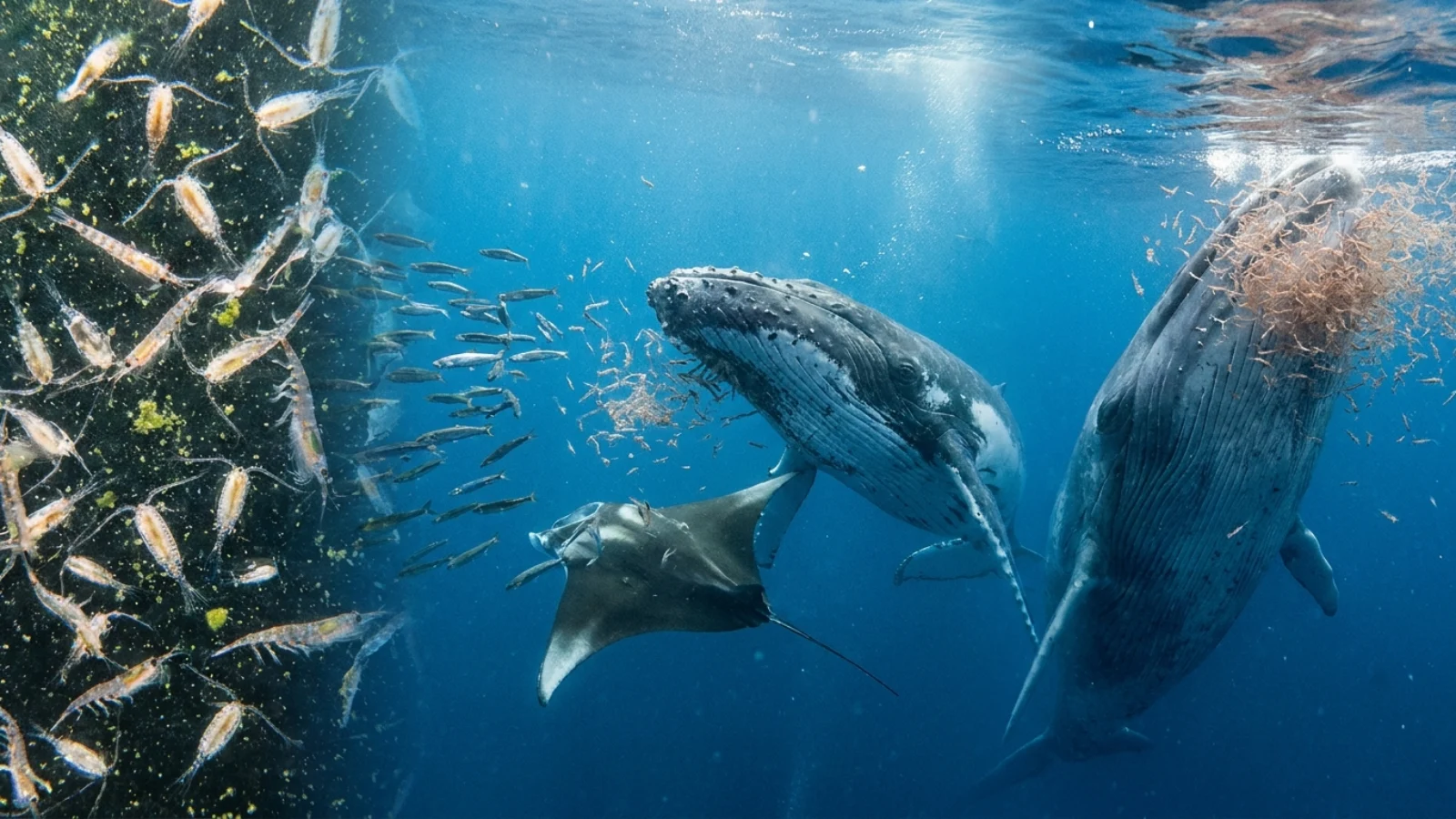
What eats zooplankton?
Almost everything bigger than them: fish larvae and small schooling fish, corals, anemones, jellyfish, comb jellies, squid, seabirds, and the ocean’s giant filter feeders.
| Predator | How it feeds | Notes |
|---|---|---|
| — | — | — |
| Blue whale | Lunge-gulps krill swarms | ~16 t of krill a day in feeding season |
| Whale shark | Suction filter feeding | 6 m juvenile filters ~600 m³ an hour |
| Basking shark | Ram filter feeding | ~2 million L of water an hour |
| Manta rays | Filter feeding | Zooplankton specialists |
| Corals | Stinging tentacles at night | Extend polyps as zooplankton rise |
| Jellyfish and comb jellies | Tentacles, sticky cells | Major zooplankton predators |
| Small fish | Pick or filter | Herring, sardines, anchovies, reef damselfish |
| Seabirds | Surface picking, diving | Many feed on krill and copepods |
How much plankton does a blue whale eat?
Roughly 16 tonnes of krill daily, for blue whales feeding off the U.S. West Coast in summer. That figure, about three times older estimates, comes from tag and sonar work by Stanford biologist Matthew Savoca and colleagues, published in Nature in 2021.
Scaling up, Savoca’s group calculated that the Southern Ocean’s minke, humpback, fin and blue whales together consumed some 430 million tonnes of krill each year before commercial whaling began. That is more than today’s estimated total Antarctic krill biomass of about 379 million tonnes (Atkinson et al. 2009), which hints at how much more productive the pre-whaling ocean was. Bowhead whales, by comparison, eat about 6 tonnes of small zooplankton a day.
The krill and crustaceans eaten by whales pages cover the prey side of this equation.
How do whale sharks and basking sharks eat plankton?
Whale sharks suck in water and plankton and strain it through filter pads; basking sharks swim with mouths open and let water flow through their gill rakers. Both are pure plankton feeders despite being the two largest fish alive.
A study by Philip Motta and colleagues of whale sharks feeding off the Yucatán Peninsula estimated that a 6 m juvenile filters about 600 m³ of water an hour and eats about 21 kg of plankton a day over roughly 7.5 hours of feeding. Their food includes tiny crustaceans, copepods, worms and fish eggs. The basking shark reaches up to 12 m and around 6 tonnes, filters about two million litres of water an hour, and eats only zooplankton. It is listed as Endangered globally by the IUCN.
Do corals eat plankton?
Yes. Most reef-building corals get much of their energy from symbiotic algae, but they also catch zooplankton, mainly at night, using tentacles armed with stinging cells.
Zooplankton hide in deep water by day and rise at dusk to feed. Corals time their feeding to that migration, extending tentacles to catch passing prey and moving it to the mouth. Their nematocysts come in sticky, harpoon-like and lasso-like types. Corals with few tentacles rely more on mucus nets, which trap particles and are carried to the mouth by cilia. Up to 95% of the products of photosynthesis may pass from the algae to the coral, but captured plankton supply nutrients the algae cannot. See why zooxanthellae matter to corals.
Which grazers eat the most phytoplankton?
The answer surprises many people: the biggest consumers of phytoplankton are not krill or copepods but single-celled grazers too small to see. These microzooplankton include ciliates, heterotrophic dinoflagellates and other protists between about 20 and 200 micrometres across. A 2004 synthesis of dilution experiments by Albert Calbet and Michael Landry, published in Limnology and Oceanography, found that microzooplankton consume about 67% of phytoplankton daily growth worldwide. The share was about 60% in coastal and estuarine waters, about 70% in the open ocean, roughly 59% in temperate, subpolar and polar seas and about 75% in tropical and subtropical waters.
That matters because protists sit one step lower in the food chain than copepods. Much of the carbon fixed by phytoplankton is eaten and respired by these tiny grazers before it ever reaches a fish. Copepods then eat the ciliates as well as the larger diatoms, so a typical pathway runs from phytoplankton to protist to copepod to fish, rather than the textbook phytoplankton-to-copepod shortcut.
Grazing is not the only way phytoplankton die. Viruses infect and burst algal cells, and some well-studied blooms, such as those of the chalk-plated coccolithophore Emiliania huxleyi, have been shown to collapse partly because of viral infection. Cells killed this way release their contents into the water as dissolved organic matter, which feeds bacteria rather than animals.
What eats plankton in the open ocean and the deep sea?
Away from coasts and reefs, the plankton eaters are themselves mostly drifting or midwater animals. Lanternfish, small fish covered in light organs, are among the most numerous vertebrates in the sea; many species spend the day hundreds of meters down and rise at night to feed on copepods and krill near the surface. Salps, barrel-shaped relatives of sea squirts, pump water through a mucous net and can bloom so quickly that they strip a patch of ocean of phytoplankton, packing what they eat into dense fecal pellets that sink fast.
Larvaceans, also called appendicularians, take a different route. Each animal builds a mucus house around itself, a filtering structure that captures particles far smaller than most grazers can handle, including bacteria-sized cells. When the filter clogs, the animal abandons it and builds a new one, sometimes several times a day, and the discarded houses sink as part of the marine snow that feeds the deep sea. Siphonophores, comb jellies and many jellyfish sit one level higher, sweeping up copepods, fish eggs and larvae with tentacles or sticky cells. Together these gelatinous grazers and predators are easy to overlook in nets, which tend to destroy them, so their role in open-ocean food webs has often been underestimated.
How do fish larvae depend on plankton?
Almost every marine fish starts life as a plankton eater. A newly hatched larva has a small yolk supply and must find food within days, and its first meals are usually copepod eggs and the youngest copepod stages, called nauplii. In 1914 the Norwegian scientist Johan Hjort proposed that the year-to-year swings in fish stocks were set during this critical early window: in years when larvae found enough food, a strong generation followed. The British fisheries scientist David Cushing later refined the idea as the match-mismatch hypothesis, arguing that recruitment depends on whether the timing of larval hatching matches the timing of the plankton bloom.
This is why warming and changes in bloom timing worry fisheries scientists. If a spring bloom arrives earlier while fish keep spawning on the same calendar, larvae can hatch into water that has already been grazed down. The pattern has been studied most closely for North Atlantic cod and herring, where survival of the youngest fish has been linked to the abundance of the copepod Calanus finmarchicus.
Which adult fish live on plankton?
Forage fish are the main plankton-eating fish by volume. Anchovies, sardines, herring, sprats, capelin and menhaden swim in dense schools and feed by picking individual prey or by swimming with mouths open and straining water across fine gill rakers. Atlantic menhaden can filter phytoplankton as well as zooplankton, which makes them one of the few fish in North America that feed directly on algae in large numbers. The Peruvian anchoveta, which feeds in the cold, plankton-rich Humboldt Current, supports one of the largest single-species fisheries on Earth, and its catches crash in strong El Niño years when warm water suppresses the plankton.
On coral reefs the plankton eaters are easy to spot. Chromis, fusiliers, anthias, sergeant majors and many cardinalfish hang in the water column above the reef, facing into the current and snapping up drifting zooplankton. A reef with a strong current often has a dense cloud of these fish on its upstream edge, where food arrives first. Their droppings and their bodies, when eaten by groupers and jacks, carry open-ocean plankton energy into the reef food web.
How do manta rays and devil rays feed on plankton?
Manta and devil rays are filter feeders that use cephalic fins, the two lobes beside the mouth, to funnel water through the gape. Their gill plates work as a cross-flow filter: water passes through, while particles bounce along the surface and are carried toward the throat, which helps keep the filter from clogging. Divers often see reef manta rays feeding in loops at the surface, somersaulting repeatedly in a dense patch of plankton, or swimming in chains in which several rays follow one another through the same patch.
Mantas also feed where people rarely see them. A 2016 stable-isotope study of oceanic manta rays off Ecuador, published in Royal Society Open Science, concluded that surface zooplankton supplied only a minority of their diet and that most came from deeper, mesopelagic sources. That fits tagging studies that record mantas diving well below recreational depths. For divers, it means the classic surface feeding events show only part of how these rays make a living.
How do baleen whales feed on plankton?
Baleen whales use three main techniques. Rorquals, the group that includes blue, fin, humpback and minke whales, lunge-feed: they accelerate into a swarm of krill or small fish, open the mouth and expand the pleated throat to engulf a volume of water that can rival the whale’s own body mass, then push the water out through the baleen. Right whales and bowheads skim-feed instead, swimming slowly with the mouth open so that a steady flow of water passes through very long, fine baleen that traps copepods. Gray whales mostly suction-feed on the seabed, rolling on their side to suck up sediment and the small crustaceans living in it.
Humpbacks add a cooperative twist. In Alaska and elsewhere, groups release rings of bubbles below a school of herring or a krill swarm, trapping the prey in a shrinking column before the whales surge up through it together. Because each lunge costs a lot of energy, whales are selective: tag studies show they target the densest prey patches and may skip feeding when swarms are too sparse to repay the effort.
What eats plankton from the seabed and the sky?
Many animals catch plankton without swimming after it. Sponges pump water through their bodies and filter out bacteria and tiny algae. Oysters, mussels and clams strain phytoplankton across their gills; a single adult eastern oyster can filter up to about 50 gallons of water a day, which is why oyster-reef restoration is promoted as a way to clear coastal water. Barnacles sweep the water with feathery legs, feather stars and basket stars hold their arms up into the current, and soft corals and sea fans expand their polyps when the current runs.
Seabirds are major zooplankton predators in cold seas. The least auklet of the Bering Sea, one of the smallest seabirds, feeds largely on copepods of the genus Neocalanus, which it carries back to its chick in a throat pouch. Prions in the Southern Ocean have comb-like lamellae on the bill that sieve small crustaceans from the water, and Adélie and chinstrap penguins rely heavily on Antarctic krill during the breeding season.
Do humans compete with plankton eaters?
The Antarctic krill fishery is the clearest case. Krill are caught mainly for aquaculture feed and omega-3 supplements, and catches have climbed sharply in recent years. The 2023 to 2024 season produced about 498,000 tonnes, the largest since its international regulator, CCAMLR, began collecting catch data in 1973. In 2025 the fishery reached its 620,000-tonne trigger level and was closed early, in early August, for the first time. Penguin and whale researchers have raised concerns that fishing concentrated in the same coastal areas as foraging predators may affect them even when the total catch is a small fraction of the krill stock.
Plankton energy also reaches people by a longer route. Much of the world’s catch of anchovies, sardines and other forage fish is ground into fishmeal and fish oil for farmed salmon, shrimp and livestock, so energy that began in phytoplankton and copepods ends up on dinner plates via a fish farm. Debates over forage-fish quotas are, at heart, debates over how much of that plankton-fed production should be left in the sea for seabirds, seals and larger fish.
Why does it matter what eats plankton?
Because plankton eaters move energy and carbon through the ocean. Zooplankton grazing at the surface and sinking by day carry carbon into the deep sea, and whales recycle nutrients that fuel new phytoplankton.
Every night, animals from the ocean twilight zone rise toward the surface to feed on plankton and sink again by dawn. Woods Hole Oceanographic Institution calls this daily round trip the largest migration of animal life on Earth, and the carbon the migrants carry down in their bodies and waste can stay in the deep sea for centuries or longer. Remove the big plankton eaters and the system changes; the whaling era did exactly that. Rebuilding whale populations is now seen partly as a way to restore ocean productivity.
Not all plankton play the same role in the food chain; see plankton as producer, consumer and decomposer for how phytoplankton, zooplankton and bacteria divide the work.
What eats plankton in the ocean?
Zooplankton such as copepods and krill eat phytoplankton. Zooplankton are eaten by fish, corals, jellyfish, seabirds, whale sharks, basking sharks, manta rays and baleen whales.
What eats phytoplankton?
Mainly zooplankton such as copepods, krill and salps, plus filter-feeding shellfish, sponges and tube worms.
What is the biggest animal that eats plankton?
The blue whale; in summer, one can swallow around 16 tonnes of krill in a single day.
What fish eat plankton?
Whale sharks, basking sharks, manta rays, and many small fish such as herring, sardines, anchovies and reef damselfish, plus nearly all fish larvae.
Do sharks eat plankton?
Three large sharks do: the whale shark, the basking shark and the megamouth shark are filter feeders.
Do jellyfish eat plankton?
Yes. Jellyfish and comb jellies are major predators of zooplankton and fish larvae.
Do humans eat plankton?
Indirectly, through seafood. Krill are also harvested for fish feed and supplements.
Do corals eat plankton?
Yes. Corals catch zooplankton at night with stinging tentacles, alongside the food their symbiotic algae supply.
Blane Perun has been exploring Earth’s oceans and marine life for over 25 years. Founder of TheSea.Org in 1999, underwater photographer, coral aquaculture pioneer, and explorer of 80+ countries.
About Blane Perun → All bioluminescence & plankton →