Silver Bank — Snorkeling With Humpback Whales
The Silver Bank is a shallow coral bank in the Atlantic, about 80 miles (130 km) north of the Dominican Republic, inside the Marine Mammal Sanctuary created in 1986. Each winter, roughly January to April, thousands of North Atlantic humpback whales gather there to mate and give birth. Only a handful of permitted liveaboard boats (regulations allow up to four; three permits were issued in recent seasons) may bring visitors, so you go on a week-long trip from Puerto Plata, typically costing several thousand dollars. Encounters are snorkel only, called “soft in-water” encounters: you float quietly at the surface and let the whales choose how close to come.
Silver Bank — at a glance
- Location: ~80 mi (130 km) north of the Dominican Republic; Atlantic Ocean
- Sanctuary: Silver Bank Marine Mammal Sanctuary, 1986; part of the D.R.’s 32,913 km² sanctuary
- Season: Roughly January–April; weekly liveaboard trips
- Access: Permitted liveaboards only, from Puerto Plata; usually 7 nights on board
- In-water rules: Mask, fins and snorkel only; no touching, chasing or free diving on whales
- Group size: About 10 people in the water at once; tenders of up to 12 passengers
- Whale numbers: Operators cite up to about 3,000 humpbacks using the bank each season
- Guest limit: One operator cites roughly 60 guests a week, about 600 a season
- Calves: If a mother and light-grey newborn calf approach, engines are shut down and no swim is attempted
- Speed limit: 10 knots inside the sanctuary
What is the Silver Bank?
A shallow bank of coral and sand in the open Atlantic north of the Dominican Republic, part of the country’s marine mammal sanctuary, where North Atlantic humpback whales gather every winter to breed and calve.
The bank’s shallow, warm, sheltered water suits mothers with newborn calves and competitive groups of males chasing females. The Dominican Republic protected it as a sanctuary in 1986, and it later became part of a wider Marine Mammal Sanctuary of 32,913 km² that includes Samaná Bay. Whales that spend summer feeding off New England, Canada, Greenland and Iceland migrate here in winter. For the species itself see humpback whale and do humpback whales travel in pods?
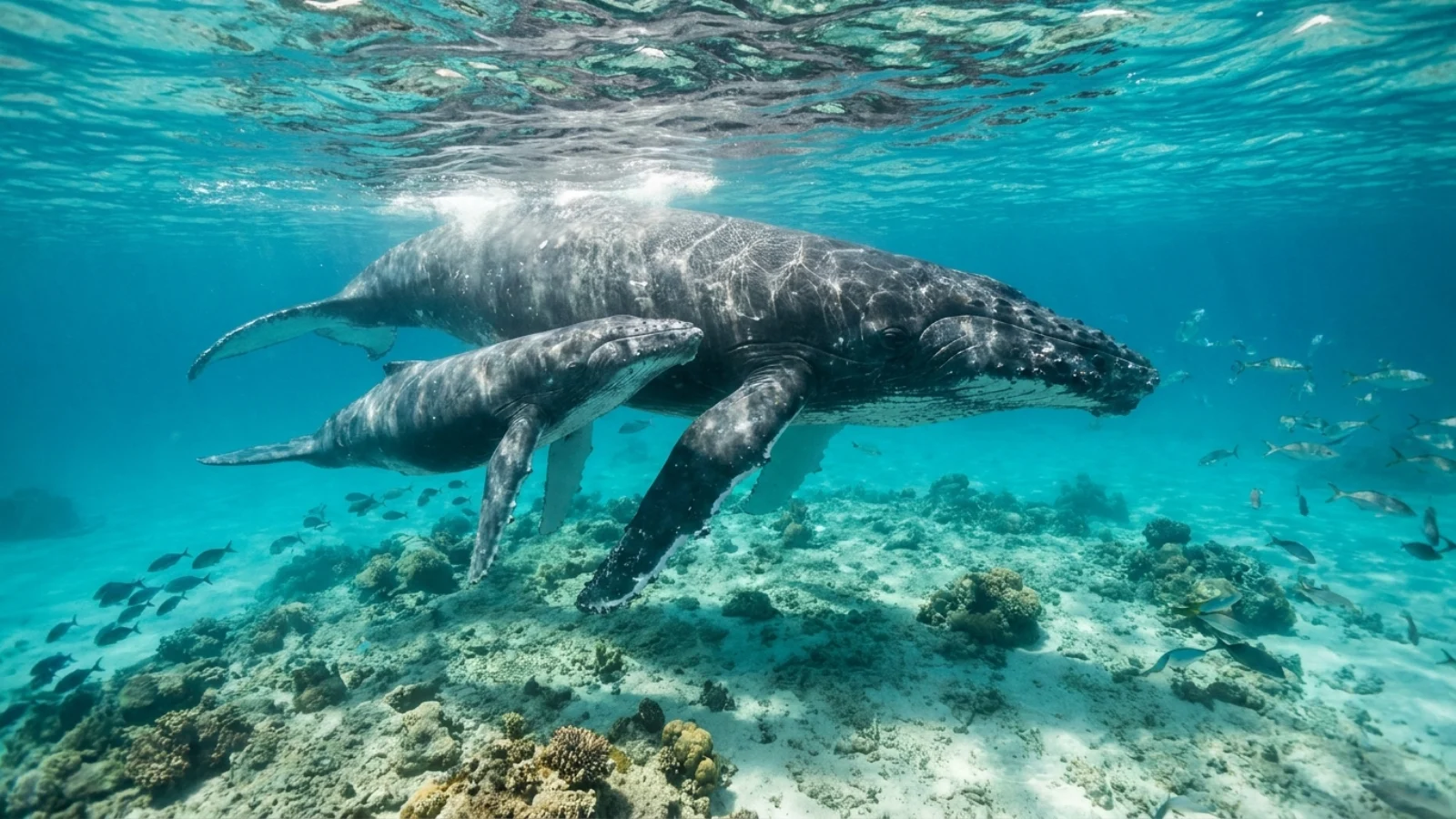
How big is the Silver Bank, and what is it like?
The Silver Bank, Banco de la Plata in Spanish, is a submerged carbonate platform covering about 1,680 square kilometres (650 square miles). It lies north of the Dominican Republic and southeast of the Turks and Caicos Islands. Silver Bank Passage separates it from Mouchoir Bank to the west, and Navidad Bank Passage from Navidad Bank to the east. Geologically the three banks and the Turks and Caicos belong to the same chain as the Bahamas, the Lucayan Archipelago.
Most of the bank sits well below the surface, but the shallow parts are only about 18 metres (60 feet) deep, and in the north many coral heads reach the surface, especially at low tide. That is why big ships avoid it and any vessel is expected to get permission before entering. The rusting freighter Polyxeni, most of it above water, still sits among the coral heads, and boarding it needs government permission.
For whales the geography is the point. The bank breaks the Atlantic swell, so mothers and newborn calves can rest in warm, relatively calm, shallow water, while the deeper channels between the banks serve as migration routes. Liveaboards stay at anchor on the bank, and daily excursions by tender usually range from about 3 to 5 miles from the anchorage, often less, according to Conscious Breath Adventures, one of the permitted operators.
Why do humpback whales come to the Silver Bank?
To mate and give birth. The North Atlantic has two separate humpback wintering populations: one in the West Indies, from Cuba to northern Venezuela, and one around the Cape Verde Islands and northwest Africa. In summer the West Indies whales feed off New England, eastern Canada and western Greenland, and some have been recorded feeding further east. Mark Carwardine’s trip notes say whales reach the bank from as far north as Arctic Norway. Humpbacks as a species migrate up to about 16,000 km (9,900 miles) a year, and in winter they live largely off their blubber rather than feeding.
The Dominican Republic’s sanctuary is one of the most important parts of that winter range. Carwardine’s notes put the number of humpbacks using the Silver Bank at up to 3,000 a season; operators’ own descriptions speak more loosely of thousands.
Breeding drives everything you see. Gestation lasts about 11.5 months and females usually calve every two years, so a female that mates on the bank one winter may return to give birth the next. Calves are born at around 4.3 metres (14 feet) long and 680 kg (1,500 lb), usually in mid-winter, and suckle for up to a year. Very young calves are pale grey with a noticeably folded dorsal fin, which is exactly the sign the sanctuary rules use to keep swimmers away from the most vulnerable pairs.
Males trail lone females and mothers with calves. The male closest to the female, the principal escort, fights off challengers, while secondary escorts hang further back. These competitive groups produce the bank’s most dramatic surface action: charging, head lunges, tail slaps and breaches. They are also the reason everyone leaves the water when behaviour turns rowdy.
What is humpback song, and will you hear it?
Male humpbacks sing during the winter breeding season, and the Silver Bank is a good place to hear it. A song is built from units, phrases and themes repeated in sequence, and a singer may perform for roughly 4 to 33 minutes depending on the region, then repeat. The sounds range from deep, low-frequency tones to harmonics above 20 kHz and can carry at least 10 km (6 miles) through water.
All the males in an area sing much the same song, and when one male changes it the others copy the change, so the song slowly evolves. Songs have also been shown to spread between neighbouring populations over successive breeding seasons. Why males sing is still debated. Females do not seem to approach lone singers, but may be drawn to gatherings of singing males, a little like a lek.
What happens on a typical day at the Silver Bank?
The liveaboard stays anchored and most of the action happens from small tenders. Under the sanctuary rules, each commercial vessel may use up to two tenders, each no longer than 26 feet and carrying up to 12 passengers. Vessels longer than 30 feet are not allowed to approach whales or run whale watching themselves, which is why the mother ship stays put.
Typical trips run two tender excursions a day. Guides look for resting whales, mothers and calves, or curious juveniles, and watch their behaviour before deciding whether a soft in-water encounter is possible. When it is, guests slip in quietly and float. Whales that are travelling, rowdy or breaching are watched from the boat. Usually only one tender works with a whale at a time.
Weather sets the schedule. When the wind blows a steady 20 knots, vessels have to talk to each other before any activity, and at a steady 30 knots all whale watching stops. Expect some days with long boat rides and few swims, and others with repeated encounters. Throwing waste overboard, burning garbage and discharging pollutants are all banned in the sanctuary, and scuba diving is not allowed when marine mammals are present.
Can you really swim with humpback whales at the Silver Bank?
Yes, under strict rules. Permitted operators run “soft in-water encounters”: guests slip quietly into the water from a small tender with mask, snorkel and fins, float at the surface, and let the whale decide whether to approach.
Touching, chasing, swimming after or free diving on whales is prohibited. If a whale shows aggressive surface behaviour, everyone leaves the water. If a mother with a pale, newborn calf approaches, the tender shuts down its engines and no swim is attempted. Scuba is not used for whale encounters. Normally only one tender works with a whale at a time, and about 10 people are in the water at once.
How do you get to the Silver Bank?
On a permitted liveaboard from Puerto Plata on the Dominican Republic’s north coast. Trips usually run one week, with about five days on the bank after an overnight crossing.
Because only a few boats hold permits and the number of guests is capped, trips sell out a year or more ahead. Prices vary with the boat, cabin and dates; recent trips have cost several thousand dollars per person before flights (one UK operator lists a 2027 package from about £7,295 excluding flights). Samaná Bay, on the mainland, offers boat-based whale watching from January to March at far lower cost, but swimming with whales is prohibited there.
How is whale tourism regulated in the Dominican Republic?
The Dominican Republic created the Silver and Navidad Bank Sanctuary on 14 October 1986. A presidential decree of 5 July 1996 enlarged it and renamed it the Sanctuary for Marine Mammals, which now also takes in Samaná Bay and the deeper water between the banks. The International Whaling Commission’s whale watching handbook gives its area as 32,913 square kilometres.
Whale watching in the country began in 1985, when an expatriate tour operator started taking tourists out of Santa Bárbara de Samaná. Regulations were first set in 1998 and have been revised several times; the current framework is Resolution 0030-17 of 2 October 2017. For the Silver Bank, the IWC reports that three commercial permits have been allocated and that the ministry can issue no more than four at once. Conscious Breath Adventures says the guidelines cap visitors at no more than 60 guests a week, or about 600 a season, and an on-site coordinator oversees activity on the bank. During whale season no vessel may visit without a permit.
The rules for swimmers are short and clear. Masks, fins and snorkels are required. Touching, chasing, swimming after or free diving on whales is banned. If a mother with a pale newborn calf with a folded dorsal fin approaches, engines are shut down and no swim is attempted. Inside the sanctuary, boats may not go faster than 10 knots.
How does Samaná Bay compare?
Samaná Bay, on the mainland’s northeast coast, is the cheap, easy way to see the same population, but only from a boat. Swimming with whales is banned there. The IWC handbook summarises the rules: no more than three boats may watch one group at a time, waiting boats stay 250 metres away, boats keep at least 50 metres from adult whales and 80 metres from groups with a calf, and engines stay in neutral rather than off while watching. A boat may spend up to 30 minutes with a group if others are waiting, speed near whales is limited to 5 knots, boats must leave the sanctuary before 4 p.m., and passengers on boats under 10 metres must wear life jackets.
The handbook lists 43 boat permits for Samaná Bay, though it also mentions 56 permits in 2018, so the exact number is unclear. Since 2011 a free land observatory at Punta Balandra has let visitors watch from shore. Recorded visitor numbers for the whole sanctuary ran between about 36,000 and 58,000 a year from 2010 to 2018, and almost all of them were boat-based whale watchers rather than Silver Bank swimmers.
What is the Silver Bank’s treasure history?
Long before whale watching, the bank was known as a ship trap. In 1641 the almiranta of the Spanish silver fleet, later identified as Nuestra Señora de la Concepción, was wrecked on its reefs. The wreck was found again in January 1687 by an expedition led by William Phips, a ship’s captain from Maine backed by English investors. A smaller ship sent to search what was then called the Ambrosia Bank, crewed partly by Native American divers including Jonas Abimeleck and John Pasqua, spotted cannons lying on the white sand of the reef.
The silver they raised weighed more than 34 tons and was valued at £205,536. Phips received £11,000 after paying the crew and was knighted by James II in June 1687, the first native New Englander to be knighted. He later became the first royally appointed governor of the Province of Massachusetts Bay. The bank’s Spanish name, Banco de la Plata, means the Silver Bank.
Are humpback whales endangered?
Not as a species. The IUCN Red List has assessed the humpback as Least Concern since 2018, with a worldwide population of around 135,000 whales, about 84,000 of them mature, and an increasing trend. In September 2016, NOAA Fisheries divided humpbacks into 14 distinct population segments under the US Endangered Species Act. The West Indies segment, which breeds on the Silver Bank, was one of nine that were no longer listed, while four segments remained endangered and one threatened.
Recovery does not mean the threats have gone. Along the US Atlantic coast, NOAA recorded 88 stranded humpbacks between January 2016 and February 2019, more than double the previous three years, and declared an unusual mortality event in April 2017. Ship strikes and fishing gear entanglement were the main causes identified. Breeding grounds such as the Silver Bank, where boat numbers, speeds and human contact are tightly controlled, are one part of protecting a population that spends the rest of the year in busy shipping and fishing waters.
How should you prepare for a Silver Bank trip?
Fitness and snorkel skills matter more than anything you can buy. Encounters happen in open water well out of sight of land, often with some swell and current, and you need to slip in quietly, float without splashing and get back into the tender without help. If you are new to snorkeling (see snorkeling for beginners), practise in a pool or calm sea first, fit a mask that does not leak, and learn to clear your snorkel without lifting your head.
The open-ocean crossing and the tender rides can be rough, so bring whatever remedy works for you and start it before departure. A long-sleeved rash guard or thin wetsuit protects against sun and keeps you warm during long floats. Book through a permitted operator only, because no other boat may legally take you swimming with whales on the bank during the season.
Is the Silver Bank ethical?
It is one of the most tightly regulated whale swims in the world: few boats, capped guests, passive encounters and whale-led approaches. Choose a permitted operator and follow the guides.
The model is the opposite of chasing whales with boats. Most of each day is spent watching from the tender; in-water encounters happen only when a whale is resting or curious and conditions allow.
One weird Silver Bank fact
The bank’s coral heads are also a ship trap: it is the area where the treasure galleon Nuestra Señora de la Concepción was wrecked in 1641, later salvaged by William Phips in 1687.- IWC Whale Watching Handbook, Dominican Republic country profile (sanctuary dates, permits, in-water rules, Samaná Bay); Conscious Breath Adventures, the Sanctuary for the Marine Mammals of the Dominican Republic (permits, guest caps); Mark Carwardine / Wildlife Worldwide, Silver Bank 2027 trip page and information sheet (location, up to 3,000 whales, price, itinerary, 10 swimmers per tender)
- Wikipedia: Silver Bank (area, depth, Polyxeni wreck, 1986 and 1996 decrees); Humpback whale (biology, song, populations, IUCN status, Atlantic strandings); William Phips (Concepción wreck and 1687 salvage)
- NOAA Fisheries final rule revising the humpback whale ESA listing into 14 distinct population segments (September 2016)
Where is the Silver Bank?
In the Atlantic, about 80 miles (130 km) north of the Dominican Republic, inside the country’s Marine Mammal Sanctuary.
When is the season for Silver Bank?
Roughly January to April, when the whales are on their winter breeding grounds. Permitted liveaboards run week-long trips through that period.
Can you swim with humpback whales at Silver Bank?
Yes, on permitted liveaboards, using snorkel only and following soft in-water encounter rules.
How much does a Silver Bank trip cost?
Typically several thousand dollars per person for a week-long liveaboard, plus flights.
Is scuba diving allowed with whales at Silver Bank?
No. Whale encounters are snorkel only.
Can you swim with whales in Samaná Bay?
No. Samaná Bay allows boat-based whale watching only.
Blane Perun has been exploring Earth’s oceans and marine life for over 25 years. Founder of TheSea.Org in 1999, underwater photographer, coral aquaculture pioneer, and explorer of 80+ countries.
About Blane Perun → All snorkeling destinations →