John Pennekamp Snorkeling — Tours, the Statue & Honest Tips
John Pennekamp Coral Reef State Park in Key Largo, opened in 1963, was the first undersea park in the United States. Park entry is $8 per vehicle plus 50 cents per person (open 8 a.m. to sunset, every day). The reefs are 3 to 8 miles offshore, so you snorkel from the park’s tour boat, which moors at shallow inner reefs 5 to 15 ft deep for about 1 to 1½ hours in the water. Weather permitting, captains visit Key Largo Dry Rocks, home of the bronze Christ of the Deep statue. Everyone must be able to swim, children under 15 need an adult, and a wetsuit helps when the water is below about 78°F.
Pennekamp — at a glance
- Park entry (Florida State Parks, Nov 2026): $8 per vehicle plus 50 cents per person up to 8; single occupant $4.50; walk-in or bike $2.50
- Hours: 8 a.m. to sunset, 365 days a year
- Snorkel reefs: Inner reefs 5–15 ft deep, about 3–8 mi offshore
- Time in water: About 1–1½ hours; the boat stays moored, so you can get out any time
- Rentals: Mask, snorkel, fins and wetsuits; small deposit
- Rules: Must be able to swim; under-15s with an adult; no touching coral
- Opened: 1963, as the first undersea park in the U.S.
- Christ of the Deep: Bronze statue near Key Largo Dry Rocks in about 25 ft of water; placed August 25, 1965
- Glass-bottom boat: Visits Molasses Reef, about 6.5 mi offshore in 10–30 ft; it does not visit the statue
- Sanctuary: The reefs lie within the Florida Keys National Marine Sanctuary
How does snorkeling at John Pennekamp work?
You pay park entry, check in at the concession, and ride the park’s snorkel boat to a moored inner reef. You get about 1 to 1½ hours in the water, then ride back. Total time is usually around 2½ to 3 hours.
The park itself is mostly underwater: its boundaries extend into the Atlantic over seagrass, mangroves and coral reef, adjoining the Florida Keys National Marine Sanctuary. The coral reefs are well offshore; unless you are an exceptional swimmer with a boat escort, you cannot reach them from the beach. Reservations are recommended, especially on holidays and weekends, and the captain chooses the reef on the day based on wind and sea conditions.
How much does it cost to snorkel at John Pennekamp?
Park entry is $8 per vehicle for two to eight people plus a 50-cent per-person Monroe County surcharge, then the snorkel tour fare, plus gear if you rent it. Call the park concession at (305) 451-6300 for current tour prices.
| Item | Cost | Notes |
|---|---|---|
| — | — | — |
| Vehicle, 2–8 people | $8 + $0.50/person | Paid at the gate |
| Single-occupant vehicle | $4.50 | |
| Pedestrian or cyclist | $2.50 | |
| Snorkel tour | Varies; check with the concession | Boat stays moored at the reef |
| Gear and wetsuit | Rental; deposit required | Bring your own mask if you have one |
Can you see the Christ of the Abyss statue snorkeling?
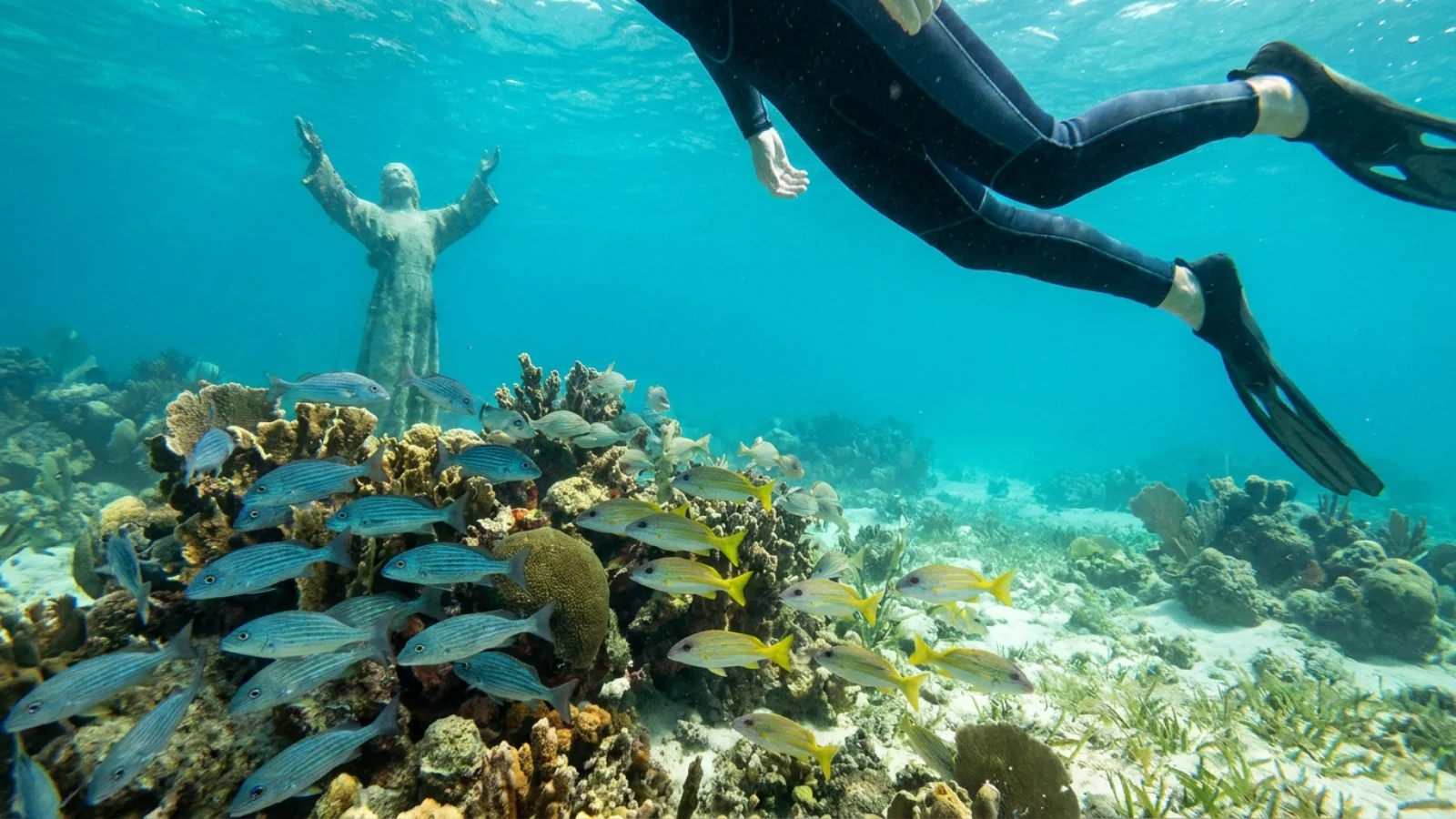
Yes, on calm days when the captain chooses Key Largo Dry Rocks. The bronze Christ of the Deep, roughly 2.5 m (8 to 9 ft) tall, stands on a concrete base in about 25 ft of water, arms raised toward the surface, so on a clear day snorkelers see it plainly from above.
The statue was cast from the same mould as Il Cristo degli Abissi, the 1954 original off San Fruttuoso near Portofino, Italy, and placed near Key Largo Dry Rocks on August 25, 1965. Moorings at Dry Rocks are limited and the captain picks the site on the day, so a visit is never guaranteed; the glass-bottom boat goes to Molasses Reef instead.
What will you see snorkeling at Pennekamp?
Brain and star corals, sea fans and sea rods, blue tang, sergeant majors, parrotfish, grunts, snapper, barracuda and sometimes nurse sharks, rays and sea turtles.
The inner reefs are patch and spur-and-groove reefs. Look for blue tang, sergeant majors and parrotfish grazing the coral, and for brain coral heads. For the reef’s science and history, see John Pennekamp Coral Reef Park and Coral Reefs Key Largo.
How did John Pennekamp become America’s first undersea park?
The idea of protecting the reefs off Key Largo is older than the park. In the 1930s, a state commission proposed a national park for the Everglades that would have included the Key Largo reefs, but opposition from property owners, outdoorsmen and Monroe County commissioners stopped it, and when Everglades National Park was created in 1947 its boundaries left out Key Largo and the reefs. By the late 1950s, damage to the reefs was obvious. Shells, corals, sponges, seahorses and other marine life were being hammered, chiselled and even dynamited off the reef to sell as souvenirs to tourists.
Two men led the campaign to stop it: Dr. Gilbert L. Voss of the Marine Institute of Miami and John D. Pennekamp, an editor at the Miami Herald. Pennekamp had helped establish Everglades National Park, had been the first chairman of the Florida Board of Parks and Historic Memorials and had worked as a consultant to the U.S. Fish and Wildlife Service. Their efforts led the state parks board to designate the state-controlled reefs off Key Largo as a permanent preserve, and in the spring of 1960 President Dwight D. Eisenhower proclaimed the adjacent federal waters the Key Largo Coral Reef Preserve. Governor LeRoy Collins later gave the state park Pennekamp’s name. Land on Key Largo and access to the Overseas Highway were acquired by purchase and donation, and the park opened in 1963.
The park is large but mostly water. It covers about 70 square nautical miles of the Atlantic, runs roughly 25 miles along the coast and extends about 3 miles offshore, with mangroves, seagrass and coral reef within its boundaries. It was added to the National Register of Historic Places on April 14, 1972. In fiscal year 2004 it had more than a million visitors, which at the time made it the most visited park in the Florida State Parks system.
Is the Christ of the Deep statue inside the park?
Not quite. The Key Largo statue is one of three bronze casts made from the mould of Il Cristo degli Abissi, the statue by Guido Galletti that was placed in the Mediterranean off San Fruttuoso, between Camogli and Portofino, on August 22, 1954, at about 17 m (56 ft). The original was based on an idea of the Italian diving instructor Duilio Marcante and placed near the spot where Dario Gonzatti, the first Italian to use scuba gear, died in 1947. A second cast was placed at St. George’s, Grenada, in 1961.
The third cast was presented to the Underwater Society of America in New York in 1962 and unveiled at the society’s convention in Chicago. On August 25, 1965, it was placed in about 25 ft of water near Dry Rocks, roughly six miles east of Key Largo, in what is now the Florida Keys National Marine Sanctuary, just outside the boundary of the state park. The bronze figure weighs about 260 kg and stands on a concrete base of roughly 9 tons. Because the statue rises well above the bottom, its head and raised arms come within easy view of snorkelers on a calm, clear day, which is why Dry Rocks is the trip most visitors hope for.
Corals, sponges and algae grow on the bronze, and the statue’s appearance changes over the years as it is cleaned or overgrown. Moorings at Dry Rocks are limited, and the site is exposed to wind and swell, so plan to be happy with whichever reef the captain chooses on the day.
Which reefs do the Pennekamp boats visit?
The concession’s snorkel tours usually go to the closer, shallower inner reefs. According to the park concession, the reefs lie between 3 and 8 miles offshore, snorkel depths average 5 to 15 ft, and guests get about 1 to 1½ hours at the reef with the boat moored, so anyone can climb back aboard at any time. The captain picks the site each trip based on weather, sea conditions and available moorings. Key Largo Dry Rocks, with the statue, is one possible destination; Grecian Rocks is another shallow inner reef often visited by snorkel boats.
The glass-bottom boat goes further out, to Molasses Reef, about 6.5 miles offshore, where the concession gives average depths of about 10 to 30 ft. Molasses is one of the best-known reefs in the upper Keys and a popular dive site, with spur-and-groove formations, larger fish and often more current than the inner reefs. Scuba trips run separately to deeper sites.
All of these reefs are part of the Florida Reef, the reef tract that runs along the seaward side of the Florida Keys. The densest reefs and clearest water on the whole tract are found seaward of Key Largo and Elliott Key, where the long islands shield the reef from the turbid water of Florida Bay and Biscayne Bay. That is why Key Largo became the centre of reef tourism in Florida.
What has happened to the coral at Key Largo?
Anyone who saw these reefs decades ago will notice the change. The Florida Reef has suffered a long run of coral losses from bleaching, disease, hurricanes and pollution. Bleaching was first recorded on the Florida Reef in 1973 and has become more frequent as sea temperatures have risen. In July 2023, record early and rapid warming caused widespread bleaching and coral death across the Keys. A 2025 study published in Science found that the heat wave killed 98 to 100% of the elkhorn and staghorn corals in the Florida Keys and Dry Tortugas, and described both species as functionally extinct on the reef.
Disease has also taken a heavy toll. Stony coral tissue loss disease was first detected off Virginia Key near Miami in late 2014 and reached the upper Florida Keys in 2016. It destroys the tissue of at least 22 species of reef-building corals, often killing small colonies within weeks and large ones within months, and it is regarded as one of the deadliest coral diseases ever recorded. Brain corals and other boulder-forming species were among those affected; elkhorn coral appears to be resistant to the disease, but not to heat.
What snorkelers see today is still worthwhile: sea fans, sea rods and other soft corals sway over the reef, surviving brain and star corals form heads and mounds, and fish life remains abundant. But expectations should match reality. The healthiest-looking parts of the reef are often dominated by soft corals rather than the branching thickets shown in older photos, and restoration groups in Key Largo continue to grow and outplant corals to try to bring them back.
What sanctuary and park rules apply to snorkelers?
The reefs off Key Largo are protected twice over: by John Pennekamp Coral Reef State Park and by the Florida Keys National Marine Sanctuary, which was designated in 1990 and covers about 2,900 square nautical miles. In practice, the rules for snorkelers are simple. Do not touch, stand on or kick coral; do not collect shells, coral or any marine life; and do not feed fish. Even a light touch can damage coral tissue and spread disease, and a fin kick can break a colony that took decades to grow.
The concession adds its own safety rules. Everyone must be able to swim, whatever their age; children under 15 must be with an adult at all times; and a safety vest is required in the water. Beginners get a short how-to-snorkel briefing on the boat, and the captain can keep anyone out of the water if sea conditions are unsafe. Wetsuits are recommended when the water is below about 78°F (25°C) and can be rented, and reservations, made online, are recommended, especially on holidays.
Park admission is paid separately at the gate. Florida State Parks listed the fees in November 2026 as $8 per multiple-occupant vehicle plus 50 cents per person up to eight people and $2.50 for each additional person, $4.50 for a single-occupant vehicle, and $2.50 per pedestrian or cyclist, with a $10 boat ramp fee per vessel for day use. The park opens at 8 a.m. and closes at sunset every day of the year, and admission is not guaranteed once the parking lot is full, so arrive early on weekends and holidays.
How do you plan a good Pennekamp day?
Start with the weather. The inner reefs are shallow and exposed, so wind and waves affect both the comfort of the boat ride and the clarity of the water. Book a morning trip if you can, when winds are often lighter, and keep a backup day free in case the boat cannot go out. Bring reef-safe sun protection, a rash guard and plenty of water, and arrive early enough to park and check in.
If you have your own mask, bring it; a well-fitting mask makes more difference to a snorkel than anything else. In the water, float rather than stand, keep your fins near the surface over shallow reef tops, and stay with your group near the moored boat. Children and nervous swimmers can practise first at the park’s beaches.
Knowing a few fish makes the hour on the reef far more rewarding. Blue tang travel in loose schools that graze algae from the rock; adults are blue, while juveniles are bright yellow. Sergeant majors, striped yellow and black, guard purple egg patches on the reef in breeding season and will dart at a snorkeler who comes too close. Parrotfish scrape algae from dead coral with beak-like teeth and can be heard crunching on a quiet day. Grunts and snapper hang in schools under ledges, and great barracuda often hover motionless near the boat, curious but harmless if left alone. Learning to recognise these common species first makes the rarer sightings, such as a nurse shark resting under a ledge or a sea turtle surfacing to breathe, easier to spot and enjoy. After the trip, the park’s visitor centre and nature trails are worth an hour, and canoeing and kayaking in the sheltered mangrove waters are other ways to see the park.
Can you snorkel at John Pennekamp from the beach?
Only in a limited way. Cannon Beach and Far Beach have shallow swimming areas with seagrass, some fish and replica cannons, but no coral reef. The real reef requires the boat.
The beach areas are good for a child’s first practice with mask and fins before the boat trip. Swim only in the marked areas.
Is Pennekamp good for kids and beginners?
Yes. The reefs are shallow, the boat stays moored, a safety vest is required in the water, and you can climb out whenever you like. Children under 15 must be with an adult, and everyone must be able to swim.
Practise in the pool or at Cannon Beach first. Our beginner’s guide covers mask clearing and breathing.
The shallow inner reefs show their colour best on a calm, sunny morning, when you can see the coral clearly without diving down. Divers visiting the same reefs can find more in our Key Largo dive guide.
One weird Pennekamp fact
The park is named after John D. Pennekamp, a Miami Herald editor who campaigned to protect the reef and helped create Everglades National Park.- Florida State Parks, John Pennekamp Coral Reef State Park hours and fees (accessed November 2026)
- Pennekamp Park concession, Frequently Asked Questions: reef distances, depths, time in water, age, vest and wetsuit rules, glass-bottom boat (accessed November 2026)
- Wikipedia, John Pennekamp Coral Reef State Park (history, area, NRHP, visitors); Christ of the Abyss (three casts, 1965 placement)
- Wikipedia, Florida Reef (bleaching history; 2025 Science study on the 2023 heat wave); Stony coral tissue loss disease; Florida Keys National Marine Sanctuary
- NOAA, Florida Keys National Marine Sanctuary
How much does it cost to snorkel at John Pennekamp?
Park entry is $8 per vehicle plus 50 cents per person; snorkel tours and gear rental are extra. Check current tour prices with the park concession.
How deep is the snorkeling at John Pennekamp?
The snorkel tours visit inner reefs about 5 to 15 ft deep.
Can you see the Christ statue while snorkeling?
Yes, if the boat goes to Key Largo Dry Rocks. The statue stands in about 25 ft of water and is visible from the surface on clear days.
How far offshore are the Pennekamp reefs?
About 3 to 8 miles offshore; you need the boat to reach them.
Do you need a wetsuit at John Pennekamp?
It is recommended when the water is below about 78°F, typically in winter. Wetsuits can be rented.
What is the best time to snorkel John Pennekamp?
Morning trips on calm days, when winds are light, usually give the clearest water; the captain chooses the reef based on conditions.
Can kids snorkel at John Pennekamp?
Yes, if they can swim. Children under 15 must be accompanied by an adult.
Is John Pennekamp worth it?
Yes on a calm day. It is the easiest way to snorkel the Key Largo reefs, at a modest park fee.
Blane Perun has been exploring Earth’s oceans and marine life for over 25 years. Founder of TheSea.Org in 1999, underwater photographer, coral aquaculture pioneer, and explorer of 80+ countries.
About Blane Perun → All snorkeling destinations →