Snorkeling in Southwest Florida — Naples to Venice, Honestly Rated
Southwest Florida has no shallow coral reefs. The Gulf here is a broad, shallow, sandy shelf, and visibility near shore is often 5 to 15 ft, better on calm days with offshore winds. What it does have: rock jetties and passes crowded with sheepshead, snapper and snook; seagrass flats with rays, conch and sea stars; offshore hard-bottom ledges and artificial reefs reached by boat; and the fossil shark teeth of Venice. The best shore options are Delnor-Wiggins Pass State Park in North Naples ($6 per vehicle), the Gulf-side jetties and the lagoons behind the barrier islands. For coral, drive about four hours to the Florida Keys.
Southwest Florida — conditions
- Coral reef: None near shore; scattered hard-bottom with sponges and soft corals offshore
- Visibility: Typically 5–15 ft near shore; clearer on calm days and incoming tides
- Best season: Late spring and early summer (April–June), before summer storms and runoff
- Water temperature: Mid-60s°F in winter to upper 80s in summer
- Hazards: Tidal currents in passes, boat traffic, stingrays (shuffle your feet), red tide events
- Dive flag: Required by Florida law where boats operate
- Delnor-Wiggins: State park opened 1976 with a hard-bottom area; $6 per vehicle, 8 a.m. to sundown
- Venice: Calls itself the “Shark Tooth Capital of the World” for fossil teeth washing up on its beaches
- Caspersen Beach: Sarasota County says the Harbor Drive access washed out in the 2024 storms; no vehicle parking, enter on foot or bike from South Brohard Park
- Red tide: Karenia brevis blooms can close beaches and irritate eyes and lungs; check FWC reports first
Is there good snorkeling in Southwest Florida?
Not in the coral-reef sense. But on a calm, clear day the jetties, passes and seagrass flats from Naples to Venice are full of life, and a few spots are genuinely good.
The Gulf shelf off Naples and Fort Myers is shallow, sandy and fed by rivers and mangrove estuaries, so the water is green rather than blue and visibility changes day to day. The trade-off is life: this is manatee, dolphin and sea turtle country, and the passes concentrate fish. The trick is picking the day: calm seas, a few days without rain, and an incoming tide.
| Spot | Area | Access | What you see | Notes |
|---|---|---|---|---|
| — | — | — | — | — |
| Delnor-Wiggins Pass State Park | North Naples | Shore | Hard-bottom, fish near the rocks | $6 per vehicle; stay clear of the pass current |
| Gulf-side jetties | Naples, Marco, Fort Myers Beach | Shore or boat | Sheepshead, snapper, snook, crabs | Calm days, slack tide; avoid fishing lines |
| Tigertail Beach lagoon | Marco Island | Shore | Seagrass, juvenile fish, sea stars | Shallow, warm, kid-friendly |
| Lovers Key State Park | Between Bonita and Fort Myers Beach | Shore | Seagrass, rays, dolphins offshore | State park fee |
| Offshore artificial reefs and ledges | Collier and Lee counties | Boat only | Goliath grouper, snapper, sponges | 20–60 ft; better for divers and free-divers |
| Venice beaches | Venice | Shore | Fossil shark teeth | Caspersen: no vehicle parking since 2024 storms |
| Egmont Key | Mouth of Tampa Bay | Boat only | Ruins of Fort Dade in the shallows | Long day trip from the north end of the region |
Where can you snorkel in Naples, Florida?
The best shore option is Delnor-Wiggins Pass State Park, where a hard-bottom area and rocks near Wiggins Pass hold fish. Otherwise, snorkelers in Naples use the jetties on calm days, or charter a boat to the offshore artificial reefs.
Delnor-Wiggins is open 8 a.m. to sundown, $6 per vehicle (exact change or QR code). Those are the fees and hours Florida State Parks listed in November 2026. Snorkel well away from the pass itself, where tidal current and boat traffic are both serious. Naples Pier is a fishing pier; do not snorkel around it. For the travel side of the region see Naples, Florida and Marco Island.
What is Delnor-Wiggins Pass State Park like for snorkelers?
Delnor-Wiggins Pass State Park occupies about a mile of relatively undisturbed barrier island in North Naples, between the Gulf and the mouth of the Cocohatchee River at Wiggins Pass. Its history explains its odd name. Joe Wiggins ran a trading post here in the late 1800s, trading with Seminoles and settlers. In 1964 Collier County acquired the land with help from Lester J. and Dellora A. Norris, which is where “Delnor” comes from, and in 1970 the state bought it from the county for a park, which opened in 1976. The park is one of the few places on this coast where a hard-bottom area lies within reach of the beach, which is why it is the default shore snorkel for Naples.
As listed on the Florida State Parks page in November 2026, the park offers swimming, snorkeling, scuba diving, paddleboarding, boating and fishing among its activities, along with a boat ramp, a canoe and kayak launch, . Entry is $6 per vehicle, payable with exact change or by QR code, and the park is open from 8 a.m. to sundown every day of the year. Drinking water is not available and temporary restrooms are in use, so bring your own water. Anglers may fish in the northern part of the beach beyond the double red flags toward the pass, which is another reason to keep your snorkeling well south of that area. Wildlife recorded in the park includes loggerhead sea turtles, West Indian manatees, bald eagles, ospreys and the gopher tortoise.
The best way to treat Delnor-Wiggins is as a calm-day snorkel. Choose a morning with little wind, after a few dry days, and go on a rising tide, when clearer Gulf water moves in. Swim parallel to the beach rather than straight out, keep to the swimming area, and stay well away from the pass, where the tide runs hard and boats come and go. Look under ledges and around any rock or rubble for sheepshead, snapper and small grouper, and scan the sand for rays, which bury themselves in the shallows.
Do snorkelers need a dive flag in Florida?
Usually, yes. Florida’s divers-down law, section 327.331 of the Florida Statutes (2025 edition), defines a “diver” as anyone wholly or partially submerged using a face mask and snorkel or breathing apparatus, so snorkelers are included. All divers must display a divers-down warning device prominently where they are diving, except in areas customarily used only for swimming. The device can be a flag or a buoy showing the divers-down symbol, a red square or rectangle with a white diagonal stripe. When displayed from the water, the symbol must be at least 12 by 12 inches; when displayed from a boat, at least 20 by 24 inches, and a flag must have a stiffener so that it stays unfurled with no wind.
The law also sets distances. In rivers, inlets and navigation channels, divers must make a reasonable effort to stay within 100 ft of their flag or buoy, and boats must make a reasonable effort to stay at least 100 ft away from it. In all other waters, the distance is 300 ft for both. A boat that has to come closer must slow to the minimum speed needed to keep headway and steer. Divers may not display the device in a river, inlet or channel in a way that creates an unreasonable navigational hazard, and the flag must come down once everyone is out of the water. A violation is a noncriminal infraction.
In practice, that means a towed float with a flag is worth carrying whenever you snorkel near a jetty, a pass or anywhere boats run. The passes along this coast, such as Wiggins Pass, are exactly the kind of channels where the 100-ft rule applies and where boat traffic is heavy.
When is the water warmest for snorkeling in Southwest Florida?
Long-term averages from NOAA’s National Oceanographic Data Center coastal water temperature guide for Naples show how wide the seasonal swing is on this coast. The Gulf averages about 66°F in January and February, 71°F in March and 77°F in April. It reaches 82°F in May, 86°F in June and about 87°F in July and August, then eases to 86°F in September, 81°F in October, 73°F in November and 68°F in December. The annual average is about 78°F.
Those numbers explain why most visitors who snorkel here in winter come out shivering. Water in the mid-60s feels cold within a few minutes even when the air is pleasant, and a 3 mm wetsuit or at least a rash guard and a vest makes a winter snorkel far more comfortable. Winter cold fronts also bring north winds that churn the shallow shelf and cloud the water for days. From May through September the water is bath-warm and no exposure suit is needed for warmth, though a rash guard still helps against sunburn and the occasional jellyfish.
Warm water is not the same as clear water. Summer is the rainy season in Southwest Florida, and afternoon thunderstorms, river runoff and tannin-stained water from the mangrove estuaries can cut visibility sharply. Late spring, roughly April to early June, often combines comfortable temperatures with drier weather and calmer seas, which is why it is usually the best window. Whatever the month, the deciding factors are still the wind, recent rain and the tide.
Why is the water so murky off Southwest Florida?
The short answer is geology and rivers. The continental shelf off this coast is very wide and very gently sloped, so the water stays shallow far from shore. When the wind blows, waves stir the fine sand and shell silt on the bottom back into the water column, and in a few feet of water there is nowhere for it to settle out of sight. A day or two of strong onshore wind can turn clear green water to cloudy brown, and it takes a run of calm days for it to clear again.
Freshwater adds to the effect. The Caloosahatchee River enters the Gulf near Fort Myers and Sanibel, and freshwater releases and storm runoff carry sediment, nutrients and dark, tea-coloured tannins from the swamps and mangroves. South of Naples, the Ten Thousand Islands are a maze of mangrove creeks that drain into the Gulf with every falling tide. That is why snorkelers time their swims for the rising tide, when clearer offshore water pushes into the passes and over the nearshore bottom.
None of this means the water is unhealthy most of the time; it is simply a different kind of coast from the Keys, where the reef sits on the edge of clear Florida Current water. The same estuaries that cloud the water feed the seagrass beds and mangrove nurseries that support snook, snapper, juvenile goliath grouper, manatees and dolphins. For a regional overview of the beaches themselves, see the Southwest Florida beaches guide.
How do you stay safe snorkeling the Gulf beaches and passes?
Most of the risks on this coast come from currents and boats rather than from wildlife. Passes such as Wiggins Pass, Big Hickory Pass and the cuts between the barrier islands carry strong tidal flows that change direction with the tide, and a tired snorkeler can be carried a long way in a few minutes. Snorkel on the beach side of the swimming area, swim with a partner, wear fins, and turn back while you still have energy. If you are caught in a current, swim across it rather than against it.
Stingrays are the most common cause of injury for waders on Gulf beaches. They rest half-buried in the sand in shallow water, and stepping on one can earn a painful sting on the foot or ankle. Shuffling your feet as you walk in pushes them away. Jellyfish appear in some seasons, and sea lice, the stinging larvae of some jellyfish, occasionally cause itchy rashes under swimsuits. Around jetties, watch for monofilament line and hooks, and give anglers space. In summer, afternoon thunderstorms build quickly; lightning is a real hazard on open water, so plan to be out early. Beach flag warnings, rip currents and other general hazards are covered in our Florida beach safety guide.
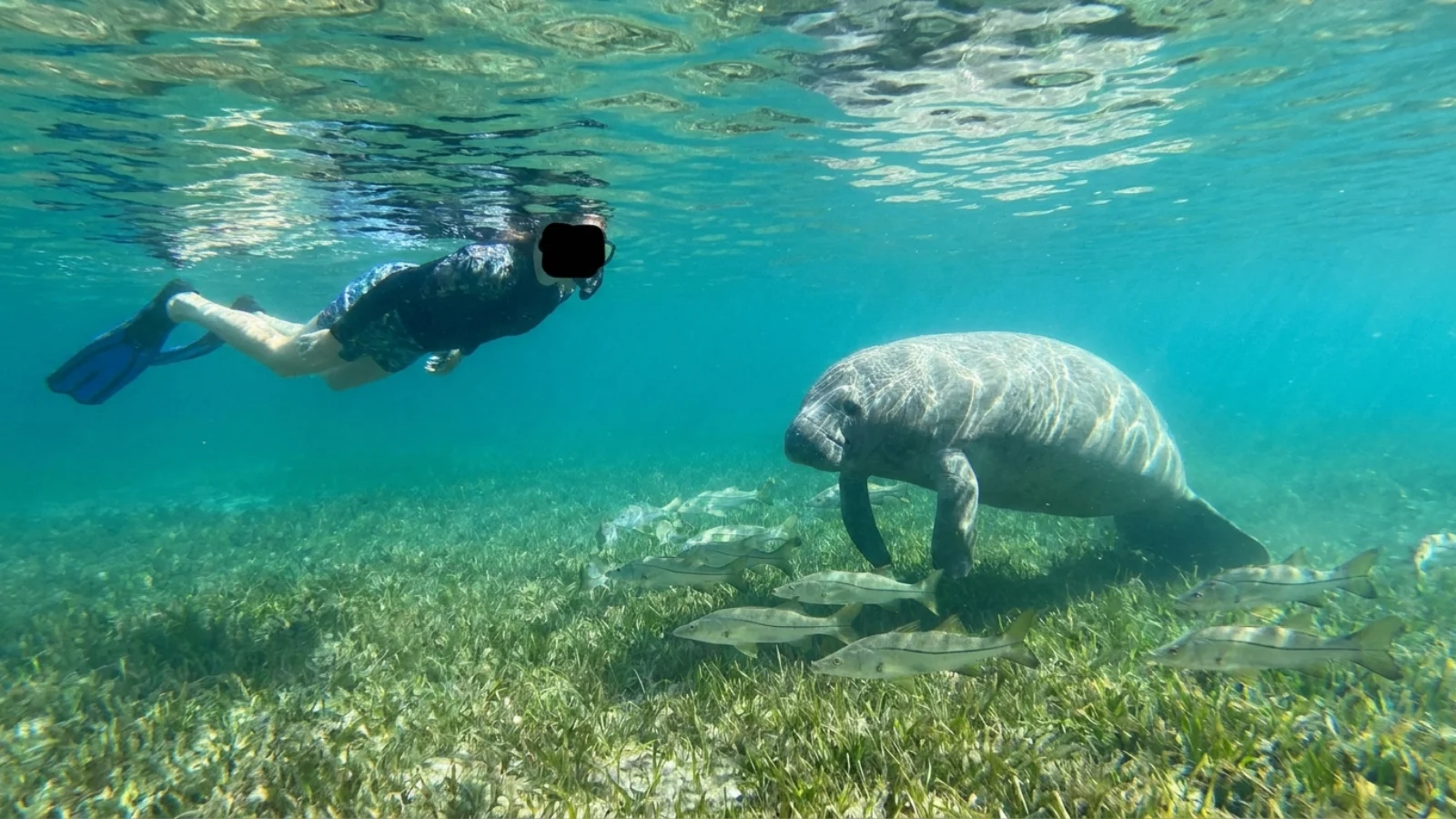
Wildlife deserves room too. Federal and state law protect manatees, dolphins and sea turtles from harassment, so let them approach on their own terms and never chase, touch or feed them. Sea turtles nest on these beaches from late spring into autumn, so stay clear of marked nests.
Can you snorkel for shark teeth in Venice?
Yes. Venice, which calls itself the “Shark Tooth Capital of the World”, has fossil teeth all along its beaches, and snorkelers find more in the shallow surf zone than beachcombers find on the sand.
Caspersen Beach is the classic spot, but its road access washed out in 2024 (details below), so most visitors now walk in from South Brohard Park. Look for small, shiny black triangles in the shell hash just beyond the waves. Most are from sharks that lived here millions of years ago; the giant ones, from megalodon, are rare finds. Venice Municipal Beach has a reef about a quarter-mile offshore that scuba divers visit.
How do you reach Caspersen Beach and the Venice shark-tooth beaches now?
The city celebrates its nickname with an annual Shark’s Tooth Festival. For snorkelers the advantage is reach: the teeth collect in the shell hash just beyond the small waves, out of reach of beachcombers working the tide line. With a mask you can scan the bottom slowly, fan away loose shell by hand and pick out the dark, glossy triangles that stand out against pale sand and broken shell.
Caspersen Beach, south of the city, is the best-known place to look, but it has not fully recovered from the 2024 hurricane season. Sarasota County says the Harbor Drive access to Caspersen Beach Park washed out during the 2024 storms. Pedestrians and cyclists can still get in, but there is no vehicle parking, and the restrooms and playground are closed until repairs are completed. The county directs visitors to enter from South Brohard Park or from the Venetian Waterway Park Trail at the City of Venice Festival Grounds. The park is open from 6 a.m. to 10 p.m.
Is Sanibel good for snorkeling?
Not especially. Sanibel and Captiva are famous for shells, not reefs, and the water over their shallow sandbars is often cloudy. Snorkeling the shallows for live shells and sea life can still be fun on calm days.
Remember Sanibel’s rules on live shells: collecting live shelled animals is prohibited. See Sanibel Island and our best shelling beaches in Florida guide.
For visitors based in Naples or Bonita Springs, a sensible plan is a calm morning on the Gulf for dolphins, manatees and a jetty full of sheepshead, followed by a separate trip to the Keys for coral. For manatees in clear spring water, Crystal River is roughly three and a half hours north by car; see snorkeling with manatees in Crystal River.
How does red tide affect snorkeling in Southwest Florida?
Florida red tide is caused by Karenia brevis, a microscopic, single-celled dinoflagellate that is present in the Gulf of Mexico all year at low concentrations, typically 1,000 cells per litre or fewer. It was first identified in Florida in 1947, although anecdotal reports of large fish kills in the Gulf go back to the 1530s. When conditions favour it, the organism multiplies into a harmful algal bloom and produces potent nerve toxins called brevetoxins, which kill fish, seabirds and marine mammals in large numbers. Manatees are especially vulnerable, and long blooms have been associated with large numbers of manatee deaths.
For people, the main problems during a bloom are respiratory and eye irritation for those on or near the water, and skin irritation from direct contact with bloom water. People with asthma, emphysema or other lung conditions are more likely to be affected. Shellfish harvested from bloom areas can cause neurotoxic shellfish poisoning, which is why shellfish beds are closed during red tides. No snorkeler wants to be in bloom water anyway: it is often discoloured, it may be full of dead fish, and visibility is poor.
Blooms are not predictable from one year to the next, and no single explanation accounts for them; temperature, salinity, light and nutrients all play a part, and runoff from fertilisers is suspected of contributing. The practical step is to check the Florida Fish and Wildlife Conservation Commission’s red tide status map before any trip to the Gulf beaches, and to pick another day, or another coast, if a bloom is reported nearby.
Can you see goliath grouper snorkeling off Southwest Florida?
Not usually from the beach, but the offshore wrecks, ledges and artificial reefs of Collier and Lee counties are goliath grouper country. FishBase gives the species a maximum length of 250 cm, a maximum published weight of 455 kg (about 1,000 lb) and a maximum reported age of 37 years. Juveniles live in mangroves and brackish estuaries, which makes the mangrove coast from Naples south through the Ten Thousand Islands an important nursery. The IUCN Red List assessed the species as Vulnerable in 2016.
Florida closed its goliath grouper fishery in 1990, and the fish’s recovery since then is one of the better conservation stories on this coast. Since spring 2023 the state has allowed a very limited harvest. Under the rules FWC restated on October 1, 2025 for the 2026 season, up to 200 fish a year may be taken statewide, with no more than 50 from Everglades National Park, using permits and tags issued by random lottery, for one fish per person between March 1 and May 31, caught on hook and line, and only fish between 24 and 36 inches in total length. Harvest remains closed in federal waters, and it is not allowed in Atlantic waters from Martin County south through the Keys, in the St. Lucie River and in Dry Tortugas National Park. For divers and snorkelers on a boat trip, the rule is simple: look, do not touch, and give these slow, curious fish space.
What sea life can you see snorkeling in Southwest Florida?
Sheepshead, mangrove snapper, snook, stingrays, horseshoe crabs, sea stars, sand dollars, and often bottlenose dolphins and West Indian manatees in the passes and bays.
Offshore ledges and artificial reefs add goliath grouper, which can exceed 600 lb; harvest has been closed for decades apart from a small, tightly limited Florida permit program reopened in 2023. Read about mangrove snapper, dolphins in Marco Island and manatees.
One weird Gulf fact
The West Florida Shelf is so wide and gently sloped that the water off Naples stays shallow far from the beach, which is one reason waves usually stay small and why the water clouds so easily when the wind blows.- Florida State Parks, Delnor-Wiggins Pass State Park: hours, $6 vehicle fee, activities and fishing area (accessed November 2026)
- Wikipedia, Delnor-Wiggins Pass State Park (history, 1976 opening, hard-bottom reef, wildlife)
- Florida Statutes 2025, section 327.331, divers-down warning devices
- NOAA National Oceanographic Data Center, Coastal Water Temperature Guide, Naples monthly averages (via Current Results)
- Wikipedia, Karenia brevis (background concentrations, history, health effects)
- Florida Fish and Wildlife Conservation Commission, goliath grouper harvest rules for the 2026 season (news release, October 1, 2025); red tide status map
- FishBase, Epinephelus itajara (size, age, juvenile habitat; IUCN Vulnerable, 2016)
- Sarasota County Parks, Caspersen Beach Park status notice (accessed November 2026); Wikipedia, Venice, Florida (Shark’s Tooth Festival); Florida Rambler, Beaches of Venice
Is there snorkeling in Naples, Florida?
Yes, but not over coral. Delnor-Wiggins Pass State Park, the jetties on calm days and offshore artificial reefs by boat are the main options.
Are there coral reefs near Naples or Fort Myers?
No shallow coral reefs. There are offshore hard-bottom areas with sponges and soft corals, and artificial reefs, mostly for divers.
Where is the closest coral reef to Naples, Florida?
The Florida Keys reef, roughly a four-hour drive to Key Largo.
When is the water clearest in Southwest Florida?
On calm days with light offshore (east) winds, after a few days without rain, on an incoming tide. Late spring is often best.
Can you find shark teeth snorkeling in Venice, Florida?
Yes. Snorkeling just beyond the surf at Venice’s beaches turns up more fossil teeth than searching the sand.
Is it safe to snorkel near Wiggins Pass?
Only well away from the pass. The pass has strong tidal currents and heavy boat traffic.
Do I need a dive flag to snorkel in Southwest Florida?
Usually. Florida Statute 327.331 counts snorkelers as divers and requires a divers-down flag or buoy except in areas customarily used only for swimming; near jetties, passes and boat traffic, carry one.
Blane Perun has been exploring Earth’s oceans and marine life for over 25 years. Founder of TheSea.Org in 1999, underwater photographer, coral aquaculture pioneer, and explorer of 80+ countries.
About Blane Perun → All snorkeling destinations →