Best Snorkeling in Belize — Hol Chan, Shark Ray Alley & the Cayes
The best snorkeling in Belize is on the Belize Barrier Reef, a UNESCO World Heritage Site since 1996. The classic trip is Hol Chan Marine Reserve, Belize’s first marine reserve (1987), and neighbouring Shark Ray Alley, where nurse sharks and southern stingrays gather around boats in shallow water, both reached in minutes from Ambergris Caye or Caye Caulker. Foreign visitors pay a reserve fee of about US$15 (raised from US$10 in August 2024), usually collected by the tour operator. From Placencia, boats run to Laughing Bird Caye National Park; for the most remote reefs, go to the atolls, Turneffe, Lighthouse Reef and Glover’s. Best season: the dry season, roughly November to May (April is driest); hurricane risk peaks in September and October.
Belize — at a glance
- Hol Chan: Founded 1987; zone A (the channel) is no-take; fee ~US$15 for foreign visitors
- Shark Ray Alley: Shallow sand flat with nurse sharks and stingrays; no scuba in the core snorkel zone
- Group size: About 8 snorkelers per guide; boats moor, never anchor
- Bases: Ambergris Caye (San Pedro), Caye Caulker, Placencia
- Best months: Dry season, November–May; April driest; hurricanes peak September–October
- Rules: No touching, no gloves, no feeding by guests, no taking anything
- Barrier reef: About 300 km of the 900 km Mesoamerican Reef, the world’s second largest reef system
- UNESCO: The Belize Barrier Reef Reserve System was inscribed as a World Heritage Site in 1996
- Hol Chan: Mayan for “little channel”; the reserve has grown from about 5 to over 160 square miles
- Atolls: Three: Turneffe, Lighthouse Reef and Glover’s Reef
Where is the best snorkeling in Belize?
Hol Chan Marine Reserve and Shark Ray Alley off Ambergris Caye, Laughing Bird Caye off Placencia, and the atolls, Lighthouse Reef, Turneffe and Glover’s, for the most pristine reef.
| Spot | Base | Access | Highlights | Notes |
|---|---|---|---|---|
| — | — | — | — | — |
| Hol Chan Channel | Ambergris Caye / Caye Caulker | Boat, short ride | Reef cut, big fish, turtles | No-take zone A; current in the cut |
| Shark Ray Alley | Ambergris Caye / Caye Caulker | Boat | Nurse sharks, southern stingrays | Shallow; guests may not feed |
| Mexico Rocks | Ambergris Caye | Boat | Patch reefs in shallow water | No-take area |
| Caye Caulker reef | Caye Caulker | Boat | Turtles, rays, reef | Laid-back island base |
| Laughing Bird Caye | Placencia | Boat, ~12 mi (19 km) | Healthy reef around a tiny caye | National park |
| Lighthouse Reef / Turneffe | Ambergris or Belize City | Long boat ride | Remote atoll reefs, Blue Hole nearby | Full-day trips |
Is Hol Chan worth it?
Yes. Hol Chan, founded in 1987 as Belize’s first marine reserve, protects a channel through the barrier reef where the fish have not been fished for decades. Combined with Shark Ray Alley, it is one of the best half-day snorkel trips in the Caribbean.
The reserve fee for foreign visitors rose from US$10 to about US$15 on August 1, 2024; tour operators usually collect it. Expect current in the channel itself, so stay with your guide. Rules: no gloves, no touching, no taking anything, boats use moorings and limit their time at busy sites, and guides keep groups to about eight snorkelers.
How big is the Belize Barrier Reef?
The Belize Barrier Reef runs for about 300 km (190 miles) along the country’s coast. It lies roughly 300 metres offshore in the north and up to 40 km out in the south, which is why Ambergris Caye’s reef is a short boat ride from the beach while southern reefs need a longer crossing. It is the Belize section of the 900 km Mesoamerican Barrier Reef System, which runs from Cancún down to Honduras and is the second largest reef system in the world after Australia’s Great Barrier Reef. Charles Darwin called it “the most remarkable reef in the West Indies” in 1842.
The Belize Barrier Reef Reserve System, a group of seven protected areas covering about 960 square kilometres, became a UNESCO World Heritage Site in 1996. Surveys list around 70 hard coral species, 36 soft corals and about 500 species of fish, and much of the reef has never been studied in detail. The reef draws almost half of Belize’s visitors and supports its fishing industry.
The reef’s protection has had ups and downs. UNESCO placed the site on its List of World Heritage in Danger in 2009. Belize banned bottom trawling in December 2010, and in December 2017 passed a law setting an indefinite moratorium on offshore oil activity. With stronger mangrove protection added in 2018, the World Heritage Committee removed the reef from the danger list on 26 June 2018.
Climate remains the biggest threat. Belize’s first recorded mass bleaching came in 1995, killing an estimated 10 percent of coral colonies. In 1998 a second bleaching event combined with Hurricane Mitch, and biologists recorded a 48 percent drop in live coral cover across the reef system.
What will you see in Hol Chan’s channel?
The heart of the reserve is the Hol Chan Cut, a natural break in the barrier reef roughly 23 metres (75 feet) wide and 9 metres (30 feet) deep, with water as shallow as 1.5 metres (5 feet) around its edges. Because the cut connects the open Caribbean with the lagoon inside the reef, fish and other animals move through it constantly, and the tide pushes a current through the channel.
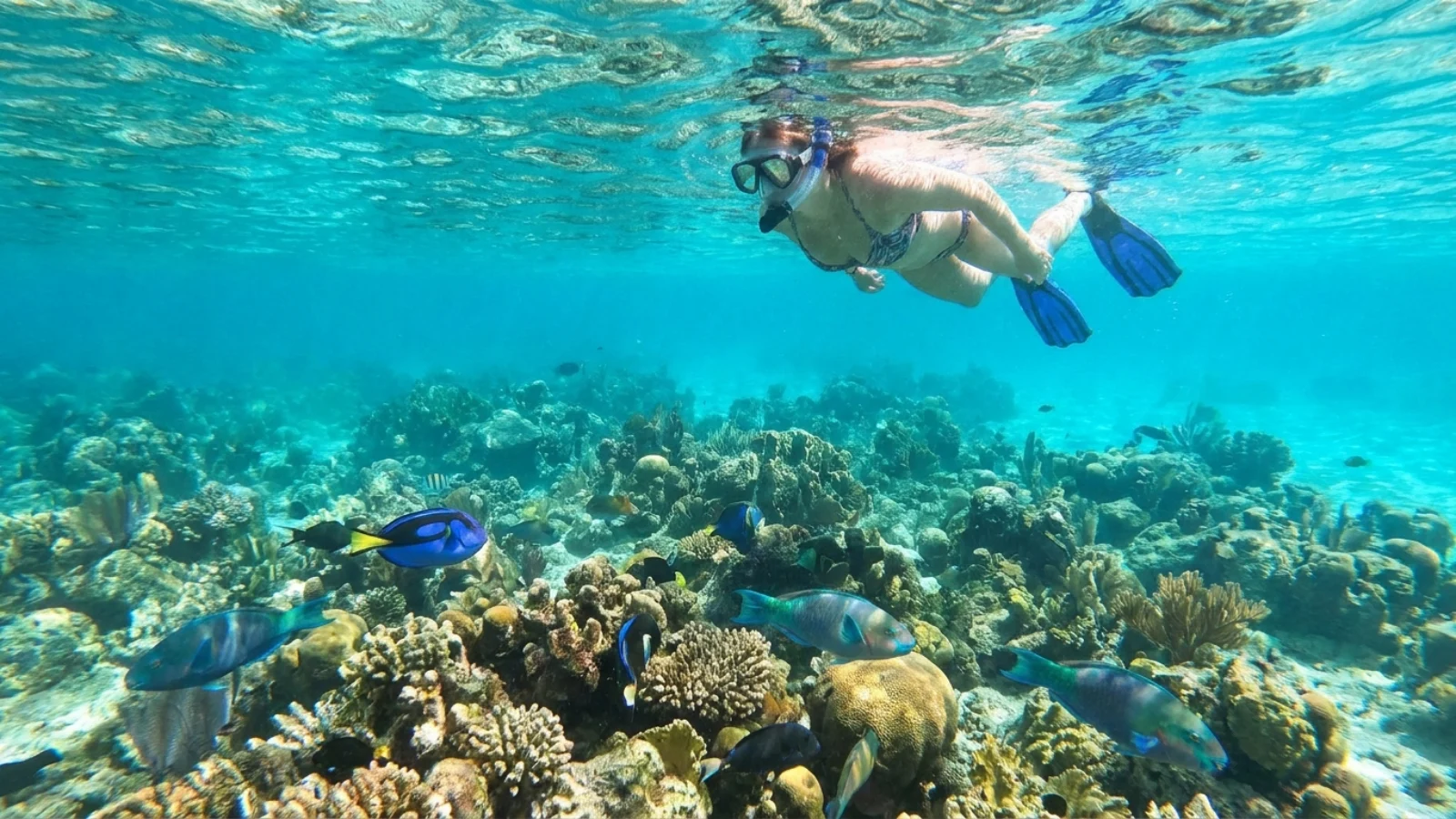
More than 160 species of fish have been recorded in the reserve, along with about 40 kinds of coral, three species of sea turtle and the West Indian manatee. Spotted eagle rays and southern stingrays are common on the channel floor. Moray eels and lobsters hide among the rocky outcrops, and schools of jacks, snappers, groupers and barracuda hang in the cut. Brain, elkhorn and finger corals line the edges. The seagrass beds and mangroves inside the reef act as nurseries, so you will often see juvenile fish that later move out to the reef.
The reserve began as a fight over that channel. In the early 1980s fish stocks were falling while tourism to the cayes was growing, and fishermen, snorkelers and divers argued over access to the cut. The biologist Janet Gibson campaigned from 1985 to 1987 with fishermen, businesses and the government, and wrote the draft management plan in 1986. The reserve was established in July 1987 with funding from WWF and USAID, after the local fishermen’s cooperative approved the plan. Enforcement began in 1989 and entrance fees for the channel zone started in 1990.
Hol Chan was first divided into three zones: the reef itself, where fishing is banned; the seagrass beds inside the reef, where licensed fishing is allowed; and the mangroves of southern Ambergris Caye. Shark Ray Alley was added as a fourth zone in 1999. The San Pedro Sun reported in 2024 that the reserve had grown from about 5 square miles at its founding to more than 160 square miles in 15 zones. The seagrass zone also holds the Boca Ciega Blue Hole, a sinkhole opening into a cavern that is dangerous for inexperienced divers and rarely visited.
What rules apply inside Hol Chan Marine Reserve?
The reserve’s regulations, as summarised on the long-running Ambergris Caye community site, are strict and backed by real penalties. Each licensed guide may take a maximum of eight snorkelers or divers into the water. Gloves are banned, as is touching or standing on coral and touching or feeding fish; visitors may not bring food for the animals. Boats should motor slowly to a mooring buoy and keep anchors and lines off coral, and must stay at least 100 yards from a divers-down flag. The channel zone is open from 6 a.m. to 9 p.m., and the listed minimum penalty for breaking the rules is a US$1,000 fine, six months in prison, or both.
In practice your tour operator handles the fee and the rules. Shared tours often include the reserve fee in the advertised price, while small boats and private charters may collect it in cash on the day, sometimes handing out a wristband or voucher as proof of payment. Busy sites run on a rotation, with boats leaving when the next one needs the mooring, so expect around 40 to 50 minutes in the water at each stop.
Why do sharks and rays gather at Shark Ray Alley?
Shark Ray Alley is a shallow, sandy area inside the reef, unremarkable apart from its animals. Fishermen traditionally cleaned their catch and nets here before heading back to port, and the scraps drew nurse sharks and stingrays. When tour guides began feeding them, the gathering became an attraction, and the shallow, clear water makes it easy to watch from the surface.
Nurse sharks are bottom-dwelling sharks that grow to about 3 metres on average, with a recorded maximum of around 4.3 metres according to FishBase. They are mainly nocturnal and solitary hunters, rooting through the sand at night for lobsters, crabs, shrimps, octopus and sea urchins, but often rest in groups by day. They feed by suction, and their suction forces are among the strongest measured in any aquatic vertebrate. Their calm reputation is double-edged: nurse sharks rank fourth among species in documented shark bites on people, largely because swimmers grab or corner them. The IUCN lists the species as Vulnerable globally (assessed 2019).
Southern stingrays have a diamond-shaped disc that can reach about 2 metres across, though a typical adult is about 90 cm across. They spend much of the day buried in sand and forage for buried invertebrates. The species is listed as Near Threatened (2019). At Shark Ray Alley they glide right under snorkelers; keep your hands to yourself and watch where you put your fins.
Is Shark Ray Alley safe?
Yes, with a licensed guide. The nurse sharks and southern stingrays that gather here are used to boats and people. Nurse sharks are slow bottom-feeders and rarely bite unless grabbed or cornered.
Guides may feed from the boat, but guests may not feed or touch the animals. Shuffle gently, keep hands to yourself, and give rays room. Learn about them in nurse shark and southern stingray.
What are Belize’s atolls like for snorkeling?
Belize has three atolls, all part of the barrier reef system: Turneffe, Lighthouse Reef and Glover’s Reef. They sit beyond the main barrier reef in deep water, so they get clearer water and less runoff than reefs closer to the mainland, but they need a long boat ride and calm weather.
Turneffe Atoll is the closest, about 20 miles (32 km) from Belize City. At around 30 miles long and 10 miles wide it is the largest atoll in Belize and in the Mesoamerican Reef. It became a marine reserve on 22 November 2012 and holds more than 500 species of fish, 65 species of stony coral, and more than 150 mangrove islands whose creeks and flats are nurseries for fish, lobster and conch. Blackbeard captured the sloop Adventure there in April 1718.
Lighthouse Reef, about 80 km (50 miles) southeast of Belize City, is the most easterly. The oblong atoll is about 35 km long and 8 km wide, around a sandy lagoon 2 to 6 metres deep. Its reefs are considered among the best developed in the Caribbean, and creole wrasse and blue chromis are the most common fish. Half Moon Caye, on the atoll, has a nesting colony of some 4,000 red-footed boobies and a rookery of magnificent frigatebirds.
Glover’s Reef, about 45 km off southern Belize, is 32 km long and 12 km wide, and its lagoon holds around 850 patch reefs and pinnacles rising to the surface. It has been a marine reserve since 1993. A Nassau grouper spawning site at its northeastern end, one of only two viable sites left of nine once known, was permanently closed to fishing in 2002.
Why is the Great Blue Hole so famous?
The Great Blue Hole, near the centre of Lighthouse Reef, is a marine sinkhole about 318 metres (1,043 feet) across and 124 metres (407 feet) deep. It formed as a cave system during the ice ages, when sea level was much lower; stalactites recovered from it date to several dry periods, and the cave flooded as the sea rose. Jacques Cousteau brought his ship Calypso there in the early 1970s (sources give 1970 or 1971) to chart its depths, and found ledges at about 21, 49 and 91 metres. From the surface you see a deep blue circle ringed by reef, which is spectacular from a plane but not from a snorkel.
Where is Laughing Bird Caye?
Laughing Bird Caye lies about 12 miles (19 km) off Placencia in the Stann Creek District and is the southernmost island in the central lagoon of the barrier reef. It was declared a national park on 21 December 1991 and is one of the protected areas in the World Heritage site. The narrow island sits on a faro, a ridge of reef shaped like a small atoll on the continental shelf, separated from the mainland and the barrier reef by deep channels. It is named after the laughing gulls that once bred there. For travellers staying in southern Belize it is the classic day trip, with shallow reef close to the beach of a tiny caye.
Is Caye Caulker a good base for snorkeling?
Caye Caulker is a small limestone island about 5 miles long and less than a mile wide, home to roughly 2,000 people and about 20 miles (32 km) north-northeast of Belize City by water taxi. Its shallow lagoon meets the barrier reef just east of the village, so reef trips are short, and Hol Chan and Shark Ray Alley are an easy boat ride north. A narrow channel called the Split divides the island in two. It is often said to have been cut by Hurricane Hattie in 1961, but villagers say they dredged it by hand after the storm opened a shallow passage.
When is the best time to snorkel in Belize?
Belize’s National Meteorological Service describes a dry season from November to May, with April the driest month, and a rainy season from June to November. From November to February cold fronts bring cooler, sometimes windy weather; from March to May the weather is warm and dry with steady southeasterly winds. Fronts pass most often in December, January and February.
The Atlantic hurricane season runs from June to November, and in Belize tropical storms and hurricanes are most frequent in September and October. Rain also varies a lot by region: the north gets around 60 inches a year, the far south about 160. The dry season avoids most of the rain and the peak storm months, but wind still decides whether boats can reach the atolls, so leave a spare day in your plans.
Can you snorkel the Great Blue Hole?
You can, but there is little to see from the surface: the Blue Hole’s walls and stalactites are 100 ft and more down. Most Blue Hole day trips include snorkel or dive stops on the shallow reefs of Lighthouse Reef atoll, which are excellent.
Read more in Lighthouse Reef Atoll and Belize, and see the reef system in the Belize coral reef ecosystem and Belize coral reef conservation.
One weird Belize fact
Belize is one of the few countries to have banned offshore oil exploration in its waters, at the end of 2017, partly to protect the barrier reef.- San Pedro Sun, new Hol Chan park fee (August 1, 2024), 1987 founding and reserve size; TheTraveler.org, Hol Chan Marine Reserve fees and rules; UNESCO World Heritage Centre, Belize Barrier Reef Reserve System (1996); Oceana, Belize removed from UNESCO’s in-danger list (June 2018) and December 2017 offshore oil moratorium
- National Meteorological Service of Belize, climate summary (seasons, fronts, hurricane frequency)
- Ambergris Caye community site, Hol Chan boundaries and regulations
- Wikipedia: Belize Barrier Reef; Hol Chan Marine Reserve; Great Blue Hole; Lighthouse Reef; Glover’s Reef; Turneffe Atoll; Laughing Bird Caye; Caye Caulker
- FishBase species summaries for Ginglymostoma cirratum and Hypanus americanus (sizes, IUCN status)
Where is the best snorkeling in Belize?
Hol Chan Marine Reserve and Shark Ray Alley off Ambergris Caye, Laughing Bird Caye off Placencia, and the atolls.
How much does Hol Chan cost?
Foreign visitors pay a reserve fee of about US$15 (since August 2024), usually included in or added to the tour price.
Is Shark Ray Alley safe for snorkeling?
Yes with a licensed guide. Nurse sharks and stingrays there are used to people; do not touch or feed them.
Is Caye Caulker or Ambergris Caye better for snorkeling?
Both reach Hol Chan and Shark Ray Alley quickly. Ambergris has more services; Caye Caulker is quieter and cheaper.
When is the best time to snorkel in Belize?
In the dry season, roughly November to May (April is the driest month). Hurricanes are most frequent in September and October, and wind decides whether boats can reach the atolls.
Can you snorkel the Belize Blue Hole?
You can, but the interesting features are deep. The surrounding Lighthouse Reef shallows are better for snorkeling.
Blane Perun has been exploring Earth’s oceans and marine life for over 25 years. Founder of TheSea.Org in 1999, underwater photographer, coral aquaculture pioneer, and explorer of 80+ countries.
About Blane Perun → All snorkeling destinations →