Bioluminescence — How and Why the Ocean Glows
Bioluminescence is light produced by a living organism through a chemical reaction. A light-emitting molecule called luciferin is oxidised with the help of an enzyme, luciferase (or a related photoprotein), and the energy comes off as a photon. In the ocean it is the rule, not the exception: MBARI’s deep-sea video surveys found that about 76% of animals in the water column and about 45% of bottom-dwellers can make their own light. Most of it is blue-green, around 470–490 nm, because that wavelength travels farthest through seawater. Near the surface, the sparkle you see in a wave or a kayak paddle is usually dinoflagellates, single-celled plankton that give off a split-second flash whenever the water around them is disturbed.
Bioluminescence
What is bioluminescence and how does it work?
Bioluminescence is a chemical reaction inside a living cell. A substrate called luciferin reacts with oxygen, an enzyme called luciferase speeds the reaction up, and the product (oxyluciferin) is left in an excited state that releases its extra energy as visible light.
The words come from Lucifer, “light-bearer”, and the chemistry is nearly cold: almost all of the energy leaves as light rather than heat. Different groups use different luciferins. Dinoflagellates use a chlorophyll-derived luciferin; many jellyfish, comb jellies and crustaceans use a molecule called coelenterazine; and some fish and squid skip the chemistry entirely by farming glowing bacteria in special light organs.
Some animals store the reaction pre-loaded in a “photoprotein” that fires when calcium floods in. That is how the crystal jelly Aequorea victoria works, and its partner green fluorescent protein (GFP) shifts the blue light to green. Isolating and developing GFP earned Osamu Shimomura, Martin Chalfie and Roger Tsien the 2008 Nobel Prize in Chemistry, and it is now one of the most used tools in biology.
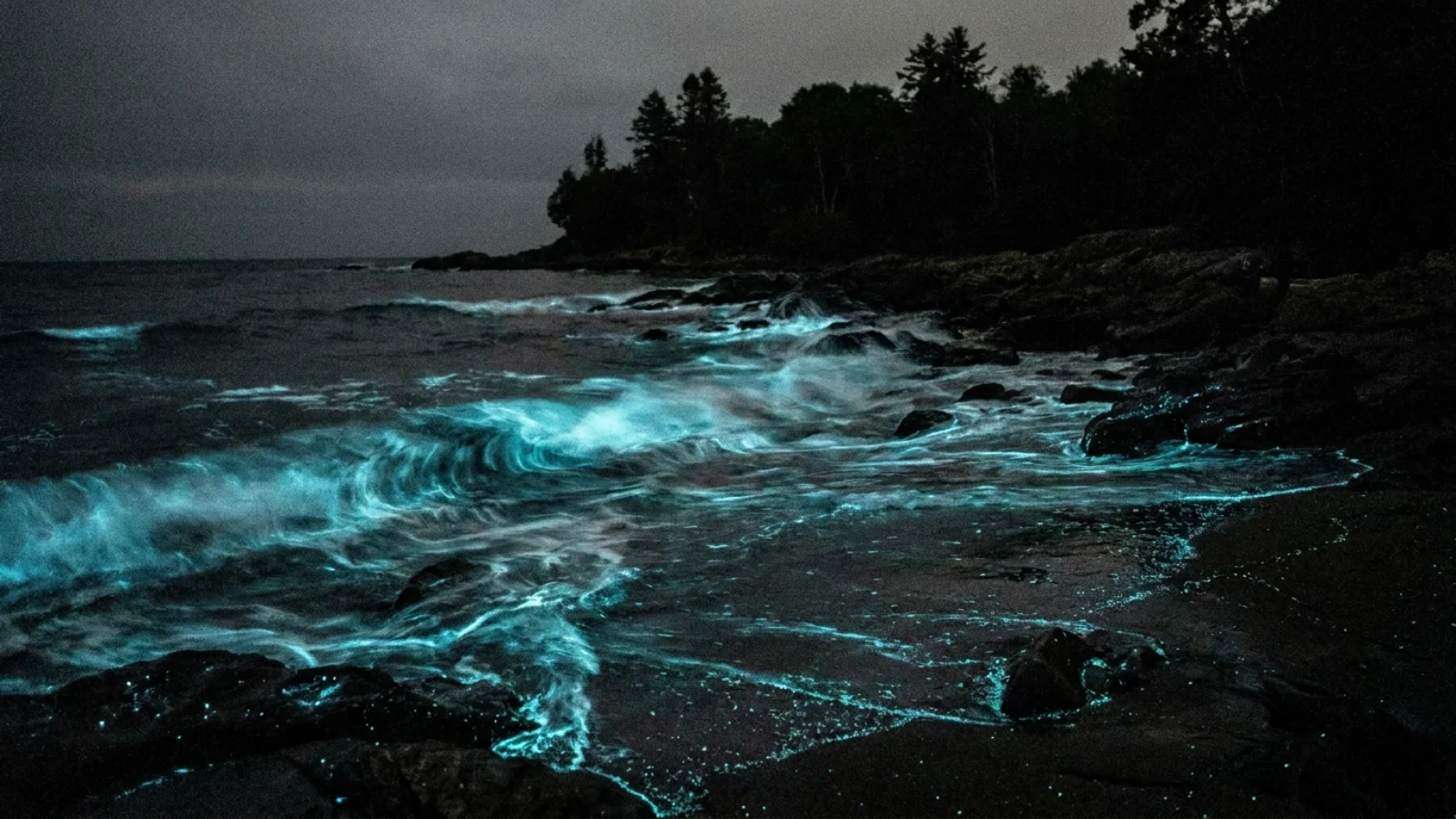
Why is most ocean bioluminescence blue?
Because blue-green light, around 470–490 nm, travels farthest through seawater. Red and orange are absorbed within the first few metres, and violet scatters, so evolution has converged on blue.
Most deep-sea animals can only see blue, which makes blue the useful colour for signals and camouflage. A few dragonfish break the rule: the stoplight loosejaw makes blue light, converts it to red with a second pigment, and can see red using a chlorophyll derivative. Because almost nothing else down there can see red, it works like a sniper scope.
Dinoflagellate flashes peak at about 472–475 nm. That is why a bio bay looks electric blue-green and a glowing wave in San Diego looks neon blue, not yellow like a firefly.
Why do ocean animals glow?
Bioluminescence does four main jobs in the sea: hiding, hunting, defending and communicating. One animal can use it for several of these at once.
- Counterillumination (hiding): many midwater fish, shrimp and squid have light organs on their bellies that match the faint light from above, erasing their silhouette from predators looking up.
- Lures (hunting): the deep-sea anglerfish dangles a glowing bait full of bacteria; some siphonophores use glowing lures too.
- Startle and smoke screens (defence): the vampire squid releases a cloud of glowing mucus instead of ink, and many shrimp spit luminous clouds.
- Burglar alarm (defence): when a copepod grabs a dinoflagellate, the flash can attract a bigger predator that eats the copepod. It also makes the copepod jump and stop feeding.
- Signals and mates: the firefly squid of Toyama Bay and many lanternfish carry species-specific light patterns.
How common is bioluminescence in the ocean?
Very common. In video surveys from the surface to about 4,000 m, MBARI scientists found that roughly three-quarters of the animals drifting in the water column were capable of making light.
That figure surprises people who think of glowing animals as rare oddities. In the open ocean the glowing animals are the majority: jellies, comb jellies, siphonophores, arrow worms, krill, shrimp, squid, lanternfish and many more. Roughly four in five of the genera known to include glowing species live in the sea, according to a 2010 review by Steven Haddock and colleagues. On land, by contrast, glowing life is mostly fireflies, a few fungi and some beetle larvae.
Bioluminescence has evolved independently at least 94 times, according to a review by Emily Lau and Todd Oakley at UC Santa Barbara, and about 30 times in marine fishes alone. It is one of the clearest examples of convergent evolution in biology.
What makes the water glow at the beach?
Almost always dinoflagellates: single-celled plankton that flash when the water around them is bent or sheared by a wave, a paddle or a swimmer.
Inside each cell, the light reaction is packed into tiny compartments called scintillons. Mechanical stress opens calcium channels, acid floods the scintillons, the pH drops below about 6, and luciferin is released from its binding protein to react with luciferase. From the first touch to the flash takes about 15 milliseconds, and a single flash is over within about a tenth to half a second. The cells also run on a clock: most dinoflagellates make far less light by day and peak a couple of hours after dark.
The species that matter for travellers are Pyrodinium bahamense, the glow of Puerto Rico’s bioluminescent bays and Florida’s Indian River Lagoon; Lingulodinium polyedra, behind California’s neon-blue glowing waves; and Noctiluca scintillans, the sea sparkle of Asia and Australia. The full story is in our guide to bioluminescent plankton.
| Glow you see | Organism | Where |
|---|---|---|
| — | — | — |
| Blue-green sparks in a bay | Dinoflagellate Pyrodinium bahamense | Puerto Rico, Jamaica, Florida, Bahamas |
| Neon-blue breaking waves | Dinoflagellate Lingulodinium polyedra | Southern California, Baja |
| Glowing “blue tears” on sand | Noctiluca scintillans | Hong Kong, Tasmania, Maldives |
| Winter blobs that glow in your hand | Comb jellies | Indian River Lagoon, Florida |
| Ocean glowing white to the horizon | Bacteria (Vibrio harveyi) | Arabian Sea, off Java (milky seas) |
Where can you see bioluminescence?
The most reliable places are the year-round bio bays of the Caribbean, above all Mosquito Bay on Vieques, and seasonal hotspots such as Florida’s Indian River Lagoon in summer.
Puerto Rico has three bays: Mosquito Bay on Vieques, rated the brightest in the world by Guinness in 2006, Laguna Grande on the Fajardo coast, and La Parguera on the southwest shore at Lajas, the only one where you can swim. Beyond them, Jamaica’s Luminous Lagoon, Salt River Bay on St. Croix and Manialtepec Lagoon in Mexico all glow; see our ranking of the world’s best bioluminescent bays and our bioluminescent kayaking guide.
Timing beats location. Plan for the darkest nights around the new moon, at least an hour after sunset, away from city lights. Moonlight is the single biggest reason people are disappointed.
Is bioluminescence ever a warning sign?
Sometimes. The organisms that light up beaches are bloom-formers, and some blooms are harmful. Not every glowing tide is toxic, and not every toxic tide glows.
The red tide of Florida’s Gulf coast, caused by Karenia brevis, produces no glow, but it does kill fish and cause coughing on the beach; our red tide guide covers the FWC cell-count levels. Pyrodinium bahamense in the Indian River Lagoon can make saxitoxin, which is why puffer fish harvest has been banned there since 2004. And the spreading green Noctiluca blooms in the Arabian Sea are linked to low-oxygen water.
How did scientists work out what bioluminescence is?
People have written about glowing seas for thousands of years. Aristotle and Pliny the Elder both described cold light from dead fish and sea creatures, and sailors’ logs are full of accounts of ships ploughing through burning water at night. For most of that time, explanations ranged from sulphur and phosphorus to static electricity.
The first experimental clue came in the 1660s, when Robert Boyle placed glowing wood and luminous meat inside the glass chamber of his air pump. As he pumped the air out the light faded, and when he let air back in it returned. Long before anyone knew what oxygen was, he had shown that living light needs something from the air.
The chemistry was named two centuries later. In the 1880s the French physiologist Raphaël Dubois worked with luminous click beetles and the glowing boring clam Pholas dactylus. He found that light appeared when he mixed a cold extract with a heat-treated one, and he named the two ingredients luciferine and luciferase. The American biologist E. Newton Harvey spent much of the early twentieth century cataloguing glowing organisms and showing how different their chemistries could be.
How do scientists study glowing animals in the deep sea?
Studying living light is tricky, because the bright lamps on submarines and robots frighten animals away and drown out their glow. Researchers have solved this in two ways: by turning off the white lights, and by using colours that deep-sea eyes cannot see.
Edith Widder, who founded the Ocean Research and Conservation Association (ORCA), designed cameras that illuminate the scene with red light, which most deep-sea animals cannot detect, paired with sensitive cameras that amplify both the red light and any natural glow. Her Eye-in-the-Sea system sat on the seafloor; its successor, Medusa, can be lowered over the side of a ship and floats back to the surface on command.
The bait is light itself. Widder’s electronic jellyfish, or e-jelly, is a ring of blue LEDs that imitates the spinning alarm display of the deep-sea jellyfish Atolla, which flashes when attacked in the hope of attracting a bigger predator to its attacker. In 2012 the Medusa camera platform recorded the first video of a live giant squid in its natural habitat, drawn in by that fake alarm.
Scientists also collect animals gently and test them aboard ship in darkened labs. They measure the colour, brightness and timing of each flash, which helps explain what the light is for, since a lure, a smoke screen and a mating signal each look different.
Is bioluminescence the same as biofluorescence?
No. Bioluminescence makes new light through a chemical reaction. Biofluorescence absorbs light that is already there, usually blue, and gives it back at a longer wavelength, often green, orange or red. A fluorescent animal is dark in total darkness; a bioluminescent one is not.
Biofluorescence turned out to be far more widespread than anyone expected. In 2014 John Sparks of the American Museum of Natural History and David Gruber of Baruch College reported more than 180 species of fluorescent fishes, including sharks and rays as well as bony fishes, after night dives in the Bahamas, off Little Cayman and in the Solomon Islands. They used blue lights to excite the glow and yellow filters on cameras and dive masks to block the blue, revealing patterns invisible to the naked eye.
Many reef fish have yellow filters in their own eyes, so the researchers suggested that some species may use fluorescent patterns for communication and mate recognition, much as deep-sea animals use bioluminescence. Corals glow too: their fluorescent proteins are the reason a reef lit with a blue torch at night turns vivid green and orange.
How do people use bioluminescence?
The most valuable use so far has been in medicine and research. Green fluorescent protein from the crystal jelly lets scientists tag genes and watch them switch on inside living cells, and luciferase enzymes from fireflies and marine animals are used in reporter tests that make a cell glow when a particular gene is active.
Firefly luciferase also powers a simple hygiene test. Because the reaction needs ATP, the energy molecule found in all living cells, a swab from a kitchen counter or hospital surface can be mixed with luciferase and luciferin, and the brightness of the glow shows how much organic residue is left behind. Food plants and hospitals use these handheld readers to check cleaning.
Navies have long been interested in the ocean’s glow for a less peaceful reason. A ship or submarine moving through water rich in dinoflagellates stirs up a trail of light that can give away its position at night, so oceanographers have mapped where and when the sea is most likely to light up.
Is there bioluminescence in fresh water or on land?
On land it is uncommon but familiar: fireflies, click beetles, some millipedes and earthworms, glowing fungi and the larvae of New Zealand’s glow-worms, which are actually fungus gnats. Glowing fungi give rotting logs the faint green light once called foxfire.
Fresh water is almost completely dark. Only a handful of freshwater organisms are known to glow, the best-known being Latia neritoides, a small limpet from New Zealand streams that releases glowing mucus. Scientists still debate why living light is so rare in rivers and lakes, though freshwater habitats are younger, shallower and often murkier than the open ocean, where the dark depths reward animals that can make their own light.
How can you watch bioluminescence without harming it?
Treat a glowing bay like a reef. Stay in the boat or kayak where swimming is banned, avoid wearing sunscreen or insect repellent into the water, and do not scoop organisms into bottles to take home; they will die within hours, and the glow fades with them.
On a beach, walk along the wet sand at the waterline after dark and watch your footprints sparkle rather than digging or stirring the shallows. Keep phone screens and torches pointed down, and give your eyes at least twenty minutes to adapt to the dark before deciding the water is not glowing. Many visitors give up too soon and leave just as the show is becoming visible to them. The longer you wait in darkness, the more faint flashes you will see, and the less you will need to disturb the water to see them.
Which animals glow? Start here
The pages below cover the science, the destinations and the glowing animals already on TheSea.Org.
What causes bioluminescence?
A chemical reaction in which a luciferin molecule is oxidised with the help of the enzyme luciferase (or a photoprotein), releasing energy as visible light.
Is bioluminescence the same as fluorescence?
No. Bioluminescence makes new light from chemistry. Fluorescence absorbs light, often blue or ultraviolet, and re-emits it at a longer wavelength, as GFP does.
What percentage of ocean animals are bioluminescent?
MBARI surveys found about 76% of animals in the water column and about 45% of seafloor animals can produce light, from the surface to about 4,000 m.
Why is bioluminescence blue?
Blue-green light around 470 to 490 nm travels farthest in seawater, and most marine animals can only see blue, so most marine light is blue.
Is bioluminescent water safe to swim in?
Usually, but it depends on the bloom. Some bloom species are harmless; others, such as Pyrodinium bahamense, can make toxins that build up in shellfish and puffer fish. Follow local rules: of Puerto Rico’s three bays, only La Parguera lets visitors into the water.
When is the best time to see bioluminescence?
On a dark night near the new moon, at least an hour after sunset, away from artificial light. In Florida, dinoflagellates peak in summer and comb jellies in winter.
Where is the brightest bioluminescent bay?
Mosquito Bay on Vieques, Puerto Rico, which Guinness World Records ranked brightest in the world in 2006, citing as many as 700,000 glowing cells in a gallon of water.
How many times did bioluminescence evolve?
At least 94 separate times across the tree of life, according to a review by Emily Lau and Todd Oakley at UC Santa Barbara.
Blane Perun has been exploring Earth’s oceans and marine life for over 25 years. Founder of TheSea.Org in 1999, underwater photographer, coral aquaculture pioneer, and explorer of 80+ countries.
About Blane Perun → All bioluminescence & plankton →