Bioluminescent Plankton — The Dinoflagellates Behind Glowing Waves
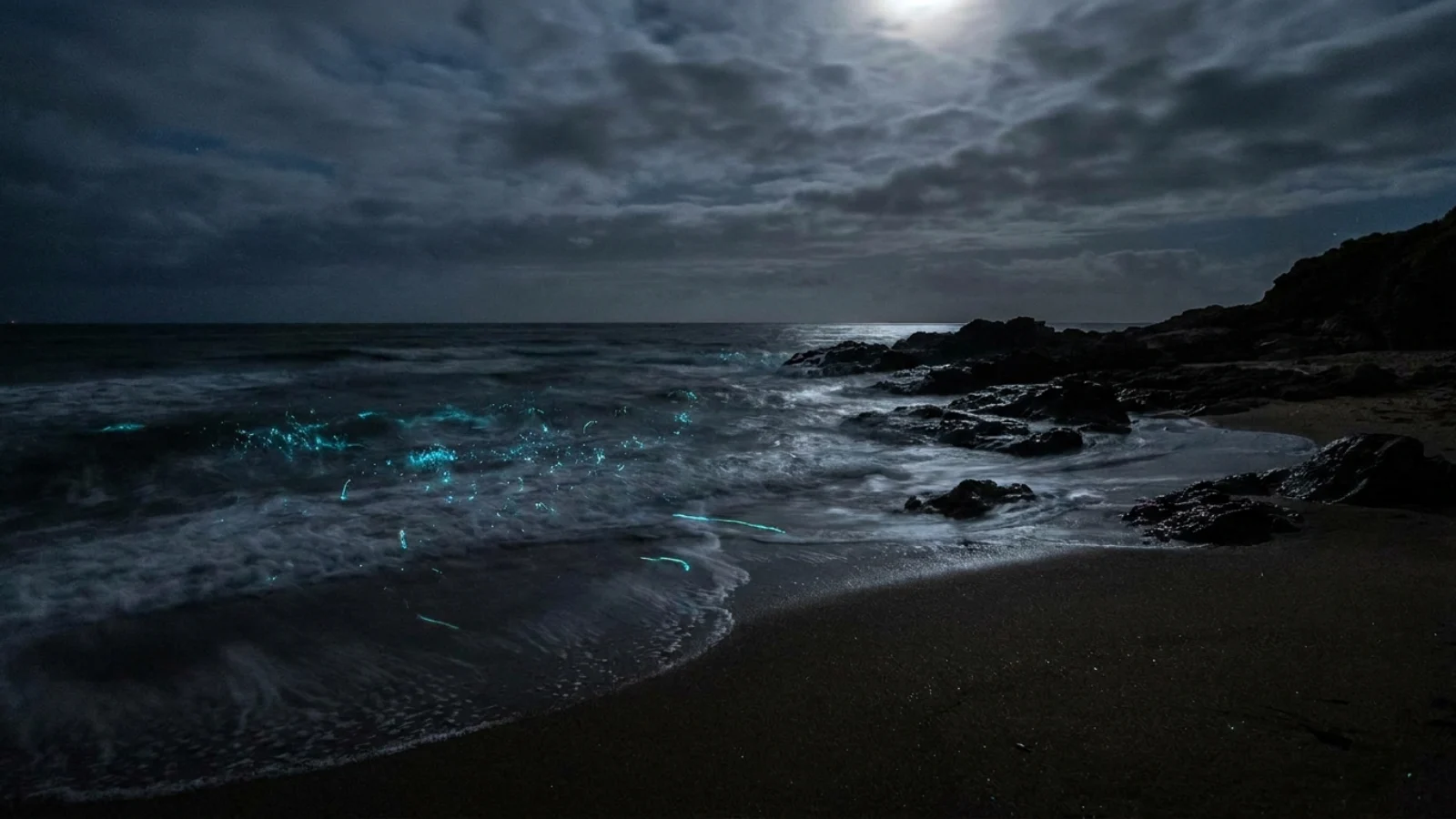
Bioluminescent plankton are drifting organisms that make their own light. At the surface, the glow in waves, wakes and bio bays comes almost entirely from dinoflagellates, single-celled plankton that flash blue-green (about 472–475 nm) when the water around them is bent by a wave, a paddle or a fish. The flash starts about 15 milliseconds after the touch and lasts roughly 0.1 to 0.5 seconds. The key species are Pyrodinium bahamense (Puerto Rico and Florida bays), Lingulodinium polyedra (California’s glowing waves) and Noctiluca scintillans (sea sparkle). Below them, many zooplankton glow too: krill, ostracods, comb jellies and jellyfish.
Glowing Dinoflagellates
What makes plankton glow?
A chemical reaction inside the cell. In dinoflagellates, a luciferin molecule is released and oxidised by the enzyme luciferase, producing a photon of blue-green light. The reaction is switched on by mechanical stress, which is why the light follows anything that moves through the water.
The machinery is packed into small compartments called scintillons. When the cell membrane is bent, a G protein and a calcium channel start a signal that spreads to the cell’s large vacuole. Protons pour from the vacuole into the scintillons, and when the pH drops below about 6, the luciferin-binding protein lets go of its luciferin, which reacts with luciferase. The whole chain takes about 15 milliseconds, according to research summarised in Chemistry World.
Dinoflagellates take the chemistry seriously: they carry 50 to 200 copies of the luciferase gene, and building luciferin may involve around 20 enzymes. Their luciferin is related to chlorophyll, which ties their light to their photosynthesis.
Why do dinoflagellates glow?
The leading idea is the “burglar alarm” hypothesis: when a copepod grabs a dinoflagellate, the flash attracts a bigger predator, such as a small fish, that eats the copepod. The flash also startles the copepod and interrupts its feeding.
It is an elegant solution for a single cell that cannot run or fight. It does not need to survive the encounter itself; the light makes grazing dangerous for the grazer. Recent experiments on the burglar-alarm cascade support the idea, and it explains why the light switches on only when the water is disturbed, not continuously.
Many dinoflagellates also run on a daily clock. They package their luminescent chemicals into scintillons late in the day and make far less light in daylight, with output peaking about two hours into darkness. That is part of why a bio bay looks dull at dusk and brightens as the night goes on.
Which plankton species glow?
At the surface, a handful of dinoflagellates account for most of the glow people see. In the open ocean, many zooplankton add their own light.
| Species | Type | Where you see it |
|---|---|---|
| — | — | — |
| Pyrodinium bahamense | Dinoflagellate | Mosquito Bay, Puerto Rico bays, Indian River Lagoon, Jamaica |
| Lingulodinium polyedra | Dinoflagellate | Southern California and Baja glowing waves |
| Noctiluca scintillans | Large heterotrophic dinoflagellate | Sea sparkle: Asia, Australia, Europe |
| Krill | Crustacean | Open ocean; krill |
| Comb jellies | Ctenophore | Florida winter glow; comb jellies |
| Ostracods | Crustacean | Night water; ostracods |
| Jellyfish and siphonophores | Cnidarians | Bioluminescent jellyfish |
In Southern California, Lingulodinium polyedra cells are roughly 35 to 40 micrometres across. By day they turn the water reddish brown; at night the same bloom lights the surf neon blue. Scripps Institution of Oceanography has sampled these red tides off its pier since 1900.
How common is light among plankton?
Far more common than most beachgoers realise. When Séverine Martini and Steven Haddock, working at the Monterey Bay Aquarium Research Institute in California, analysed years of video from remotely operated vehicle dives, classifying the animals they could identify, they found that more than three-quarters of the individual macroplankton seen in the water column off central California belonged to groups able to make light. A follow-up study of the seafloor in the same area put the figure for bottom-living animals at roughly 30 to 41%. In the open ocean, in other words, producing light is not an oddity but the norm.
That abundance is the result of many separate inventions. A 2020 review in Biological Reviews by Emily Lau and Todd Oakley estimated that bioluminescence has evolved at least 94 times across the tree of life. Plankton account for a large share of those origins, from single-celled dinoflagellates and radiolarians to crustaceans, comb jellies, jellyfish, salps and the larvae of fish. Each lineage arrived at its glow independently, which is why the chemistry, the colour and the purpose of the light vary so much between the drifting animals in a single bucket of seawater.
Do all glowing plankton use the same chemistry?
No. Every bioluminescent reaction pairs a light-emitting molecule, called a luciferin, with an enzyme or protein that oxidises it, but the luciferins themselves are not related. Four kinds dominate the sea. Dinoflagellates use their own luciferin, a molecule derived from chlorophyll, which is why the photosynthetic species can make it from scratch. Many jellyfish, comb jellies, copepods, shrimps and fish rely on coelenterazine. Ostracods and a few fish, such as the midshipman, use a third compound called vargulin. Luminous bacteria use a fourth system built around a reduced flavin.
Coelenterazine shows how light can move through a food web. It was first isolated from the crystal jelly Aequorea victoria and the sea pansy Renilla, and the two research groups involved found they were working with the same molecule. Later work showed that Aequorea does not make coelenterazine at all; it obtains the compound from its diet, largely from crustaceans such as copepods. Copepods of the genus Metridia, by contrast, can build it themselves from amino acids, and some of their luciferases are secreted into the water, an unusual trait that lets them release a glowing cloud rather than glowing inside their own tissues.
Which glowing plankton are crustaceans?
Crustaceans are some of the most important light-makers in the plankton. Copepods are the most numerous animals in many ocean samples, and luminous species among them can squirt a puff of light as they dart away from a predator. Laboratory observations suggest that grazing copepods often spit out dinoflagellate cells that flash, which fits the idea that the alarm works.
Krill go further. Except for one deep-water species, Bentheuphausia amblyops, all krill carry light organs called photophores, and these are surprisingly sophisticated: they have lenses, can focus light, and can be rotated by muscles. Biologists generally interpret them as a form of counter-illumination, matching the faint light filtering down from above so that a krill’s silhouette disappears to a predator looking up, although they may also play a role in schooling or signalling.
Ostracods, small seed-shaped crustaceans often called sea fireflies, have the most varied light shows. Bioluminescence evolved twice within the group. Halocyprid ostracods produce green light inside glands in their shells, while cypridinid ostracods mix their chemicals in the water and release a cloud of blue light from the upper lip. The Japanese species Vargula hilgendorfii, only about 3 millimetres long, lives in sand in shallow water and swims up at night to feed. During the Second World War the Japanese army collected these animals in quantity and dried them, because a little moistened powder produced enough dim light to read a map without being seen from afar.
Vargula also has a place in the history of chemistry. Scientists in Japan studied its light from at least 1917, and the young Osamu Shimomura, who later shared a Nobel Prize for work on the green fluorescent protein of jellyfish, was the first to purify its luciferin into crystals. The structure of that molecule, vargulin, was worked out in 1968. In seawater the reaction peaks at about 452 nanometres, a deep blue, though the exact colour shifts slightly with acidity and salt content, between roughly 448 and 463 nanometres.
Why do some ostracods flash in patterns?
Most bioluminescent plankton use their light defensively, but the cypridinid ostracods of the Caribbean also use it for courtship. In at least 75 species, males leave the reef or seagrass after dusk and release a series of light pulses into the water as they swim, leaving a trail of glowing dots behind them. Each species has its own pattern of spacing, timing and direction, and females recognise it.
Molecular dating published in 2023 suggests that this courtship behaviour evolved only once, in a group the authors named Luxorina, at least 151 million years ago. The same work found that lineages using light for courtship have formed new species at a higher rate than relatives that use light only to deter predators. Other research has linked differences between species in their display to the kinetics of a single enzyme, cypridinid luciferase, making these animals an unusually clear example of how a change in biochemistry can drive a change in behaviour.
What are comb jellies and radiolarians doing?
Comb jellies are often the most beautiful animals in a night plankton tow, but much of what people photograph is not bioluminescence. The rainbow ripples that run along the eight rows of beating cilia by day are caused by light scattering off the combs. The true bioluminescence comes from cells called photocytes, usually along the canals beneath the comb rows, which produce blue or green light that is only visible in darkness. Most species can do it; a notable exception is the common sea gooseberry, Pleurobrachia, which cannot. The function of comb jelly light has not been pinned down.
Radiolarians, single-celled protists with intricate mineral skeletons, add another source. Some colonial species light up when disturbed, using a calcium-activated photoprotein similar to those of jellyfish. They are seldom noticed at the surface, but in plankton samples they are a reminder that even outside the dinoflagellates, the ability to glow has appeared in very different branches of life.
What is Pyrocystis, the dinoflagellate in classroom kits?
Many people first meet bioluminescent plankton in a flask rather than the sea. The species usually sold for schools and hobbyists is Pyrocystis fusiformis, a giant among dinoflagellates: a spindle-shaped cell up to about a millimetre long, large enough to see with the naked eye. Unlike most dinoflagellates it cannot swim, having lost its flagella by adulthood. In the wild it lives mainly between about 60 and 100 metres deep in tropical and subtropical seas, and it has been recorded at 200 metres.
Pyrocystis is easy to grow under a lamp and follows a strict daily cycle. It photosynthesises by day and produces most of its light at night, and its chloroplasts even move inside the cell, spreading towards the wall in daylight and gathering near the nucleus after dark. Shake the flask during its night phase and the whole culture lights up blue; shake it again straight away and the flashes are weaker, because the cells need roughly 15 to 60 minutes to recharge. The same sensitivity makes Pyrocystis useful to scientists, who have used its light output to track water flow and as a quick test for pollutants, since stressed cells produce less light.
How did a glowing dinoflagellate become a model for biological clocks?
The southern Californian species Lingulodinium polyedra, long known as Gonyaulax polyedra, has played an outsized role in biology. Its cells are only about 35 to 40 micrometres across, yet nearly everything they do, from photosynthesis to cell division to light production, follows a 24-hour rhythm. Because bioluminescence is easy to measure, it became a convenient way to watch an internal clock at work in a single cell. Experiments with these cultures from the 1950s onwards helped establish that daily rhythms persist under constant conditions, a key piece of evidence that organisms carry their own timekeepers instead of simply responding to sunrise and sunset.
Lingulodinium has a past as well as a present. When conditions turn unfavourable it can form a resting cyst covered in spines, which sinks to the seafloor. These cysts preserve well, and the fossil form has been traced back to the Paleocene. Because the length of the spines changes with salinity and temperature, geologists have used fossil cysts to reconstruct the past saltiness of the Black Sea.
How do scientists measure glowing plankton?
Counting flashes is harder than counting cells. The standard tool is a bathyphotometer, an instrument that pumps seawater through a dark chamber, stirs it to trigger the organisms and records the light with a sensitive detector. Profiles taken this way show that bioluminescence is often concentrated in thin layers and changes from hour to hour as animals migrate up at dusk and down at dawn. Recent laboratory work has found that the peak brightness of a dinoflagellate’s flash scales with the surface area of its cell, and because each species has a characteristic flash shape, researchers hope to identify plankton in the field from the light alone.
These measurements have practical as well as scientific value. Light from disturbed plankton can reveal the wake of a ship, a submarine or a swimming animal, which is why navies have long funded bioluminescence research. For biologists, the same signal offers a way to map where the plankton are, and how many there are, at night and at depth, where cameras and nets struggle.
Is bioluminescent plankton dangerous?
Being in glowing water is usually not the problem. The risk comes from toxins some species make, which build up in shellfish and fish, and from oxygen loss when big blooms die.
- Pyrodinium bahamense can make saxitoxin. In Florida’s Indian River Lagoon it caused 28 puffer fish poisoning cases in 2002–2004, and puffer harvest there has been banned since 2004. UF/IFAS notes the species does not directly affect people in the water.
- Lingulodinium polyedra makes yessotoxin in the Mediterranean, but Scripps reports that Southern California populations do not.
- Noctiluca scintillans makes no toxin, but dense blooms can release ammonium and drop oxygen, killing fish.
Florida’s Gulf coast red tide, Karenia brevis, is a different and much more harmful dinoflagellate, and it does not glow.
How can you see bioluminescent plankton?
Go somewhere dark on a moonless night and disturb the water: a bio bay kayak tour, a beach during a bloom, a night dive, or even a dock where you can stir the water with your hand.
For the bigger picture, see the bioluminescence and plankton overviews linked above and our dinoflagellates in reef tanks page for the aquarium side of the group.
In the Caribbean, dinoflagellates light up a handful of sheltered bays, including Jamaica’s Luminous Lagoon and Salt River Bay on St. Croix.
What is bioluminescent plankton?
Plankton that make their own light, mostly dinoflagellates at the surface, plus zooplankton such as krill, ostracods and comb jellies.
Why does plankton glow when disturbed?
Mechanical stress on the cell triggers a pH drop inside light-producing compartments called scintillons, releasing luciferin to react with luciferase. The flash may act as a burglar alarm against grazers.
How long does a dinoflagellate flash last?
About 0.1 to 0.5 seconds, starting roughly 15 milliseconds after the cell is disturbed.
Is bioluminescent plankton safe to swim in?
Usually, but some species make toxins that build up in seafood, so follow local rules. Some bays ban swimming to protect the plankton.
What colour is bioluminescent plankton?
Blue-green, peaking around 472 to 475 nm, because that colour travels farthest through seawater.
Where can I see bioluminescent plankton?
Puerto Rico’s bio bays, Jamaica’s Luminous Lagoon, Florida’s Indian River Lagoon in summer, and seasonal glowing beaches in California, the Maldives and Tasmania.
Do dinoflagellates glow during the day?
They make much less light by day. Most bioluminescent dinoflagellates follow a daily rhythm, with output peaking a couple of hours after dark.
Is bioluminescent plankton the same as red tide?
Sometimes. California’s glowing red tide is Lingulodinium polyedra. Florida’s Gulf coast red tide, Karenia brevis, is toxic and does not glow.
Blane Perun has been exploring Earth’s oceans and marine life for over 25 years. Founder of TheSea.Org in 1999, underwater photographer, coral aquaculture pioneer, and explorer of 80+ countries.
About Blane Perun → All bioluminescence & plankton →