Bioluminescent Beaches in California — San Diego’s Glowing Waves and Tomales Bay
California’s best-known glowing beaches are in San Diego County, from La Jolla and Pacific Beach to Encinitas, where waves turn neon blue during red tides of the dinoflagellate Lingulodinium polyedra. Displays are irregular, sometimes years apart, and have reached Orange County and Los Angeles. Further north, Tomales Bay in Marin County offers glowing kayak tours most reliably from late summer into autumn.
Every few years, Southern California gets a show that makes the evening news: waves breaking in glowing electric blue along beaches from San Diego to Los Angeles. Crowds gather on the sand after dark, dolphins are filmed surfing through lit-up waves, and photographers chase the glow from one beach to the next. Then, after a few weeks, it fades and may not return for years. Further north, a quieter kind of bioluminescence lights up the water of Tomales Bay on calm autumn nights. This page explains what causes California’s glowing water, where to look, when it happens and what to expect. For the wider topic, see our guide to bioluminescent beaches.
San Diego’s glowing waves
The famous blue waves of San Diego are caused by blooms of a single dinoflagellate, Lingulodinium polyedra, during what locals call a red tide.
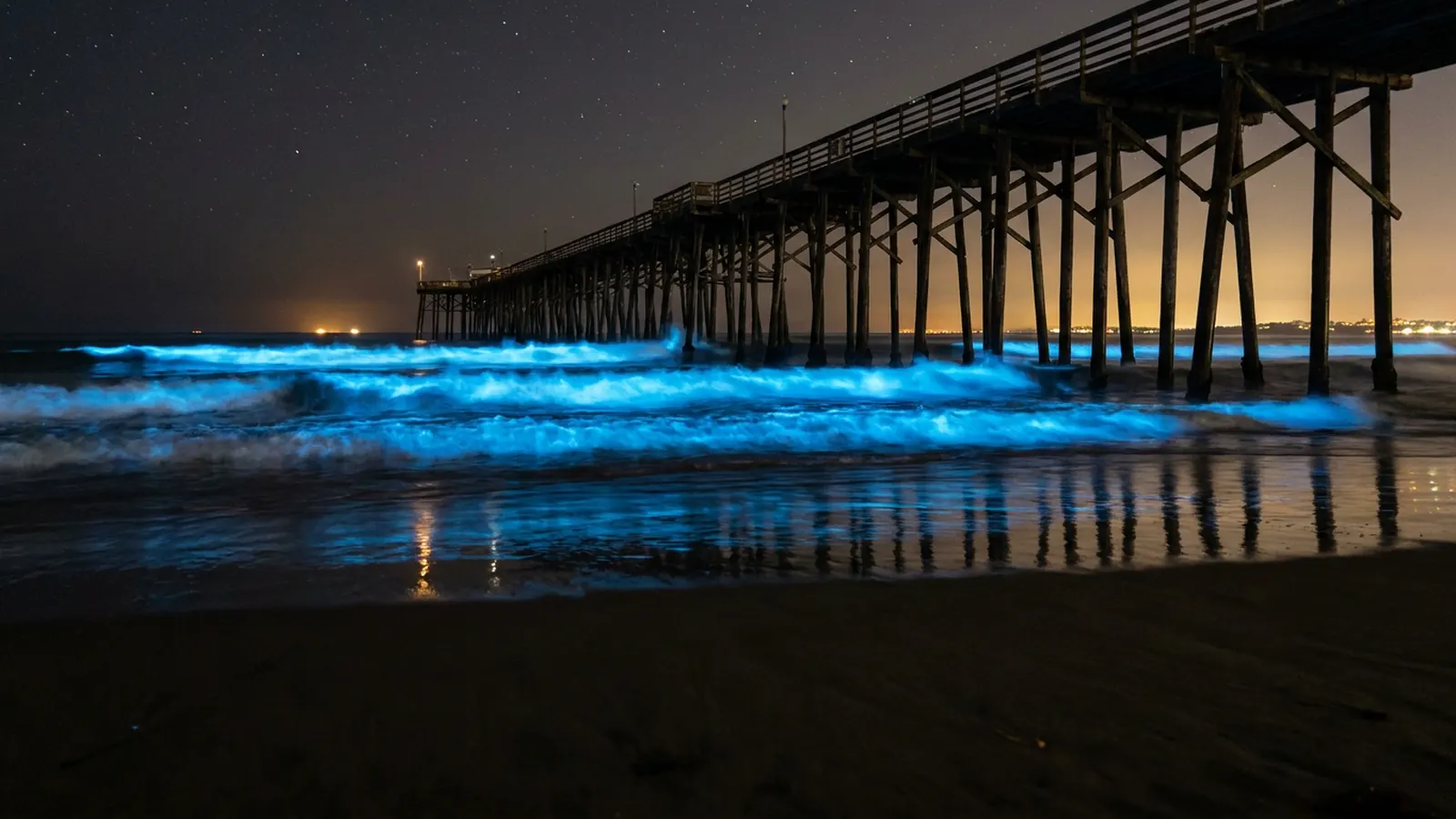
During the day, a bloom shows up as patches or broad bands of reddish-brown water along the coast. That color comes from pigments in billions of dinoflagellate cells. At night, the same cells produce flashes of blue light whenever the water is disturbed. Breaking waves disturb the most water at once, so they light up in long glowing lines; footprints in wet sand sparkle, and fish, dolphins and surfers leave trails of light.
Researchers at Scripps Institution of Oceanography in La Jolla have studied these blooms for decades, using the pier and long-term sampling to track the plankton. Major glowing events have been recorded several times in recent memory, including notable displays in 2011, 2018 and an exceptionally strong and long-lasting bloom in spring 2020 that stretched from San Diego north into Orange County and Los Angeles County. Between events, years can pass with little or no glow.
What makes the plankton glow
Lingulodinium polyedra produces light through a chemical reaction inside tiny structures in the cell called scintillons. When the water around the cell is disturbed, the change triggers a reaction in which the enzyme luciferase acts on luciferin and releases a brief flash of blue light. The light is thought to act as a burglar alarm: a small grazer trying to eat the dinoflagellate is suddenly lit up, making it visible to fish and other predators that eat grazers. The cells also follow a daily clock and produce more light at night than during the day. Our bioluminescent plankton page goes deeper into how this works.
Why the blooms happen in some years and not others is still an active research question. Warm, calm water, sunlight, nutrient pulses from upwelling or runoff, and the swimming behaviour of the dinoflagellates, which can move up toward light by day and down toward nutrients by night, all seem to play a role. Once the bloom is concentrated near the coast, onshore winds and currents can push it into the surf zone.
Where to see it in Southern California
When a bioluminescent red tide is under way, almost any beach with breaking waves and little artificial light can put on a show. In San Diego County, popular viewing spots during past events have included La Jolla Shores, the beaches near Scripps Pier, Torrey Pines, Pacific Beach, Ocean Beach, Del Mar, Encinitas and Leucadia. In bigger events, glowing waves have been reported at Newport Beach, Huntington Beach, Manhattan Beach and Malibu.
The best way to know whether the glow is happening is to watch for reports of red tide by day and check local news, surf reports and social media for recent sightings. Scripps researchers and local media usually publicise strong events. If the water looks reddish-brown along the shore during the day, it is worth heading back after dark.
| Location | Type of glow | Typical timing | How to see it |
|---|---|---|---|
| San Diego County beaches | Glowing waves in red tides | Irregular, often spring to autumn | Walk the beach after dark |
| Orange County and Los Angeles | Glowing waves in large events | Rare | Walk the beach after dark |
| Mission Bay, San Diego | Glowing water in calm bay | During red tides | Kayak or paddleboard |
| Tomales Bay, Marin County | Glowing water in a sheltered bay | Roughly August to November | Guided night kayak tour |
Tomales Bay: Northern California’s glowing bay
Tomales Bay is a long, narrow inlet on the eastern edge of Point Reyes National Seashore, about an hour and a half north of San Francisco. It lies along the San Andreas Fault, and its shallow, sheltered water warms up in late summer. From roughly August into November, dinoflagellates in the bay often become dense enough to light up paddles, kayak bows and fish on dark nights.
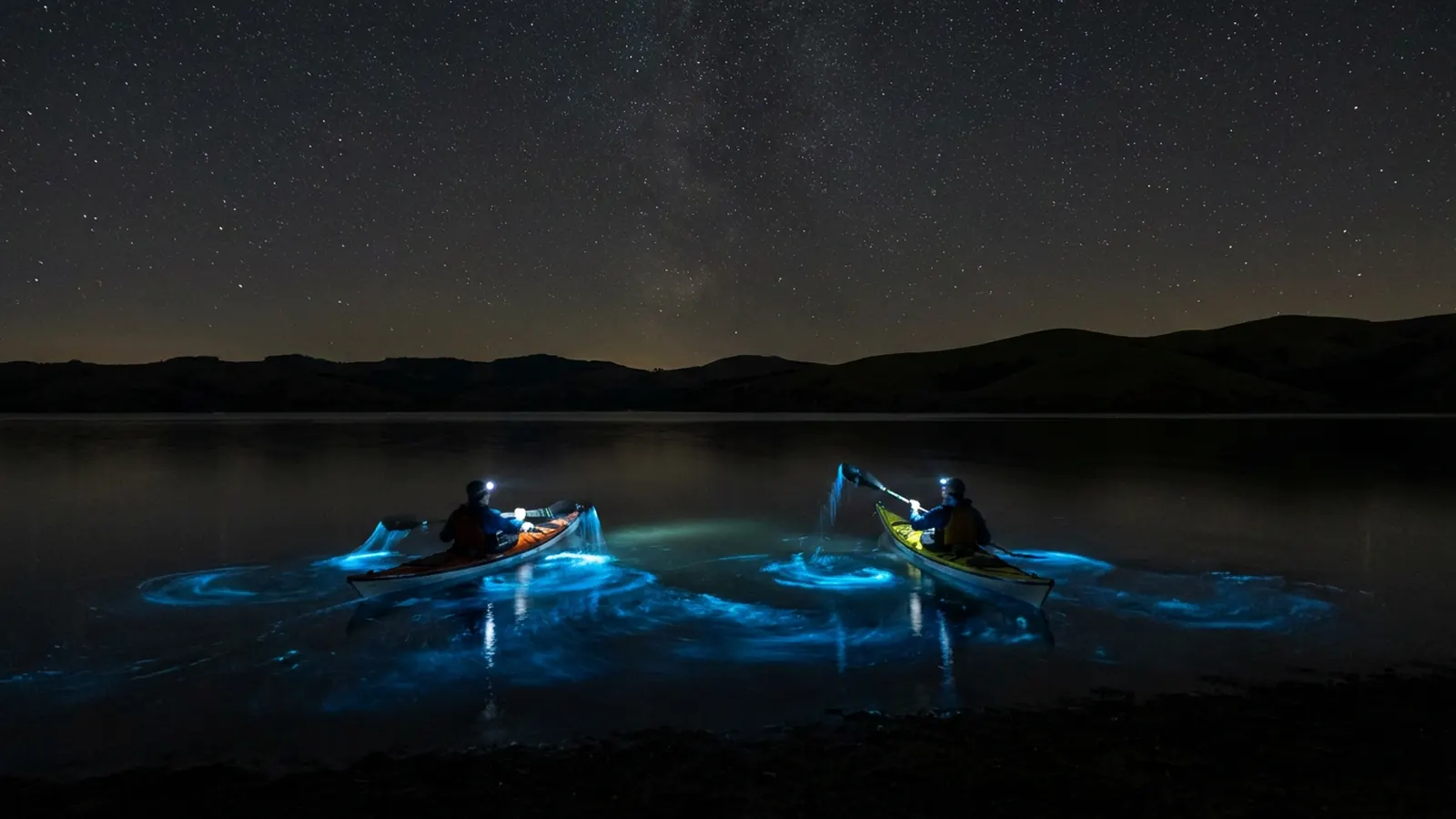
Unlike the dramatic glowing waves of the south, Tomales Bay’s bioluminescence is a calm-water experience. Visitors usually see it on guided night kayak tours, paddling out from the eastern shore. The glow appears as swirls from each paddle stroke and sparkles as water drips off the blade; jellies and fish sometimes leave trails of light as they move. Because the bay is sheltered and the plankton build up seasonally, the glow is more predictable here than on open beaches, though it still varies from night to night. For more paddling destinations, see bioluminescent kayaking.
Is a bioluminescent red tide harmful?
Not every red tide is toxic. The blooms of Lingulodinium polyedra that cause San Diego’s glowing waves are generally not considered dangerous to swimmers, and many people surf and swim during them. The species can produce compounds called yessotoxins, so shellfish harvesting may be monitored during blooms, and very dense blooms can irritate the eyes or skin of sensitive people.
The bigger risk comes when a large bloom dies off. As the dead cells decompose, bacteria use up oxygen in the water, which can cause fish kills in enclosed areas such as harbours and lagoons. That happened during the 2020 event, when low oxygen killed fish in parts of the coast. The decaying bloom can also produce a strong smell. This is very different from the Florida red tide caused by Karenia brevis, which produces brevetoxins that can harm people, fish and marine mammals; see red tide and bioluminescence in Florida.
Tips for seeing California’s glowing water
Timing matters most. In Southern California, you are waiting for a bloom, so watch for red tide reports and recent sightings. Once one is under way, go out an hour or more after sunset, ideally on a night with little or no moon. Choose a stretch of beach away from piers, streetlights and busy boardwalks, and give your eyes ten to fifteen minutes to adjust to the dark without looking at a phone screen.
Watch the breaking waves first; they usually show the strongest glow. Then walk along the wet sand at the waterline and watch your footsteps. If you want to see the light up close, scoop a little water and splash it. For Tomales Bay, book a tour in the late-summer and autumn season and pick a date near the new moon. Dress warmly; northern California nights on the water are cold even in summer.
Other glowing life on the California coast
Dinoflagellates are not the only light-makers off California. Comb jellies drifting in Monterey Bay and other coastal waters flash and shimmer when disturbed, and divers on night dives often see sparks from tiny crustaceans and other plankton as they move their hands through the water. Offshore, the deep Monterey Canyon is one of the best-studied places on Earth for deep-sea bioluminescence, thanks to decades of submersible and robot dives by local research institutions. Those deep animals, from glowing squid to siphonophores, never reach the beach, but they are a reminder that the light you see in the surf is only a small part of what California’s waters can produce.
Photographing the glow
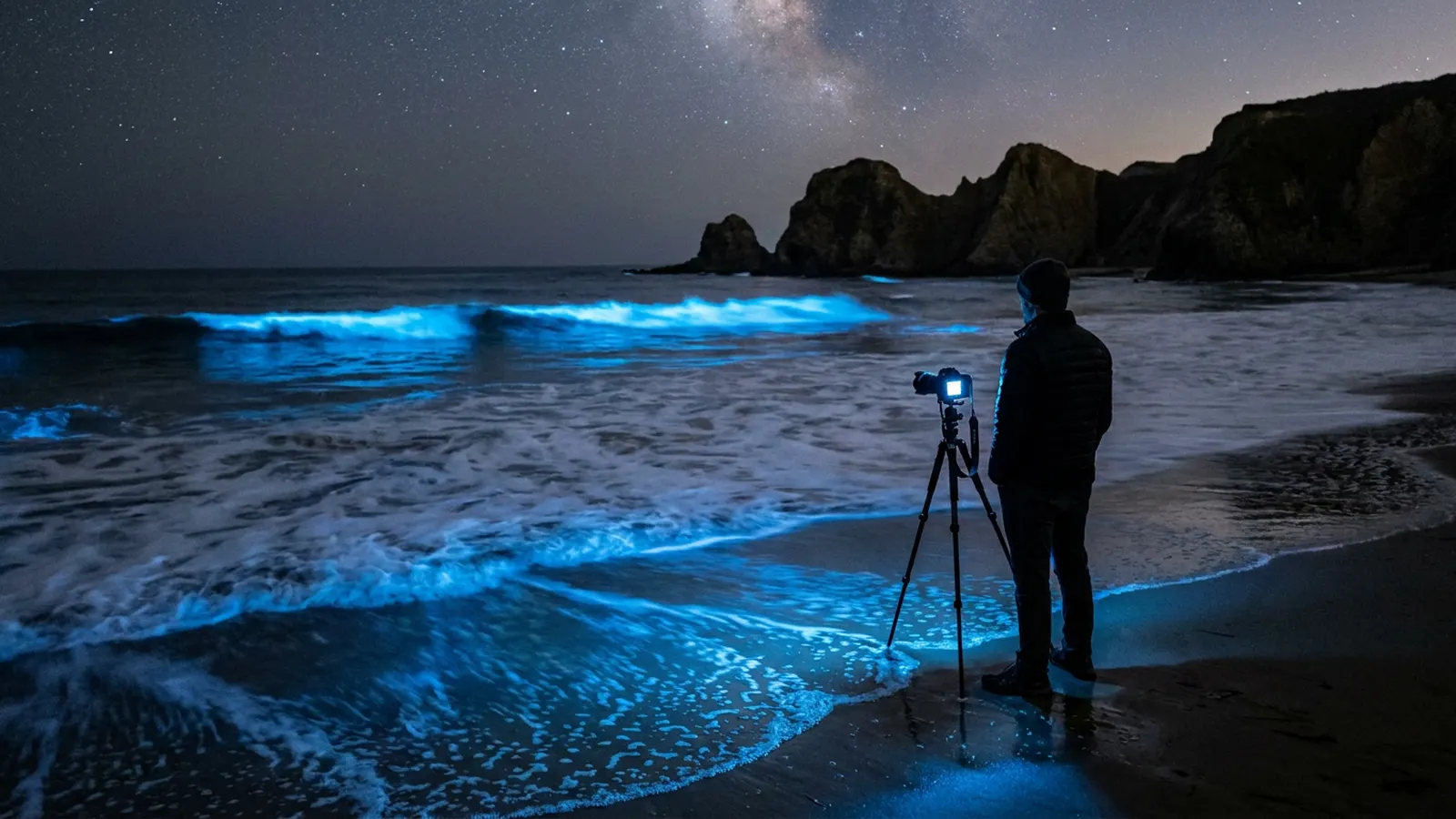
The best images of glowing California waves are long exposures taken on a tripod, often a few seconds long, which add up many brief flashes. Use a wide-aperture lens, a high ISO and manual focus set on the waves. Avoid flash and torches. Phones with night modes sometimes capture strong events, but the glow almost always looks more vivid in photos than to the eye, so manage your expectations.
How I would approach it
I haven’t seen a San Diego red tide glow myself, so I won’t pretend otherwise. But from decades of keeping reef systems since 1996 and diving coastlines from the Florida Keys to the Pacific, I know that plankton events are about patience and timing. If I lived in Southern California, I would keep an eye on red tide reports through spring and summer and be ready to drive to a dark beach on short notice. If I were visiting, I would plan on Tomales Bay in autumn, where the odds are better, and treat any San Diego glow as a lucky bonus.
California’s coast has plenty more to offer after dark and by day: kelp forests, sea lions, migrating gray whales and some of the best cold-water diving in North America. See scuba diving in San Diego, whale watching in San Diego and sea otters in Monterey Bay.
Where can you see bioluminescence in California?
On San Diego County beaches during red tides, occasionally in Orange County and Los Angeles, and in Tomales Bay on autumn kayak tours.
What causes San Diego’s glowing waves?
Blooms of the dinoflagellate Lingulodinium polyedra, which flashes blue when disturbed.
When is bioluminescence season in San Diego?
There is no fixed season; blooms are irregular and can happen from spring to autumn, sometimes years apart.
When is the best time for Tomales Bay bioluminescence?
Roughly August to November, on dark nights near the new moon.
Is it safe to swim in a glowing red tide in California?
Usually yes, but avoid swallowing the water and stay out if your skin or eyes are irritated.
Is a bioluminescent red tide the same as Florida’s red tide?
No. Florida’s red tide is caused by Karenia brevis, which is toxic and does not glow brightly.
- Scripps Institution of Oceanography, UC San Diego: Red tide and bioluminescence updates.
- National Park Service: Point Reyes National Seashore, Tomales Bay.
- NOAA National Ocean Service: What is a harmful algal bloom?
- Haddock, S.H.D., Moline, M.A. & Case, J.F. (2010). Bioluminescence in the sea. Annual Review of Marine Science 2: 443–493.
Blane Perun has been exploring Earth’s oceans and marine life for over 25 years. Founder of TheSea.Org in 1999, underwater photographer, coral aquaculture pioneer, and explorer of 80+ countries.
About Blane Perun → More on bioluminescence →