Jamaica Bioluminescent Lagoon — Swimming in the Glowing Water of Luminous Lagoon
Jamaica’s Luminous Lagoon sits at Glistening Waters near Falmouth, Trelawny, on the island’s north coast, where the Martha Brae River meets the sea. Billions of single-celled dinoflagellates flash blue-green whenever the water moves. Unlike Puerto Rico’s bays, it is one of the few bioluminescent lagoons where visitors are still allowed to swim.
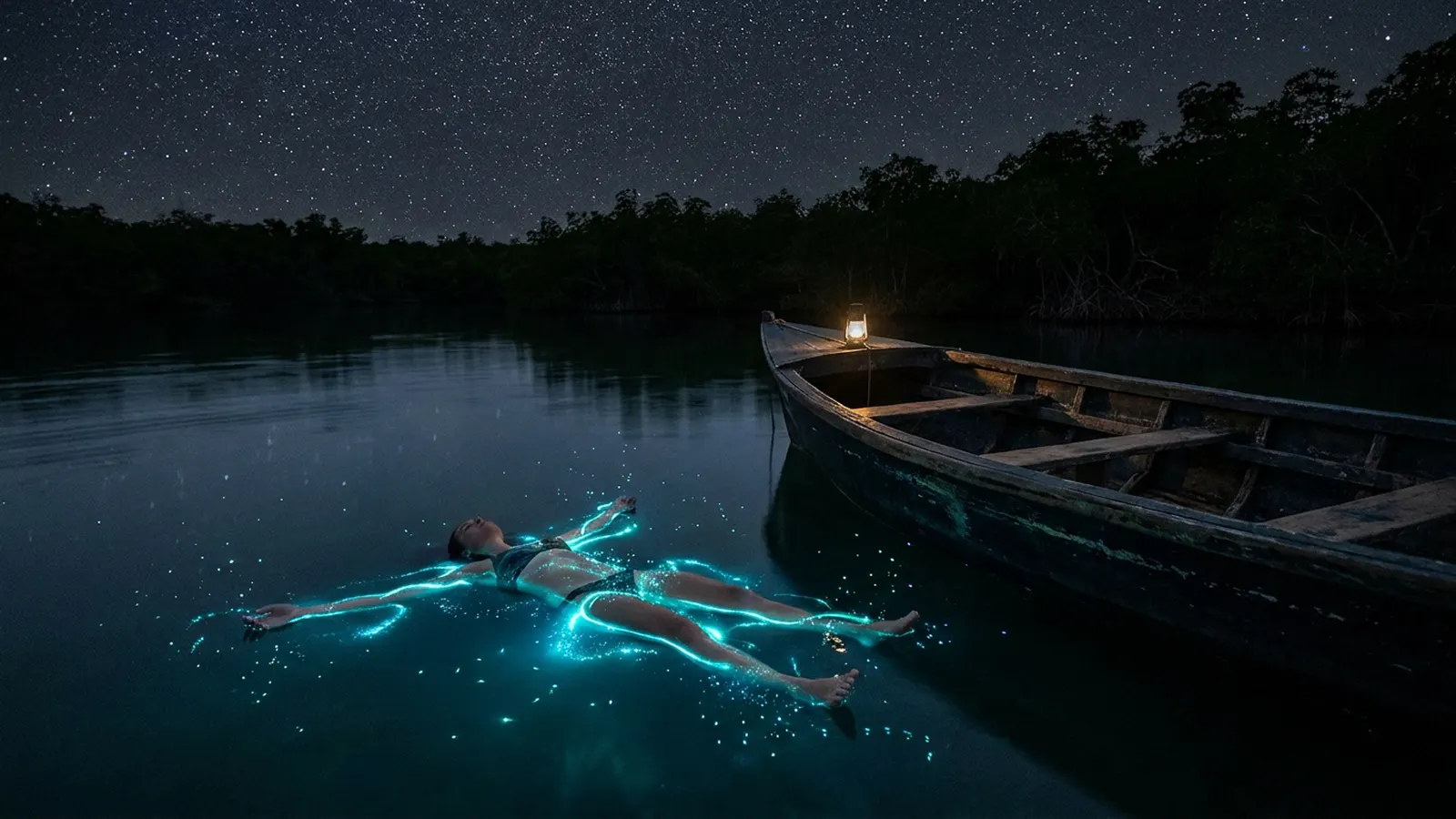
Most of the world’s famous glowing bays are look-but-don’t-touch places. In Puerto Rico you can paddle a kayak through the light, but swimming has been restricted for years. Jamaica’s Luminous Lagoon is different. Here the tour boats stop in the middle of the lagoon, people slide into the warm, dark water, and every kick and arm stroke lights up in a cloud of blue-green sparks. That is what puts it on so many travel lists, and it is also why it deserves a little more care than a typical tourist stop. This guide explains where the lagoon is, what actually makes it glow, how a visit works, and what I would want to know before going. For the science behind all of this, see our bioluminescence guide.
Where Luminous Lagoon is
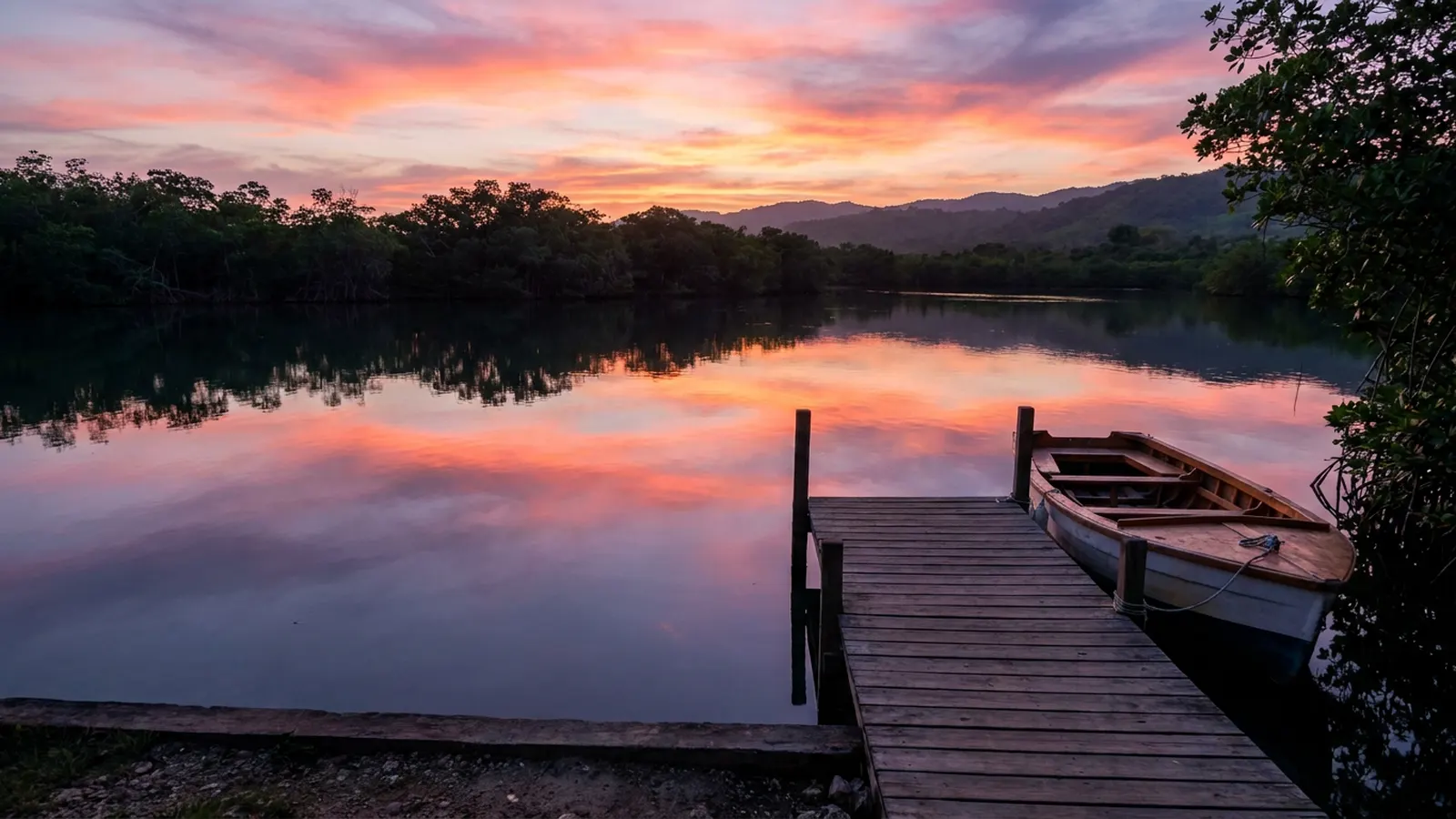
The lagoon lies on Jamaica’s north coast at a place called Glistening Waters, just east of the old Georgian town of Falmouth in Trelawny Parish.
It is roughly halfway between Montego Bay and Ocho Rios, which makes it an easy evening trip from either resort area, and it is close enough to the Falmouth cruise pier that many cruise lines sell it as a night excursion. The lagoon is fed by the Martha Brae River, which flows down from the hills of Trelawny and empties into the sea here. Mangroves line much of the shoreline. Most visits start from the marina and restaurant at Glistening Waters, where the boats tie up, and from a few smaller operators along the same stretch of coast.
You will see the lagoon described under several names: Luminous Lagoon, Glistening Waters, the Falmouth bioluminescent lagoon and simply the Jamaica glowing lagoon. They all refer to the same body of water. If you want a sense of the wider reef system along this coast, our Jamaica coral reef maps page shows where the reefs lie.
What makes the water glow
The light comes from dinoflagellates, single-celled plankton that drift in the water by the billions. The dominant species in Jamaica’s lagoon is Pyrodinium bahamense, the same organism that lights up the famous bays of Puerto Rico. Each cell carries tiny light-producing structures called scintillons. When the water around a cell is disturbed, the change in pressure triggers a chemical reaction in which an enzyme, luciferase, acts on a molecule called luciferin and releases a flash of light lasting a fraction of a second. One cell is invisible to the eye; millions of them flashing together outline a moving hand, a fish or a boat wake in light.
Biologists think the flash is a defence. A small crustacean grazing on dinoflagellates suddenly finds itself lit up, which can attract the fish that eat crustaceans. This idea is called the “burglar alarm” hypothesis, and it explains why the light only appears when something moves the water. Our bioluminescent plankton page goes deeper into how the reaction works.
Why this lagoon glows so brightly
Dinoflagellates live in almost every sea, but very few places concentrate them enough to light up every night. Bright bioluminescent bays tend to share a handful of features, and Luminous Lagoon has most of them. It is shallow and fairly enclosed, so the plankton are not flushed out to sea with every tide. The mangroves around the edge shed leaves that break down into organic matter and nutrients, including vitamin B12, which Pyrodinium needs. The Martha Brae adds fresh water and more nutrients from the land.
The mixing of river water and seawater is a big part of the story here. Fresh water is lighter than salt water, so the river tends to spread across the surface while seawater sits below. Many visitors notice that the water feels cooler and fresher near the top and saltier as they sink deeper. The dinoflagellates thrive in this brackish zone where the nutrients and the salinity suit them. The same balance makes the lagoon fragile: change the flow of the river, clear the mangroves or pour more nutrients and chemicals into the water, and the community of plankton can shift away from the glowing species.
What a visit is like
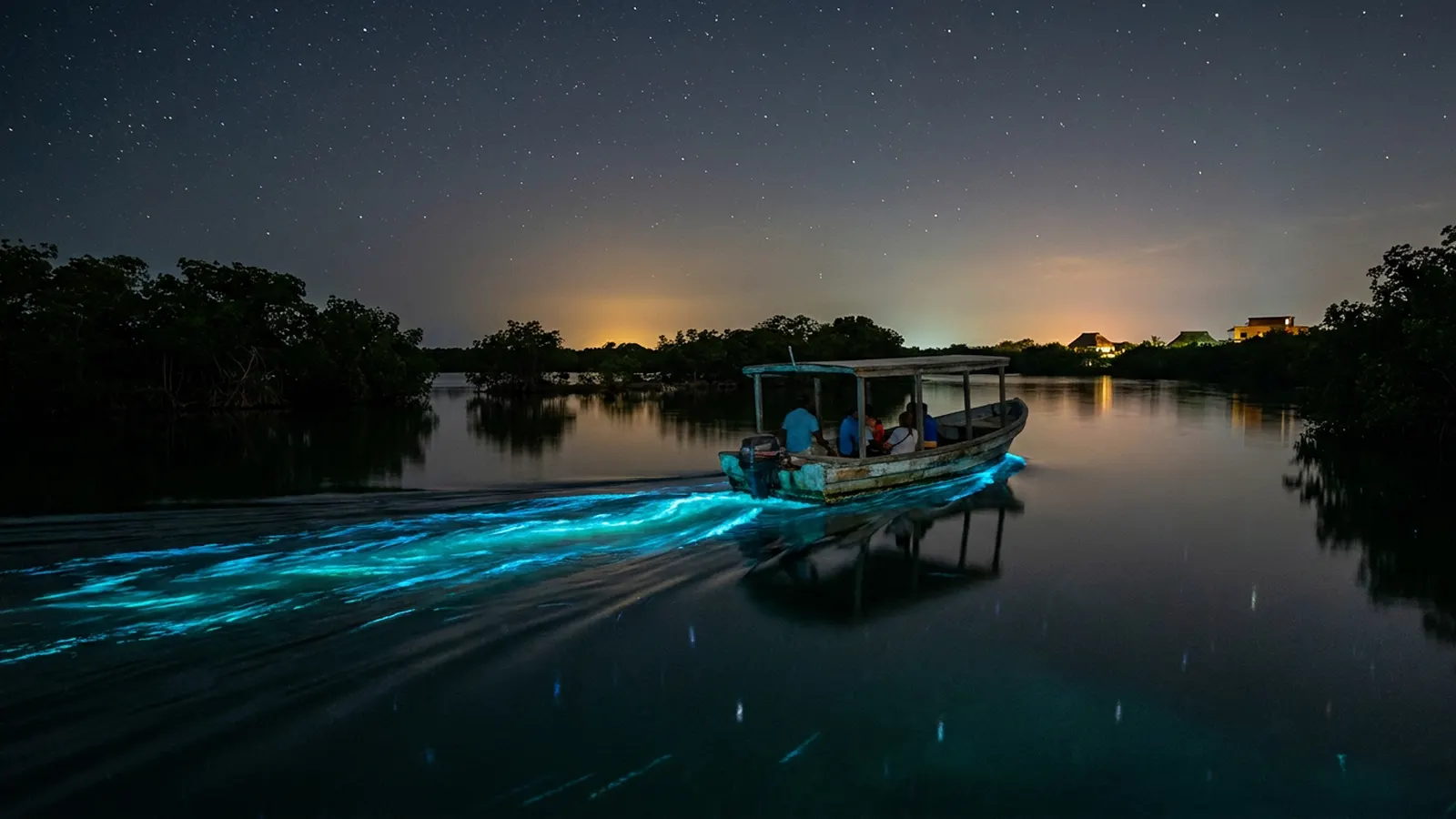
Tours run after dark, usually starting shortly after sunset and lasting under an hour on the water. A guide takes a small group out in a motor boat, and the first thing most people notice is the wake: a churning stripe of light behind the propeller. Once the boat is in deeper water, the guide stops, and swimmers are invited to jump in. Every movement you make sends a glow trailing off your fingers and legs. Fish darting away from the boat leave little comet tails of light. Scoop up a handful of water and it sparkles as it runs through your fingers.
The glow is stronger on some nights than others. It depends on the plankton density, the recent weather and, more than anything, how dark the sky is. Light from a full moon or a bright shoreline washes out the effect. Heavy rain upriver can also reduce it for a few days by diluting the lagoon. Guides will usually tell you honestly how the glow has been that week.
Don’t expect good photographs. The light is faint and lasts a fraction of a second, so phone cameras rarely capture what your eyes see. Most of the vivid images online are long exposures or heavily edited. I would leave the camera in the bag for most of the trip and just enjoy it.
How it compares with other bioluminescent bays
There are only a few places in the Caribbean where dinoflagellate light is reliably bright year-round. Puerto Rico has three famous bays: Mosquito Bay on Vieques, Laguna Grande near Fajardo and La Parguera on the southwest coast. The US Virgin Islands have Salt River Bay on St. Croix. Jamaica’s lagoon belongs in the same group, and the main difference for visitors is the swimming.
| Site | Country | Main glowing organism | Swimming allowed? | Usual way to visit |
|---|---|---|---|---|
| Luminous Lagoon | Jamaica | Pyrodinium bahamense | Yes, on tours | Motor boat, then swim |
| Mosquito Bay, Vieques | Puerto Rico | Pyrodinium bahamense | No | Electric boat or clear kayak |
| Laguna Grande, Fajardo | Puerto Rico | Pyrodinium bahamense | No | Kayak through mangrove channel |
| La Parguera | Puerto Rico | Pyrodinium bahamense | Restricted | Boat tour |
| Salt River Bay, St. Croix | US Virgin Islands | Dinoflagellates | No (kayak tours) | Kayak |
Puerto Rico tightened its rules because sunscreen, insect repellent, body oils and heavy traffic were thought to be harming the bays, and Mosquito Bay famously went dark for a time after Hurricane Maria in 2017 before recovering. For more on those bays, see bioluminescent bay Puerto Rico, Mosquito Bay and La Parguera. Our overview of every major bioluminescent bay covers the rest of the world.
Threats to the lagoon
A bioluminescent bay is a balancing act, and Luminous Lagoon faces the same pressures as the others. Development along the coast, including the large cruise port that opened at Falmouth, brought dredging and construction close to the lagoon and raised concerns among scientists and local residents. Runoff from roads, farms and buildings can carry sediment and excess nutrients into the water. Too many nutrients can feed other algae that outcompete Pyrodinium. Mangrove clearance removes the natural filter and the source of the vitamins the dinoflagellates depend on. And the swimming itself is a pressure: hundreds of bodies a night covered in sunscreen, lotion and insect repellent add chemicals to a small, enclosed body of water.
None of this means the lagoon is about to go dark. It has glowed for as long as anyone can remember and it still does. But the experience of other bays shows that these systems can change quickly, and that the glow is not guaranteed forever.
What I would do before going
I have been keeping reef tanks since 1996, and if there is one thing a reef keeper learns, it is how sensitive a small, enclosed body of water is to what goes into it. A lagoon is not a tank, but the principle is the same. If I were planning a night at Luminous Lagoon, I would do a few simple things.
First, I would check the moon calendar and pick a night as close to the new moon as my schedule allowed. A dark sky makes a far bigger difference than the choice of tour company. Second, I would skip sunscreen and insect repellent that evening, or at least rinse off before getting in the water. The tour is after dark, so you do not need sunscreen anyway. Third, I would choose an operator that keeps groups small and does not churn the lagoon with oversized boats. Finally, I would go in with realistic expectations. On a good night it is magical; on a bright, rainy night it can be subtle.
If you cannot get to Jamaica, the same light shows up in other places. Florida’s Indian River Lagoon glows in summer from dinoflagellates and comb jellies; see bioluminescence in Florida. Glowing surf from plankton blooms appears on beaches around the world; see bioluminescent beaches. And if you prefer to paddle instead of swim, our bioluminescent kayaking guide lists the best spots.
Getting there and timing
From Montego Bay the drive to Glistening Waters is usually under an hour; from Ocho Rios it is a bit longer. Many hotels can arrange transport with the tour. If you are arriving by cruise ship at Falmouth, the lagoon is only a short drive from the pier, but check the ship’s departure time carefully, because tours run after dark.
The lagoon glows year-round, so there is no single season to aim for. Jamaica’s rainier months, roughly May and again from September into November, can bring nights when runoff dims the glow, while the drier winter months tend to be more consistent. The phase of the moon matters more than the month. Bring a towel, a change of clothes and something to rinse off with; the water is warm, but the boat ride back can feel cool.
Can you swim in Jamaica’s bioluminescent lagoon?
Yes. Guided boat tours at Luminous Lagoon let visitors swim in the glowing water, unlike most bays in Puerto Rico.
Where is the bioluminescent lagoon in Jamaica?
At Glistening Waters near Falmouth in Trelawny Parish, between Montego Bay and Ocho Rios on the north coast.
What causes the glow in Luminous Lagoon?
Dinoflagellates, mainly Pyrodinium bahamense, which flash blue-green when the water is disturbed.
Is the Luminous Lagoon safe to swim in?
The dinoflagellates are harmless to touch, and swimming happens on supervised tours. Do not swallow the water.
When is the best time to see the lagoon glow?
On dark, moonless nights, ideally near the new moon and away from periods of heavy rain.
Does the lagoon glow every night?
It glows year-round, but brightness varies with moonlight, weather and plankton density.
Can you photograph the glow?
Only with difficulty. The flashes are faint and brief, so phone photos rarely show what you see.
- NOAA Ocean Exploration: What is bioluminescence?
- Smithsonian Ocean: Bioluminescence.
- Jamaica National Environment and Planning Agency (NEPA): Protected areas and coastal resources.
- Haddock, S.H.D., Moline, M.A. & Case, J.F. (2010). Bioluminescence in the sea. Annual Review of Marine Science 2: 443–493.
Blane Perun has been exploring Earth’s oceans and marine life for over 25 years. Founder of TheSea.Org in 1999, underwater photographer, coral aquaculture pioneer, and explorer of 80+ countries.
About Blane Perun → More on bioluminescence →