Plankton Under a Microscope — What Diatoms, Copepods and Dinoflagellates Look Like
Under a microscope, a drop of seawater turns into a crowded world. Phytoplankton such as diatoms look like tiny glass boxes, chains and needles, often golden-brown; dinoflagellates appear as armoured cells with grooves and whip-like flagella. Zooplankton such as copepods look like miniature shrimp with long antennae, alongside the larvae of crabs, fish and worms.
Most of the life in the ocean is invisible to us. Scoop a jar of seawater off a dock and it looks clear and empty, but that same jar can hold thousands of single-celled algae, a few dozen tiny crustaceans and a scattering of larvae that will one day be crabs, snails or fish. Put a drop under a microscope and the whole picture changes. This guide walks through what you will actually see when you look at plankton under a microscope, how to tell the main groups apart, and how to collect a sample worth looking at. For the big-picture difference between the plant-like and animal-like drifters, start with our plankton guide.
Phytoplankton vs zooplankton at a glance
The first thing to learn at the eyepiece is the split between drifting algae and drifting animals. They look, and move, very differently.
Phytoplankton are single-celled algae and cyanobacteria. Under the microscope they tend to be geometric: boxes, discs, rods, chains and spiny stars. Many are tinted golden-brown or green by their chlorophyll and accessory pigments, and most of them either sit still or drift slowly. Some, especially dinoflagellates, spin or wobble across the field of view as their flagella beat.
Zooplankton are animals, or animal-like protists, that drift with the currents. At low magnification they look like what they are: little creatures with legs, eyes, guts and antennae. Copepods jerk across the slide in short hops. Crab larvae paddle. Arrow worms dart. If something in your sample is clearly hunting, kicking or swimming in a straight line, it is almost certainly zooplankton. Our zooplankton page covers the main animal groups in more detail.
| Organism | Group | What it looks like | Magnification |
|---|---|---|---|
| Diatoms | Phytoplankton | Glassy boxes, discs, needles, zig-zag chains; golden-brown | 100–400× |
| Dinoflagellates | Phytoplankton / mixotroph | Armoured cells with a belt groove, horns, two flagella | 100–400× |
| Coccolithophores | Phytoplankton | Tiny spheres covered in chalk plates | 400×+ (best by SEM) |
| Copepods | Zooplankton | Teardrop body, long antennae, single eye spot | 20–60× |
| Crab zoea larvae | Zooplankton (larva) | Big eyes, long spines, curled tail | 20–60× |
| Radiolarians and foraminifera | Zooplankton (protists) | Ornate silica or chalk shells, radiating spines | 100× |
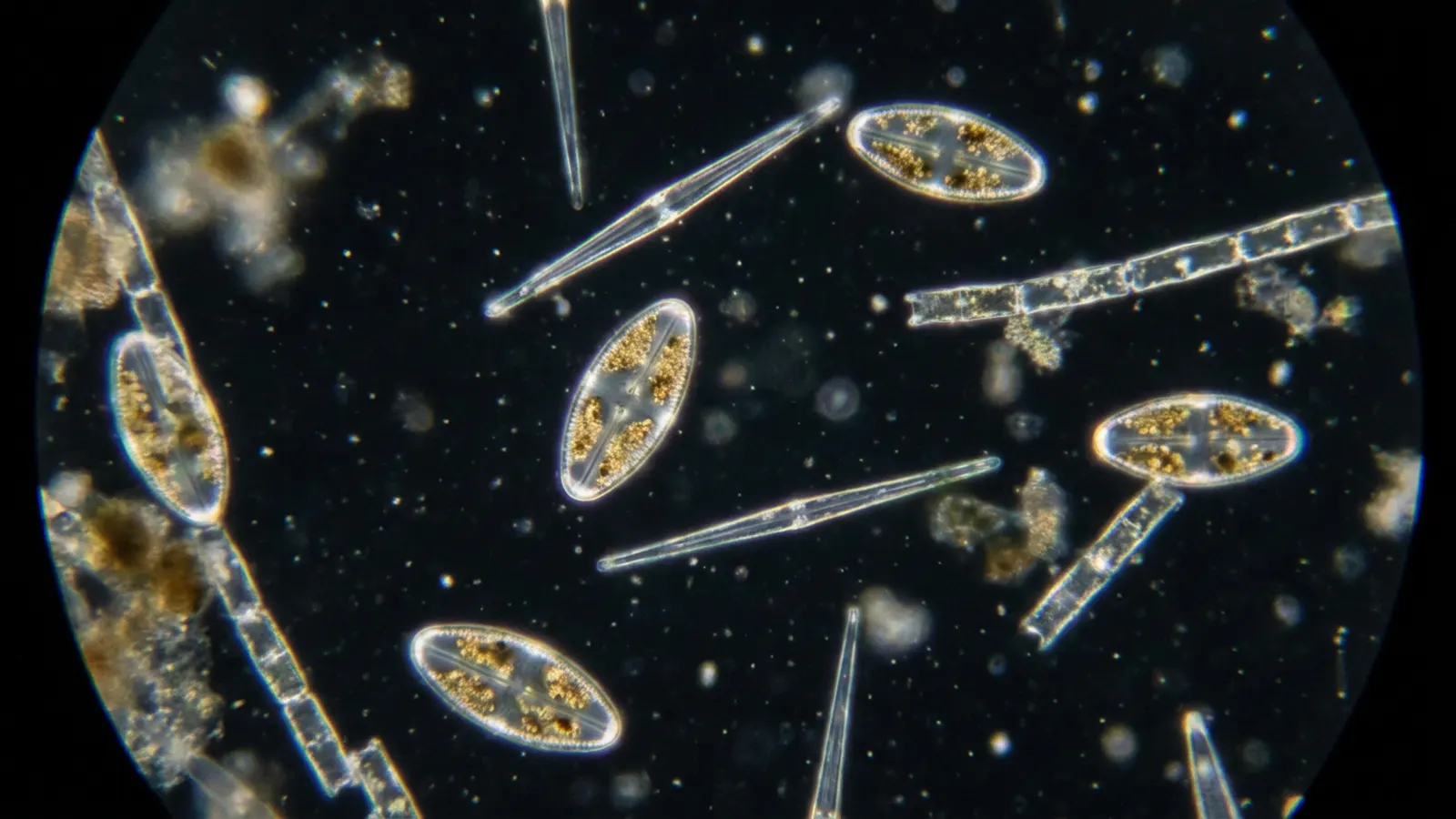
Diatoms: glass houses
Diatoms are the showpieces of a plankton slide. Each cell lives inside a two-part shell made of silica, the same material as glass, which fits together like the lid and base of a petri dish. The shells are etched with rows of pores and ribs so fine and regular that microscope makers once used them to test the quality of their lenses. Centric diatoms are round, like tiny pillboxes or coins. Pennate diatoms are long and boat-shaped, and some glide slowly across the slide.
Many diatoms form chains. You will see zig-zag ribbons, straight strings of boxes, and the long spiny chains of Chaetoceros, whose bristles help it stay suspended in the water. In coastal water during a spring bloom, diatoms can dominate a sample so completely that the slide looks like a pile of broken jewellery. That golden-brown colour is why heavy diatom blooms tint the sea brown or olive; see phytoplankton blooms for how those bursts happen.
Dinoflagellates: armour and whips
Dinoflagellates look more like little armoured vehicles. Many species are covered in cellulose plates and have a groove running around their middle like a belt, with a second groove running down one side. One flagellum sits in the belt groove and makes the cell spin; the other trails behind and pushes it forward. Under the microscope, that combination gives dinoflagellates a distinctive corkscrew swimming motion.
Some, such as Ceratium (now often placed in Tripos), have long horns that make them look like anchors or tuning forks. Others, such as the big round Noctiluca scintillans, look like clear jelly balloons with a single tentacle. Noctiluca is one of the organisms behind glowing waves, and if you tap the slide in a dark room you may even see a sample flash. Our bioluminescent plankton page explains that light. Dinoflagellates are also behind many red tides and are a familiar nuisance in home aquariums; see dinoflagellates in reef tanks.
Copepods and other zooplankton
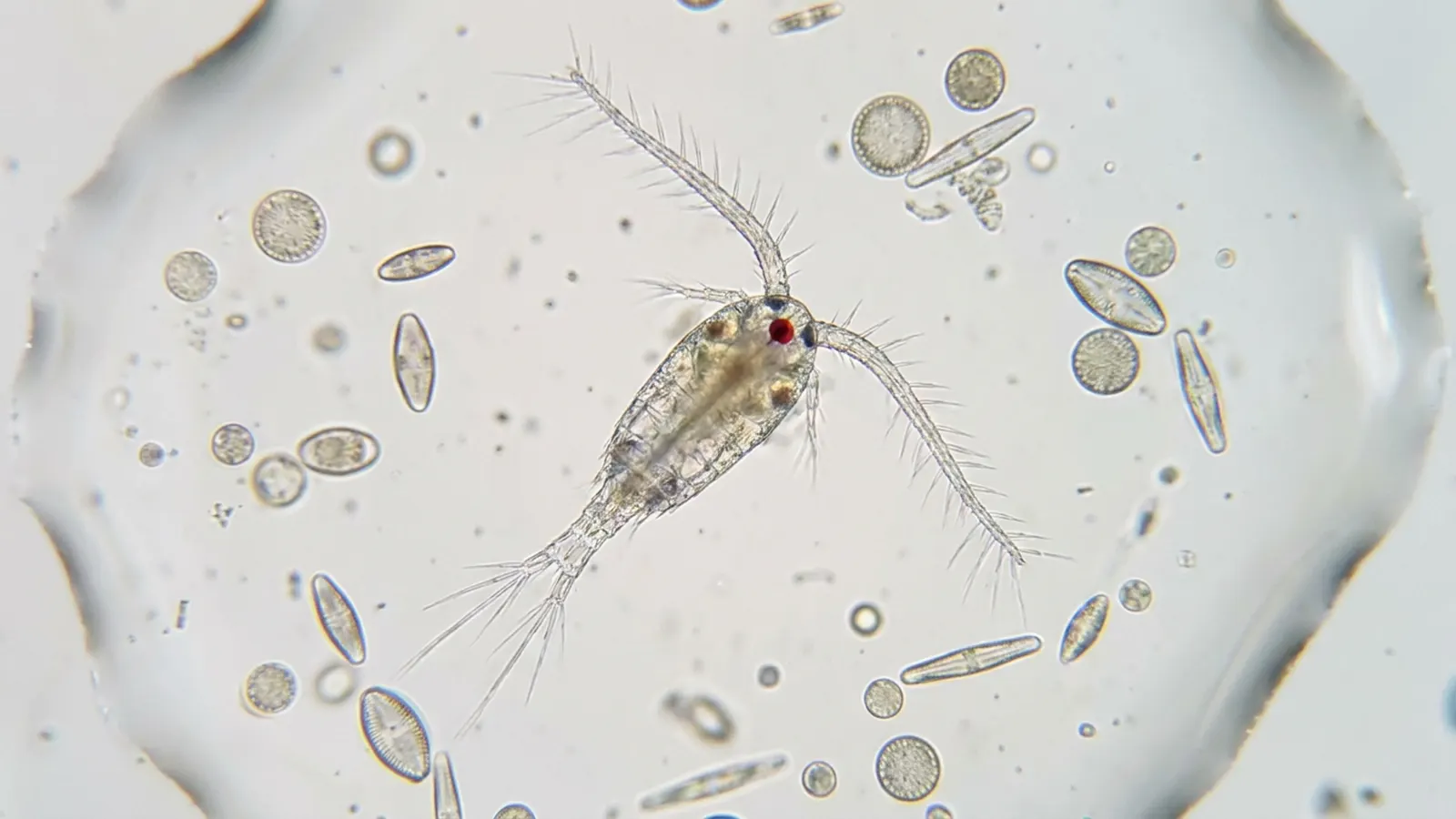
If you only find one animal in your sample, it will probably be a copepod. These small crustaceans are among the most numerous animals on Earth, and under the microscope they look like teardrops with a pair of long antennae sticking out sideways and a single red or black eye spot near the front. You can often see the gut, sometimes green or brown with the algae they have just eaten, and females carrying egg sacs that hang off the back like little bunches of grapes. They move in sudden jumps, which makes them tricky to keep in focus.
Alongside copepods you are likely to meet a rotating cast of larvae. Crab zoea have huge eyes and long spines that make them look like something from science fiction. Barnacle nauplii are triangular with three pairs of legs. Fish eggs are clear spheres with an oil droplet, and if you are lucky you can watch a tiny larva twitching inside. Snail and clam larvae (veligers) beat ciliated lobes that look like spinning propellers. Arrow worms, transparent and torpedo-shaped, hunt copepods with a ring of grasping spines. For more on the crustaceans in particular, see planktonic crustaceans and small crustaceans.
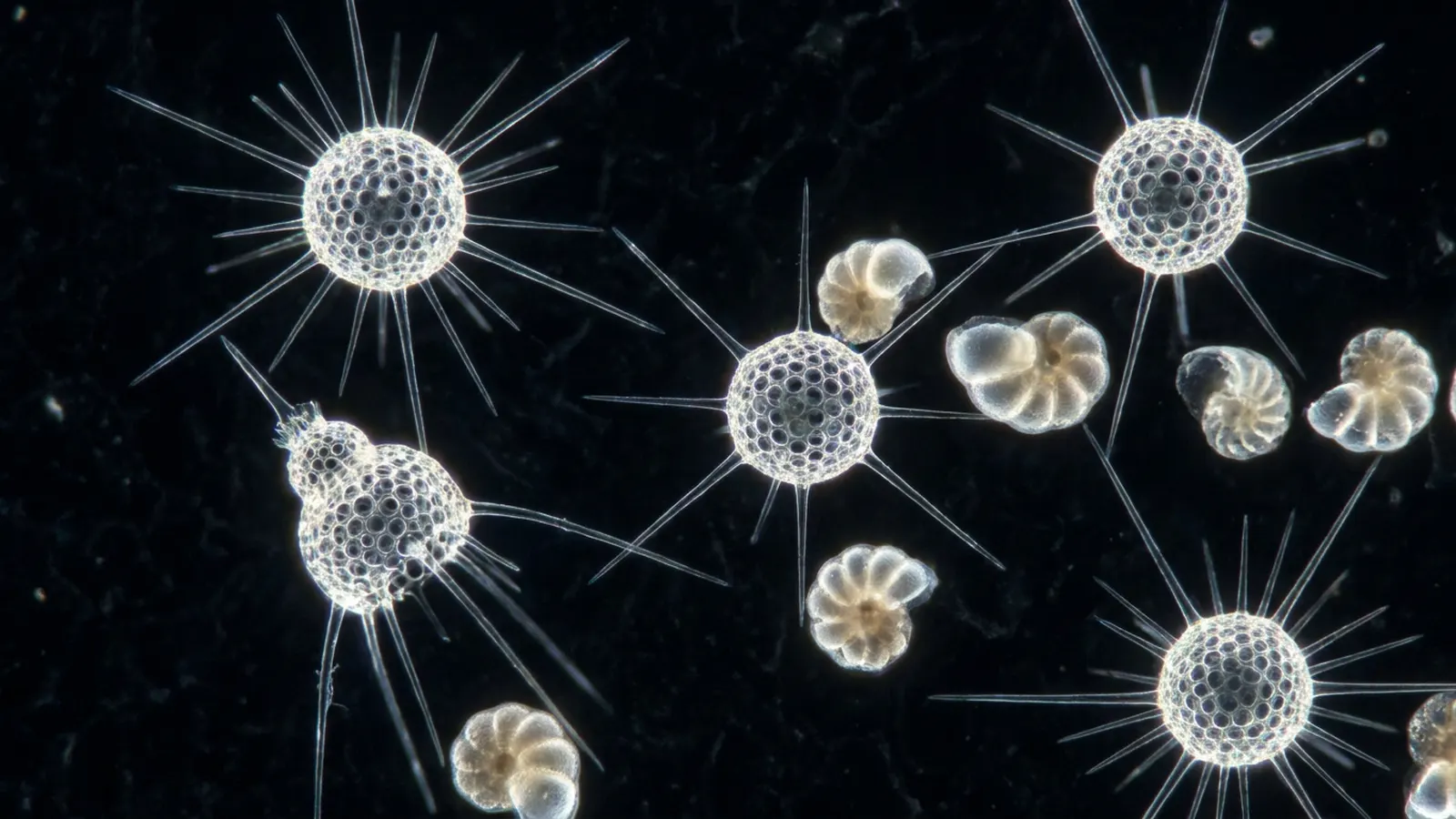
Protists with shells: radiolarians and forams
Some of the most beautiful things on a plankton slide are single-celled animals with skeletons. Radiolarians build intricate glassy lattices with spines radiating out like a sunburst. Foraminifera build chambered shells of calcium carbonate that can look like tiny snail shells or bunches of bubbles. Both groups are more common in open ocean samples than in a harbour, and both leave their shells on the seafloor when they die. Over millions of years those shells build up into sediments, which is why geologists use them to read ancient ocean conditions. Coccolithophores, tiny algae armoured with chalk plates, do the same, but they are so small that their plates are best seen with an electron microscope.
How to collect and view a plankton sample
You do not need a research vessel. A simple plankton net, a cone of fine mesh with a small collecting jar at the narrow end, can be towed slowly behind a kayak or thrown from a dock and pulled back in several times. Mesh size decides what you catch: around 20 to 80 micrometres for phytoplankton, and around 150 to 200 micrometres for zooplankton. Without a net, a large volume of water poured through a coffee filter or a fine cloth will concentrate enough to look at.
A few practical points make a big difference. Sample at night if you want zooplankton, because many species migrate up toward the surface after dark and sink again at dawn. Keep the jar cool and out of the sun, and look at it within a few hours, because many organisms die quickly in a warm jar. Start with a stereo (dissecting) microscope or the lowest objective at around 40× to find the animals, then move to 100× and 400× for the algae. A depression slide or a shallow dish lets things swim without being crushed. A drop of carbonated water or a little clove oil can slow fast swimmers if you want a photo.
From my reef tanks: why I like a microscope
I have kept reef tanks since 1996, from a 40-gallon system up through multi-tier systems and a dedicated coral farm with stock tanks, and if I had to recommend one under-used tool to another reef keeper, it would be a basic microscope. Films and slimes on rock and glass all look roughly the same to the naked eye: brown, stringy, maybe with bubbles. Under the lens they separate cleanly into diatoms, cyanobacteria and dinoflagellates, and each one has a different cause and a different fix. Guessing wrong means treating the wrong problem.
The same habit is useful for anyone who cultures live food. If you are growing phytoplankton or copepods to feed corals and fish, a quick look tells you whether the culture is healthy, crashing or contaminated before you dump it in the tank. Our phytoplankton for reef tanks page covers which species are commonly used. My view is simple: you learn more about the water in ten minutes at the eyepiece than in a week of guessing.
Why it matters beyond the slide
Looking at plankton is not only a curiosity. Phytoplankton produce roughly half of the oxygen made by photosynthesis on Earth and form the base of nearly every marine food web. Copepods and krill turn that algae into food for fish, seabirds and whales; see what eats plankton and krill. Scientists track changes in plankton communities to follow warming, acidification and pollution, and long-running surveys such as the Continuous Plankton Recorder in the North Atlantic have been sampling the same routes for decades. When you look through a microscope at a drop of seawater, you are looking at the engine room of the ocean.
What magnification do you need to see plankton?
About 40× is enough for copepods and larvae. Diatoms and dinoflagellates need roughly 100× to 400×.
Can you see plankton without a microscope?
Some. Copepods, krill, jellies and many larvae are visible as tiny moving specks; most phytoplankton are not.
What do diatoms look like under a microscope?
Glassy, golden-brown boxes, discs, needles or chains with finely patterned silica shells.
What do copepods look like under a microscope?
Teardrop-shaped crustaceans with long antennae, a single eye spot and jerky, hopping movement.
How do I collect plankton for a microscope?
Tow a fine-mesh plankton net or filter a large volume of seawater, keep it cool and look within a few hours.
Is it easier to find plankton at night?
Yes for zooplankton. Many species migrate toward the surface after dark.
- NOAA Ocean Service: What are plankton?
- Smithsonian Ocean: Plankton.
- Johnson, W.S. & Allen, D.M. (2012). Zooplankton of the Atlantic and Gulf Coasts: A Guide to Their Identification and Ecology. Johns Hopkins University Press.
- Marine Biological Association: Continuous Plankton Recorder Survey.
- Tomas, C.R. (ed.) (1997). Identifying Marine Phytoplankton. Academic Press.
Blane Perun has been exploring Earth’s oceans and marine life for over 25 years. Founder of TheSea.Org in 1999, underwater photographer, coral aquaculture pioneer, and explorer of 80+ countries.
About Blane Perun → More on plankton →