Krill vs Shrimp — Are Krill Shrimp?
No. Krill and shrimp are both crustaceans and look alike, but they belong to different orders. Krill are Euphausiacea, a group of about 85 species of open-ocean plankton; true shrimp are decapods, the ten-legged order that includes crabs and lobsters. Krill have gills exposed below the shell, no claws and, in most species, glowing light organs.
Krill get called “tiny shrimp” so often that most people assume they simply are shrimp. Look at one next to a shrimp under a magnifying glass and the resemblance holds up: a curved, see-through body, long antennae, lots of legs and a fanned tail. But the two groups split from each other a very long time ago, and the differences are real and easy to spot once you know where to look. This page explains how krill and shrimp are related, how to tell them apart, why the difference matters for whales and fisheries, and what it means if you are allergic to shellfish. For the krill themselves, see our main krill page.
Where krill and shrimp sit on the family tree
Krill and shrimp are cousins, not the same animal. Both are crustaceans in the large class Malacostraca, which also includes crabs, lobsters, isopods and amphipods.
Within Malacostraca, true shrimp, prawns, crabs and lobsters are grouped in the order Decapoda, meaning “ten feet”. Krill belong to a separate order, Euphausiacea. There are only around 85 species of krill, compared with thousands of decapods, and they are all marine. Older classifications placed krill together with decapods in a group called Eucarida because they share a shell (carapace) fused to all of the thoracic segments, but that does not make them shrimp, any more than a fox is a dog.
To complicate things, “shrimp” is a loose everyday word. Mantis shrimp, brine shrimp, mysid “opossum” shrimp, skeleton shrimp and fairy shrimp are all called shrimp but are not decapods either. The commercial shrimp and prawns sold for food, and the cleaner and peppermint shrimp kept in aquariums, are the true decapod shrimp. When people compare krill to shrimp, those are usually the animals they mean.
| Feature | Krill | True shrimp |
|---|---|---|
| Order | Euphausiacea | Decapoda |
| Number of species | About 85 | Thousands |
| Gills | Exposed, feathery, below the thorax | Enclosed under the carapace |
| Thoracic legs | Mostly similar, used to filter food | 3 pairs feeding legs + 5 pairs walking legs |
| Claws | None | Often on first one to three leg pairs |
| Light organs | Yes, in almost all species | Only in some deep-sea species |
| Habitat | Marine, mostly open ocean | Marine, brackish and fresh water |
| Lifestyle | Swarming plankton | Mostly bottom-living |
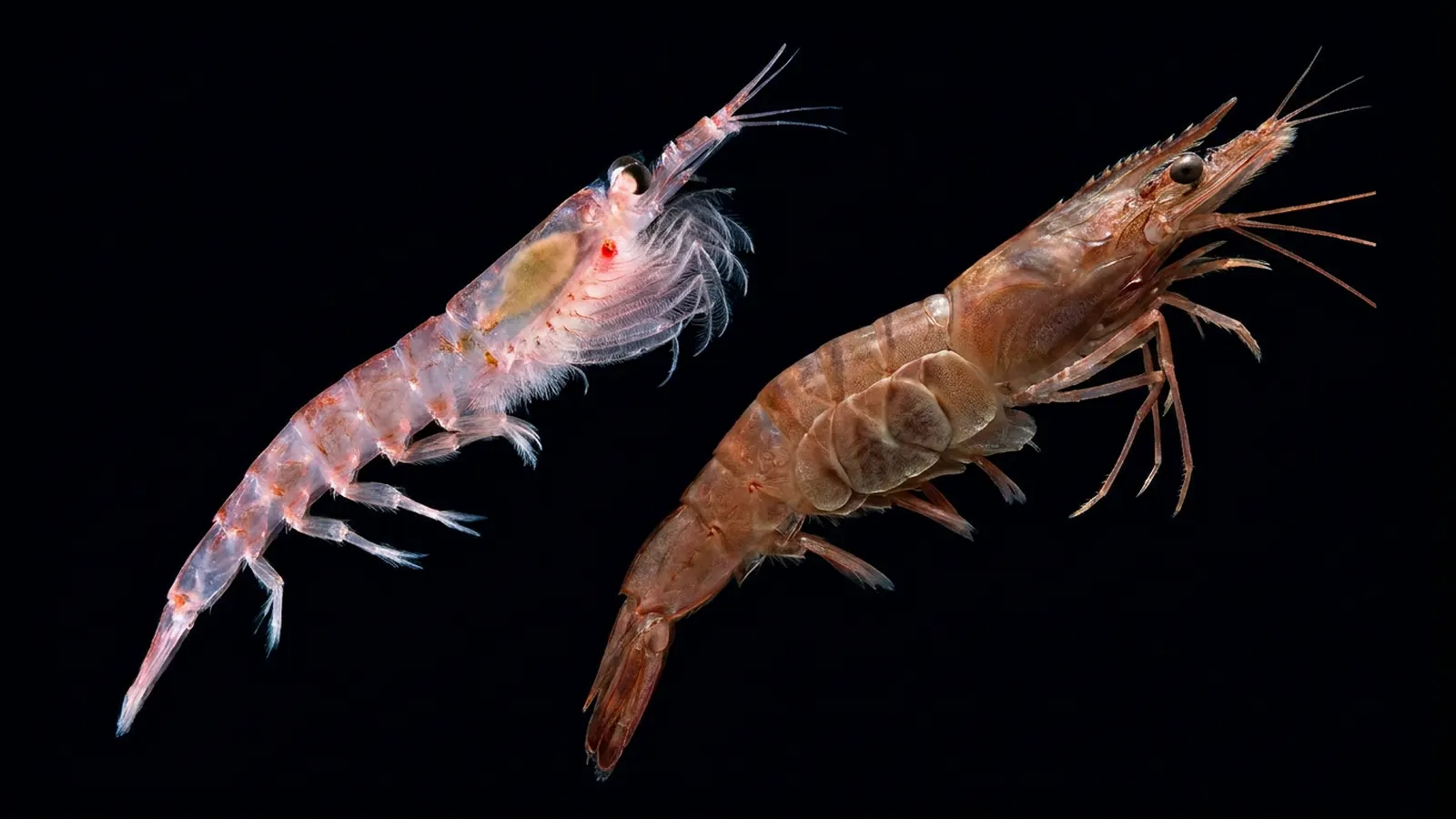
How to tell krill from shrimp
The most reliable feature is the gills. In a decapod shrimp, the gills sit in a chamber under the side of the carapace, hidden from view. In krill, the carapace is short at the sides and the feathery gills hang exposed under the body, behind the legs. Under a hand lens, a krill looks like it has fringed tufts along its underside. The name “euphausiid” actually comes from Greek words meaning “truly shining”, a nod to their light organs, but the gills are what taxonomists check first.
The legs are the next clue. A shrimp has three pairs of mouthparts on the thorax (maxillipeds) plus five pairs of walking legs, and the front one to three pairs usually carry small pincers. Krill have thoracic legs that are much more alike, fringed with fine bristles that form a feeding basket to strain food out of the water. They have no claws. Finally, krill eyes are large, black and very prominent, and many species have a slimmer, more uniform body shape than a typical shrimp.
The glow: krill light organs
Almost all krill species carry light-producing organs called photophores: a pair on the eyestalks, pairs on the thorax and a row along the underside of the abdomen. These organs can produce a blue-green glow. The leading idea is that krill use this light for counter-illumination, matching the faint light coming down from the surface so that predators looking up from below cannot see their silhouette. It may also help swarms keep together or signal to mates. Most shrimp you will meet in shallow water do not glow, though a number of deep-sea shrimp produce light or squirt glowing fluid at predators. See our bioluminescence guide for how marine animals make light.
How they live: swarming drifters vs bottom dwellers
Krill are plankton. They swim constantly, but they cannot hold position against ocean currents, and they live in the open water column, often in dense swarms. Many species migrate vertically each day, rising to feed near the surface at night and sinking to deeper, darker water by day. They feed mostly by filtering phytoplankton, especially diatoms, though many species also take small zooplankton and some scrape algae from the underside of sea ice. Antarctic krill are the best-known species and live for several years, reaching about 6 centimetres.
Most shrimp, by contrast, live on or near the bottom: on mud, sand, rock, reef, seagrass and the roots of mangroves. Many are scavengers or omnivores that pick through sediment, and some, such as cleaner shrimp, have specialised relationships with fish. There are open-water and deep-sea shrimp too, but the typical shrimp is a crawler and occasional swimmer, not a drifter. Shrimp also live in fresh water and brackish estuaries, where krill never do.
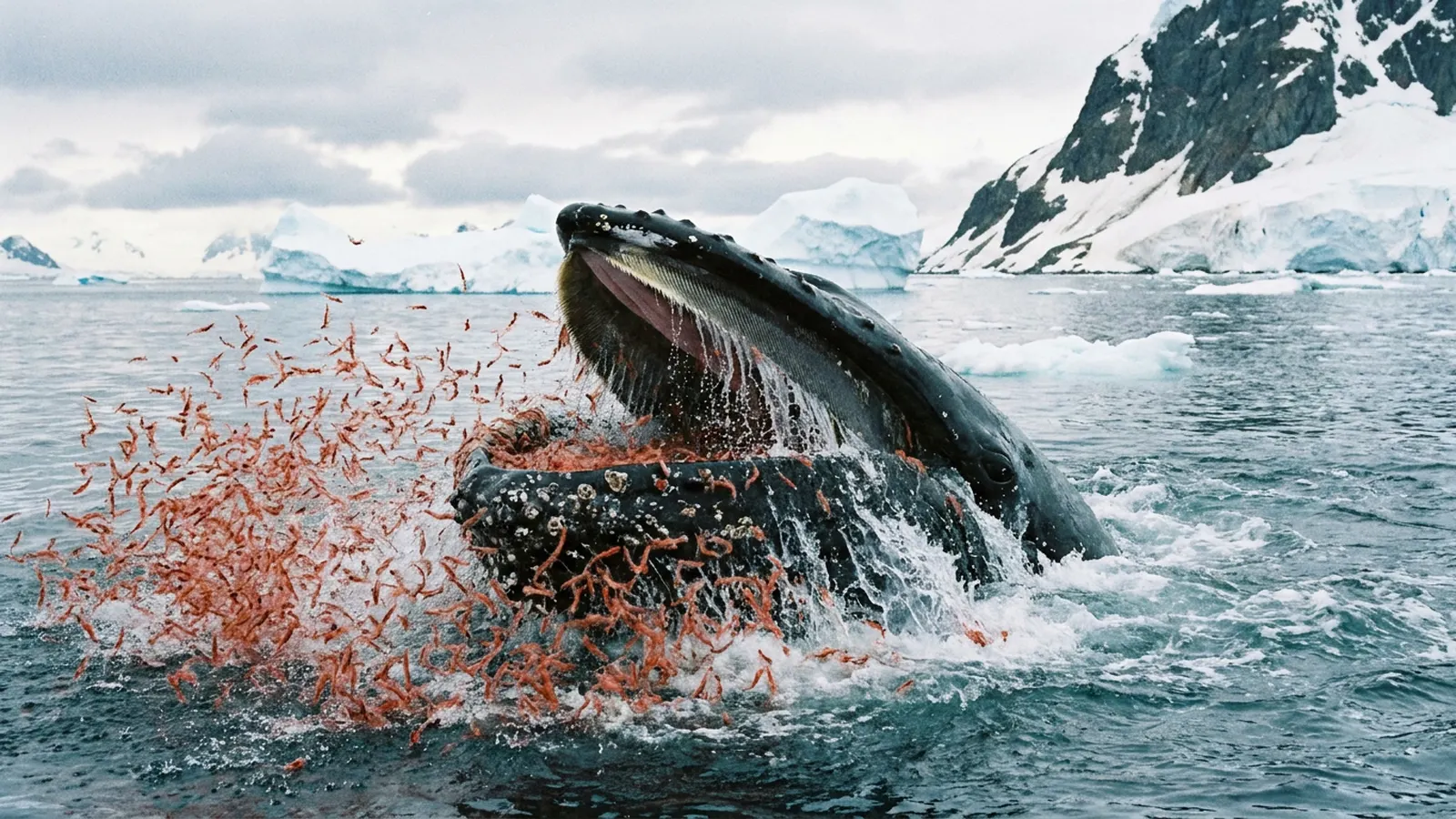
Why the difference matters for whales and fisheries
Krill are a keystone food in cold seas. In the Southern Ocean, Antarctic krill support penguins, seals, seabirds, fish, squid and the great baleen whales; the total biomass of this single species is estimated in the hundreds of millions of tonnes, which makes it one of the most abundant animals on the planet. Blue, fin and humpback whales feed on krill swarms, gulping enormous mouthfuls; see crustaceans eaten by whales and what lives in the Southern Ocean.
Because so much depends on krill, the Antarctic krill fishery is managed by an international body, the Commission for the Conservation of Antarctic Marine Living Resources (CCAMLR), with catch limits meant to leave enough for predators. Most of the catch goes into fishmeal for aquaculture, krill oil supplements and pet and aquarium foods rather than plates of krill. Shrimp fisheries and shrimp farming, by contrast, are mostly about human food, and their main environmental issues are bycatch in trawls and the loss of mangroves to coastal shrimp ponds.
Can you eat krill like shrimp?
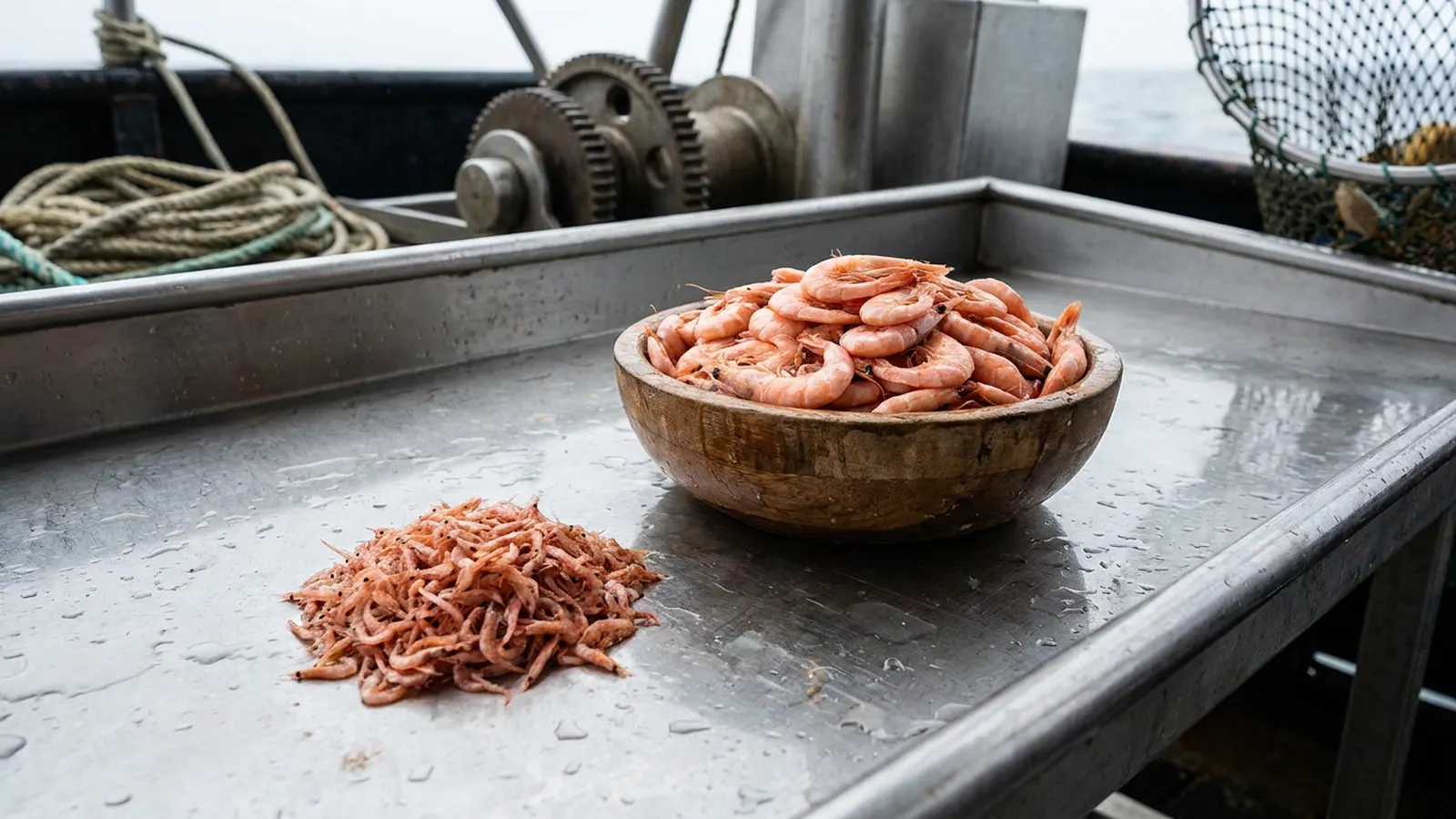
People do eat krill. Small krill are used in fermented pastes and dried products in parts of Asia, and peeled krill meat has been sold in some markets. But krill are not a straightforward substitute for shrimp. They are small, so peeling them is impractical, and they spoil fast because powerful digestive enzymes start breaking down the body soon after capture. Antarctic krill also concentrate fluoride in their shells, so products have to be processed quickly to keep fluoride levels down in the meat. That is a big part of why krill end up as meal and oil rather than as a shrimp-cocktail alternative.
If you have a shellfish allergy, treat krill as shellfish. Krill and shrimp share the muscle protein tropomyosin, the main allergen in crustacean allergies, and krill oil supplements typically carry a shellfish warning. Anyone with a known shellfish allergy should check with a doctor before taking krill oil.
Other look-alikes: mysids, amphipods and brine shrimp
Krill are not the only small crustaceans that get lumped in with shrimp. Mysids, often sold as “mysis shrimp”, are a separate order (Mysida) and are easy to separate from krill: female mysids carry their eggs in a brood pouch under the thorax, which is why they are nicknamed opossum shrimp, and they have a small balance organ (a statocyst) visible as a bubble in each of the inner tail fans. Krill have no brood pouch; most species simply release their eggs into the water. Amphipods, another common plankton and aquarium crustacean, are flattened from side to side and lack a carapace altogether. Brine shrimp (Artemia) are not even malacostracans; they are branchiopods that live in salt lakes and swim upside down, beating leaf-like legs. All of these are sometimes called “shrimp”, and all of them are different animals from both krill and true decapod shrimp. If you want a quick rule, check the gills, the legs and the eggs: exposed gills and no pouch means krill.
My take as a reef keeper
In the reef hobby, where I have kept tanks since 1996, krill and shrimp show up in a different way: as food and as livestock. Frozen krill, usually Pacific krill, and frozen mysis (which are not true shrimp either) are standard feeds for fish and larger-polyp corals, while true decapod shrimp, such as cleaner, peppermint and fire shrimp, are kept as tank inhabitants. I think it is useful to understand the difference. Krill are a rich, oily open-ocean food, which is part of why fish take them so readily, but a big, whole krill is too large for many smaller fish and corals, so size and portion matter. The decapod shrimp in the tank, meanwhile, are crawling scavengers and cleaners with completely different needs.
So when someone asks me whether krill are just tiny shrimp, my answer is no: they are a separate branch of the crustacean tree that happens to look similar, and they play a far bigger role in the ocean than their size suggests. Our pages on planktonic crustaceans and crustaceans show where both groups fit.
Are krill shrimp?
No. Krill are in the order Euphausiacea; true shrimp are decapods. They are related crustaceans but separate groups.
What is the main difference between krill and shrimp?
Krill have exposed feathery gills, no claws and light organs; shrimp have hidden gills, ten walking and feeding legs and often small claws.
Are krill bigger than shrimp?
Usually smaller. Most krill are 1–6 cm, while many food shrimp are 5–20 cm or more.
Do krill glow?
Yes. Almost all krill species have photophores that produce a blue-green light.
Is krill oil safe with a shellfish allergy?
It is generally advised against. Krill share the allergen tropomyosin with shrimp; ask a doctor first.
Do whales eat shrimp or krill?
Mostly krill. Baleen whales filter krill swarms, along with copepods and small fish.
- NOAA Fisheries: Antarctic krill.
- Australian Antarctic Division: Krill biology and ecology.
- CCAMLR (Commission for the Conservation of Antarctic Marine Living Resources): Krill fisheries.
- Everson, I. (ed.) (2000). Krill: Biology, Ecology and Fisheries. Blackwell Science.
- World Register of Marine Species (WoRMS): Euphausiacea.
Blane Perun has been exploring Earth’s oceans and marine life for over 25 years. Founder of TheSea.Org in 1999, underwater photographer, coral aquaculture pioneer, and explorer of 80+ countries.
About Blane Perun → More on plankton →