Phytoplankton Blooms — What Causes Them and Why They Matter
A phytoplankton bloom is a rapid increase in microscopic algae or cyanobacteria in the water, often enough to change its colour. Blooms happen when nutrients, sunlight and calm, stable water line up, letting cells divide faster than they are eaten. Most blooms are natural and feed the whole food web; some produce toxins or, when they die and decay, strip oxygen from the water.
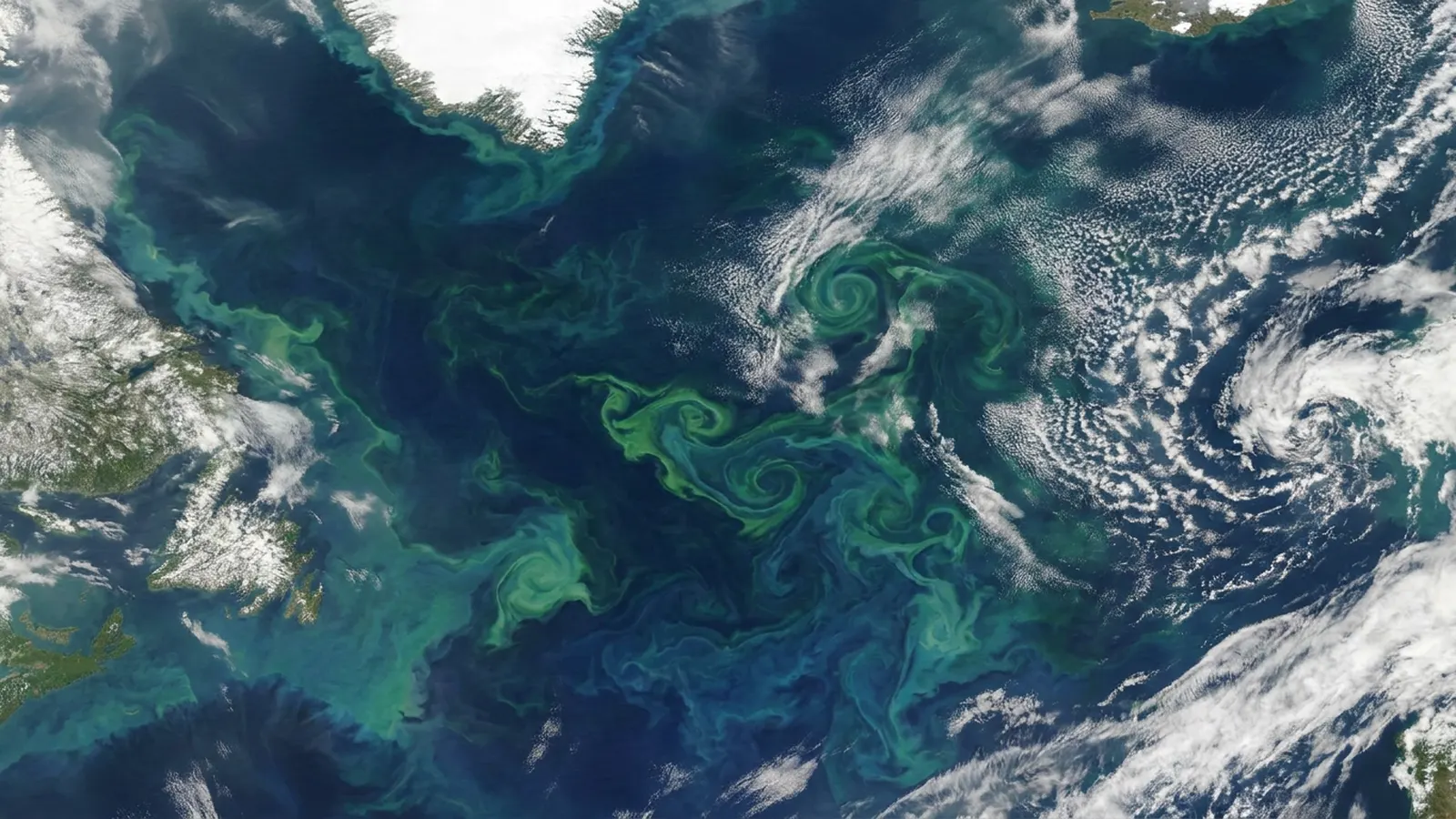
From space, the ocean is not one shade of blue. Satellite images show swirls of green, turquoise and brown spreading across thousands of kilometres each spring, following currents, eddies and coastlines. Those swirls are phytoplankton blooms, and they are among the largest biological events on Earth. They feed krill, fish, seabirds and whales, pull carbon dioxide out of the atmosphere and help set the rhythm of life in the sea. They can also close beaches, kill fish and leave behind dead zones. Here is how they start, what keeps them going, how they end, and when they become a problem.
What causes a phytoplankton bloom?
A bloom needs three things at once: enough nutrients, enough light, and water that holds the cells near the surface long enough to use both. When all three line up, a population that divides about once a day can multiply many times over in a week or two.
Phytoplankton are single cells, so their growth is a simple numbers game. Each cell takes in nitrogen and phosphorus (plus silica for diatoms and trace iron for almost everyone), uses sunlight to build new material, and splits in two. Under good conditions that can happen roughly daily. Normally the population is held in check by limited nutrients, poor light or grazing by zooplankton. A bloom is what happens when one of those brakes is suddenly released.
Nutrients usually arrive from below or from land. Winter storms mix deep, nutrient-rich water up to the surface. Coastal upwelling, where winds push surface water offshore and colder water rises to replace it, does the same along California, Peru and West Africa. Rivers carry fertiliser and sewage nutrients into estuaries and coastal seas. Dust blowing off deserts can deliver iron to the open ocean.
Light is the limiting factor in winter at high latitudes and below the top few tens of metres everywhere. Stability is the third piece. If wind and waves keep mixing cells down into the dark, they cannot grow fast enough to outpace losses. When the surface warms and a lighter layer forms on top, the cells stay in the sunlit zone and the bloom takes off.
The spring bloom
The most famous example is the spring bloom of the North Atlantic, the North Pacific and polar seas. Over winter, storms mix the water deeply, refilling the surface with nutrients, but days are short and cells get carried down into darkness. In spring, as days lengthen and the surface warms, the water stratifies. Suddenly the phytoplankton have light, nutrients and a stable surface layer all at once, and the bloom erupts, typically led by diatoms. In 1953 the Norwegian oceanographer Harald Sverdrup described this with his “critical depth” idea, and scientists have been refining and debating the details ever since.
The spring bloom is the engine of cold-water ecosystems. Copepods and krill time their reproduction to it, fish larvae hatch into it, and the seabirds and whales that feed on those animals arrive to follow it. In the Southern Ocean, blooms around islands and along the retreating sea-ice edge feed the krill that feed the great whales; see krill and what eats plankton.
| Bloom type | Typical organisms | Where and when | Effect |
|---|---|---|---|
| Spring bloom | Diatoms | Temperate and polar seas, spring | Feeds the food web; sinks carbon |
| Upwelling bloom | Diatoms, dinoflagellates | California, Peru, West Africa | Supports major fisheries |
| Coccolithophore bloom | Emiliania huxleyi | North Atlantic, Bering Sea, summer | Milky turquoise water visible from space |
| Red tide | Karenia brevis | Florida Gulf coast, often late summer to winter | Fish kills, respiratory irritation |
| Domoic acid bloom | Pseudo-nitzschia | US West Coast | Shellfish and crab closures, sea lion poisoning |
| Cyanobacteria bloom | Trichodesmium, Microcystis | Warm seas; lakes and estuaries | Nitrogen input or toxins |
| Sea sparkle | Noctiluca scintillans | Coastal Asia, Australia, Arabian Sea | Glowing waves; ammonia; low oxygen |
How a bloom ends
Blooms are self-limiting. The faster cells grow, the faster they use up the nutrients that fed them, and within a few weeks the surface layer is stripped. Grazers catch up: copepod populations explode and can eat a large share of the bloom. Viruses that infect specific phytoplankton spread quickly through dense populations; coccolithophore blooms are known to collapse when viral infections sweep through. Diatoms, heavy with silica, clump together and sink.
That sinking is important. Dead cells, faecal pellets and clumps known as marine snow carry carbon from the surface into the deep sea, where some of it stays for centuries. This “biological pump” is one of the ways the ocean takes carbon dioxide out of the atmosphere, and spring blooms drive a big share of it.
Scientists have tried to exploit that pump by fertilising patches of iron-poor ocean with dissolved iron. Experiments in the Southern Ocean and the equatorial Pacific since the 1990s did trigger blooms, proving that iron limits growth there, but how much of the extra carbon actually sank and stayed down was much less clear, and large-scale ocean fertilisation remains controversial. Nature runs its own version: volcanic ash, desert dust and iron washing off subantarctic islands all spark blooms downstream that show up clearly in satellite images.
When blooms turn harmful
Only a small fraction of phytoplankton species produce toxins, but when one of them blooms the effects can be serious. Scientists call these harmful algal blooms, or HABs.
Along Florida’s Gulf coast, the dinoflagellate Karenia brevis causes the red tide. It produces brevetoxins that kill fish, sea turtles, manatees and dolphins, and when waves break the cells, the toxins become airborne and irritate the throats and lungs of people on the beach. The Florida Fish and Wildlife Conservation Commission samples the coast and publishes cell counts; see our red tide guide. On the US West Coast, the diatom Pseudo-nitzschia produces domoic acid, which builds up in shellfish, crabs and anchovies and poisons sea lions and seabirds. A huge bloom in 2015 shut down Dungeness crab fishing along much of the coast. Other dinoflagellates cause paralytic shellfish poisoning and ciguatera, and some cyanobacteria release liver toxins in lakes and estuaries.
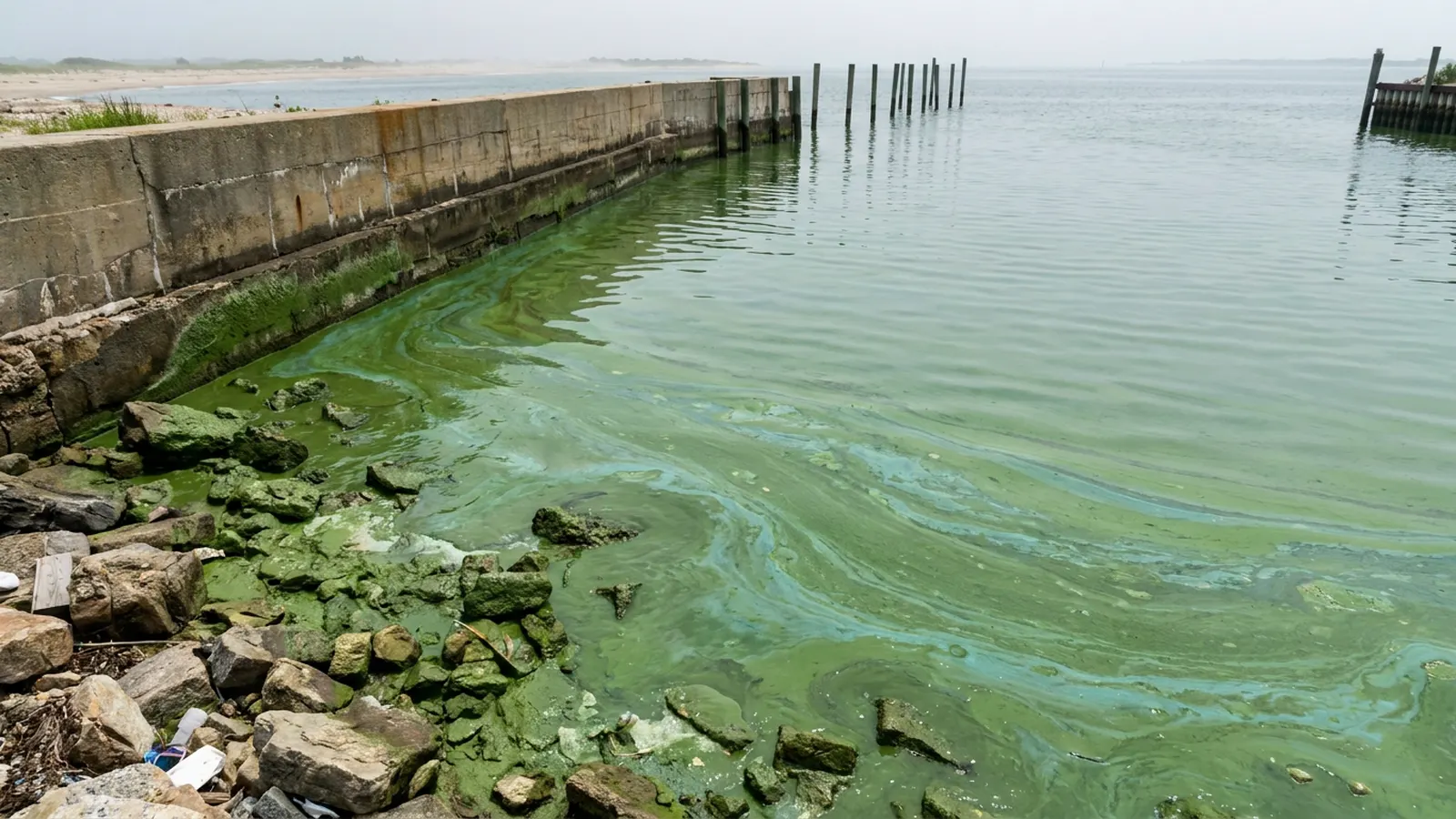
A bloom does not have to be toxic to cause harm. When a large bloom dies, bacteria decompose the cells and use up dissolved oxygen as they do. In places where the water is stratified and does not mix, that can create a hypoxic “dead zone” where fish and crabs either leave or die. The best-known example in the United States is the summer dead zone in the northern Gulf of Mexico, fed by nutrients carried down the Mississippi River and measured each summer by NOAA-funded scientists.
Why blooms seem to be getting worse
Harmful blooms appear to be more frequent and widespread in many coastal areas than a few decades ago, though better monitoring also explains part of the increase. The main drivers are well understood. Fertiliser runoff, sewage and animal waste add nitrogen and phosphorus to rivers and coasts. Warmer water favours some harmful species, especially dinoflagellates and cyanobacteria, and strengthens the stratification that lets blooms grow and dead zones form. Ships’ ballast water has carried some species to new coasts. Reducing nutrient loads is the lever that has worked best where it has been tried, such as in parts of Chesapeake Bay and the Baltic.
Blooms you can see, and some that glow
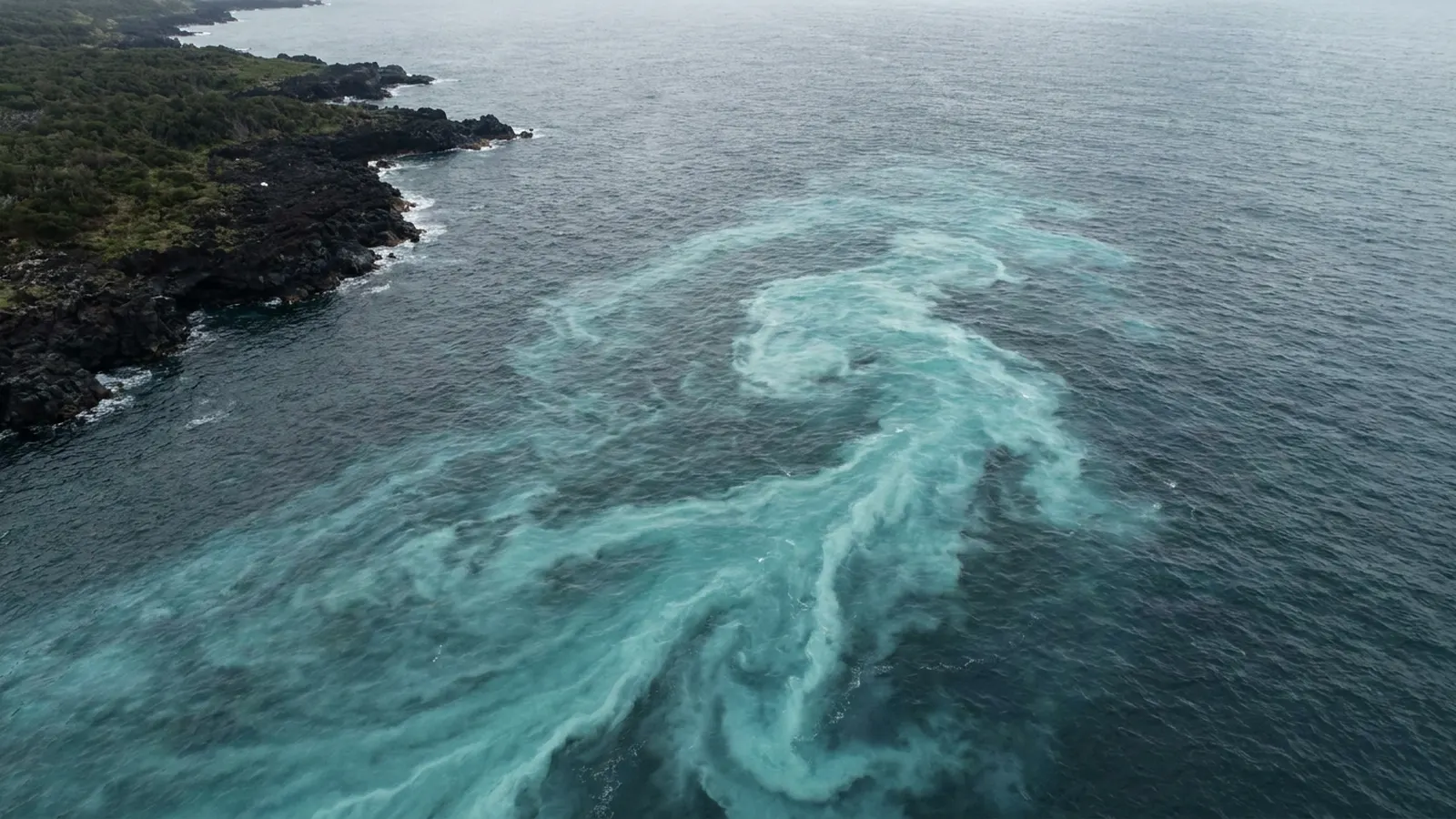
Some blooms put on a show. Coccolithophore blooms turn the sea a milky turquoise that is spectacular from the air and easy to spot in satellite photos. Dense dinoflagellate blooms can turn water rust-red or brown in daylight, and at night some of the same dinoflagellates light up blue-green whenever a wave breaks or a paddle moves through them. The glowing surf of southern California and the “blue tears” of Asian beaches are bloom events; see bioluminescent plankton, sea sparkle and bioluminescent beaches.
My take, from the reef-tank side
I have kept reef systems since 1996, and a reef tank is a small, closed version of the same story. Add light and nutrients to still water, and something will grow. When I built the lighting over my multi-tier reef system, I chose lower-wattage metal halides over the shallow lagoon section precisely because more intense light in shallow water would have fed nuisance algae. Later, when I did increase intensity, I had to manage temperature and other parameters to keep the algae in check. That is the same balance of light, nutrients and control that decides whether a coastal bay stays clear or turns green.
The lesson I take from both is that a bloom is rarely the root problem; it is a symptom of what is coming into the water. In a tank, that might be overfeeding or poor export. On a coast, it is usually what flows down the rivers. If I were planning a beach trip on a coast known for harmful blooms, I would check the state monitoring maps before going, and I would treat dead fish on the sand or a scratchy throat at the water’s edge as a sign to move on. Most blooms, though, are not something to fear. They are the ocean’s seasonal harvest, and almost everything else in the sea depends on them.
What causes phytoplankton blooms?
A combination of high nutrients, plenty of light and stable surface water that keeps cells in the sunlit layer, often triggered by spring warming, upwelling or runoff.
Are phytoplankton blooms good or bad?
Most are natural and vital, feeding the food web. A minority produce toxins or cause oxygen loss when they decay.
How long does a phytoplankton bloom last?
Typically days to a few weeks, until nutrients are used up or grazers and viruses catch up. Some harmful blooms persist for months.
Can you see phytoplankton blooms from space?
Yes. Satellites measure chlorophyll and ocean colour, and large blooms show up as green or turquoise swirls.
What is the difference between an algal bloom and red tide?
Red tide is one kind of algal bloom, in Florida usually caused by the toxic dinoflagellate Karenia brevis.
How do blooms cause dead zones?
When a large bloom dies, bacteria decomposing it use up dissolved oxygen, leaving low-oxygen water that animals cannot survive in.
- NOAA National Ocean Service: What is a harmful algal bloom? and Gulf of Mexico hypoxia forecasts.
- NASA Earth Observatory: phytoplankton and ocean colour imagery.
- Sverdrup, H.U. (1953). On conditions for the vernal blooming of phytoplankton. Journal du Conseil 18: 287–295.
- Florida Fish and Wildlife Conservation Commission: red tide status reports.
- McCabe, R.M. et al. (2016). An unprecedented coastwide toxic algal bloom linked to anomalous ocean conditions. Geophysical Research Letters 43.
Blane Perun has been exploring Earth’s oceans and marine life for over 25 years. Founder of TheSea.Org in 1999, underwater photographer, coral aquaculture pioneer, and explorer of 80+ countries.
About Blane Perun → More on bioluminescence & plankton →