Bioluminescent Bacteria — Vibrio, Light Organs and Milky Seas
Bioluminescent bacteria are microbes that produce their own light using the enzyme bacterial luciferase. Most are marine, in genera such as Vibrio, Aliivibrio and Photobacterium. Unlike flashing plankton, they glow continuously in blue-green light, but only when enough cells are crowded together, a behaviour called quorum sensing. They light the organs of squid and fish and may cause milky seas.
When people think of ocean light, they usually picture glowing waves or a deep-sea anglerfish. Behind a surprising amount of that light are bacteria. Luminous bacteria live free in seawater, on decaying fish and in the guts of marine animals, and some have formed partnerships with squid and fish that are among the best-studied symbioses in biology. They also gave science one of its most important discoveries about how bacteria talk to each other. This page covers what bioluminescent bacteria are, how they make light, which animals use them, and how they may be behind one of the strangest sights at sea. For the wider picture of ocean light, see our bioluminescence guide.
Which bacteria glow?
Almost all known luminous bacteria are marine, and most belong to a handful of related groups in the family Vibrionaceae.
The best known is Aliivibrio fischeri, long called Vibrio fischeri, which lives in the light organs of bobtail squid and some fish. Vibrio harveyi and its relatives live free in warm seawater, on the surfaces of marine animals and in their guts, and some strains cause disease in farmed shrimp and fish. Photobacterium phosphoreum and Photobacterium leiognathi are common in cooler water and in the light organs of fish such as ponyfish. A few luminous bacteria live in other habitats: Photorhabdus lives on land inside insect-killing nematode worms, and it is the only well-known luminous bacterium that is not from the sea.
Luminous bacteria are common in seawater but usually too dilute to see. They become visible when they gather at high density: inside a light organ, on a decomposing fish, in a lab culture, or in the vast surface blooms thought to cause milky seas.
| Bacterium | Where it lives | Known for |
|---|---|---|
| Aliivibrio fischeri | Bobtail squid and fish light organs, seawater | Discovery of quorum sensing |
| Vibrio harveyi | Seawater, animal surfaces and guts | Suspected cause of milky seas; aquaculture disease |
| Photobacterium phosphoreum | Cool seas, fish guts and light organs | Glow on spoiling fish |
| Photobacterium leiognathi | Ponyfish and other fish light organs | Counter-illumination in fish |
| Photorhabdus luminescens | Nematode worms in soil | The only well-known land glow bacterium |
How bacteria make light
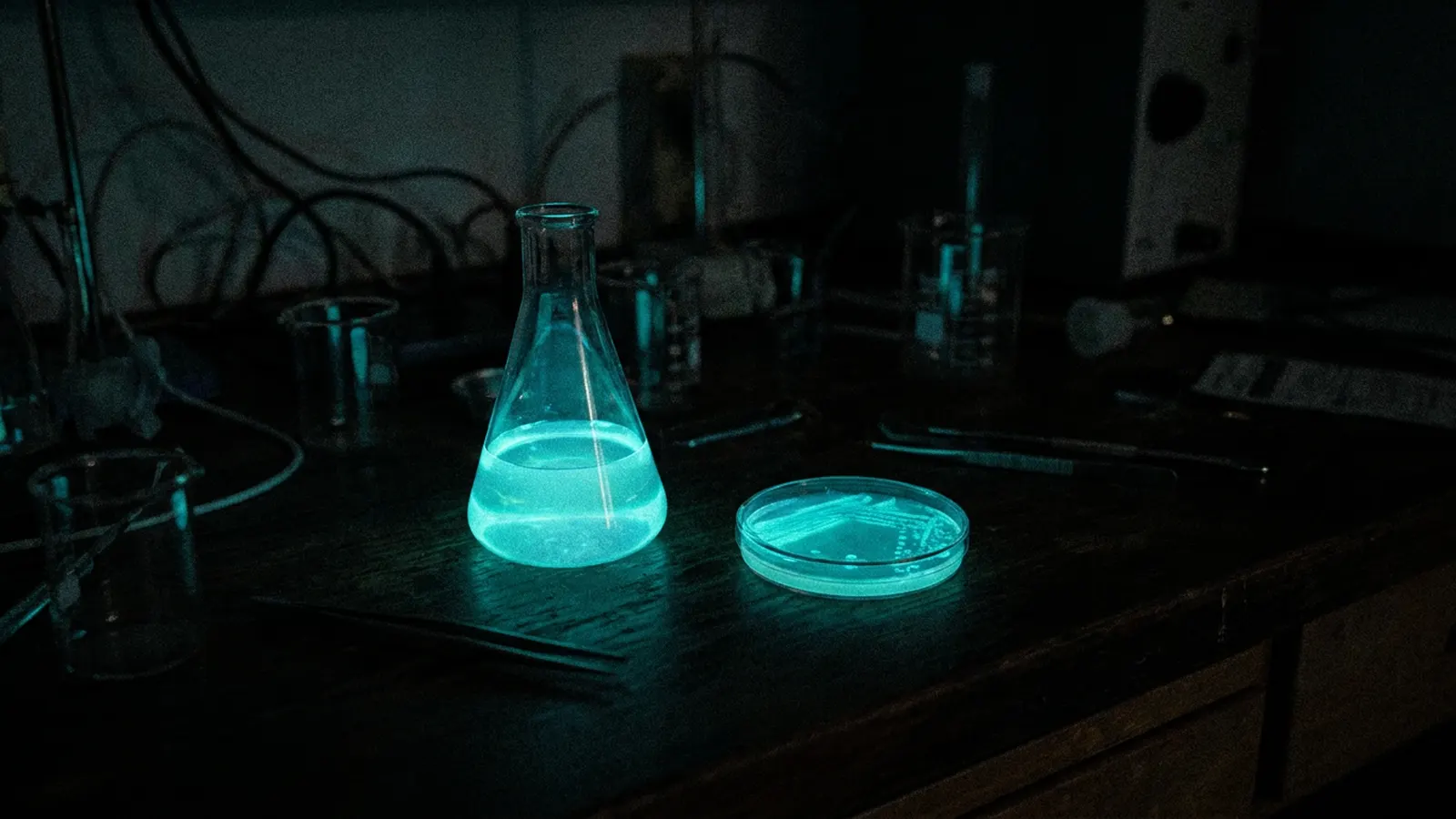
All bioluminescence involves a chemical reaction in which an enzyme, luciferase, oxidises a light-emitting molecule and releases energy as light. In bacteria, the reaction uses reduced flavin mononucleotide (a form of vitamin B2), a long-chain fatty aldehyde and oxygen. The genes for the enzyme and for making the aldehyde are clustered together in a set called the lux operon, usually written luxCDABE. Because the whole kit is encoded in a few genes, the lux genes can be moved into other bacteria to make them glow, which has made them a favourite tool in laboratories.
The light is a steady blue-green glow, peaking around 490 nanometres, which is close to the wavelength that travels furthest through seawater. That steady glow is the most obvious difference from dinoflagellates, which produce brief, bright flashes only when they are disturbed; see bioluminescent plankton. Making light is costly for a cell, using a meaningful share of its energy, so bacteria only switch it on when it pays off.
Quorum sensing: bacteria that count
In the 1970s, researchers including Kenneth Nealson and J. Woodland Hastings noticed something odd about cultures of luminous marine bacteria. A thin culture did not glow at all. As the cells multiplied, nothing much happened, until they reached a certain density, and then the whole culture lit up at once. The bacteria were releasing a small signalling molecule, which they called an autoinducer, into the water. When enough cells were present, the autoinducer reached a threshold concentration and switched on the lux genes in every cell.
That mechanism, later named quorum sensing, turned out to be widespread. Many bacteria, including disease-causing species, use similar signals to decide when to act as a group, for example when to release toxins or form biofilms. Work by Bonnie Bassler and others on Vibrio harveyi showed that bacteria can use several different signals, including some that work across species. What started with glowing squid symbionts is now a major field in medicine and microbiology. For a single bacterium, glowing alone would be a waste of energy; glowing as a crowd creates a light big enough to matter.
The bobtail squid and its glowing partners
The most famous partnership is between the Hawaiian bobtail squid, Euprymna scolopes, and Aliivibrio fischeri. The squid is a small nocturnal hunter that forages over sand flats in shallow water. On moonlit nights, a squid swimming above the bottom would cast a shadow that predators below could see. The bacteria living in its light organ produce a glow that the squid controls with a reflector, a lens-like tissue and an ink sac shutter, matching the moonlight from above so the shadow disappears. This trick is called counter-illumination.
Remarkably, a newly hatched squid has no bacteria. It picks up A. fischeri from the surrounding seawater within hours, selecting it from among millions of other microbes. Each morning, the squid vents most of the bacteria into the sea, and the remainder regrow to full density by the next night, which also seeds the water with more symbionts for the next generation of squid. Margaret McFall-Ngai, Edward Ruby and colleagues have spent decades studying this relationship as a model for how animals and their microbes cooperate. Our bobtail squid page covers the animal side.
Fish that borrow bacterial light
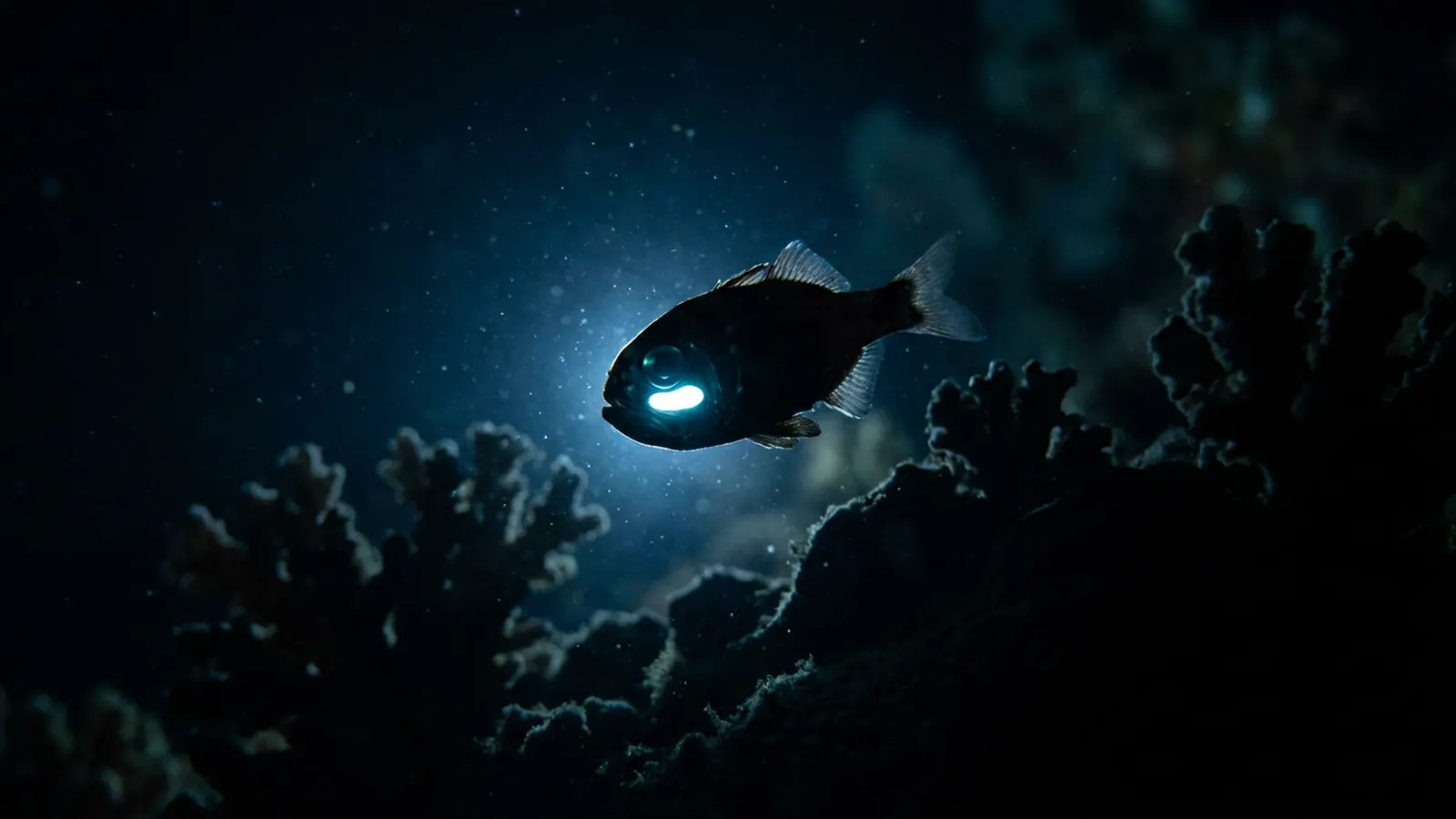
Several groups of fish have also recruited bacteria to light their organs. Ponyfish, small silvery fish common in the Indo-Pacific, house Photobacterium in a light organ around the throat and use it to counter-illuminate. Flashlight fish and lanterneye fish carry bright pouches of bacteria under each eye. They live on reefs and come up into shallow water on dark nights, using the light to find food, signal to one another and confuse predators; they “switch off” by rotating the organ downward or covering it with a lid of skin. Their bacteria appear to be so specialised that they have lost many genes and cannot be grown in a lab.
Many deep-sea anglerfish also use bacteria to light their lures, the glowing tip of the modified fin ray that dangles in front of the mouth. Recent genetic work suggests the anglerfish bacteria are also specialised symbionts with reduced genomes. See our deep-sea anglerfish page for how the lure works. By contrast, many other glowing animals, such as lanternfish, dragonfish, jellyfish, krill and most squid, make their light chemically themselves without bacteria.
Milky seas: bacteria on a giant scale
For centuries sailors reported nights when the whole sea glowed a steady, milky white from horizon to horizon, unlike the sparkling flashes of plankton in a bow wave. These milky seas are most often reported in the northwest Indian Ocean and around Indonesia. In 1985 a research ship sailing through one in the Arabian Sea collected water samples and found a bloom of luminous bacteria associated with the microalga Phaeocystis, and in 2005 Steven Miller and colleagues identified a milky sea off Somalia in satellite images, a glowing patch roughly the size of Connecticut. The leading explanation is a huge bacterial bloom, probably related to Vibrio harveyi, growing on organic material from an algal bloom. The bacteria would glow continuously once their quorum was reached, lighting the surface for nights at a time. Our milky seas page covers these sightings and the satellite detections.
Glowing fish, glowing wounds and lab uses
Luminous bacteria have been noticed on land for a long time too. Fish and meat left in cool storage sometimes glow faintly as luminous bacteria grow on the surface, an observation recorded by naturalists centuries ago. After the Battle of Shiloh in 1862, soldiers reported that some wounds glowed in the dark and that those soldiers seemed to heal better; in 2001 two students suggested Photorhabdus, which produces antibiotics and could have suppressed other infections in chilled, wet wounds. It is a nice story, though impossible to prove.
Today luminous bacteria and their genes are tools. Water-toxicity tests such as Microtox use cultures of Aliivibrio fischeri: if a sample dims their glow, it contains something harmful. Researchers fuse lux genes to other genes so that bacteria light up when a gene switches on, and use glowing bacteria to track infections inside living animals without having to cut them open.
My take: the hidden glow in every bucket of seawater
What I find most interesting about luminous bacteria, as someone who has spent years since 1996 thinking about the microbes in reef tanks, is how invisible they usually are. Every reef tank and every bucket of seawater carries a huge, unseen population of bacteria doing chemistry: breaking down waste, cycling nitrogen and, in some cases, quietly carrying the genes to make light. The bobtail squid shows how precise an animal can be about choosing the right microbe from that crowd. If I were trying to show someone that bacteria are not just germs, this is the example I would use: a squid that hires a glowing bacterium to make itself invisible, and gets a fresh crew every evening.
If you want to see bacterial light rather than plankton flashes, the places to look are public aquariums with bobtail squid or flashlight fish exhibits, and night dives on reefs where flashlight fish are known to rise into shallow water on dark, moonless nights.
Glowing bacteria are also the likely explanation for the “Angel’s Glow” wounds reported after the Battle of Shiloh; see are humans bioluminescent?

What bacteria are bioluminescent?
Mainly marine bacteria in Vibrio, Aliivibrio and Photobacterium, plus the land bacterium Photorhabdus.
How do bacteria produce light?
The enzyme bacterial luciferase oxidises reduced flavin and a fatty aldehyde, releasing blue-green light.
Why do bacteria only glow in large numbers?
Quorum sensing: they release a signal molecule and switch on their light genes only when its concentration is high.
Do bioluminescent bacteria cause milky seas?
That is the leading explanation; samples from one milky sea found a bloom of luminous bacteria.
Which animals use glowing bacteria?
Bobtail squid, ponyfish, flashlight fish and many deep-sea anglerfish.
Are bioluminescent bacteria harmful?
Most are harmless, but some Vibrio strains cause disease in farmed fish and shrimp.
- Nealson, K.H. & Hastings, J.W. (1979). Bacterial bioluminescence: its control and ecological significance. Microbiological Reviews 43(4): 496–518.
- Miller, S.D. et al. (2005). Detection of a bioluminescent milky sea from space. PNAS 102(40): 14181–14184.
- Nyholm, S.V. & McFall-Ngai, M.J. (2004). The winnowing: establishing the squid–vibrio symbiosis. Nature Reviews Microbiology 2: 632–642.
- Waters, C.M. & Bassler, B.L. (2005). Quorum sensing: cell-to-cell communication in bacteria. Annual Review of Cell and Developmental Biology 21: 319–346.
- MBARI: Bioluminescence research.
Blane Perun has been exploring Earth’s oceans and marine life for over 25 years. Founder of TheSea.Org in 1999, underwater photographer, coral aquaculture pioneer, and explorer of 80+ countries.
About Blane Perun → More on bioluminescence →