Gelatinous & Bioluminescent — The Drifters That Make Their Own Light
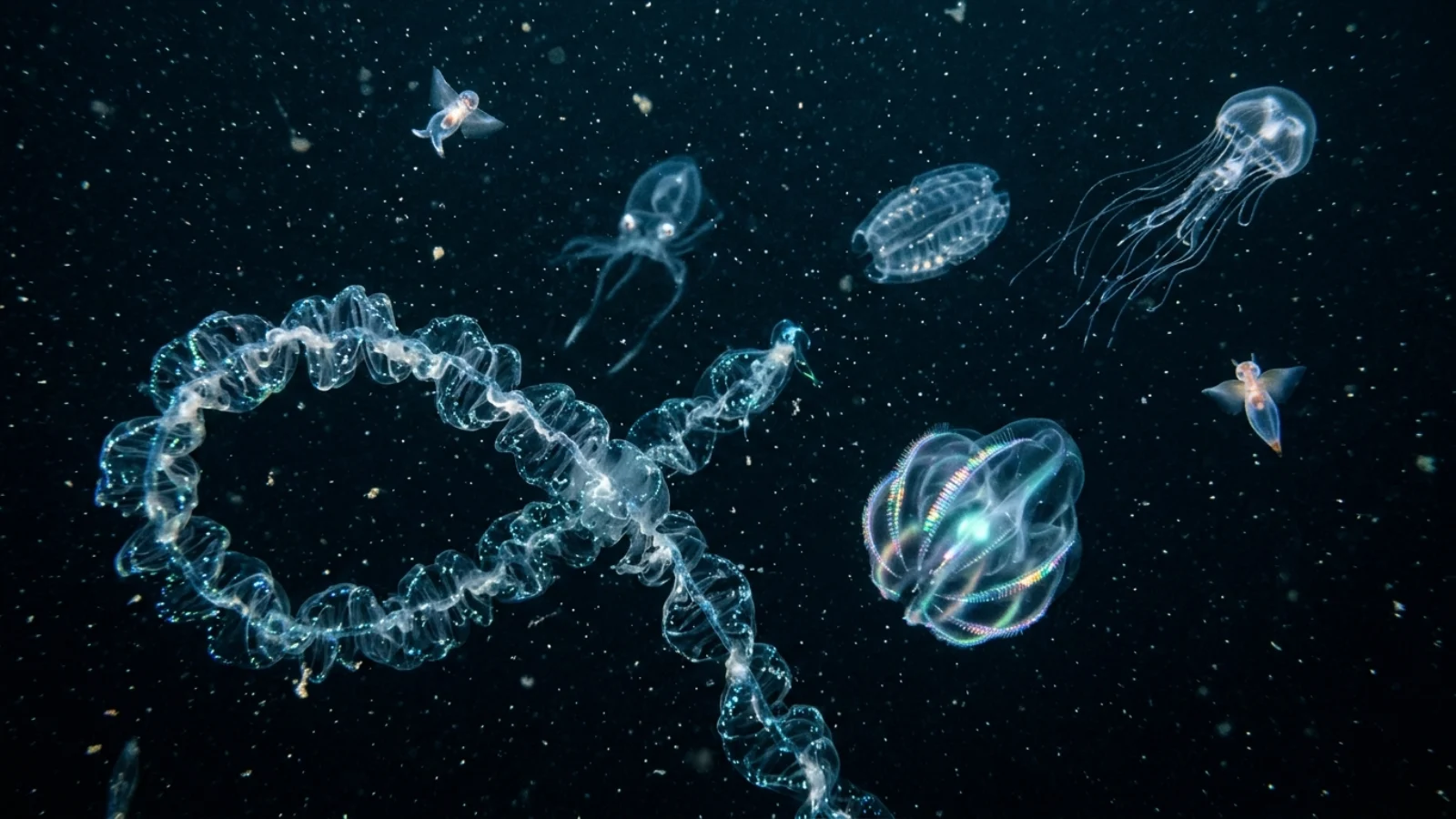
Gelatinous and bioluminescent sea creatures are the soft-bodied, often glowing animals of the open ocean and deep sea — jellyfish, comb jellies, siphonophores, salps, pteropods, transparent cephalopods, and the deep-sea nudibranchs. Most are more than 95% water by mass. Most produce their own light. They collectively form one of the largest animal biomasses on Earth, and yet they remain the least understood group in marine biology — because they fall apart in trawl nets, decompose within hours of capture, and can only be studied properly in situ by submersibles and remotely operated vehicles.
If you want to see the animals that built the open ocean ecosystem, look at the gelatinous and bioluminescent groups. They are the invisible majority — the soft-bodied drifters that make up most of the biomass in the middle of the water column, and the glowing flashes that make the deep sea look like the night sky in motion. Fifteen of them are profiled here: jellyfish with tentacles longer than a blue whale, octopuses found nearly seven kilometres down, a squid that is the only living member of its entire order, and a deep nudibranch with a hood that snaps shut in four seconds. Each one represents a different solution to drifting, glowing, and surviving in water.
Bioluminescence — why almost everything down there glows
An estimated 76 percent of all animals living in the mesopelagic zone produce their own light. Bioluminescence is the rule in the deep ocean, not the exception — and it serves several distinct biological functions.
Counter-illumination is the most common: animals produce a faint glow on their undersides that matches the dim light filtering down from above, eliminating the silhouette that would otherwise reveal them to predators below. Some species use bioluminescent lures to attract prey within striking range — the deep sea anglerfish is the textbook example, but the same trick is used by the giant siphonophore. Defensive flashes startle predators and buy escape time. Some siphonophores release glowing particles as decoys. The benthic comb jelly produces a rolling wave of light along its comb rows when disturbed. The entire mesopelagic zone is, biologically, a living display — one we mostly cannot see because the wavelengths are tuned for deep-water optical conditions, not human eyes.
Why gelatinous bodies dominate the open ocean
Soft, watery, transparent bodies are not a primitive trait. They are an active adaptation to the physics of living suspended in the open ocean column.
A body that is mostly water has the same density as seawater, which means the animal needs to spend almost no energy maintaining buoyancy. Transparent tissue makes the animal nearly invisible to predators without requiring camouflage colouration. A flexible body absorbs the impact of being struck and is forgiving of pressure changes — the same body plan works from the surface to several thousand metres. The trade-off is fragility: gelatinous animals fall apart on contact with hard surfaces, including trawl nets, which is why so much of what we know about jellies, salps, ctenophores, and siphonophores has come only in the last 30 years, with the rise of submersible and ROV imaging. Animals that look like flimsy curiosities in a jar are, in their natural environment, the most successful body plan in the largest habitat on Earth.
Soft bodies, hard problems — how we study them
Almost everything in this group decomposes on contact with a net. The study of gelatinous and bioluminescent animals is the study of in situ observation.
Until the late twentieth century, most of what we knew about jellies came from animals that had washed ashore in a state of collapse. The introduction of crewed submersibles like Alvin in the 1960s, followed by ROVs (remotely operated vehicles) like MBARI’s Tiburon and Ventana from the 1990s onward, completely rewrote the field. Animals that were unknown to science forty years ago are now routinely filmed at full extension in their natural depth and behaviour. The squidworm, discovered in 2007, the bioluminescent octopus, the benthic comb jelly at 7,000 m, the Halitrephes “fireworks” jellyfish — all of these owe their description to a generation of in-situ imaging technology, not to specimen collection. The history of this group is, in a real sense, the history of marine technology.
Are gelatinous and bioluminescent species dangerous to humans?
Most are not. The deep-sea species in this group — vampire squid, dumbo octopus, the deep jellies and ctenophores, the Stygiomedusa — live at depths inaccessible to swimmers and divers, and pose no risk. Surface jellyfish are the exception: lion’s mane, box jellyfish, and several other surface species can deliver painful or in rare cases dangerous stings, but those species are not part of this hub. The bioluminescent octopus, sea angels, nudibranchs, and siphonophores profiled here are either too deep, too small, or too soft to threaten a person. The fragility that defines the group is also what makes it harmless.
Why do so many deep sea animals glow?
Bioluminescence solves several problems at once in an environment with no sunlight. Counter-illumination on the underside cancels the silhouette an animal would cast against the faint downwelling light. Glowing lures attract prey within reach in an environment where prey is rare. Sudden flashes startle predators long enough to escape. Released glowing particles can serve as decoys. Roughly 76 percent of mesopelagic animals produce their own light, making bioluminescence the most common animal trait in the largest habitat on Earth.
What is the longest animal in the ocean?
The giant siphonophore (Praya dubia and related species) is the longest animal on Earth, with confirmed specimens reaching 46 metres — longer than the longest blue whale. It is technically a colonial superorganism: thousands of genetically identical zooids working as one animal, each specialised for a different function. Each individual zooid is small, but the colony stretched out is the longest single animal ever recorded.
How do gelatinous animals survive without bones or shells?
A body that matches the density of seawater needs no support against gravity, because there is no effective gravity for the animal in suspension. The water itself provides the structural support that bones or shells provide in other animals. The trade-off is that gelatinous animals cannot survive on land — or in a trawl net, where the abrasion against the mesh destroys them within minutes.
Why is the vampire squid neither a squid nor an octopus?
It is the only living member of Vampyromorphida, an order that diverged from both squids and octopuses roughly 165 million years ago. It retains ancestral features of both: it has eight arms like octopuses, but also possesses two retractable sensory filaments that are entirely unique. Genetically and morphologically it sits on its own evolutionary branch, with no other living relatives.
Why are deep-sea jellies and siphonophores discovered so recently?
Because they fall apart in nets. Until in-situ observation by submersibles and remotely operated vehicles became routine in the late twentieth century, most gelatinous species could not be studied as living animals. The history of this group as a science is closely tied to the history of marine imaging technology — many species described in the last 20 years would have been unknowable before.
Blane Perun has been exploring Earth’s oceans and marine life for over 25 years. Founder of TheSea.Org in 1999, underwater photographer, coral aquaculture pioneer, and explorer of 80+ countries.
About Blane Perun → More on Bizarre Sea Creatures →