Oceania Coral Reef Maps — Australia, Melanesia, Micronesia and Polynesia
Oceania holds the largest share of the world’s coral reef area. Its reefs fall into three Pacific regions: Melanesia, which holds about three-quarters of the reef mapped here, including Australia’s Great Barrier Reef and the Coral Triangle reefs of Papua New Guinea and the Solomon Islands; Micronesia, a realm of atolls from Palau to Kiribati; and Polynesia, from Hawaii to Tonga and French Polynesia. Australia alone holds nearly half the region’s reef. This hub maps 22 Pacific countries and territories and links to a detailed coral reef map for each.
Oceania is the heart of the coral world. Spread across the vast Pacific, its reefs range from the largest reef system on Earth to tiny atolls hundreds of kilometres from the nearest neighbour. For many Pacific nations, reefs are not just scenery: they are the source of food, the foundation of the land and a central part of culture. This page maps where Oceania’s reefs lie, compares the 22 areas covered on TheSea.Org, and explains the climate challenges facing the atoll nations.
The reefs of Oceania
Three great island regions, all defined by reefs.
The Pacific islands are traditionally grouped into three cultural and geographic regions. Melanesia, in the south-west, includes Australia’s neighbours New Guinea, the Solomon Islands, Vanuatu, New Caledonia and Fiji, and holds the bulk of the reef. Micronesia, north of the equator, is a scatter of small high islands and atolls. Polynesia is a vast triangle from Hawaii in the north to New Zealand in the south-west and Easter Island in the east. For mapping purposes, Australia is grouped here with Melanesia.
The pattern of reefs follows the geology. Large continental and volcanic islands in the west have long fringing and barrier reefs; further east, many islands are old volcanoes that have sunk, leaving atolls — the classic sequence described by Darwin and explained in coral reef types. Coral diversity is highest in the west near the Coral Triangle and declines eastward across the Pacific. The chart below shows how reef area is shared between the 22 areas in this section.
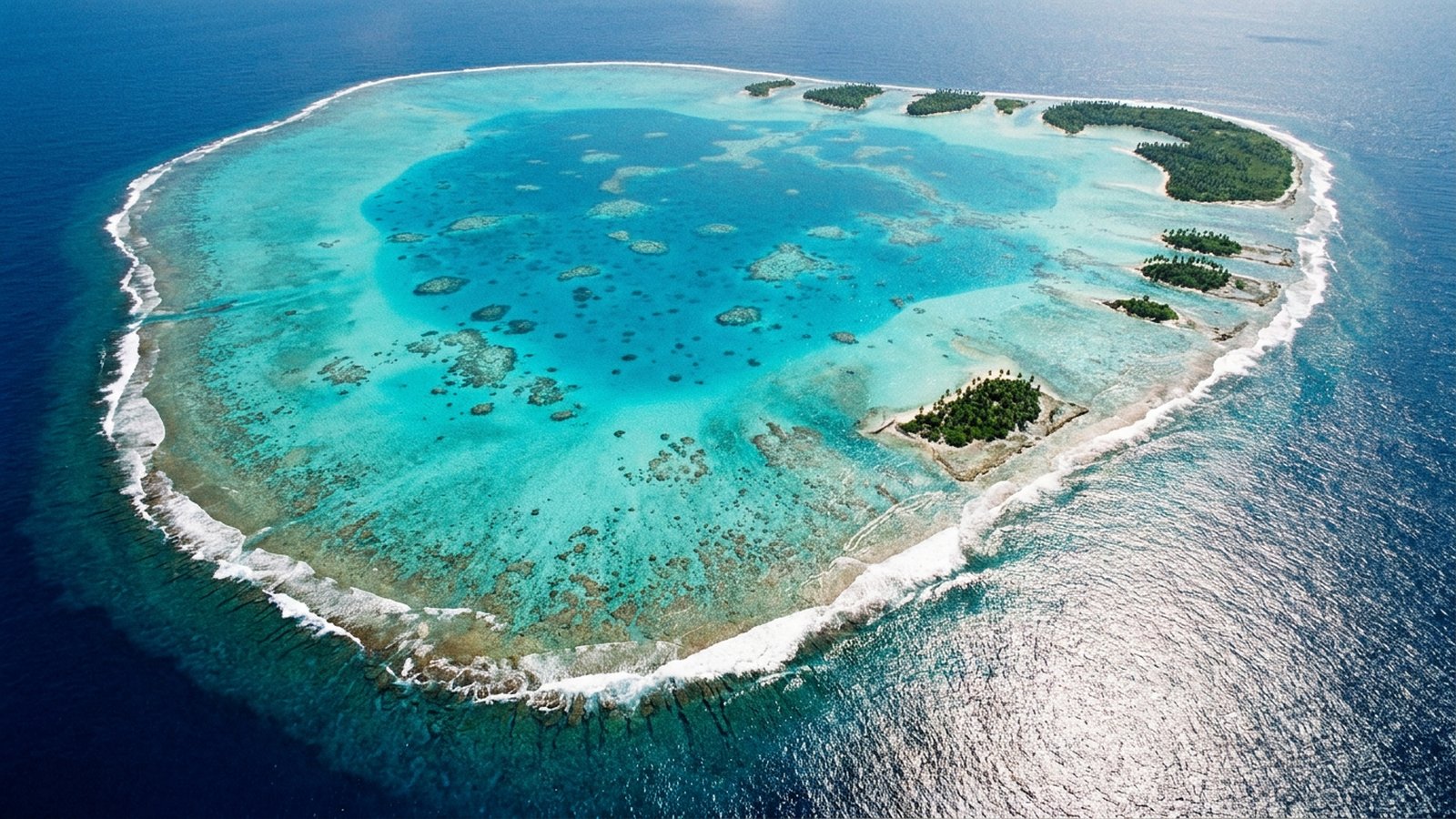
Oceania’s coral reefs by area
Twenty-two maps, from the Great Barrier Reef to Clipperton’s lonely atoll.
| Area | Region | Relative reef extent | Known for |
|---|---|---|---|
| Australia | Melanesia (grouped) | Largest in the region | Great Barrier Reef, Ningaloo, Coral Sea |
| Papua New Guinea | Melanesia | Very large | Coral Triangle diversity; Kimbe Bay, Milne Bay |
| New Caledonia | Melanesia | Large | World Heritage barrier-reef lagoons |
| Fiji | Melanesia | Large | Great Sea Reef; soft corals |
| Hawaii (USA) | Polynesia | Large | Papahānaumokuākea; high endemism |
| Micronesia (FSM) | Micronesia | Large | Chuuk Lagoon wrecks |
| French Polynesia | Polynesia | Large | Tahiti, Bora Bora, Tuamotu atolls |
| Solomon Islands | Melanesia | Large | Marovo Lagoon; WWII wrecks |
| Marshall Islands | Micronesia | Moderate | Kwajalein and Bikini atolls |
| Kiribati | Micronesia | Moderate | Kiritimati; Phoenix Islands Protected Area |
| Tonga | Polynesia | Moderate | Humpback whales; three island groups |
| Tuvalu | Polynesia | Moderate | Low atolls on the climate front line |
| Vanuatu | Melanesia | Moderate | Volcanic reefs; SS President Coolidge wreck |
| Palau | Micronesia | Moderate | Rock Islands; Blue Corner |
| Wallis & Futuna | Polynesia | Small | Wallis lagoon |
| Cook Islands | Polynesia | Small | Aitutaki lagoon; Marae Moana |
| Samoa | Polynesia | Small | Upolu and Savai’i fringing reefs |
| Guam | Micronesia | Small | Largest island in Micronesia |
| Tokelau | Polynesia | Small | Three atolls; solar-power pioneer |
| Niue | Polynesia | Very small | Raised coral island; clear water |
| Nauru | Micronesia | Very small | Raised coral island |
| Clipperton | Eastern Pacific | Very small | Remote atoll off Mexico |
Melanesia — the reef heartland
About three-quarters of Oceania’s mapped reef, and some of the greatest reef systems on Earth.
Australia holds nearly half the region’s coral, dominated by the Great Barrier Reef, the largest reef system in the world, stretching about 2,300 km along Queensland. Western Australia adds Ningaloo, one of the longest fringing reefs, and offshore reefs extend into the Coral Sea and the Indian Ocean. North and east lie the Coral Triangle reefs of Papua New Guinea and the Solomon Islands, among the most biodiverse on Earth, where places such as Kimbe Bay, Milne Bay and the Solomons’ Marovo Lagoon combine extraordinary coral with traditional community management.
The volcanic islands of Vanuatu carry fringing reefs and famous wrecks. To the south-east, New Caledonia is ringed by one of the world’s longest barrier reefs, enclosing lagoons listed as a UNESCO World Heritage Site, and Fiji holds the Great Sea Reef (Cakaulevu), one of the longest barrier reef systems in the world, and is known for its colourful soft corals. Together these nations make Melanesia the reef heartland of the Pacific.
Micronesia — a realm of atolls
Small islands and vast lagoons scattered north of the equator.
The Federated States of Micronesia stretch across four states, including Chuuk Lagoon, whose sunken Second World War Japanese fleet is one of the world’s most famous wreck-diving sites. Palau, at the western edge, holds the celebrated Rock Islands — a UNESCO World Heritage Site — and dive sites such as Blue Corner, and has been a pioneer of shark protection and large-scale marine reserves.
Eastward lie the great atoll nations: the Marshall Islands, with Kwajalein’s vast lagoon and Bikini Atoll’s nuclear-testing history, and Kiribati, spread across a huge expanse of the central Pacific and home to Kiritimati, the atoll with the largest land area in the world, and the Phoenix Islands Protected Area. Smaller Guam and the raised coral island of Nauru complete the Micronesian maps.
Polynesia — the scattered islands
A vast triangle of islands with smaller but culturally rich reefs.
Hawaii, at Polynesia’s northern apex, has reefs with a high proportion of species found nowhere else, and the vast protected chain of Papahānaumokuākea across the north-western Hawaiian Islands. French Polynesia, with Tahiti, Bora Bora and the Tuamotu atolls, holds the largest Polynesian reef area; Moorea, next to Tahiti, is one of the most intensively studied reefs in the world.
Across the region lie the reefs of Tonga, Samoa, the Cook Islands, Wallis and Futuna and the raised island of Niue, along with the low atoll nations of Tuvalu and Tokelau. Far to the east, off Mexico, Clipperton is a lonely atoll in the eastern Pacific, where reefs are otherwise scarce.
The atoll nations and climate change
For some countries, the reef is the foundation of national existence.
Tuvalu, Kiribati, the Marshall Islands and Tokelau are built largely or entirely of coral atolls rising only a few metres above the sea. Their islands are made of sand and rubble produced by the surrounding reefs, and the reef crest protects them from waves. Rising seas, stronger storms, saltwater intrusion into freshwater supplies and coral loss from bleaching threaten their homes as well as their reefs.
These nations have become powerful voices in international climate negotiations, pressing for deep emission cuts. Research suggests healthy reefs that keep growing and supplying sediment can help some islands adjust to rising seas, which makes reef health part of national survival. Their plight gives Oceania’s reefs a significance far beyond their beauty.
Threats and protection across Oceania
The world’s largest marine reserves, set against warming seas.
Warming seas have driven repeated mass bleaching across the Pacific, including on the Great Barrier Reef, the most severe threat the region faces. Overfishing, coastal development, runoff and sediment, crown-of-thorns sea star outbreaks and powerful cyclones add further strain, and the low atoll nations face sea-level rise. Yet Oceania also leads the world in response: some of the largest marine protected areas on Earth, from Papahānaumokuākea to the Phoenix Islands and the Cook Islands’ Marae Moana; Palau’s pioneering protection; and traditions of customary marine tenure that let communities close and open fishing grounds. Read more in coral reef conservation, and for the data behind these maps return to the coral reef maps hub.
All maps in this section are based on the UNEP-WCMC global coral reef dataset, so each area is comparable, though exact figures vary between datasets. Reefs near maritime boundaries are attributed to the nearest coastline for convenience only, and independent Samoa is mapped separately from American Samoa, as is Guam from the Northern Mariana Islands.
Seeing Oceania’s reefs
From day trips on the Great Barrier Reef to liveaboards in the remote Pacific.
The Great Barrier Reef is reached by boat from towns such as Cairns, Port Douglas and the Whitsundays, while Ningaloo offers some of the world’s easiest reef snorkelling straight from the beach. Fiji, Palau, Chuuk, Papua New Guinea, the Solomon Islands and French Polynesia are famous among divers for walls, wrecks, soft corals and sharks, and many smaller islands offer lagoon snorkelling right off the shore. Cyclone season in the South Pacific generally falls in the southern summer, so timing matters. In many Pacific communities reefs are owned or managed under customary tenure, so visitors should ask permission, respect local closures and use local guides where possible.
Related on TheSea
Which Pacific country has the most coral reef?
Australia, thanks mainly to the Great Barrier Reef, holds nearly half of the reef mapped in Oceania. Papua New Guinea, New Caledonia and Fiji also have very large reef areas.
What is the largest coral reef in the Pacific?
The Great Barrier Reef off Queensland, Australia, about 2,300 km long, is the largest reef system in the world. New Caledonia’s barrier reef and Fiji’s Great Sea Reef are among the other longest barrier reefs.
Which countries are made of coral atolls?
Kiribati, the Marshall Islands, Tuvalu and Tokelau are built largely or entirely on coral atolls, as is the Maldives in the Indian Ocean. Their islands rise only a few metres above sea level.
What is the largest atoll in the world?
By land area, Kiritimati (Christmas Island) in Kiribati is the largest atoll. By total area including the lagoon, very large atoll structures such as the Great Chagos Bank in the Indian Ocean are bigger.
Does Hawaii have coral reefs?
Yes. Hawaii has extensive fringing reefs around the main islands and reefs and atolls throughout the north-western Hawaiian Islands, protected within Papahānaumokuākea. Many Hawaiian reef species are found nowhere else.
Where does the Oceania reef map data come from?
From the UNEP-WCMC global coral reef dataset, which combines satellite mapping and survey data, so each area’s map is comparable. Exact figures vary between datasets.
Blane Perun has been exploring Earth’s oceans and marine life for over 25 years. Founder of TheSea.Org in 1999, underwater photographer, coral aquaculture pioneer, and explorer of 80+ countries.
About Blane Perun → More Coral Reef Maps →