Solomon Islands Coral Reef Maps — Marovo Lagoon, Wrecks and the Coral Triangle
Coral reefs fringe almost every island in the Solomon Islands, a double chain of mountainous islands running south-east from Papua New Guinea. The richest reef areas are in the Western Province — especially Marovo Lagoon on New Georgia, often described as the largest saltwater lagoon in the world, and the islands around Gizo and Munda. Other key areas include the waters off Guadalcanal and Iron Bottom Sound, the artificial reef islands of Malaita’s lagoons, raised-atoll Rennell, and remote atolls such as Ontong Java. The Solomons lie within the Coral Triangle, and UNEP-WCMC maps roughly 2,800 km² of reef.
The Solomon Islands combine some of the most biodiverse reefs in the Pacific with one of the densest concentrations of Second World War wrecks anywhere. Most reefs are owned by local communities, and much of the coast is still lined by villages that depend on the reef for food. This page maps the Solomons’ reefs, introduces the main areas and looks at how communities are trying to protect them.
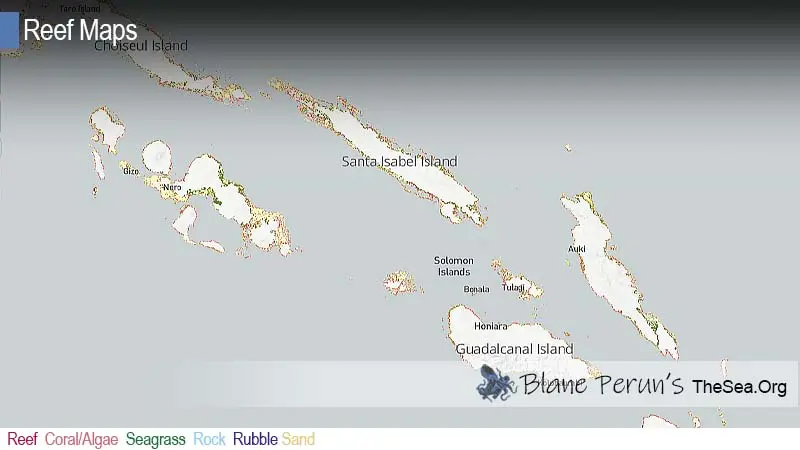
Solomon Islands coral reef map
A double chain of reef-fringed islands, with great lagoons in the west.
On the map, reefs trace the coastlines of the six large islands — Choiseul, New Georgia, Santa Isabel, Guadalcanal, Malaita and Makira — and hundreds of smaller ones. The most extensive reef systems appear in the Western Province, where barrier reefs enclose Marovo, Roviana and Vonavona lagoons around New Georgia. Further out, isolated atolls such as Ontong Java and Sikaiana and the raised island of Rennell carry their own reefs.
The reef outlines are taken from the UNEP-WCMC global warm-water coral reef dataset, which combines satellite imagery and field surveys. Shading shows mapped reef extent, not live coral cover, and the map is a guide rather than a navigation chart.
Marovo Lagoon and the Western Province
A double barrier reef encloses one of the largest lagoons on Earth.
Marovo Lagoon, on the east side of New Georgia, is enclosed by a double line of barrier reef and raised islands, with hundreds of small islands scattered inside. Passages through the barrier connect the calm lagoon to the open ocean, and where clear ocean water flows in, coral growth is spectacular: walls of sea fans and soft corals, hard coral gardens and big schools of fish. Villages around the lagoon are known for woodcarving and for strong customary management of the reef.
To the west, Roviana and Vonavona lagoons near Munda and the islands around Gizo offer some of the country’s best diving, with reef walls, coral gardens and wrecks. Near Gizo, small Kennedy Island is named after John F. Kennedy, whose crew swam there after their patrol boat, PT-109, was sunk in 1943. Tetepare, a large uninhabited island, is protected by its customary landowners for its forests, reefs and turtle nesting beaches.
Iron Bottom Sound and the WWII wrecks
The Guadalcanal campaign left dozens of ships and aircraft on the seabed.
Between August 1942 and early 1943, Allied and Japanese forces fought a long campaign for Guadalcanal. So many warships were sunk in the strait between Guadalcanal and the Florida Islands that it became known as Iron Bottom Sound. Most of those wrecks lie too deep for recreational divers, but others are accessible. At Bonegi, west of Honiara, two Japanese transport ships sunk in 1942 lie just off the beach, their shallow ends reachable by snorkellers and their hulls covered in coral. Aircraft wrecks, landing craft and other ships are scattered across the Western Province.
These wrecks are now artificial reefs, encrusted with corals, sponges and sea fans and home to dense fish life. They are also war graves and historic sites that deserve respect. More in our shipwrecks section.
Malaita’s artificial islands, Rennell and the outer atolls
Islands built from coral by hand, the world’s largest raised coral atoll, and remote Polynesian outliers.
- Langa Langa and Lau lagoons (Malaita) — communities here have built artificial islands from coral rock piled on the reef flats, living on them for generations. Langa Langa is also known for traditional shell money.
- Rennell — the largest raised coral atoll in the world, with the brackish Lake Tegano in its old lagoon. East Rennell is a UNESCO World Heritage Site, listed as in danger because of logging pressures.
- Ontong Java and Sikaiana — remote atolls far to the north, inhabited by Polynesian communities.
- Arnavon Islands — a community conservation area between Choiseul and Santa Isabel, protecting an important hawksbill turtle nesting site.
Reef life in the Solomon Islands
Coral Triangle diversity, from tiny pygmy seahorses to big pelagic fish.
As part of the Coral Triangle, the Solomons support hundreds of species of hard coral and a very large number of reef fish species. Outer walls are covered in sea fans, whip corals and soft corals; lagoons hold branching coral thickets, giant clams and seagrass; and passes bring in barracuda, trevally, bumphead parrotfish, grey reef sharks, manta rays and dolphins. Saltwater crocodiles live in mangrove estuaries, and dugongs graze in seagrass beds. For background, see what animals and plants live in coral reefs.
Reefs, customary tenure and community conservation
Most reefs belong to clans and villages, and that is the starting point for protection.
Under customary tenure, communities hold rights to the reefs off their land. Locally managed marine areas, where villages set their own closures, gear rules and no-take zones, have spread widely, often supported by NGOs and the national fisheries ministry. These approaches build on traditional practices such as temporary closures after a chief’s death. The Solomons also take part in the regional Coral Triangle Initiative.
Threats to the Solomon Islands’ reefs
Logging sediment is the most visible local threat; a warming ocean the biggest global one.
Logging has been a major industry, and soil washed from logged hillsides and log ponds smothers nearshore reefs and seagrass. Overfishing and destructive fishing affect reefs near growing towns, and harvests of sea cucumbers and other export species have at times been closed to let stocks recover. Marine heatwaves cause bleaching, crown-of-thorns starfish outbreaks occur in places, and low-lying atolls and artificial islands are exposed to sea-level rise. See our reef conservation and coral reef bleaching pages.
Related on TheSea
Do the Solomon Islands have coral reefs?
Yes. Reefs fringe almost every island, and the Western Province has extensive barrier reefs and lagoons. UNEP-WCMC maps roughly 2,800 km² of reef.
Is Marovo Lagoon the largest lagoon in the world?
Marovo Lagoon on New Georgia is often described as the largest saltwater lagoon in the world. It is enclosed by a double barrier reef and dotted with hundreds of islands.
Why is it called Iron Bottom Sound?
So many warships were sunk there during the 1942–43 Guadalcanal campaign that the strait between Guadalcanal and the Florida Islands became known as Iron Bottom Sound.
Where is the best diving in the Solomon Islands?
Marovo Lagoon, Gizo and Munda in the Western Province, and the wrecks near Honiara such as those at Bonegi, are the best-known areas.
Are the Solomon Islands in the Coral Triangle?
Yes. The Solomons form the south-eastern part of the Coral Triangle, which has the highest coral and reef fish diversity on Earth.
What threatens coral reefs in the Solomon Islands?
Sediment from logging, overfishing and destructive fishing, bleaching from marine heatwaves, crown-of-thorns starfish and, for low islands, sea-level rise.
- UNEP-WCMC, WorldFish Centre, WRI, TNC: Global distribution of warm-water coral reefs, v4.1 (2021)
- UNESCO World Heritage Centre: East Rennell
- Coral Triangle Initiative on Coral Reefs, Fisheries and Food Security (CTI-CFF)
Blane Perun has been exploring Earth’s oceans and marine life for over 25 years. Founder of TheSea.Org in 1999, underwater photographer, coral aquaculture pioneer, and explorer of 80+ countries.
About Blane Perun → More Oceania Coral Reef Maps →