Clipperton Atoll Coral Reef Maps — The Lone Atoll of the Eastern Pacific
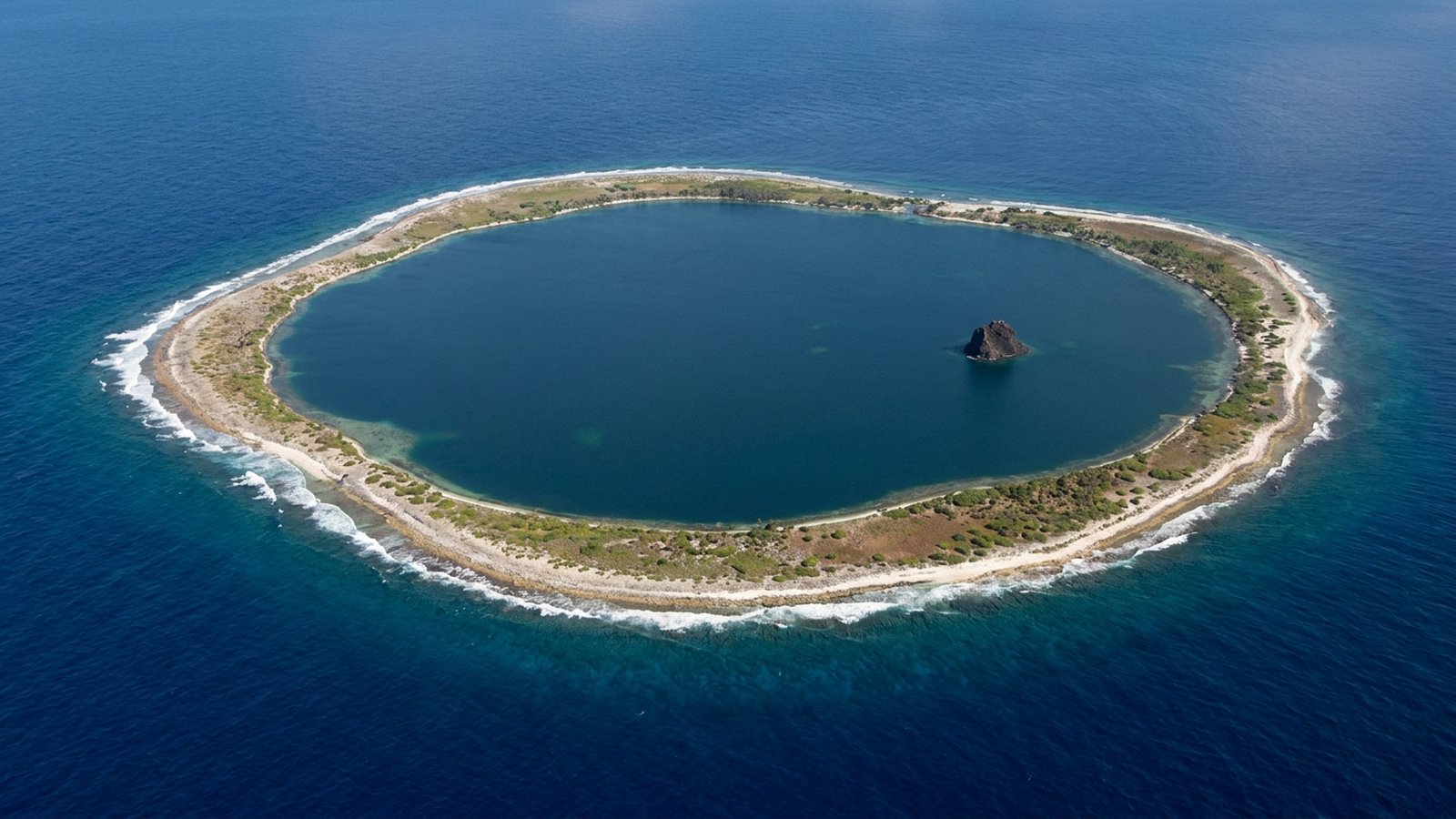
Clipperton Atoll is a tiny, uninhabited ring of coral in the eastern Pacific Ocean, roughly 1,000 km south-west of the Pacific coast of Mexico. It is the only coral atoll in the eastern tropical Pacific, a vast region otherwise almost without atolls. A French possession since an international arbitration in 1931, Clipperton is made up of a narrow ring of reef and low land that completely encloses a stagnant lagoon, cut off from the sea. Global reef mapping by UNEP-WCMC records only about 4 km² of coral reef here, but that small reef is one of the most isolated on Earth. The map below shows the atoll and its reef ring.
Most of the world’s atolls cluster in the central and western Pacific and the Indian Ocean. The eastern Pacific, off the Americas, has cooler upwelling waters, a narrow continental shelf and very few islands, so coral reefs there are small and scattered. Clipperton breaks the pattern: a complete coral ring standing alone in the ocean, hundreds of kilometres from the nearest reef. This page explains where its reef is, how the atoll formed, what lives there and why scientists value it so highly.
Where is Clipperton’s coral reef?
The reef forms the outer edge of the atoll itself, a near-circular ring a few kilometres across, isolated in the open eastern Pacific.
Clipperton lies north of the Equator, roughly 1,000 km from the Mexican coast and far from any other land. Its low rim of coral sand and rubble rises only a few metres above sea level, except at Clipperton Rock, a remnant of the volcano on which the atoll grew, on the south-east side. The living reef faces the open ocean all around the rim, dropping quickly into deep water. Inside the ring lies the enclosed lagoon.
On the map, Clipperton appears as a single small ring of coral. So complete is its isolation that the nearest coral reefs, in Mexico’s Revillagigedo Islands and along the mainland coast, lie many hundreds of kilometres away. That distance makes Clipperton a true island of coral in an ocean region almost without it.
How did Clipperton Atoll form?
Like other atolls, Clipperton is a coral ring built on top of an old, sunken volcano.
Clipperton grew on the summit of an extinct volcano rising from the deep floor of the Pacific. As the volcano slowly subsided, reef-building corals kept growing upward around its edges, staying close to the sunlit surface while the volcanic peak sank below. The result is the classic atoll shape: a ring of reef and low islands around a central lagoon, with only Clipperton Rock still showing the volcanic foundation. Charles Darwin first explained this process in the nineteenth century, and Clipperton is a textbook example. Read more about how different coral reef types form.
The atoll sits close to the Clarion Fracture Zone, one of the long scars in the Pacific sea floor. The deep water around it means the outer reef slope falls away steeply, so there is very little shallow habitat beyond the ring itself.
Why is Clipperton’s lagoon closed and fresh?
Unlike most atolls, Clipperton’s rim has sealed completely, cutting the lagoon off from the ocean.
Most atoll lagoons connect to the sea through channels in the reef, and tides flush them twice a day. At Clipperton the rim closed off its former passes, and with no regular exchange of seawater and heavy tropical rainfall, the lagoon’s surface water became brackish to almost fresh. Deeper down, the water is stagnant, low in oxygen and rich in hydrogen sulphide, making it inhospitable to most marine life. Few atolls anywhere have a lagoon like this.
The result is a sharp contrast. On the outside of the rim is a living, ocean-washed coral reef; on the inside is a still, enclosed lake with its own unusual chemistry. For coral reef scientists, that contrast makes Clipperton a natural laboratory for studying how atolls change over time.
What lives on Clipperton’s reef?
Clipperton’s reef has relatively few coral species, but in places the coral cover is high, and its fish include species found almost nowhere else.
Eastern Pacific reefs have far fewer coral species than reefs in the Indo-Pacific, and Clipperton is no exception. Its outer reef is built mainly by a handful of hardy reef-building corals typical of the region, such as Porites, Pocillopora and Pavona. Expeditions have described stretches of the outer slope with dense, healthy coral cover, because the atoll is so remote from human pressures.
Its fish fauna is a mix of eastern Pacific species and larvae carried from across the ocean by currents. Clipperton is the home of the Clipperton angelfish (Holacanthus limbaughi), a species found essentially only around the atoll. Sharks, including whitetip reef sharks and larger open-ocean species, patrol the reef edge, and moray eels and jacks are common. The surrounding waters support rich tuna fisheries. See our guide to coral reef fish for more on reef fish communities.
Seabirds, land crabs and an isolated wildlife refuge
On land, Clipperton is dominated by seabirds and by enormous numbers of orange land crabs.
Clipperton hosts one of the largest colonies of masked boobies in the world, along with brown boobies and other seabirds drawn to a rare patch of land in an empty ocean. Birds feed far out at sea and return to nest on the open ground of the rim, carrying ocean nutrients ashore.
The atoll is also famous for its land crabs (Johngarthia planata), which swarm over the ground in the millions and keep vegetation low by eating seedlings. When pigs were left on the island in the late nineteenth century they ate crabs and seabird eggs, and vegetation spread; after the pigs were removed in the 1950s, the crabs and birds recovered and the island returned to its bare, crab-dominated state. Introduced rats are a more recent threat to the birds. The connection matters for the reef too: seabird guano washing into the sea can boost productivity in nearby reef waters.
Clipperton’s history: pirates, guano and a sovereignty dispute
Clipperton has a strange and sometimes tragic human story for such a small island.
The atoll is traditionally said to be named after John Clipperton, an English privateer of the early eighteenth century. France claimed it in 1858, while Mexico also asserted sovereignty, and in the late nineteenth and early twentieth centuries guano was mined there. Mexico stationed a small garrison on the island in the early 1900s. When supply ships stopped coming during the Mexican Revolution, the garrison and their families were left stranded; many died of scurvy and violence, and a handful of survivors were rescued by a US Navy ship in 1917.
The sovereignty dispute between France and Mexico went to international arbitration under King Victor Emmanuel III of Italy, who ruled in France’s favour in 1931. Clipperton has been uninhabited for most of its history since, visited only by scientific expeditions, naval patrols and occasional fishing boats. It is administered directly by the French government, and its large exclusive economic zone gives it strategic and fisheries value well beyond its size.
Threats and protection for Clipperton’s reef
Isolation has spared Clipperton most local pressures, but warming seas, El Niño, illegal fishing and debris still reach it.
The eastern Pacific is strongly affected by El Niño, which can push water temperatures high enough to bleach and kill corals, and long-term ocean warming adds to that risk. Illegal fishing in the rich surrounding waters is hard to police so far from port, and plastic and other marine debris wash up even on this remote shore. Shipwrecks have also brought pollution and introduced pests.
France has placed the atoll and its surrounding waters under environmental protection, and its remoteness remains its best defence, keeping the reef among the least disturbed in the eastern Pacific. Enforcing protection across such a vast and remote stretch of ocean is still a challenge. Explore the wider picture in our coral reef conservation pages, or compare Clipperton with the much larger atoll systems of French Polynesia and Kiribati.
Where is Clipperton Atoll?
In the eastern Pacific Ocean, roughly 1,000 km south-west of the Pacific coast of Mexico and far from any other land. It is the only coral atoll in the eastern tropical Pacific.
Who owns Clipperton Island?
France. After a long dispute with Mexico, an international arbitration by the King of Italy awarded the atoll to France in 1931. It is administered directly by the French government.
Does anyone live on Clipperton Atoll?
No. Clipperton is uninhabited. It is visited occasionally by scientific expeditions, French naval patrols and fishing vessels.
How much coral reef does Clipperton have?
Very little by area. The UNEP-WCMC global dataset maps about 4 km² of reef, the ring that forms the atoll, but the outer reef can have dense coral cover.
Why is Clipperton’s lagoon unusual?
It is completely closed off from the sea. Fed by rainfall, its surface water is brackish to fresh, while its deeper water is stagnant and low in oxygen, unlike the sea-flushed lagoons of most atolls.
What happened on Clipperton Island in 1917?
A small Mexican garrison and their families were stranded on the island when supply ships stopped arriving during the Mexican Revolution. Many died, and a few survivors were rescued by a US Navy ship in 1917.
What wildlife lives on Clipperton?
One of the world’s largest masked booby colonies, other seabirds, millions of orange land crabs, and reef fish including the Clipperton angelfish, found almost nowhere else.
- UNEP-WCMC, WorldFish Centre, WRI, TNC (2021). Global distribution of warm-water coral reefs, v4.1.
- Arbitral award on the subject of the difference relative to the sovereignty over Clipperton Island (France v. Mexico), 1931.
- Published scientific expedition reports on the reefs, fishes and seabirds of Clipperton Atoll.
Blane Perun has been exploring Earth’s oceans and marine life for over 25 years. Founder of TheSea.Org in 1999, underwater photographer, coral aquaculture pioneer, and explorer of 80+ countries.
About Blane Perun → More Coral Reef Maps →