Are Crocodiles Dinosaurs? — The Archosaur Family Tree Explained
No. Crocodiles are not dinosaurs, but they are close relatives. Crocodilians and dinosaurs both belong to the archosaurs, the “ruling reptiles”, which split in the Early to Middle Triassic, more than 240 million years ago, into a crocodile-line branch (Pseudosuchia) and a bird-line branch (Avemetatarsalia) that produced pterosaurs and dinosaurs. Birds are the only dinosaurs alive today, so a crocodile’s closest living relative is not a lizard or a turtle but a bird. Modern crocodilians appeared in the Late Cretaceous and survived the extinction that ended the dinosaurs 66 million years ago.
Crocodiles did not evolve from dinosaurs, and dinosaurs did not evolve from crocodiles. Both descend from a common archosaur ancestor that lived in the Early Triassic.
Are crocodiles dinosaurs or not?
Crocodiles are not dinosaurs. To a palaeontologist, a dinosaur is any member of a specific group of animals, defined as the most recent common ancestor of Triceratops and modern birds and all of its descendants. That group includes Tyrannosaurus, Brachiosaurus, Stegosaurus, Velociraptor and every living bird, but it does not include crocodiles, alligators, caimans or gharials.
The confusion is understandable. Crocodilians look ancient, with scaly, armoured bodies, and their ancestors lived alongside the dinosaurs for more than 150 million years. Fossil crocodilians are often displayed in the same museum halls as dinosaurs, and some, like Deinosuchus and Sarcosuchus, were large enough to eat them. But looking ancient is not the same as being a dinosaur. Crocodilians belong to a separate branch of the reptile family tree that has been evolving independently since the Triassic.
Many other famous prehistoric reptiles are not dinosaurs either. The flying pterosaurs, the marine ichthyosaurs, plesiosaurs and mosasaurs, and the sail-backed Dimetrodon all fall outside the dinosaur group. Our guide to prehistoric marine reptiles explains where those ocean giants fit.
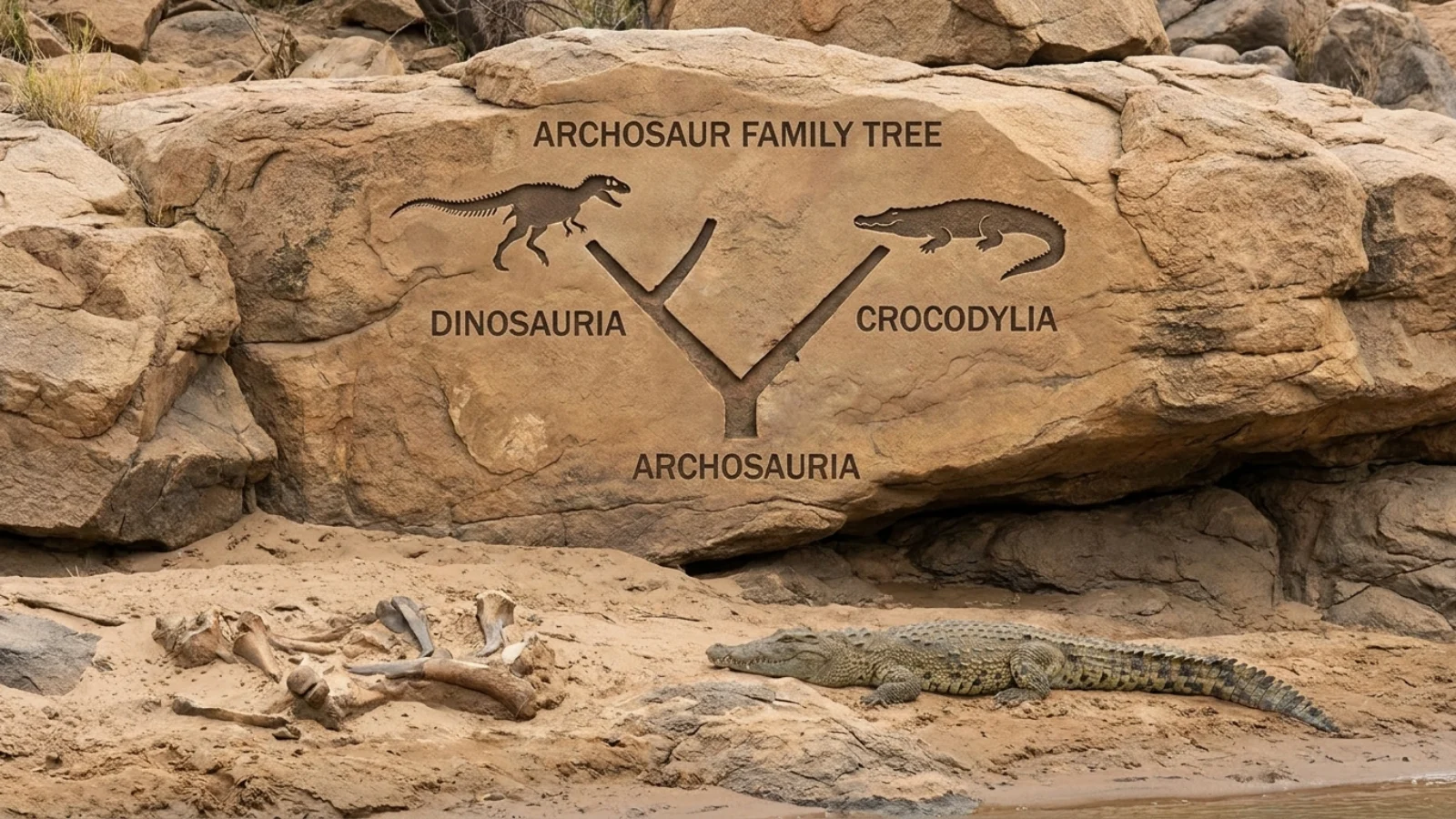
How are crocodiles related to dinosaurs?
Crocodiles and dinosaurs are both archosaurs, a name that means “ruling reptiles”. The archosaurs appeared in the Early Triassic, after the end-Permian mass extinction around 252 million years ago wiped out most life on Earth. Within a few million years, the archosaurs had divided into two great branches.
One branch, called Pseudosuchia, is the crocodile line. It includes modern crocodilians and all the extinct animals more closely related to them than to birds. The other branch, called Avemetatarsalia, is the bird line. It includes the pterosaurs, the dinosaurs and, through the dinosaurs, modern birds.
So crocodiles and dinosaurs are cousins that share a common ancestor, not ancestors and descendants. That common ancestor was a small to medium-sized reptile of the Early Triassic, more than 240 million years ago, whose exact identity is still debated by palaeontologists.
| Branch | Includes | Survivors today |
|---|---|---|
| Pseudosuchia (crocodile line) | Phytosaur-like forms (debated), aetosaurs, rauisuchians, poposauroids, crocodylomorphs | Crocodiles, alligators, caimans, gharials |
| Avemetatarsalia (bird line) | Pterosaurs, early dinosauromorphs, dinosaurs | Birds |
Are crocodiles more closely related to birds than to lizards?
Yes. This is one of the most surprising facts in reptile evolution. Because birds are dinosaurs, and dinosaurs are archosaurs, birds and crocodilians are each other’s closest living relatives. They are the only two surviving groups of archosaurs. A crocodile is more closely related to a pigeon or an eagle than it is to a lizard, a snake or a turtle.
The family resemblance is hidden by appearance, but it shows up in anatomy, physiology and behaviour. Crocodilians have a four-chambered heart, as birds do, rather than the three-chambered heart of most other reptiles. Studies published in 2010 and 2013 showed that air flows in a one-way loop through crocodilian lungs, a system similar to the unidirectional breathing of birds and different from the in-and-out breathing of mammals.
Crocodilians and birds also share behaviours. Both build nests and care for their eggs and young, and both communicate with calls. Baby crocodiles call from inside the egg before hatching, prompting the mother to open the nest, and young birds of many species do the same. Some palaeontologists use these shared features to infer how dinosaurs, which sit between the two on the family tree, may have behaved.
What did crocodile relatives look like in the Triassic?
In the Triassic, the crocodile line was more diverse and more dominant than the dinosaurs. By the late Middle Triassic, pseudosuchians filled most of the roles of large land predator, while dinosaurs were still small and relatively rare.
Some pseudosuchians looked nothing like modern crocodiles. Rauisuchians such as Saurosuchus and Prestosuchus were large land predators that walked with their legs held under the body, more like a dinosaur than a crocodile. Poposauroids included bipedal hunters such as Postosuchus and Poposaurus, and toothless, beaked plant eaters that looked remarkably like ostrich-shaped dinosaurs. Aetosaurs were armoured plant eaters with rows of bony plates and sometimes long spikes along the sides.
Phytosaurs, long-snouted animals that looked very like gharials and lived in rivers and lakes, were once placed in the crocodile line, but some recent studies put them just outside it. Their crocodile-like shape is a good example of convergent evolution, in which unrelated animals evolve similar bodies because they live similar lives.
Why did the dinosaurs take over from the crocodile line?
At the end of the Triassic, about 201 million years ago, a mass extinction linked to huge volcanic eruptions and climate change wiped out most pseudosuchians. Only the crocodylomorphs, the small, lightly built group that includes the ancestors of modern crocodiles, survived. The extinction removed the main competitors of the dinosaurs, which then spread and diversified through the Jurassic and Cretaceous.
Palaeontologists once explained the rise of the dinosaurs by assuming they were simply superior animals, with better posture or physiology. Studies of the fossil record have challenged that idea, suggesting that the dinosaurs were in large part lucky survivors of an extinction that hit the crocodile line much harder. Research published in 2013 found that pseudosuchians and dinosaurs had evolved at similar rates during the Triassic, and that the extinction, not competition, opened the door for dinosaur dominance.
What makes an animal an archosaur?
Archosaurs are defined by their ancestry, but they share a set of anatomical features that palaeontologists use to recognise them in the fossil record. The most obvious is an extra opening in the skull in front of each eye socket, called the antorbital fenestra. Most archosaurs also have an opening in the lower jaw, the mandibular fenestra. These openings lightened the skull and gave space for muscles and air sacs.
Archosaurs also have teeth set in deep sockets in the jaw bones, a condition known as thecodont dentition, which is shared with mammals but not with most lizards and snakes. Modern crocodilians still have socketed teeth, which are replaced throughout life. Birds have lost their teeth, but their dinosaur ancestors had socketed teeth too.
Some of these features have been modified or lost in modern crocodilians. The antorbital fenestra, for example, closed up during crocodile evolution, so it cannot be seen in the skull of a living alligator. Scientists rely on fossils of early crocodile-line archosaurs, which still show it clearly, to link modern crocodiles to the rest of the group.
How do scientists tell a crocodile-line fossil from a dinosaur?
Because early members of the two archosaur branches looked similar, palaeontologists use details of the skeleton to tell them apart. Two of the most important are the ankle and the hip.
Crocodile-line archosaurs have an ankle joint in which a peg on one ankle bone fits into a socket on the other, allowing the foot to rotate as the animal walks. This arrangement, sometimes called a crocodile-normal ankle, is still present in living crocodilians. Bird-line archosaurs, including dinosaurs, have a simple hinge-like ankle, in which the joint runs between the ankle bones and the rest of the foot. Birds still have this arrangement, although their ankle bones are fused into the lower leg and foot.
Dinosaurs also have an open hip socket, with a hole through the middle of the socket rather than a solid bony wall, and their legs are held directly under the body. This combination gave dinosaurs an upright posture. Living crocodilians can raise their bodies off the ground in the “high walk”, but their hip sockets are closed and their legs are held more to the side when they crawl. Some Triassic crocodile-line animals, however, evolved fully upright legs independently, which is one reason the early archosaurs can be difficult to classify.
Did crocodiles live with dinosaurs?
Yes. Crocodylomorphs lived alongside dinosaurs throughout the Jurassic and Cretaceous, a span of about 135 million years. During that time, the crocodile line diversified into forms that would look strange today. There were fully marine crocodylomorphs, the thalattosuchians and metriorhynchids, with paddle-like limbs and tail flukes. There were small, land-dwelling plant eaters with complex teeth, and long-legged land predators.
Some crocodyliforms were huge and preyed on dinosaurs. Deinosuchus, which lived in North America during the Late Cretaceous, including along the coasts of what are now Georgia, the Carolinas and Texas, left tooth marks on dinosaur bones. Sarcosuchus lived in rivers in what is now the Sahara about 110 million years ago and may have reached 9 to 12 m.
Modern crocodilians, the group that includes the living alligators, crocodiles and gharials, appeared in the Late Cretaceous, near the end of the age of dinosaurs. Our guide to when crocodiles first appeared tells that story in detail.
How did crocodiles survive the extinction that killed the dinosaurs?
About 66 million years ago, an asteroid struck the Earth near what is now the Yucatán Peninsula of Mexico, triggering the mass extinction that killed all non-bird dinosaurs, the pterosaurs and many marine reptiles. Crocodilians survived, along with birds, turtles, lizards, snakes and mammals. Why they survived is still being researched, but several features probably helped.
Crocodilians are ectotherms with low metabolic rates, and they can survive for months without food, an advantage when food chains collapse. Many lived in freshwater rivers, lakes and swamps, whose food webs were partly based on dead organic matter rather than on living plants, and which may have been less affected by the collapse of photosynthesis after the impact. Crocodilians also have flexible diets, can shelter in water and burrows, and lay eggs that can survive in buried nests.
Even so, the crocodile line did not escape unscathed. Many crocodyliform groups disappeared at the end of the Cretaceous or soon after, and the diversity of the group has declined over the past few tens of millions of years, especially as global climates cooled.
Are crocodiles living fossils?
Crocodiles are often called living fossils, but the term is misleading. Modern crocodilians have not remained unchanged since the age of dinosaurs. The living species belong to genera that are relatively young, and many features of their anatomy and behaviour have evolved since the Cretaceous. What has remained stable is the basic body plan of a semi-aquatic ambush predator, which has worked so well for so long that crocodilians with similar shapes have evolved several times.
Genetic studies also show that modern crocodilians evolve slowly at the molecular level compared with birds and mammals, which may reflect their long generation times and stable lifestyles. Scientists who sequenced the genomes of the American alligator, saltwater crocodile and gharial in 2014 found that crocodilian genomes have changed far more slowly than those of birds.
Modern crocodilians are also more diverse than the term suggests. The 26 or so living species, recognised by the IUCN, range from the 1.5 m dwarf crocodile to the 6 m saltwater crocodile, and live in rivers, swamps, lakes, estuaries and coastal seas on every tropical continent. Our crocodiles hub covers them all.
Are alligators dinosaurs?
No, for the same reason that crocodiles are not. Alligators belong to the family Alligatoridae, which with the crocodiles and gharials makes up the order Crocodylia. All of them sit on the crocodile-line branch of the archosaurs, separate from the dinosaurs.
In Florida, you can still see the two surviving branches of the archosaur tree side by side. An alligator basking on a lake shore while an anhinga dries its wings on a branch overhead, or a great blue heron stalking fish in front of a crocodile in Florida Bay, is a meeting of the last representatives of two lineages that split in the Triassic. The heron is the dinosaur. The alligator is its cousin.
That makes Florida’s wetlands one of the best places in the world to think about the archosaurs. The state’s fossil record adds to the picture: Florida’s rivers and phosphate mines have produced fossil crocodilians and gavialoids from the last few tens of millions of years, alongside the bones of ancient birds, showing that both branches of the family have lived in the region for a very long time.
Are crocodiles dinosaurs?
No. Crocodiles and dinosaurs are both archosaurs, but they are on different branches that split more than 240 million years ago.
Did crocodiles evolve from dinosaurs?
No. Neither evolved from the other. They share a common archosaur ancestor from the Early Triassic.
What is the closest living relative of the crocodile?
Birds. Birds are living dinosaurs, and birds and crocodilians are the only surviving archosaurs.
Did crocodiles live with dinosaurs?
Yes. Crocodile-line reptiles lived alongside dinosaurs for about 135 million years, and some, like Deinosuchus, ate dinosaurs.
Why did crocodiles survive when dinosaurs died out?
Probably because of low energy needs, the ability to fast for months, freshwater habitats with resilient food webs and flexible diets.
Are alligators dinosaurs?
No. Alligators are crocodilians, on the crocodile line of the archosaurs, not the dinosaur line.
Are birds dinosaurs?
Yes. Birds evolved from small feathered theropod dinosaurs in the Jurassic and are classified as living dinosaurs.
How old are crocodiles?
The crocodile line dates back more than 240 million years. Modern crocodilians appeared in the Late Cretaceous.
- Wikipedia, “Pseudosuchia” and “Crocodilia” (archosaur phylogeny, crocodilian origins, heart and breathing).
- Phys.org (2013), “Extinction of pseudosuchians let dinosaurs flourish”.
- Green, R.E. et al. (2014), “Three crocodilian genomes reveal ancestral patterns of evolution among archosaurs”, Science 346.
- Farmer, C.G. & Sanders, K. (2010), “Unidirectional airflow in the lungs of alligators”, Science 327.
- IUCN SSC Crocodile Specialist Group: living crocodilian species.
Blane Perun has been exploring Earth’s oceans and marine life for over 25 years. Founder of TheSea.Org in 1999, underwater photographer, coral aquaculture pioneer, and explorer of 80+ countries.
About Blane Perun →