The Largest Crocodile Ever Recorded — Lolong, Krys and the Prehistoric Giants
The largest crocodile ever reliably measured is Lolong, a male saltwater crocodile captured in the Philippines in 2011 that measured 6.17 m (20 ft 3 in) and weighed 1,075 kg (2,370 lb). Bigger crocodiles have been claimed, most famously Krys, an 8.63 m (28 ft 4 in) saltwater crocodile shot in Queensland in 1957, but no body, skull or photograph survives to confirm it. If extinct species count, the prehistoric Sarcosuchus and Purussaurus reached roughly 9 to 12 m.
A crocodile over 6 m long is a rare and extraordinary animal. Only a handful have ever been measured with a tape rather than estimated from a boat, and every one of them was a male saltwater crocodile.
What is the largest crocodile ever recorded?
The largest crocodile ever recorded with a reliable measurement is Lolong, a male saltwater crocodile (Crocodylus porosus) captured in a creek in Bunawan, in the province of Agusan del Sur on the Philippine island of Mindanao, on 3 September 2011. Lolong measured 6.17 m (20 ft 3 in) from snout to tail and weighed 1,075 kg (2,370 lb). In November 2011, Australian zoologist Adam Britton, working with a National Geographic team, measured him and confirmed that he was the longest crocodile in captivity. Guinness World Records recognised him as the largest crocodile in captivity.
Lolong was caught after a series of attacks on people and livestock in the area, and was believed responsible for at least one human death. He was kept in a purpose-built enclosure at an ecopark in Bunawan, where he became a national celebrity and a tourist attraction. He died on 10 February 2013, at an estimated age of about 50. A necropsy found pneumonia, a fungal infection, cardiac arrest and stress, problems that were linked to his confinement.
Lolong’s measurement matters because it was made by a specialist with a tape on a restrained animal, not estimated from a distance. That makes it the benchmark against which all other claims are judged.
The biggest crocodiles on record
| Crocodile | Species | Length | Status |
|---|---|---|---|
| Krys (Queensland, 1957) | Saltwater | 8.63 m (28 ft 4 in) | Claimed; no remains survive |
| Lolong (Philippines, 2011) | Saltwater | 6.17 m (20 ft 3 in) | Measured; died 2013 |
| Cassius (Australia, 1984) | Saltwater | 5.48 m (18 ft) | Measured; died 2024 |
| Gustave (Burundi) | Nile | 6 m+ (estimated) | Never captured |
| Sweetheart (Australia, 1979) | Saltwater | 5.1 m (17 ft) | Preserved specimen |
Who was Krys the crocodile?
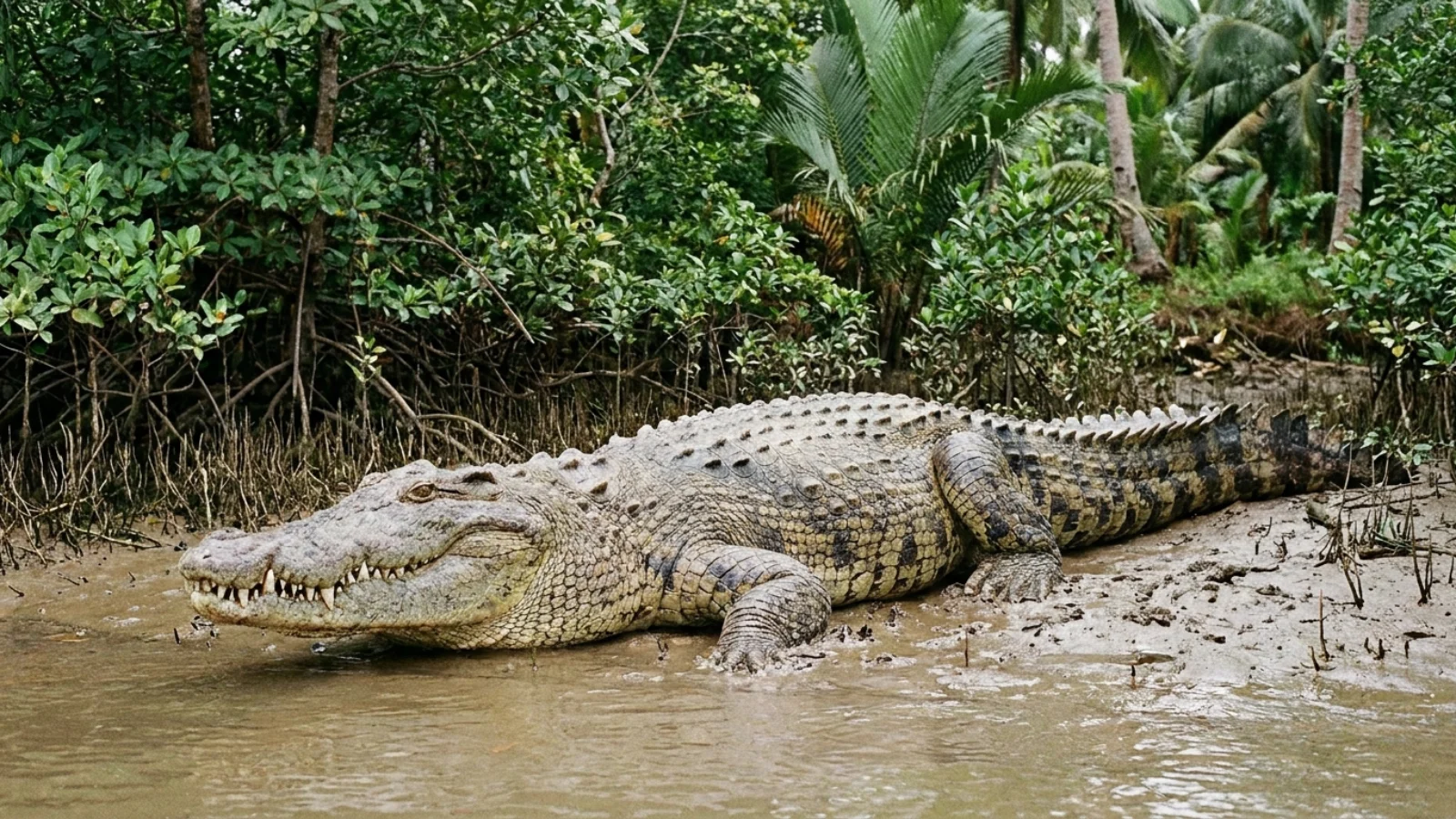
The largest crocodile ever claimed is Krys, a saltwater crocodile shot in July 1957 on the MacArthur Bank of the Norman River in the Gulf country of northern Queensland, Australia. The hunter was Krystyna Pawlowski, a Polish-born woman then aged about 30, who became known as one of the most successful crocodile shooters in Queensland during the era of commercial hide hunting. The crocodile was reported to measure 8.63 m (28 ft 4 in).
If accurate, Krys would be by far the largest crocodile ever recorded, more than 2 m longer than Lolong. But there is no physical evidence to support the claim. No skull, skin or bones were kept, and the only known photograph is of poor quality and does not allow the animal to be measured. Many crocodile scientists consider the figure doubtful, although Pawlowski was an experienced hunter who kept careful records.
Today a life-size replica of Krys stands in Normanton, Queensland, as a monument to the claim and a popular roadside stop. Whatever its true length, the story shows how large saltwater crocodiles may once have grown before commercial hunting removed the biggest animals.
How big was Cassius?
Cassius was a saltwater crocodile captured in 1984 on the Finniss River in Australia’s Northern Territory, after he repeatedly attacked boats. In 1987 he was moved to Marineland Melanesia, a crocodile park on Green Island off Cairns in Queensland, where he lived for the rest of his life. At his arrival he measured 5.30 m, and later measurements gave 5.48 m (18 ft). His weight was estimated at well over a tonne.
Guinness World Records recognised Cassius as the largest crocodile in captivity in 2011. He lost the title in 2012 to Lolong and regained it after Lolong’s death in February 2013. Cassius died in November 2024. Because he was thought to have been an adult when captured in 1984, estimates of his age at death ranged widely, with some suggesting he was more than 110 years old.
Old males like Cassius often carry the damage of decades of fighting. Missing tail tips are common in very large crocodiles, and they make measurements smaller than the animal’s true size, so a scarred record holder may once have been longer than the tape now shows.
Why do crocodile size records shrink when measured?
Crocodile size has always attracted exaggeration. Hunters, villagers and tourists usually see big crocodiles in the water, where only the head and back are visible, and they estimate total length from these clues. Estimates made in this way, especially by people who are frightened or excited, tend to be too large.
Historic records also suffer from poor methods. Some lengths were measured along the curve of the body rather than in a straight line, some were measured on skins, which stretch when removed and dried, and some were simply never measured at all. A skin that was 8 m long may have come from a crocodile of much less than 8 m.
For this reason, modern scientists prefer measurements of skulls, which do not stretch and are often kept as trophies. There is a close relationship between skull length and total body length in crocodiles, so a reliably measured skull allows a good estimate of the animal’s size. Studies of skulls in museum collections suggest that saltwater crocodiles of 6 to 7 m did exist in the past, but very few above 7 m. Our saltwater crocodile skull page explains how skulls reveal a crocodile’s size and bite.
Which crocodile species grows the largest?
The saltwater crocodile is the largest living crocodilian and the largest living reptile. Adult males commonly reach 4.5 to 5.5 m, and the largest individuals exceed 6 m and 1,000 kg. Females are much smaller, rarely more than 3.5 m. Saltwater crocodiles live from eastern India and Sri Lanka through Southeast Asia to northern Australia and the islands of the western Pacific, and they swim long distances at sea. Our saltwater crocodile profile covers the species in full.
The Nile crocodile is the second-largest species. Big males reach 5 m or more, and the legendary Burundi crocodile Gustave, profiled in our Gustave crocodile article, is estimated at more than 6 m. Other large species include the gharial, whose males can exceed 5 m, the Orinoco crocodile of Venezuela and Colombia, and the American crocodile, which can reach about 5 to 6 m in Central and South America.
The American alligator is smaller than these species. Large males reach about 4 to 4.5 m, and very few alligators have reliably exceeded 4.6 m.
How big do crocodiles get in Florida?
Florida’s native crocodile is the American crocodile (Crocodylus acutus), which lives in the southern tip of the state, mostly in Florida Bay, the Keys and the mangrove coasts of Everglades National Park and Biscayne Bay. Florida’s crocodiles are at the northern edge of the species’ range and are generally smaller than those further south. Most adults in Florida measure about 2.5 to 4 m, although larger males are occasionally seen.
In Central and South America, American crocodiles can grow much larger, with old records of 6 m or more. As with saltwater crocodiles, the largest animals were removed by hunting in the twentieth century, and today very few American crocodiles approach that size anywhere.
The American crocodile has made a strong comeback in Florida since it was listed as endangered in 1975, and it was downlisted to threatened in 2007. A surprising number of crocodiles now live around the cooling canals of the Turkey Point power station south of Miami, one of the most important nesting areas for the species in the state. Our American crocodile profile covers that recovery.
What was the largest crocodile that ever lived?
If extinct species are included, living crocodiles are not the largest ever. During the Cretaceous and the Miocene, several crocodilians and their relatives grew to sizes that dwarf Lolong.
Sarcosuchus imperator, which lived about 110 million years ago in what is now the Sahara, is listed by Guinness World Records as the largest crocodyliform ever. Early estimates gave it a length of 11 to 12 m and a weight of up to 8 tonnes. A 2019 study suggested more conservative figures of up to about 9.5 m and 4.5 tonnes.
Purussaurus brasiliensis, a giant caiman that lived in the Amazon region in the late Miocene, is the other main candidate. A 2015 study by Tito Aureliano and colleagues estimated it at about 12.5 m and 8.4 tonnes, with a wide range of uncertainty. Other researchers have since argued for smaller figures, from about 10.9 m down to under 8 m. Deinosuchus, which lived in North America during the Late Cretaceous, probably reached a similar size to Sarcosuchus and is known to have fed on dinosaurs.
Prehistoric giants compared
| Animal | When | Where | Estimated length |
|---|---|---|---|
| Sarcosuchus imperator | About 110 million years ago | North Africa | About 9–12 m |
| Purussaurus brasiliensis | Late Miocene | Amazon basin | About 8–12.5 m |
| Deinosuchus | Late Cretaceous | North America, including the Southeast US | Similar to Sarcosuchus |
| Gunggamarandu maunala | Pliocene–Pleistocene | Queensland, Australia | About 7 m |
Where do the biggest crocodiles live today?
The best places to find very large crocodiles today are the river systems of northern Australia. In the Northern Territory and Queensland, saltwater crocodiles were hunted almost to commercial extinction by the late 1960s, then fully protected. Their numbers have since recovered to many tens of thousands, and because hunting stopped decades ago, some of the males that survived the hide-hunting era, or hatched soon after it, are now very old and very large. Rivers such as the Adelaide, Mary and East Alligator in the Northern Territory are known for big males, and boat tours there regularly show visitors crocodiles of 5 m and more.
Other strongholds of the species include the Sundarbans of India and Bangladesh, the Bhitarkanika mangroves of Odisha in eastern India, and remote parts of Papua New Guinea, Indonesia and the Solomon Islands. In Bhitarkanika, where saltwater crocodiles have been protected and reintroduced since the 1970s, park officials have reported several animals estimated at over 6 m, although these are estimates rather than measurements of captured animals.
The Philippines, where Lolong was caught, still has wild saltwater crocodiles, but the population is small and fragmented. The fact that a crocodile of more than 6 m lived undetected in a creek on Mindanao until 2011 shows that very large crocodiles can survive in places where few people expect them.
Nile crocodiles in large lakes and rivers of East and southern Africa, including Lake Turkana and the rivers of the Okavango and Zambezi systems, also produce very large males. As with salties, the largest Nile crocodiles are old animals in places where hunting is controlled.
Could a crocodile today reach 7 metres?
It is possible but unlikely. Crocodiles grow throughout their lives, but growth slows dramatically after they reach maturity, and only the oldest males in protected populations reach the largest sizes. Very large males also need large territories and plenty of prey, which are increasingly rare in a world dominated by people.
The populations most likely to produce record crocodiles are those that have been protected for the longest time, such as the saltwater crocodile populations of northern Australia, which have been protected since the early 1970s. As these populations recover and age, some biologists expect more crocodiles of 6 m and over to appear. Old male saltwater crocodiles over 5.5 m are already seen in the rivers of the Northern Territory and Queensland.
Even so, a living crocodile measured at over 7 m would be an extraordinary event. Until one is caught and measured, Lolong’s 6.17 m remains the record.
How do scientists measure a giant crocodile?
Measuring a large crocodile is difficult and dangerous. The animal must be captured, usually in a trap or with nooses, then restrained with ropes and tape over the jaws. Its total length is measured in a straight line along the back from the tip of the snout to the tip of the tail. Some scientists also measure the length of the head, which can be used to check the total length.
Weighing a big crocodile is even harder. Animals over a tonne need cranes or heavy-duty scales, and many weights in the literature are estimates. Lolong’s measurement in 2011 was carried out in this way by a team that included specialists, which is why it is accepted as reliable.
For wild animals that cannot be captured, researchers are increasingly using drones and photographs from directly above, comparing the head length with objects of known size. These methods allow scientists to estimate the size of large crocodiles without the risk of capture, and may help settle future claims about record animals.
- Lolong, 6.17 m and 1,075 kg, is the largest crocodile ever reliably measured.
- Krys (8.63 m, 1957) is the largest claim, but no remains or usable photos survive.
- Cassius (5.48 m) held the captive record until his death in November 2024.
- Saltwater crocodiles are the largest living reptiles; Florida’s American crocodiles are smaller.
- Extinct Sarcosuchus and Purussaurus reached roughly 9 to 12 m.
What is the biggest crocodile ever recorded?
Lolong, a saltwater crocodile captured in the Philippines in 2011, measured 6.17 m (20 ft 3 in) and weighed 1,075 kg. It is the largest crocodile ever reliably measured.
Was Krys the crocodile real?
Krys was a real crocodile shot in Queensland in 1957 and reported at 8.63 m, but no remains or measurable photos survive, so the length cannot be verified.
What is the biggest crocodile alive today?
No living crocodile is officially recognised since Cassius died in 2024. Large wild saltwater crocodiles in northern Australia and Southeast Asia may exceed 6 m.
How big was Lolong?
6.17 m (20 ft 3 in) long and 1,075 kg (2,370 lb), measured in November 2011 by zoologist Adam Britton.
What was the largest crocodile ever to live?
Extinct giants such as Sarcosuchus imperator and Purussaurus brasiliensis, estimated at roughly 9 to 12 m long.
Are crocodiles bigger than alligators?
Generally yes. Saltwater and Nile crocodiles grow much larger than American alligators, which rarely exceed 4.5 m.
How big are crocodiles in Florida?
Florida’s American crocodiles usually measure about 2.5 to 4 m. The species grows larger in Central and South America.
- Guinness World Records: largest crocodile in captivity (Lolong) and largest crocodyliform ever (Sarcosuchus).
- WorldAtlas, “What Was The Largest Crocodile Ever Recorded?” (Lolong measurements, capture and necropsy).
- Wikipedia, “Cassius (crocodile)” (capture 1984, 5.48 m, death November 2024).
- Facts and Details, “Crocodiles in Australia” (Krys, 1957, Norman River).
- Aureliano, T. et al. (2015), PLoS ONE: Purussaurus brasiliensis size estimate; and later reassessments.
- U.S. Fish and Wildlife Service: American crocodile reclassification (2007).
Blane Perun has been exploring Earth’s oceans and marine life for over 25 years. Founder of TheSea.Org in 1999, underwater photographer, coral aquaculture pioneer, and explorer of 80+ countries.
About Blane Perun → More Crocodiles →