Gharial — The Fish-Eating Crocodile With a Pot on Its Nose
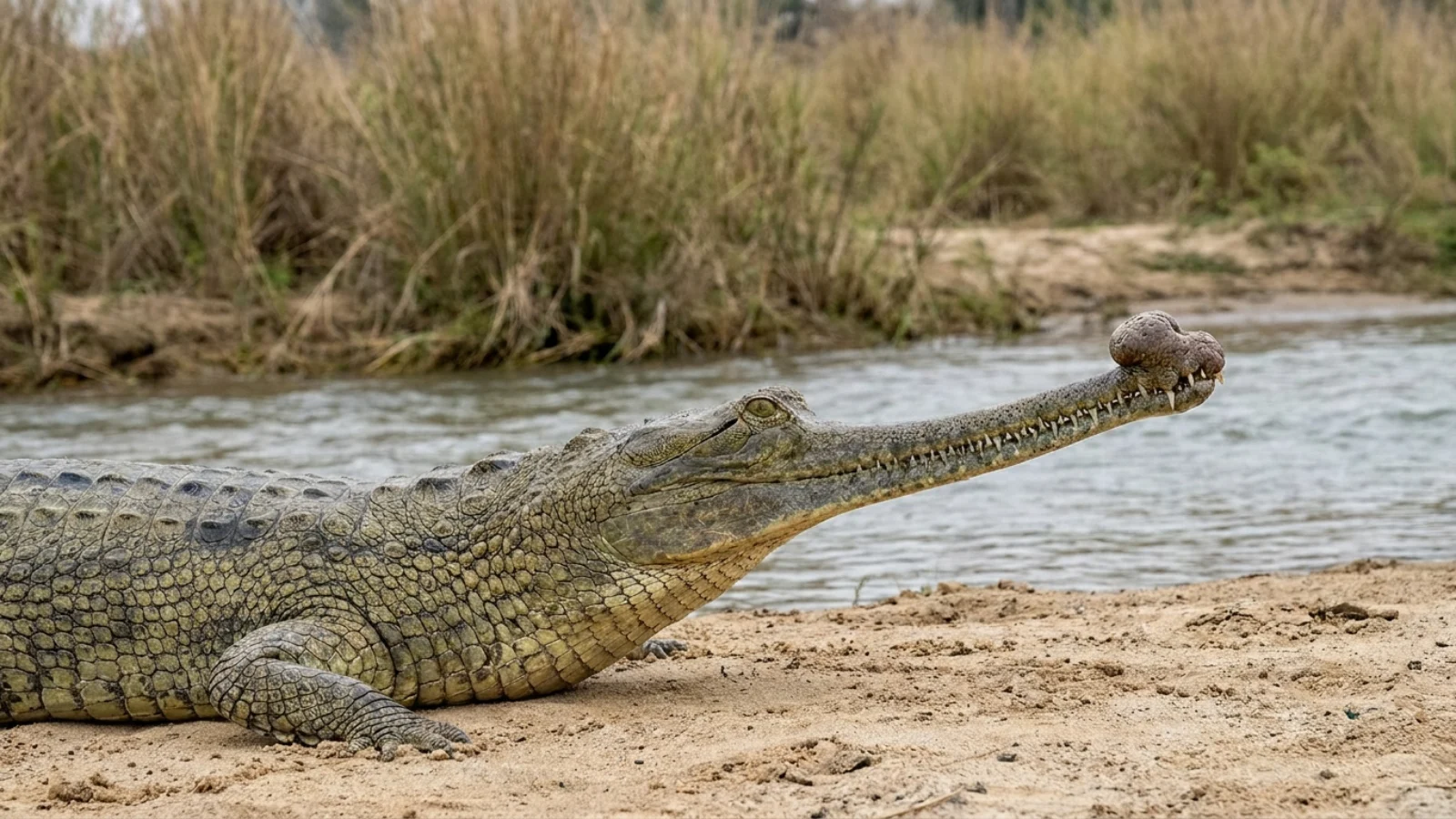
The gharial (Gavialis gangeticus) is a long, thin-snouted crocodilian that lives only in the rivers of northern India and Nepal and eats almost nothing but fish. Adult males can pass 5 m and sometimes approach 6 m, and grow a hollow, pot-shaped knob on the snout tip called a ghara. The species has been Critically Endangered on the IUCN Red List since 2007: only a few hundred breeding adults remain, most of them in the Chambal River.
Ghara is the Hindi word for an earthenware pot, the shape of the bulb on an adult male’s snout. “Gavial”, the older English name, is thought to be a European misspelling of the same word.
What is a gharial?
A gharial is a large crocodilian, a relative of crocodiles and alligators, that has specialised more completely than any of its cousins in catching fish. Its snout is so long and narrow that it looks almost like a beak, and it is lined with rows of small, needle-sharp teeth that interlock when the jaws close. The animal behind that snout can be as long as a saltwater crocodile, yet it is close to harmless to people because its jaws are too slender to tackle anything much bigger than a fish.
The gharial is the only living species in the genus Gavialis. It shares the family Gavialidae with one other living species, the false gharial or tomistoma (Tomistoma schlegelii) of Borneo, Sumatra and the Malay Peninsula. For decades anatomists placed the two in separate families, because the gharial’s skull is so distinctive, but DNA studies have repeatedly shown that they are each other’s closest relatives. The false gharial’s snout is thicker, tapers more gradually and carries fewer teeth, but the family resemblance is clear once you see them side by side.
Gharials are river animals. They need deep, fairly fast-flowing water with sandbanks where they can bask and dig nests, and they spend more time in the water than almost any other crocodilian. On land they are awkward. Their leg muscles are too weak to lift the body into the high walk that crocodiles and alligators use, so adults usually push themselves along on their bellies when they leave the water.
How big do gharials get?
Gharials are among the longest living crocodilians. Most published sources give adult lengths of about 3.5 to 6 m, and Britannica gives the full range as 4 to 6.5 m. Males are much larger than females: a big male is commonly 5 m or more, while females usually stop growing somewhere between about 3 and 4.5 m. Typical adult weights are quoted at around 160 to 180 kg, which is light for the length because so much of the animal is slender snout and tail.
Historic records of 7 m animals exist from the days of colonial hunting, but they are hard to check, and modern surveys rarely find animals that size. The great hunting and fishing pressure of the twentieth century removed most of the oldest, largest males, so the giant gharials that early naturalists described are probably now extremely rare or gone.
That length makes the gharial an impressive sight on a sandbank, but it is not an especially heavy animal. A saltwater crocodile of the same length can weigh several times as much, because of its broad head, deep body and heavy jaw muscles. The gharial’s build is designed for speed in the water, not for overpowering large prey.
What is the knob on a gharial’s nose?
The most famous feature of the gharial is the ghara, a hollow, bulbous growth on the tip of the snout of mature males. It develops as males reach breeding size and sits over the nostrils, partly covering them. It is made of soft tissue rather than bone, and it gives the end of the snout the look of a small clay pot balanced on a stick.
The ghara has two jobs that researchers are confident about. First, it acts as a resonating chamber. When a male exhales forcefully through his nose, air passing through the ghara produces a loud buzzing or humming sound that carries over the water during the breeding season. Second, it is a visual signal. Only mature males have it, so it advertises a male’s sex and status to females and rivals at a glance. Males have also been observed blowing bubbles through the nostrils during courtship, and the ghara may shape that display too.
Because only breeding males grow a ghara, it is also useful to scientists. Surveyors counting gharials from boats along the Chambal and other rivers can tell adult males apart from females and younger animals, which helps them track the ratio of the sexes in a population that has very few breeding adults.
What do gharials eat?
Adult gharials are almost entirely fish eaters. They do not lie in wait for antelope or cattle at the water’s edge the way Nile and saltwater crocodiles do. Instead, they hunt in the water, often in the current, by sweeping the long snout sideways through the water and snapping it shut on fish that come within reach. The narrow jaws meet very little resistance from the water, so they can move sideways much faster than the broad jaws of other crocodilians.
The teeth are adapted for this. Gharials have about 110 sharp teeth that interlock when the mouth closes, creating a cage that holds slippery fish. Once a fish is caught, the gharial usually lifts its head out of the water and works the prey around in the jaws so that it can be swallowed head first. Pressure-sensitive organs in the skin of the jaws, shared with other crocodilians, help them sense the vibrations of fish moving nearby, even in murky water.
Young gharials eat smaller prey, including insects, crustaceans and frogs, before moving on to fish as they grow. Gharials have also been seen feeding on human remains from funeral rites on the Ganges, where bodies are sometimes placed in the river. That observation is the root of an old belief that gharials are man-eaters, but there is no reliable evidence that a gharial has ever killed a person. Their jaws are simply not built for it.
How do gharials breed?
Gharials mate in the cool season, usually in December or January. Males are polygynous: a dominant male defends a stretch of river and mates with several females, using his ghara buzz and bubble displays to attract them and warn off other males. In a healthy population, a few big males therefore father most of the young, which is one reason why the loss of large males was so damaging.
Females nest in the dry season, around March and April, when sandbanks are exposed. Each female digs a hole in a sandbank above the waterline and lays a clutch of eggs, averaging about 40 according to most sources. Gharial eggs are among the largest laid by any crocodilian, weighing up to about 170 g each. The female covers the clutch with sand and stays nearby to guard it.
Incubation takes about 60 to 80 days. As in all crocodilians, the temperature of the nest during incubation determines the sex of each hatchling. The young hatch at the start of the monsoon, when the rivers rise, and the mother stays with them for weeks or even months. Hatchlings often gather in groups near the nest site under the protection of one or more adults. Even so, most do not survive their first year; floods wash them downstream and fish, birds and other predators take them.
Where do gharials live?
The gharial once lived in the major river systems of the northern Indian subcontinent: the Indus in Pakistan, the Ganges and its tributaries in India, the Brahmaputra in India and Bangladesh, and the Mahanadi in eastern India, with reports from Bhutan and Myanmar. Estimates suggest its range once covered more than 20,000 km of river. Today it survives in only a few fragments of that range, perhaps 2% of the original.
The most important population by far is in the Chambal River, which flows through the states of Rajasthan, Madhya Pradesh and Uttar Pradesh in central India. The river is protected as the National Chambal Sanctuary, which holds the large majority of the world’s breeding gharials. Smaller groups live on the Girwa River in Katarniaghat Wildlife Sanctuary, on the Son River, on parts of the Ganges and in the Rapti and Narayani rivers of Chitwan National Park in Nepal, plus a few other rivers where captive-raised animals have been released.
The species has disappeared from Pakistan and Bhutan, and very few, if any, remain in Bangladesh. Without action, the gharial could follow other large river animals of the region, such as the Ganges river dolphin, into further decline.
How many gharials are left?
Population figures for the gharial vary because they depend on what is being counted and when. Researchers estimate there were 5,000 to 10,000 wild gharials in the 1940s. By the mid-1970s, surveys found that the species had come close to extinction, with only a few dozen to a few hundred animals left across India, Nepal, Bangladesh and Pakistan.
In 2007 the IUCN uplisted the gharial to Critically Endangered after surveys showed that the number of breeding adults had fallen to about 200 to 250. Captive breeding and release programmes since then have helped, and recent estimates suggest roughly 650 mature adults, within a likely range of about 300 to 900. Counts that include juveniles are higher. The great majority of these animals live in the Chambal.
Those figures sound better than the low point of the 1970s, but the species remains fragile. A single disease outbreak, pollution event or dam project on the Chambal could affect most of the world’s breeding gharials at once. That is exactly what nearly happened in the winter of 2007–2008, when about 110 dead sub-adult gharials were found along the lower Chambal. Investigators traced the cause to toxins the animals had been exposed to in a stretch of the river itself, not to the polluted Yamuna as first suspected.
Why are gharials endangered?
The gharial’s decline was caused by people. Through the nineteenth and twentieth centuries, gharials were hunted for their skins and as trophies, and their eggs were collected for food and medicine. Males were sometimes killed for the ghara, which was believed to have medicinal value.
Today the biggest threats are to habitat. Dams, barrages and irrigation canals have reduced river flows and fragmented the long stretches of river that gharials need. Sand mining strips the sandbanks they use for basking and nesting. Fishing nets drown gharials, which become entangled while chasing fish, and overfishing reduces their food supply. Pollution from farms, towns and factories adds to the pressure.
The gharial’s way of life makes it especially sensitive to these changes. It cannot live in ponds, swamps or reservoirs, as many other crocodilians can, and it cannot walk overland to a new river. When its stretch of river is dammed, dredged or drained, it has nowhere to go.
Are gharials making a comeback?
Conservation work began in 1975, when India launched a crocodile conservation project with the support of the United Nations. Eggs were collected from the wild and hatched in breeding centres, and the young were raised in captivity until they were large enough to avoid most predators, then released into protected rivers. The Kukrail Gharial Rehabilitation Centre in Lucknow and the Gharial Breeding Centre in Chitwan National Park, Nepal, both established in the late 1970s, are two of the best-known programmes. Thousands of captive-reared gharials have been released since 1981.
Head-starting saved the species from extinction, but it is not enough by itself. Released animals need safe, connected rivers with fish and sandbanks to survive and breed. Conservation groups now focus on protecting the remaining nesting beaches, working with fishing communities to reduce deaths in nets, curbing illegal sand mining and monitoring the Chambal population each year.
The 2007–2008 die-off was a turning point. It led to a scientific task force, long-term tracking of gharials with radio tags and a much better understanding of how the animals use the river. Those studies showed that some gharials travel long distances along the river, which means that protected areas must cover entire river stretches, not just a few beaches.
How old is the gharial lineage?
Long-snouted crocodilians have evolved several times in the past, and the gharial is the last of an old line. Genetic estimates suggest that the gharial’s lineage split from other crocodilians more than 40 million years ago. Fossil gharials and their relatives are known from the Siwalik Hills of India and Pakistan, and from Africa, Asia and South America. Some extinct relatives lived in coastal waters, which helps explain how the group reached so many continents.
One of the most famous fossil relatives is Rhamphosuchus, a giant long-snouted crocodilian from the Miocene rocks of the Siwalik Hills. Early estimates made it one of the largest crocodilians that ever lived, although later studies reduced those figures considerably. Our guide to the largest prehistoric sea creatures covers the giant crocodilians that really did reach record sizes.
Gharial vs crocodile: what is the difference?
The easiest way to tell a gharial from a crocodile is the snout. A gharial’s snout is extremely long and narrow, with parallel sides along most of its length, and it widens suddenly at the tip. A crocodile’s snout is broader and more triangular, built to hold large prey. The gharial’s teeth are all very similar in size and shape, while crocodiles have a mixture of larger and smaller teeth.
Behaviour differs too. Crocodiles are generalists that will take mammals, birds and reptiles as well as fish, and several species are dangerous to people. Gharials are specialists that rarely leave the river. The marsh crocodile, or mugger, shares some rivers with the gharial in India and Nepal, and the contrast between the two is striking: the mugger has a broad, heavy snout, and our marsh crocodile profile covers that species. Our alligator vs crocodile guide covers how to separate the other crocodilian groups.
Where can you see a gharial?
In the wild, the best place to see gharials is the National Chambal Sanctuary in India, where boat trips on the river regularly pass gharials basking on sandbanks, along with mugger crocodiles, river dolphins and Indian skimmers. Chitwan National Park in Nepal also offers sightings on the Rapti and Narayani rivers, often from dugout canoes.
In the United States, a few zoos keep gharials. Here in Florida, the St. Augustine Alligator Farm Zoological Park, which opened in 1893, became the first place in the world to display every species of crocodilian in 1993, and gharials have long been part of its collection. Seeing one in person makes the strangeness of the animal clear: a crocodilian body with a snout that looks borrowed from a heron.
Is a gharial a crocodile?
A gharial is a crocodilian, the group that includes crocodiles, alligators and caimans, but it is not a true crocodile. It belongs to the family Gavialidae with the false gharial.
Are gharials dangerous to humans?
There is no reliable record of a gharial killing a person. Its narrow snout and small teeth are built for fish, although any large reptile should be given space.
How many teeth does a gharial have?
About 110 sharp, interlocking teeth, which act like a cage to trap slippery fish.
What is the bump on a gharial’s nose?
It is the ghara, a hollow growth found only on mature males. It amplifies a buzzing call and signals that the male is mature.
Where do gharials live?
In rivers of northern India and southern Nepal. Most breeding adults live in the Chambal River, within the National Chambal Sanctuary.
How many gharials are left in the wild?
Recent estimates put the number of mature adults at about 650, within a likely range of 300 to 900. Counts including young animals are higher.
Why is the gharial critically endangered?
Past hunting and egg collection, then dams, sand mining, fishing nets, overfishing and pollution that destroy or fragment its river habitat.
Do gharials live in Florida?
No. Gharials are native only to South Asia. In Florida they can be seen in zoos such as the St. Augustine Alligator Farm Zoological Park.
- Britannica, “Gharial (Gavialis gangeticus)”: size, teeth, range and IUCN listing.
- Live Science, “Gharial: the prehistoric crocodilian that buzzes and blows bubbles to find a mate”.
- San Diego Zoo Wildlife Alliance Library, Gharial fact sheet: population history (Whitaker 1974, 2007; Choudhury et al. 2007).
- IUCN Red List: Gavialis gangeticus (assessment 2017; Critically Endangered).
- ThePrint, on the 2008 Chambal gharial deaths and the Gharial Ecology Project.
- St. Augustine Alligator Farm Zoological Park history (opened 1893; all crocodilian species displayed from 1993).
Blane Perun has been exploring Earth’s oceans and marine life for over 25 years. Founder of TheSea.Org in 1999, underwater photographer, coral aquaculture pioneer, and explorer of 80+ countries.
About Blane Perun →