Yellow Moray Eel — The Temperate Moray of New Zealand and Southern Australia, and Its Tropical Namesakes
The yellow moray (Gymnothorax prasinus) is a temperate moray of New Zealand, the Kermadec Islands, southern Australia and Tasmania, where it is the only moray known. Published maximum lengths range from 80 cm to 1.5 m. It is plain brown, dirty yellow or green with a pale streak on top of the head, and lives in holes and crevices on rocky reefs to about 40 m, feeding mainly on crabs and fish. It is one of the few morays adapted to temperate water. In the tropics, “yellow moray” can also refer to the yellow-edged moray or the yellowmouth moray.
Most of the world’s moray eels are tropical reef fish, and only a handful have made a living in cool water. The yellow moray is one of them. A 2001 museum revision described it as a well-known species of the south temperate waters of Australia and New Zealand, said to be common off New Zealand and south-eastern and south-western Australia. In Australia it goes by a different name, and it is the only moray known from Tasmania. This page sets out what is actually documented about the species, where the published sources disagree, and how to tell it apart from the several tropical morays that are also sold or described as “yellow morays”. For the general biology shared by all morays, see the moray eels overview.
What does the yellow moray look like?
A medium-sized, plain-coloured moray: brown, dirty yellow or green in life, with no spots or bars, and a pale streak along the top of the head flanked by darker bands. Our guide to eel colours compares it with other yellow, green and blue eels.
The most detailed modern description comes from E.B. Böhlke and J.E. McCosker’s 2001 revision of the moray eels of Australia and New Zealand, which examined 39 specimens between 155 and 855 mm long. In preservative the body and fins are a uniform dark brown, usually coated in a pale, greenish mucus. The head is paler brown, with a pale stripe running down the midline from the snout to behind the eyes, bordered on each side by a darker stripe. The nostrils and the sensory pores on the head are dark and stand out against the head colour, and the tip of the tail is sometimes pale. In life the body colour ranges from brown to dirty yellow to green, and the authors suggest that the green may come partly from the thick layer of mucus rather than from the skin itself. The Australian Museum adds that the head is usually orange in living fish.
That plain colouring is the key field mark. Many of the morays that share its range are spotted, mottled, barred or patterned in mosaics; the yellow moray is not. Böhlke and McCosker wrote that it is “readily recognised” by its uniform body colour combined with the contrasting snout streak and the dark nostrils and head pores. Older descriptions that mention fine freckles or mottling over the body are not supported by that revision, and a patterned eel in New Zealand or southern Australia is more likely to be one of the other species described further down this page.
Structurally it is a typical Gymnothorax moray. It has no pectoral or pelvic fins, a continuous dorsal fin that begins just behind the head, and a tail that is flattened from side to side. The jaw teeth are stout and smooth-edged rather than serrated, with a short inner row of longer teeth in the upper jaw in fish of all sizes, three stout teeth along the centre line of the palate area, and a row of 9 to 14 small teeth on the vomer, the bone in the roof of the mouth. Böhlke and McCosker counted 134 to 140 vertebrae. The Australian Museum notes that the mouth extends well behind the eye, and that the two nostrils on each side of the head are unusually far apart: the front pair sit on the snout at the end of tubes, while the rear pair, with shorter tubes, lie above the eyes.
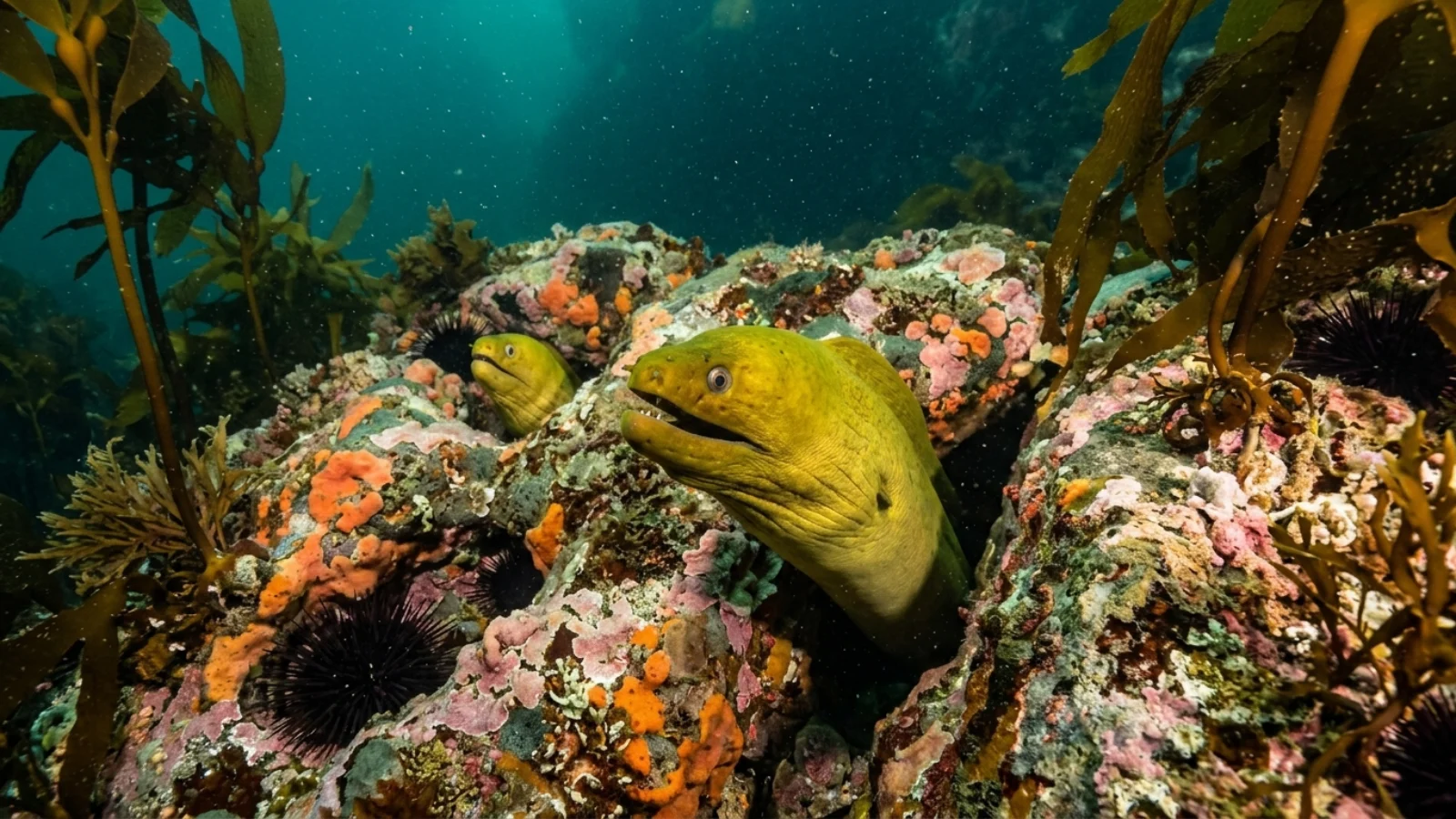
Yellow moray, green moray or southern green moray?
The same fish carries different common names on either side of the Tasman Sea. Böhlke and McCosker recorded that it is generally called the “green moray” in Australia and the “yellow moray” in New Zealand, and the Australian Museum still lists it as the green moray. Because the Caribbean Gymnothorax funebris and an eastern Pacific species are also called green morays, the 2001 revision proposed “southern green moray” as a standard name to avoid confusion. All three names refer to Gymnothorax prasinus.
The scientific name is descriptive. The Australian Museum explains Gymnothorax as “bare chest”, from Greek words for naked and chest, and the species name as coming from the Greek prasinos, leek-green. The colour that gives it the name is variable enough that the English names settled on two different colours.
How was the yellow moray first described?
The species was named Muraena prasina by J. Richardson in 1848. According to Böhlke and McCosker, his description was based on a dried skin 23.5 inches long, collected by a Mr McGillivray, together with notes made when the fish was caught, and the type locality was Bondi Bay in Sydney. The holotype was rediscovered in 1995 in the dry collection of the Natural History Museum in London. The head and the skin of the left side had been mounted on a strip of wood so that it looked like a whole stuffed fish, and the base had been labelled with another name, Muraena afra, an eastern Atlantic species under which the specimen had once been filed. The original name and locality were found pencilled underneath.
Over the following century the same moray was described again several times under other names, which were later merged into G. prasinus. They include Gymnothorax jacksoniensis from Port Jackson (1863), Muraena callorhyncha from Fremantle in Western Australia (1870), Muraena krulli from the Bay of Islands in New Zealand (1877), whose type specimen is believed lost, and Gymnothorax leecote, described in 1965 from a fish caught in a crayfish net set at 10 fathoms off north-eastern Tasmania. In 1931 the Australian ichthyologist Whitley went further and created a separate genus, Verdithorax, for the species, without giving a reason; it was soon absorbed back into Gymnothorax. The 2001 revision added Gymnothorax maculaepinnis to the list of synonyms.
Where does the yellow moray live?
FishBase gives the range as the south-west Pacific: New Zealand, the Kermadec Islands and southern Australia. Böhlke and McCosker place it in western, southern and south-eastern Australia, Tasmania and New Zealand, all south of 26°S, and they note as a curiosity that it is the only moray known to live in Tasmania. The Australian Museum describes the Australian range as temperate coastal waters from south-eastern Queensland to Shark Bay in Western Australia, including northern Tasmania. In New Zealand, Wikipedia gives the range as North Cape to the Māhia Peninsula on the North Island. A specimen once reported from Cape Radstock in far western South Australia is considered to have been outside the species’ normal range.
The habitat is broad for a moray. The Australian Museum lists shallow rocky reefs, weed-covered reefs, estuaries and deeper offshore water, and FishBase gives a maximum depth of about 40 m. Like most morays it spends the day in holes and crevices, usually with only the head showing, and it will use man-made shelters such as pipes.
How big does the yellow moray get?
Published maximum sizes vary widely, and no single figure should be treated as definitive. FishBase gives a maximum total length of 91.5 cm. The identification key in the 2001 revision gives “to 80 cm”, and the largest of the 39 specimens examined for that study was 855 mm, a fish from Victoria; the Tasmanian holotype of G. leecote measured 815 mm. The Australian Museum gives a much larger maximum of 1.5 m, while saying that the species commonly reaches about 1 m. The safest summary is that adults are commonly somewhere around 80 cm to 1 m, with larger fish reported.
What is known about its life cycle?
Very little. Böhlke and McCosker reported that none of the specimens they examined, up to 855 mm long, was sexually mature, and FishBase has no data on the size or age at maturity. Spawning has not been described for the species. Like all eels, morays have a transparent, leaf-shaped larva called a leptocephalus that drifts in the plankton of the open sea before settling and transforming into a juvenile, and the Australian Museum notes that this larval stage is shared by every eel family. The long drifting stage is the most likely explanation for how a single species can occupy coastlines separated by the Tasman Sea, but no study has yet traced the larvae of this particular moray.
How far does a yellow moray move?
The only published tracking work is a short 2011 paper in the Journal of Fish Biology by D. Bassett and J. Montgomery, who followed yellow morays with acoustic telemetry in northern New Zealand. Their summary is that the eels used multiple sites within a localised area, in other words a home range made up of several shelters rather than a single fixed den. That fits what has been found for tropical relatives: a long-term tracking study of the spotted moray in Belize also found eels switching between several holes within a small area.
What does the yellow moray eat?
FishBase summarises the diet as mainly crabs and fish. The Australian Museum describes the hunting method common to morays in its range: the eel waits in a crevice and darts out to seize invertebrates and fish, using the side-to-side body waves known as anguilliform swimming, and can reverse almost as efficiently to retreat into shelter. The flattened tail and well-developed dorsal fin act like the blade of an oar and make those short bursts more efficient.
The same source notes that morays can tie their bodies into knots to gain leverage when tearing prey apart, a behaviour that was long dismissed as a story before being confirmed. Smell plays a large part in finding food, and the widely spaced, tubed nostrils of the yellow moray are part of that system. Once prey is caught, morays swallow it with a second set of jaws in the throat, which is covered in the moray skull and second jaws page. The smooth, pointed teeth of the yellow moray are those of a grasping predator of fish and soft-bodied prey, quite unlike the flattened, crushing teeth of the shell-eating zebra moray.
Which other morays live in New Zealand and temperate Australia?
The 2001 revision recognised 59 moray species from Australia and New Zealand, most of them tropical species from northern Australia. Only seven were found to be limited to temperate waters south of about 25°S: the yellow moray, the mosaic moray (Enchelycore ramosa), Gymnothorax annasona, the newly described G. austrinus, the cloudy moray (G. nubilus), the obese moray (G. obesus) and the lowfin moray (G. porphyreus). Several of these reach New Zealand, so a moray seen there is not automatically a yellow moray.
The mosaic moray is the most distinctive. It has a long snout with curved jaws and needle-like teeth that remain visible when the mouth is closed, and a pale body overlain with a brown to dark mosaic pattern; the revision gives a length of up to 150 cm and a range of south-eastern Australia, New Zealand and Easter Island. The Australian Museum notes that it feeds at night on fishes and crustaceans. It belongs to the same genus as the Indo-Pacific dragon moray. The obese moray is a large, deep-water species, dark brown with small, close-set pale spots, recorded to 170 cm in the key; a New Zealand specimen originally described as a separate species, Muraena tuhua, was said to come from 146 m. The lowfin moray is dark with darker mottling and spots and dark nostrils and head pores, reaching about 130 cm, and has an unusual range that runs from the Kermadec, Lord Howe and Norfolk islands and New Zealand to Easter Island, Chile and Peru. The cloudy moray is smaller, said to reach 680 mm, with brown and pale reticulations forming cloud-like spots and a pale margin on the anal fin. A spotted species, the saw-tooth moray (G. prionodon), also occurs in south-eastern Australia and New Zealand.
The revision also pointed out that morays are routinely under-counted because they hide. It cited a 1979 study by Brock, Lewis and Wass on a patch reef in Kāneʻohe Bay, Oʻahu, in which ichthyocides (fish poisons) were used to sample the fish community, and morays turned out to make up as much as 47% of the carnivorous fish biomass. The Australian Museum, citing Hawaiian reefs more generally, gives the figure as 46%. Nothing comparable has been measured for the yellow moray, but the point stands for temperate reefs too: a predator that spends the day out of sight is easily overlooked in visual surveys.
Is the yellow moray dangerous?
The Australian Museum states that, despite their appearance, morays are not considered dangerous to people, although larger individuals can inflict serious wounds. It also notes reports that some species have poor eyesight, which may explain why morays occasionally bite divers’ hands, perhaps mistaking them for an octopus. The practical advice is the same for any moray: do not put hands into crevices, and do not hand-feed eels. The food-safety issue that applies to some large tropical morays, ciguatera poisoning, is covered on the honeycomb moray page.
Is the yellow moray threatened?
The species is listed as Least Concern on the IUCN Red List. The assessment, by D.G. Smith, K. Tighe and J. McCosker, is dated 18 August 2011, and FishBase reports the same status in version 2025-2 of the Red List. No population counts or trend data have been published for the species, so the listing rests on its wide range rather than on monitoring.
Which other morays are called ‘yellow morays’?
Outside New Zealand, “yellow moray” is used loosely for several tropical species with yellow in their colouring. None of them is closely related to G. prasinus in any special way; they simply share a colour word. The table below summarises them, and the notes that follow give the details.
| Species | Where | Max size (sources differ) | ID |
|---|---|---|---|
| Yellow moray (G. prasinus) | NZ, S Australia, Tasmania | 80 cm–1.5 m | Plain brown, yellow or green; pale head streak, dark nostrils |
| Yellow-edged moray (G. flavimarginatus) | Indo-Pacific, E Pacific | 1.2–2.4 m | Yellowish, densely mottled brown; yellow-green rear fin edge; black blotch at gill opening |
| Yellowmouth moray (G. nudivomer) | Indo-Pacific | 1–1.8 m | Brown with pale spots, small at the head and larger toward the tail; yellow inside mouth |
| Dirty yellow moray (G. melatremus) | Indo-Pacific incl. Hawaii | 26–30 cm | Golden to brown; dark spot around gill opening; blue eye |
| Yellowhead or banded moray (G. rueppelliae) | Indo-Pacific | ~80 cm | 16–21 dark bars; yellow top of head; dark spot at corner of mouth |
The yellow-edged moray
The yellow-edged or yellow-margined moray (Gymnothorax flavimarginatus) is the large tropical eel most often meant when divers talk about a yellow moray. FishBase describes it as yellowish and densely mottled with dark brown, with a purplish-grey front to the head, reddish eyes, a black blotch around the gill opening and yellow-green rear margins on the fins. Juveniles are sometimes bright yellow with brown blotches. The Australian Museum quotes the moray specialist John Pogonoski as noting that in preserved specimens the yellow margin is very narrow and largely restricted to the rear of the tail, so the name is more useful underwater than in a museum jar.
It is widespread: FishBase lists South Africa and the Red Sea east to the Tuamotu and Austral islands, north to the Ryukyu and Hawaiian islands, south to New Caledonia, and across to Costa Rica, Panama and the Galápagos, from the surface to about 150 m. Sizes again vary by source: FishBase gives a maximum of 240 cm, Wikipedia notes that a more typical length is about 80 cm, and the Australian Museum gives 1.2 m. It lives on coral or rocky reef flats, protected shorelines and seaward reefs, usually alone and with its head out of a hole, and Wikipedia describes it as mainly nocturnal but also swimming in the open in the morning and evening. Its diet includes fish, cephalopods and crustaceans.
FishBase records a striking piece of behaviour: the eel most often appears on the reef after a fish has been speared in daylight, and the speed and regularity of those appearances show that it is especially sensitive to signals from an injured or stressed fish. Wikipedia adds that it sometimes shares a shelter with others of its kind or with other morays, that it has been reported as a natural predator of the lionfish Pterois miles in the Red Sea, and that a small shrimp, Stenopus pyrsonotus, has often been found close to it, raising the possibility of a cleaning relationship. FishBase also notes that it is eaten in some parts of the Indo-Pacific. It is listed as Least Concern.
The yellowmouth moray
The yellowmouth moray (Gymnothorax nudivomer) is brown with pale spots and gets its name from the bright yellow lining of its mouth, which shows whenever it opens its mouth. The spots follow a distinctive pattern: FishBase describes them as small and numerous toward the head and larger and more widely spaced toward the tail, and the Australian Museum describes a light brown fish with white spots at the front that becomes darker toward the back, with a dark blotch around the gill opening. Wikipedia also gives “starry moray” as a name for it, which is easily confused with the snowflake or starry moray of the genus Echidna, a completely different fish.
It ranges from the Red Sea and South Africa to Hawaii and the Marquesas, north to the Ryukyu Islands and south to New Caledonia, and in Australia it is known from tropical Western Australia and from the Great Barrier Reef to northern New South Wales. FishBase records it from 2 to 271 m, usually below about 30 m, and mainly at oceanic locations on inner and outer reef slopes. FishBase gives a maximum of 180 cm, while the 2001 key gives 100 cm. Large individuals have a relatively short, blunt snout, lack teeth on the vomer and along the centre of the upper jaw, and have finely serrated large teeth. FishBase also notes that its skin mucus is toxic.
The dirty yellow moray
At the other end of the size scale is Gymnothorax melatremus, known as the dirty yellow moray, blackspot moray or dwarf moray. FishBase gives a maximum length of 30 cm and Wikipedia 26 cm, making it one of the smallest morays. FishBase describes it as golden with a dark spot around the gill opening, but variable from brown to bright golden yellow, with a deep blue eye. It has short, conical teeth and no canines. It lives in holes and crevices of seaward reefs from the surge zone to over 26 m, with a recorded depth range of 1 to 58 m, and is solitary, secretive and seldom seen. Its range runs from East Africa to the Marquesas and Mangareva, north to Hawaii and south to the Austral Islands. Wikipedia notes that it occasionally enters the aquarium trade.
The yellowhead or banded moray
Gymnothorax rueppelliae has a long list of common names, including banded moray, Rüppell’s moray and yellow-headed moray. FishBase describes it as pale greyish brown with 16 to 21 dark bars that become indistinct in large individuals, a yellow top to the head and a dark brown spot at the corner of the mouth. It reaches about 80 cm and is found in clear lagoons and on seaward reefs from the Red Sea and East Africa to Hawaii, the Tuamotus and the Marquesas, from the shallows to about 40 m, and FishBase also lists it from brackish water. Adults feed on fish and crustaceans, mainly at night, and FishBase describes the species as nervous and aggressive.
How to tell them apart
Geography does most of the work. A plain-coloured moray on a temperate reef in New Zealand, Tasmania or southern mainland Australia is almost certainly G. prasinus, and the pale streak on top of the head with dark nostrils confirms it. On a tropical reef, a large mottled eel with a black gill blotch and a yellow-green tail edge is a yellow-edged moray; a spotted eel with a yellow mouth is a yellowmouth moray; a small golden eel with a dark ring around the gill opening is a dirty yellow moray; and a pale, barred eel with a yellow crown is a banded moray. For the wider range of species, see types of moray eels and the spotted eel identification guide.
Where do yellow morays live?
Gymnothorax prasinus lives on rocky reefs, weedy reefs and in estuaries in New Zealand, the Kermadec Islands, southern Australia and Tasmania, to about 40 m.
How big do yellow morays get?
Sources differ: FishBase gives 91.5 cm, a 2001 museum revision gives about 80 cm (largest specimen examined 855 mm), and the Australian Museum gives up to 1.5 m, commonly about 1 m.
Are yellow moray eels dangerous?
Morays are not considered dangerous to people, but larger ones can inflict serious wounds if handled, fed or approached in their crevices.
What do yellow morays eat?
Mainly crabs and fish.
Are there morays in New Zealand?
Yes. Besides the yellow moray, species recorded from New Zealand include the mosaic, cloudy, obese, lowfin and saw-tooth morays.
What is the yellow-edged moray?
A large Indo-Pacific moray (G. flavimarginatus) recorded at 1.2–2.4 m depending on source, yellowish and densely mottled with brown, with a black gill blotch and yellow-green rear fin margins.
Is the yellow moray the same as the green moray?
In Australia Gymnothorax prasinus is called the green moray; it is a different species from the Caribbean green moray, G. funebris. A 2001 revision proposed the name southern green moray to avoid confusion.
- Böhlke, E.B. & McCosker, J.E. (2001). The moray eels of Australia and New Zealand, with the description of two new species (Anguilliformes: Muraenidae). Records of the Australian Museum 53: 71–102. doi:10.3853/j.0067-1975.53.2001.1325
- Bassett, D. & Montgomery, J. (2011). Home range use and movement patterns of the yellow moray eel Gymnothorax prasinus. Journal of Fish Biology 79: 520–525. doi:10.1111/j.1095-8649.2011.03018.x
- Australian Museum. Green Moray, Gymnothorax prasinus; Mosaic Moray, Enchelycore ramosa; Yellowmargin Moray, G. flavimarginatus; Yellowmouth Moray, G. nudivomer (species pages).
- FishBase (Froese & Pauly, eds.), species summaries. Gymnothorax prasinus, G. flavimarginatus, G. nudivomer, G. melatremus, G. rueppelliae.
- Brock, R.E., Lewis, C. & Wass, R.C. (1979). Stability and structure of a fish community on a coral patch reef in Hawaii. Marine Biology. doi:10.1007/BF00395790
- Smith, D.G., Tighe, K. & McCosker, J. (2011). Gymnothorax prasinus. IUCN Red List of Threatened Species. doi:10.2305/IUCN.UK.2019-1.RLTS.T195781A2417073.en
- Wikipedia: Yellow moray; Yellow-edged moray; Gymnothorax nudivomer; G. melatremus; G. rueppelliae.
Blane Perun has been exploring Earth’s oceans and marine life for over 25 years. Founder of TheSea.Org in 1999, underwater photographer, coral aquaculture pioneer, and explorer of 80+ countries.
About Blane Perun →More on Eels →