Electric Eel — Not an Eel at All — and It Packs 860 Volts
An electric eel is a large South American freshwater fish of the genus Electrophorus that stuns prey and predators with electric shocks. Despite its name, it is not a true eel: it is a knifefish, more closely related to catfish and carp than to morays or congers. Electric eels grow to about 2.5 metres, breathe air at the surface, and three species are now recognised. One of them, Volta’s electric eel (Electrophorus voltai), has been measured at 860 volts — the strongest electric discharge recorded from any animal. (It isn’t the only fake eel: the air-breathing rice field eel now loose in Florida is a swamp eel.)
The electric eel belongs on any list of bizarre animals, even on a sea site, because it breaks two assumptions at once: it is not an eel, and it lives in fresh water. It also does something no other vertebrate does as well. It even raises its young in foam nests guarded by the father (see how electric eels reproduce). It turns most of its body into a biological battery and uses it to hunt, to defend itself and to “see” in murky water. (How it finds and stuns fish is covered in what electric eels eat.) Marine life has its own electric fish — torpedo rays and stargazers — but none comes close to the electric eel’s output.
Is an electric eel actually an eel?
No. The electric eel is a knifefish in the order Gymnotiformes. True eels belong to the order Anguilliformes. The two groups only look alike because both have long, snake-like bodies. (Before anyone understood electricity, it went by names such as “the trembler”; see what electric eels were called before electricity. For a side-by-side with a true eel, see moray eel vs electric eel.)
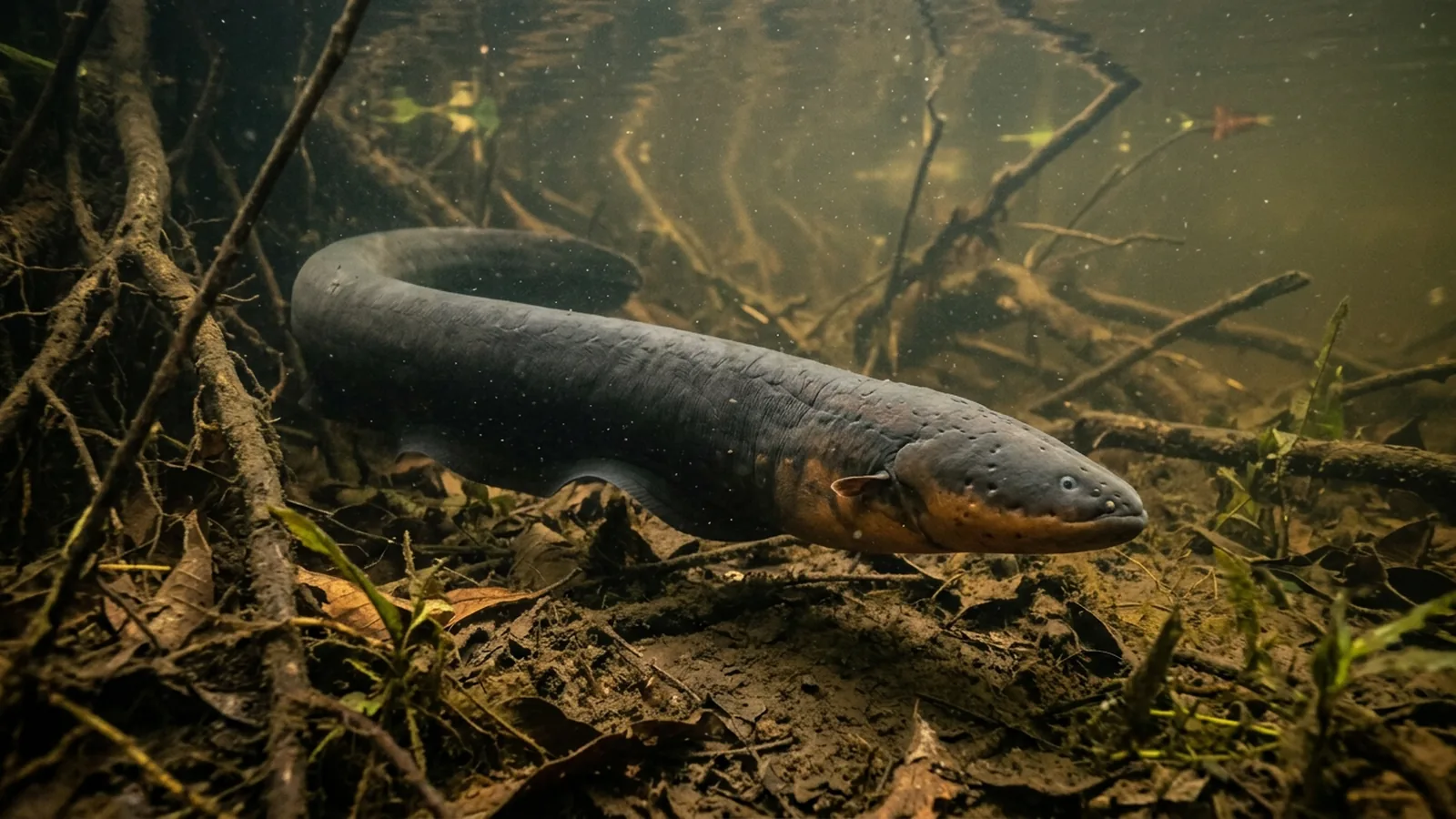
Look closely and the differences are obvious. True eels such as moray eels and conger eels have a dorsal fin running along the back. The electric eel has no dorsal fin at all. Instead, a long ribbon-like anal fin runs along its underside, and it swims by rippling that fin, which lets it glide forward or backward with a rigid body. That is the knifefish method of swimming.
Genetically, electric eels sit in a branch of fishes that includes catfish, carp and characins (the tetras and piranhas). They are much closer to a catfish than to a moray. For more on true eels, see our guide to eels and the question are eels related to snakes?
How many volts can an electric eel produce?
Electric eels typically produce discharges of several hundred volts. Volta’s electric eel set the record at 860 volts, measured in 2019; the previous record was 650 volts.
The 860-volt figure comes from a 2019 study in Nature Communications led by Carlos David de Santana of the Smithsonian’s National Museum of Natural History. Analysing 107 specimens from Brazil, Suriname, French Guiana and Guyana, the team found that what had been treated as one species since Linnaeus described it in 1766 was actually three. Discharges differ between them: E. varii, for example, was measured at 151–572 volts.
High voltage does not mean high power for long. An electric eel’s discharge is low in current, around 1 amp, and lasts only milliseconds per pulse. It fires in bursts — volleys of hundreds of pulses per second — which is what makes the shock so effective at locking up a prey animal’s muscles.
How does an electric eel make electricity?
An electric eel makes electricity with thousands of modified muscle cells called electrocytes, stacked in three electric organs that fill most of its body. Firing them together adds their small voltages up like batteries in series.
Each electrocyte produces only a tiny voltage, about the same as a nerve cell. But electrocytes are flat, disc-shaped cells stacked in long columns from head to tail, and when the eel’s nervous system triggers them at the same instant, their voltages add. Thousands in series produce hundreds of volts.
The electric eel has three organs. The main organ and Hunter’s organ produce the powerful hunting and defensive shocks. Sachs’ organ generates weak low-voltage pulses used for electrolocation: the eel senses distortions in its own electric field to detect objects and prey in dark, muddy water. Its vital organs are packed into the front part of the body, behind the head; most of the long tail is electric organ.
Electric eels also use high-voltage pulses as a kind of remote control. Research by Kenneth Catania at Vanderbilt University showed that short doublets of high-voltage pulses make hidden prey twitch, revealing its position, and that full volleys cause involuntary muscle contractions that immobilise prey before the eel strikes.
What are the three species of electric eel?
The three species are Electrophorus electricus, E. voltai and E. varii, separated by geography and water type in northern South America.
| Species | Range | Notes |
|---|---|---|
| E. electricus | Guiana Shield: northern Brazil, Guyana, Suriname, French Guiana | The original species, described by Linnaeus in 1766 |
| E. voltai | Brazilian Shield, south of the Amazon | Clear, fast, oxygen-rich upland rivers; record 860 V; named for Alessandro Volta |
| E. varii | Lowland Amazon Basin | Murky, low-oxygen water; 151–572 V; named for Smithsonian ichthyologist Richard Vari |
The study suggests the lineages split from a common ancestor about 7.1 million years ago, with E. voltai and E. electricus separating around 3.6 million years ago. The discovery that a large, famous animal studied for centuries was actually three species shows how much is still unknown about Amazonian biodiversity.
Do electric eels hunt in packs?
Usually not, but at least one population does. In 2021 researchers described more than 100 Volta’s electric eels hunting together in a lake on Brazil’s Iriri River.
Electric eels were thought to be solitary. Then scientists working along the Iriri River in Pará state documented a group of more than 100 adults, many over 1.2 metres long, living in a small river-fed lake. At dawn and dusk the eels swam in a large circle to herd shoals of small tetras into shallow water. Bands of 2 to 10 eels then split off and fired simultaneous high-voltage shocks into the packed fish, which were stunned and eaten. Each hunt lasted about an hour, with 5 to 7 attacks.
The study, published in Ecology and Evolution, was the first to describe social hunting in electric eels. It is one of the few known cases of group hunting in fishes, and the only one involving coordinated electric attack.
Why do electric eels breathe air?
Electric eels are obligate air-breathers. They get most of their oxygen by surfacing to gulp air, which lets them live in warm, stagnant, oxygen-poor water where other fish struggle.
The mouth lining is heavily folded and packed with blood vessels, and works as a breathing surface. An electric eel has to come up regularly to breathe and will drown if it cannot reach the surface. The adaptation makes sense in floodplain lakes and slow rivers, where the water can be nearly oxygen-free in the dry season.
Electric eels are top predators in those waters. Adults eat fish, crustaceans and occasionally small amphibians and mammals; young eels eat invertebrates. Males build nests from saliva foam at the surface, where females lay eggs, and the male guards the nest and young.
Can an electric eel kill a human?
An electric eel can deliver a painful and dangerous shock, but deaths are rare. The risk is that repeated shocks cause a person to collapse and drown in shallow water, or affect someone with a heart condition.
The shock is high voltage but low current and brief. A single discharge is unlikely to kill a healthy adult directly. The danger rises in the water: repeated volleys can cause respiratory paralysis or loss of muscle control, leading to drowning. Eels also defend themselves aggressively. Catania’s experiments showed that a threatened eel will leap partly out of the water and press its chin against a threat, sending current directly through it instead of through the water — a behaviour that matches a famous 1800 account by Alexander von Humboldt of eels attacking horses driven into a pool in Venezuela.
Electric eels are not assessed as threatened by the IUCN; they are widespread across a huge range. Their biggest risks are dams and habitat change in the Amazon basin.
Is an electric eel an eel?
No. Electric eels are knifefishes (order Gymnotiformes), more closely related to catfish and carp than to true eels such as morays and congers.
How many volts is an electric eel?
Electric eels usually produce several hundred volts. Volta’s electric eel (Electrophorus voltai) holds the record at 860 volts, the strongest discharge measured in any animal.
Can an electric eel kill you?
Rarely. The shock is high voltage but low current. The main danger is that repeated shocks cause a person to lose muscle control and drown, or affect people with heart problems.
Do electric eels live in the ocean?
No. All three species live in fresh water in the Amazon, Orinoco and Guiana Shield rivers of northern South America.
How big do electric eels get?
Up to about 2.5 metres long. Adults over 1.2 metres are common.
How do electric eels not shock themselves?
Their vital organs are packed near the head and insulated by fatty tissue, and the current takes the path of least resistance through the water rather than through their own body. Exactly how much protection this gives is still studied.
How many species of electric eel are there?
Three: Electrophorus electricus, E. voltai and E. varii, identified as separate species in a 2019 study.
Why do electric eels breathe air?
They are obligate air-breathers adapted to warm, oxygen-poor water. They surface regularly to gulp air and can drown if they cannot reach the surface.
What do electric eels eat?
Adults eat mainly fish, plus crustaceans and occasionally small amphibians and mammals. Young eels eat invertebrates.
Blane Perun has been exploring Earth’s oceans and marine life for over 25 years. Founder of TheSea.Org in 1999, underwater photographer, coral aquaculture pioneer, and explorer of 80+ countries.
About Blane Perun → More on Bizarre Sea Creatures →