Spotted Eel — A Diver’s Guide to the Eels That Wear Spots
“Spotted eel” is a common name, not a single species. Divers and anglers use it for several unrelated eels with spotted skin. In the Atlantic it usually means the spotted moray (Gymnothorax moringa) or the spotted snake eel (Ophichthus ophis); in the Indo-Pacific the snowflake moray (Echidna nebulosa), the tiger snake eel (Myrichthys maculosus) or the spotted garden eel (Heteroconger hassi). Ocean, habitat and body shape quickly tell you which one you saw. (A plain olive eel in a river or creek is more likely an American eel.)
At least half a dozen common eels are spotted, and they belong to four different families: morays, snake eels, conger and garden eels, and freshwater eels. Three questions, which ocean, which habitat and what the eel was doing, narrow the choice quickly. This guide describes each candidate in turn, using FishBase descriptions and other published sources.
Which spotted eels live in the Atlantic and Caribbean?
The classic Caribbean ‘spotted eel’ is the spotted moray, Gymnothorax moringa. FishBase describes it as a moderate-sized moray with distinct small, round, overlapping dark brownish to purplish-black spots on a white or pale yellow background. It is commonly about 60 centimetres long and can reach 2 metres, with a maximum published weight of about 2.5 kilograms. Its range runs from North Carolina and Bermuda through the Gulf of Mexico and the Caribbean to south-eastern Brazil, with outposts on the mid- and eastern Atlantic islands of Ascension and St Helena. It is usually found between the surface and 35 metres, though it has been recorded to 200 metres.
The spotted moray is abundant in shallow rocky and grassy areas and on coral reefs, and less common in turbid bays and harbours. Divers usually see only the head, protruding from a hole with the body hidden. Unlike many morays it is active during the day, sometimes hunting alongside other predators, and it feeds on fish and crustaceans. Among its many local names are conger, red moray, speckled moray and white-jawed moray, which shows how loosely ‘spotted eel’ and even ‘conger’ are used. FishBase warns that its bite is very dangerous and records observations of unusually aggressive behaviour towards people. It supports a minor fishery and is sold fresh and salted.
The second Atlantic candidate is the spotted snake eel, Ophichthus ophis, a much longer and more reclusive animal. It grows to 2.1 metres, though about 1 metre is a common length, and has a pale body with a dark band across the back of the head. It lives permanently in a burrow, often in very shallow water, with only its head protruding diagonally from the sand. It is nocturnal and feeds mainly on octopus and fish. FishBase calls it bold and easily approached and notes that fishers fear it. It occurs from Bermuda and southern Florida to Brazil and in the eastern Atlantic from Senegal to Angola.
Two smaller Atlantic eels add to the confusion. The goldentail moray, Gymnothorax miliaris, is dark brown covered in yellow dots that are smallest on the head and largest towards the tail, which ends in a pale or deep yellow tip. It reaches about 70 centimetres, is one of the most common and easily recognised morays of West Indian reefs, and, like the spotted moray, is often active in daylight. A largely yellow colour form is sometimes called the ‘banana eel’. The sharptail eel, Myrichthys breviceps, is a snake eel up to about 1 metre long, light brown to greyish brown with pale spots. It is commonly seen swimming near the bottom in clear, shallow water from harbours to reefs, mostly shallower than 9 metres, and feeds mainly on crabs.
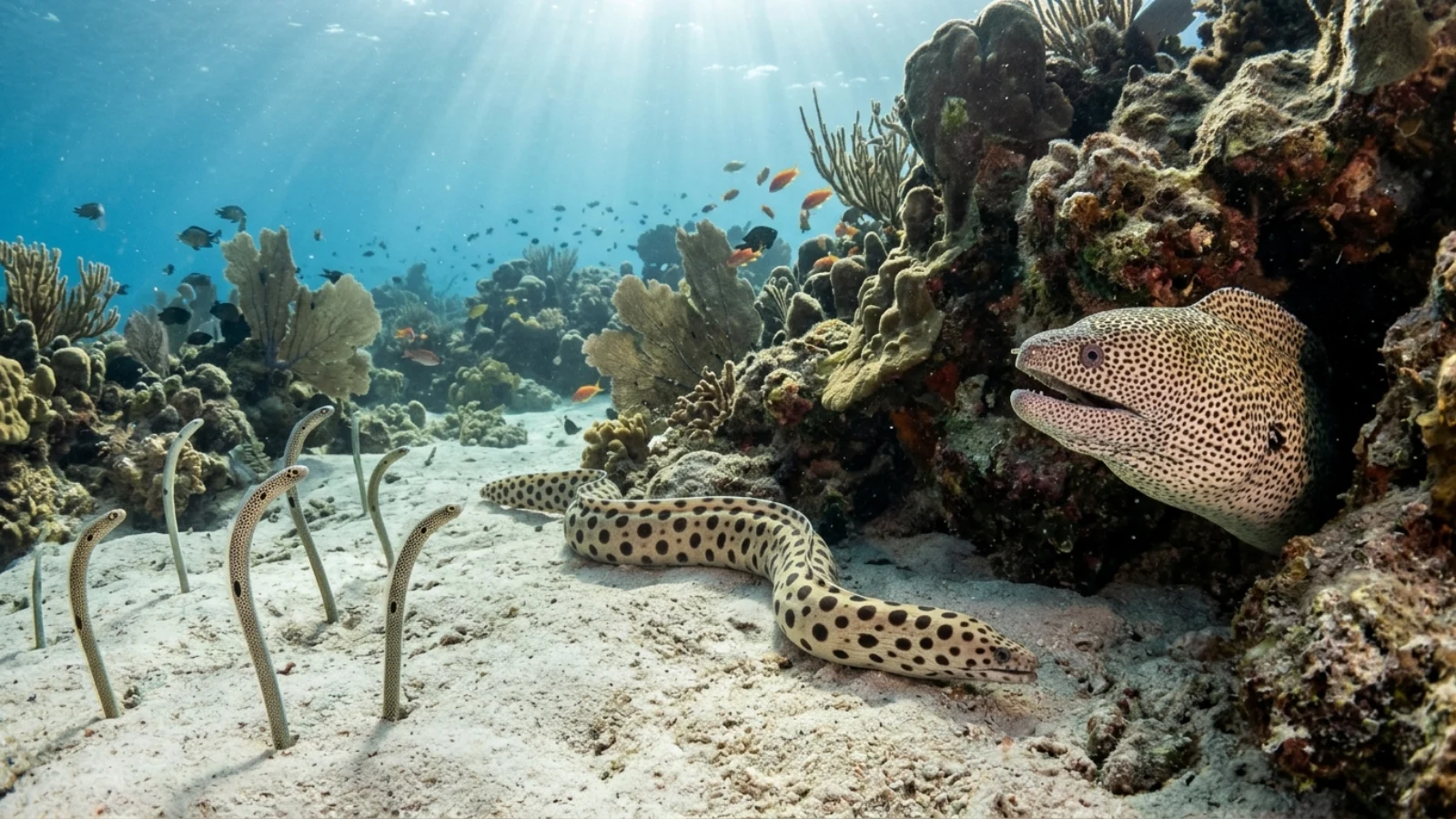
Which spotted eels live in the Indo-Pacific and Hawaii?
In the Indo-Pacific the eel most often called spotted is the snowflake or starry moray, Echidna nebulosa. FishBase describes a white body with two rows of large, branching black blotches, black spots between them that become irregular lines with age, and yellow eyes. It also has yellow tubular nostrils on a blunt white snout. It reaches about 1 metre, with 50 centimetres a common size, and lives among rocks and corals on intertidal reef flats and in shallow lagoons and seaward reefs, mostly within 10 metres of the surface. It is nocturnal and feeds mainly on crustaceans, which it crushes with blunt teeth. Its range runs from the Red Sea and East Africa to the Society Islands, Hawaii and southern Japan, and it also lives in the eastern Pacific. In Hawaii it is called puhi kāpā.
The tiger snake eel, Myrichthys maculosus, is cream or yellow with large brown or black round or oval spots. Young fish have a single row of spots along the side, while large adults have three rows. It reaches 1 metre, with about 50 centimetres more common. It lives buried in sand on reef flats, in lagoons and seagrass beds and on seaward reefs, digging in tail first, and has been recorded to about 260 metres. It is mainly nocturnal, but sometimes swims fully exposed over sand or seagrass by day while searching for prey, which it finds by smell. Its prey includes crustaceans, small fishes and even banded snake eels. At night it can gather in large numbers under artificial lights. FishBase gives its range as the Red Sea and East Africa to the central Pacific; other sources extend it to French Polynesia and the Galapagos.
The tiger snake eel is absent from Hawaii, where it is replaced by the magnificent snake eel, Myrichthys magnificus. This is a yellow to tan eel with brown to brownish-black spots about the size of the eye or smaller, which become more numerous as the eel grows. It reaches about 78 centimetres and is found only in the Hawaiian Islands, including the Leeward Islands and Midway, and at Johnston Atoll. It is common in shallow water over sand and coral, and occasionally swims at the surface.
The spotted garden eel, Heteroconger hassi, is a completely different animal. It is a thin, white eel about 14 millimetres across, covered in small black spots, with usually two or three larger black spots: one near the gill opening, one at mid-body and one around the anus. It reaches about 40 to 45 centimetres. Spotted garden eels live in colonies of up to several hundred on sandy slopes swept by currents, generally below 15 metres, from the Red Sea and East Africa to Polynesia. Each eel stays in its own burrow with about a third of its body raised, facing into the current to pick zooplankton from the water, and withdraws into the sand when approached. During the breeding season, neighbours move their burrows closer together until partners can touch.
Finally, the honeycomb moray, Gymnothorax favagineus, is white with large black blotches forming a net-like pattern and is one of the two largest Indo-Pacific morays, reaching about 3 metres. Its blotches vary with habitat: individuals on clear reefs tend to have less black than those in turbid water.
Same name, different eels
Common names are the root of the problem. ‘Spotted moray’ is the standard name for Gymnothorax moringa, yet that species is also called conger, red moray and speckled moray in different places, while ‘spotted moray eel’ is also applied to the Indo-Pacific Gymnothorax isingteena. ‘Spotted snake eel’ is even more ambiguous. It is the usual name of the Atlantic Ophichthus ophis, but some sources use it for the Indo-Pacific tiger snake eel, and the same name is given to Myrichthys tigrinus, a member of the genus found in the eastern Pacific. A fisher in Florida, a diver in Indonesia and a snorkeler in Mexico can all use the same words for three different animals.
That is why scientific names matter. A two-part Latin name such as Echidna nebulosa refers to one species everywhere, while English names vary by country and even by dive shop. When looking up an eel, searching for the scientific name, or checking a source such as FishBase that lists all known common names, is the quickest way to avoid mixing up species.
What all these eels share
Despite their differences, all of the eels in this guide are members of the same order, Anguilliformes, a group of about 1,000 species. None has pelvic fins, and all begin life as leptocephali, flat, transparent larvae that drift in the open ocean for months before transforming into small eels. That long larval stage is one reason so many spotted eels have huge ranges spanning entire ocean basins, and why a single species such as the snowflake moray can occur from the Red Sea to Mexico.
How do you tell them apart quickly?
| What you saw | Most likely eel | Key clue |
|---|---|---|
| Head out of a reef hole, Caribbean | Spotted moray | No pectoral fins, dense fine spots |
| Head angled out of sand, Atlantic | Spotted snake eel | Large spots, burrow in open sand |
| Spotted eel swimming over sand, Indo-Pacific | Tiger snake eel | Pointed tail, big round spots |
| Spotted eel swimming over sand, Hawaii | Magnificent snake eel | Hawaii, Johnston & Midway only; spots eye-sized or smaller |
| Dozens of thin eels swaying out of sand | Spotted garden eel | Colonial, thin, pulls into sand |
| White eel with black stars on reef flat | Snowflake moray | Blunt white snout, yellow eyes, two rows of branching blotches |
| Big eel with black net pattern | Honeycomb moray | Up to 3 m, Indo-Pacific |
Moray, snake eel or garden eel: what is the difference?
Morays (Muraenidae) mostly lack pectoral fins, live in reef holes and have a second set of throat jaws. Snake eels (Ophichthidae) mostly have a hard, finless pointed tail for burrowing in sand tail first. Garden eels belong to the conger family (Congridae), live in colonies with their tails anchored in burrows and feed on plankton. For more, see moray eels, snake eels and garden eels.
Why are so many eels spotted?
There is no single answer, because spotted eels belong to four different families that evolved their patterns independently. For snake eels, one widely cited explanation is mimicry: many snake eels are spotted or banded in ways that resemble venomous sea snakes, which may deter predators. For morays, the pattern seems to be tied to camouflage in a broken, dappled environment. The honeycomb moray offers a clue: individuals on clear coral reefs usually carry proportionally less black than those living in turbid water, which suggests the pattern adjusts to background and light.
Patterns also change as eels grow, which makes identification harder. The tiger snake eel starts with one row of spots and ends with three. Young tiger snake eels can show black saddles instead of spots. The magnificent snake eel gains more spots with size, and the snowflake moray’s spots become irregular lines with age. A small spotted eel may therefore look quite different from the adult pictured in a field guide.
A freshwater spotted eel
Not every spotted eel lives in the sea. The giant mottled eel, Anguilla marmorata, of rivers and estuaries across the Indo-Pacific, is yellowish with greenish-brown to black marbling over the back. It is a true freshwater eel of the family Anguillidae and is widely described as the largest of its family, with females listed at up to about 2 metres. Unlike the marine eels above, it grows up in fresh water and migrates to the open ocean to spawn. Anyone who sees a large spotted eel in a river or lake in the tropical Pacific or Indian Ocean has almost certainly met this species.
Are spotted eels safe to eat?
Some are eaten. The spotted moray supports a minor fishery and is sold fresh and salted, while the spotted snake eel is rarely consumed. Morays as a group, however, are among the fishes most often linked to ciguatera, a poisoning caused by toxins that build up through reef food chains and are not destroyed by cooking. A 2017 review in Toxins by T. Y. K. Chan concluded that moray eels can accumulate very high toxin levels, especially in the liver, and that even small eels can cause severe or fatal illness. The review notes that ciguatoxins from the Pacific are generally more potent than those from the Indian Ocean, which in turn are more potent than Caribbean forms. It recommended that the public be warned to avoid eating moray eels.
Your photograph might be a record
Identifying a spotted eel is not just a matter of curiosity. In Hawaii, several fish species have been added to the known fauna on the strength of photographs taken by divers and anglers. A 2019 paper by John Randall and colleagues documented five new Hawaiian fish records, four of them based on photographs, including a banded snake eel photographed off Kaua‘i in 2010. If an eel does not match any species known from the area, a clear photograph showing the head, the full body pattern and the tail, with the date, place and depth, can be valuable to local scientists.
Are spotted eels dangerous?
None of them is venomous. Garden eels and snake eels are harmless and shy. Morays, especially big spotted morays and honeycombs, can bite hard if fed, handled or cornered. The usual rule applies: look, don’t touch, and keep hands out of holes.
What is a spotted eel?
A common name used for several eels with spots, most often the spotted moray in the Atlantic and the snowflake moray or tiger snake eel in the Indo-Pacific.
Is a spotted eel a moray?
Sometimes. The spotted moray and snowflake moray are morays, but spotted snake eels and spotted garden eels belong to other families.
Are spotted eels poisonous?
No. None are venomous, though large morays can carry ciguatera if eaten and can bite if provoked.
What spotted eel lives in Hawaii?
The magnificent snake eel, found only in the Hawaiian chain and at Johnston Atoll, and the snowflake moray.
What eel has black and white spots?
The tiger snake eel (white with black spots), the spotted garden eel and the snowflake moray all fit.
Is there a freshwater spotted eel?
The giant mottled eel (Anguilla marmorata) of Indo-Pacific rivers has a mottled, spotted pattern.
- FishBase (Froese & Pauly, eds.), species summaries, version 2025. Gymnothorax moringa, G. miliaris, G. favagineus, Ophichthus ophis, Myrichthys breviceps, Echidna nebulosa, Myrichthys maculosus, M. magnificus, Heteroconger hassi.
- Chan, T.Y.K. (2017). Regional variations in the risk and severity of ciguatera caused by eating moray eels. Toxins 9: 201.
- Randall, J.E. et al. (2019). Five new records of fishes for the Hawaiian Islands. Journal of the Ocean Science Foundation 33: 28–43.
- Wikipedia (2023 snapshot). Spotted moray, Goldentail moray, Myrichthys maculosus, Heteroconger hassi, Snowflake moray, Ophichthidae.
- Smith, D.G. (2012). A checklist of the moray eels of the world (Teleostei: Anguilliformes: Muraenidae). Zootaxa 3474: 1–64.
Blane Perun has been exploring Earth’s oceans and marine life for over 25 years. Founder of TheSea.Org in 1999, underwater photographer, coral aquaculture pioneer, and explorer of 80+ countries.
About Blane Perun →More on Eels →