Full-Grown Fire Eel — How Big It Gets and What It Needs
A full-grown fire eel (Mastacembelus erythrotaenia) can reach about 100 cm (39 in), according to FishBase, making it one of the largest spiny eels. Aquarium fish often stay smaller but still need a tightly covered tank of about 120 × 60 × 60 cm (about 430 L) or larger with soft sand. It is a Southeast Asian freshwater spiny eel, not a true eel; our guide to freshwater eels explains the difference.
How big does a full-grown fire eel get?
Up to about 1 m (39 in). FishBase gives a maximum length of 100 cm total length for Mastacembelus erythrotaenia, and the aquarium reference Seriously Fish lists 1,000 mm. That makes the fire eel one of the largest members of its family, which FishBase describes as reaching about 0.9 m in general.
That maximum is a ceiling, not a typical size. Like most fish, fire eels in aquariums often stay well short of the record figure, and growth depends heavily on tank size, diet and water quality. The important point for anyone buying one is that a pencil-thin juvenile sold in a shop tank is the young of a fish that can, in the wild, grow as long as a child is tall. Fire eels are not a short-term fish and are not suited to a standard community aquarium once grown.
The species’ biology also suggests it grows and reproduces slowly. FishBase rates its resilience as low, with a minimum population doubling time of 4.5 to 14 years, and gives it a fishing vulnerability score of 55 out of 100, at the boundary between moderate-to-high and high. Those are model estimates based on traits such as size rather than field measurements, but they fit a large, slow-maturing fish. FishBase’s summary, drawing on W.J. Rainboth’s work on Mekong fishes, also notes that the fire eel has apparently become rare in recent years in parts of its range.
There is no published, well-documented figure for the fire eel’s lifespan, either in the wild or in captivity. What is clear from its size and slow population growth is that it is a long-term fish, and a keeper should plan for many years of care rather than a few.
Is a fire eel a real eel?
No. The fire eel is a spiny eel, family Mastacembelidae, in the order Synbranchiformes. True eels, such as morays, congers and the freshwater Anguilla eels, belong to a completely different order, the Anguilliformes. The resemblance is a case of similar body shapes evolving separately.
Spiny eels get their name from a row of well-separated spines along the back in front of the soft dorsal fin. FishBase describes the family as having usually 9 to 42 isolated dorsal spines, followed by a dorsal fin of 52 to 131 soft rays, plus usually two or three spines in the anal fin. The other giveaway is the head: spiny eels have a long, fleshy snout appendage with two tubular nostrils, a feature Wikipedia’s account calls very characteristic of the group. True eels have neither the separate dorsal spines nor the trunk-like snout.
The life cycles are different too. The freshwater Anguilla eels are catadromous: they grow up in rivers and lakes and migrate to sea to spawn. Spiny eels are primary freshwater fish. FishBase classes the family as freshwater and brackish, not marine, and the fire eel lives its whole life in fresh water. The fire eel’s skeleton is different as well. Its relative the tire-track eel, Mastacembelus armatus, has 87 to 98 vertebrae, and FishBase puts the family range at roughly 66 to 110, while the European eel averages about 114 to 115. For more on the anatomy of true eels see our eel skeleton page, and for the wider question of what counts as an eel, is an eel a reptile?
The family is not large. FishBase lists 3 genera and about 90 species, found from Africa through Syria to the Malay Archipelago and China. The three genera are Mastacembelus, the larger species including the fire eel; Macrognathus, smaller fish such as the peacock eel; and Sinobdella. A 2004 review rejected the old subfamilies and merged the African genera Caecomastacembelus and Aethiomastacembelus into Mastacembelus. A fossil of an unidentified mastacembelid is known from Middle Miocene rocks on Iki Island, Japan. In 2017 researchers sequenced the complete mitochondrial genomes of the fire eel and the tire-track eel to clarify relationships within the family.
What does a full-grown fire eel look like?
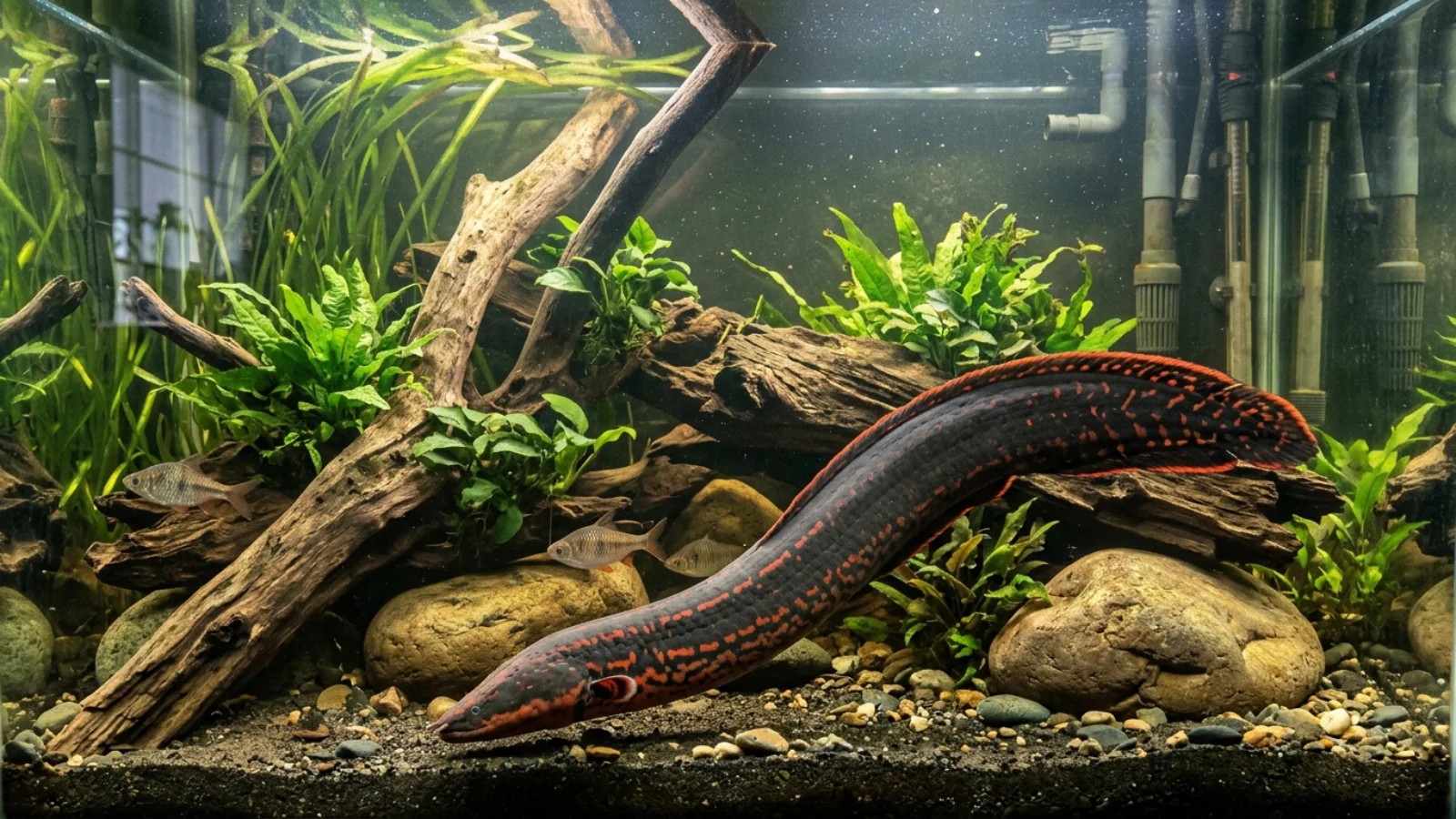
A long, dark, snake-shaped fish with bright red bands on the head and front of the body, red spots and dashes further back, and fins edged in a sharp white margin.
The formal description in FishBase is precise. The soft-rayed parts of the dorsal, anal and tail fins and the pectoral fin have a sharply defined white outer margin, while the bases of those fins are dark. The head and the front part of the body carry lengthwise red and black bands, and the rest of the body has red spots or elongated red marks on a black background. Adults are among the most striking large fish in freshwater aquariums because the red markings stand out so clearly against the dark body.
Three fish are commonly confused in the trade. The fire eel is the one with red stripes and spots. The tire-track eel, Mastacembelus armatus, is dull brown with one to three darker zigzag lines that join into a net-like pattern over the upper two-thirds of the body; it grows to about 90 cm total length and has 33 to 40 dorsal spines. The peacock eel, Macrognathus siamensis, is much smaller, up to about 30 cm standard length, and is identified by 13 to 19 dorsal spines and a row of three to six conspicuous eyespots along the base of the soft dorsal fin. Juveniles of all three can be sold under loose names, so it is worth checking the pattern before buying.
Male and female fire eels look alike. Seriously Fish notes that females in breeding condition are fuller-bodied, but there is no reliable external difference outside that.
| Spiny eel | Max size | Pattern | Dorsal spines |
|---|---|---|---|
| Fire eel (Mastacembelus erythrotaenia) | ~100 cm TL | Red bands and spots on black; white fin margins | Isolated spines (family range 9–42) |
| Tire-track eel (M. armatus) | ~90 cm TL | Brown with dark zigzag network | 33–40 |
| Peacock eel (Macrognathus siamensis) | ~30 cm SL | 3–6 eyespots along dorsal fin base | 13–19 |
Where do fire eels live in the wild?
In lowland rivers and floodplains of mainland and island Southeast Asia, from Thailand and Cambodia south to Indonesia.
FishBase gives the range as Thailand and Cambodia to Indonesia, and Seriously Fish lists Laos, Vietnam, Cambodia, Thailand, Malaysia and Indonesia. Within that range the fire eel is a large lowland floodplain species, found in slow-moving rivers and seasonally flooded plains. Its environment is tropical, at 24 to 28°C, and soft to moderately hard. That lifestyle explains much of its behaviour in captivity: it is a bottom-dweller of sluggish, soft-bottomed water, used to hiding in mud, sand and vegetation and to moving through flooded ground.
The wider spiny eel family shares those habits. Some species bury themselves in the substrate during the day or for certain months, and some have been found buried in soil during dry periods. Fire eels in the wild are caught by draining or dry-pumping bodies of standing water, which suggests how much time they spend in pools and backwaters left by retreating floods.
The fire eel is also a food fish. FishBase notes that it is marketed fresh in its home range as well as exported for the aquarium trade. In Central Kalimantan, Indonesian Borneo, the fish is known locally as ikan telan and is regarded as a characteristic fish of the Barito River basin; a 2023 community project in Murung Raya regency turned it into fish nuggets mixed with local vegetables as part of a programme to fight child stunting. The project’s authors noted that the fish had little economic value locally despite its good nutritional content.
What does a fire eel eat?
In the wild it feeds on bottom-living insect larvae and worms, with some plant material. In aquariums it does best on meaty foods such as prawn, krill and lancefish, and it will eat small fish.
FishBase describes the wild diet as benthic insect larvae, worms and some plant material. Seriously Fish describes wild fire eels more broadly as omnivores that take smaller fish, aquatic invertebrates, plant matter and detritus. Both point to an opportunistic bottom feeder that uses its long snout to probe soft sediment.
In the aquarium the practical rules are straightforward. Offer meaty foods, vary them, and feed in the evening when the fish is most active. Seriously Fish recommends prawn, krill and lancefish as preferred items, lists algae wafers among suitable foods, and notes that some individuals will take vegetable matter, although that is fairly rare. It also warns that live and frozen foods alone are unlikely to sustain a larger fire eel, so a fish raised on bloodworm needs to be moved onto larger, more substantial foods as it grows. Because fire eels eat live fish in the wild, any small tankmate is potential food.
Feeding can also bring in parasites. In 2025 Japanese researchers described camallanid nematodes, worms of the group sometimes called Zeylanema, from the digestive tracts of fire eels kept in an aquarium in Japan, and used DNA to show that the genus belongs within Camallanus. Imported wild-caught fish can carry such worms, which is one reason careful quarantine of new fish matters.
What size tank does a full-grown fire eel need?
A large, tightly covered tank: around 120 × 60 × 60 cm (48 × 24 × 24 in, about 430 L or 114 US gallons) as the base size for one adult, according to Seriously Fish, with bigger always better.
The footprint matters more than height. A fire eel spends most of its time on or in the bottom, so floor area and a deep layer of soft sand are the priorities. Seriously Fish recommends sand because the fish often buries itself, with plenty of hiding places such as bogwood, rock caves and lengths of PVC pipe, a well-planted tank with floating plants to cut the light, and fairly gentle water flow. Dim lighting encourages it to come out more. Sharp gravel is a poor choice for a fish that pushes its body into the substrate.
The lid is not optional. Seriously Fish notes that the fire eel can find its way through the smallest of gaps, so every opening around filters, heaters and cables needs to be closed. A large fish that gets out of its tank is unlikely to survive for long.
A big fish needs big filtration. Seriously Fish suggests two filters each rated at about 865 to 1,080 litres per hour, giving a turnover of four to five times the tank volume per hour, and roughly 175 to 250 watts of heating split between two heaters for a room at around 20°C. Water should be kept at 24 to 28°C. For pH, FishBase gives 6.0 to 8.0 and Seriously Fish a narrower 6.0 to 7.0; for hardness, FishBase gives 5 to 19 dH and Seriously Fish 5 to 12 dGH. A pH near neutral and moderate hardness therefore fits both sources, and stability matters more than hitting an exact number: Seriously Fish rates the species moderate in difficulty, partly because it needs a steady pH and temperature. Juveniles can start in a smaller tank, but they should be moved up as they grow rather than kept in a tank sized for the fish you bought.
Are fire eels aggressive?
Not usually towards other species. Fire eels are generally peaceful community fish with tankmates too big to eat, but they can be aggressive towards their own kind, so most keepers house one per tank.
Seriously Fish describes the species as generally peaceful, with the important condition that tankmates must be too large to be seen as prey. Good companions are robust, medium to large fish that occupy the middle and upper water and are not themselves aggressive or nippy. Small tetras, rasboras and shrimp are likely to be eaten as the eel grows.
Keeping more than one is where problems arise. The usual advice is a single fire eel per tank because they may fight with their own kind. Seriously Fish notes that this can sometimes be avoided by keeping a group of five or more, which spreads aggression, but a group of metre-long fish needs a very large aquarium, so for most keepers one fish is the realistic option. They are harmless to people. FishBase lists the species as harmless.
A newly introduced fire eel is often secretive, spending much of the day buried with only the head showing and coming out mainly at dusk and at night. With dim lighting, plenty of cover and a stable routine, many become bolder over time.
Do fire eels breed in captivity?
Rarely. Seriously Fish reports that the fire eel has been bred in aquariums only occasionally, and that those spawnings appear to have been accidental rather than planned.
Little is published on the fire eel’s reproduction. FishBase lists the spiny eel family as non-guarders, meaning that the parents do not guard eggs or young, but has no species-specific data on maturity or fecundity for the fire eel. Because aquarium breeding is so rare, the fish in the trade are largely wild-caught, which puts some pressure on wild populations already described as becoming rare in places. Anyone considering a fire eel should be prepared to keep one fish for its whole life rather than expecting to breed it.
Are fire eels endangered?
No. The IUCN Red List assesses the fire eel as Least Concern, most recently on 12 December 2019, but FishBase notes that it has become rare in parts of its range.
The species has been assessed twice for the Red List, first by Chavalit Vidthayanon in 2011 and again by Vidthayanon and Daniels in 2019, both times as Least Concern. That rating reflects a wide range across several countries. The local picture is less comfortable. The fire eel is fished for food, collected for the aquarium trade, and caught by draining floodplain pools, while FishBase’s estimates point to low resilience and high vulnerability to fishing. A fish with those traits can decline locally even while the global assessment remains Least Concern.
For aquarium keepers the practical points follow from that: buy from sources that can say where their fish come from, avoid impulse purchases of juveniles you cannot house as adults, and never release an unwanted fire eel into local waters. A large predatory fish from Southeast Asia does not belong in rivers elsewhere.
How big does a fire eel get?
Up to about 100 cm (39 in) in total length, according to FishBase. Aquarium specimens are often smaller.
What tank size does a full-grown fire eel need?
Around 120 × 60 × 60 cm (about 430 L) or larger, with a tight lid, soft sand and plenty of cover.
Is a fire eel a true eel?
No. It is a freshwater spiny eel (Mastacembelidae, order Synbranchiformes), not a member of the true eel order Anguilliformes.
Where do fire eels come from?
Lowland rivers and floodplains of Southeast Asia, from Thailand and Cambodia to Malaysia and Indonesia.
What do fire eels eat?
Insect larvae, worms and some plant material in the wild; prawn, krill and lancefish in aquariums. They will eat small fish.
Can you keep two fire eels together?
Usually not; they can be aggressive to their own kind unless kept as a group of five or more in a very large tank.
How do I tell a fire eel from a tire-track eel?
Fire eels have red bands and spots on a black body; tire-track eels are brown with a dark zigzag network.
Are fire eels endangered?
The IUCN lists them as Least Concern (2019), though FishBase notes they have become rare in some areas.
- FishBase: Mastacembelus erythrotaenia Bleeker, 1850, Fire eel (size, environment, biology, resilience, IUCN status).
- FishBase: Family Mastacembelidae, spiny eels; Mastacembelus armatus; Macrognathus siamensis.
- Seriously Fish: Mastacembelus erythrotaenia species profile (tank, water, diet, behaviour, breeding).
- Vidthayanon, C. (2011) and Vidthayanon, C. & Daniels, A. (2019). Mastacembelus erythrotaenia. IUCN Red List of Threatened Species.
- Han, C. et al. (2017). Complete mitochondrial genomes of Mastacembelus erythrotaenia and M. armatus. Conservation Genetics Resources. doi:10.1007/s12686-017-0807-0
- Saito, T. et al. (2025). “Zeylanema” nematodes in the digestive tract of fire eels raised in an aquarium in Japan. Journal of Parasitology. doi:10.1645/24-58
- Ravenska et al. (2023). Local food diversification from ikan telan (Mastacembelus erythrotaenia), Murung Raya. Jurnal Bakti UPPR.
- Wikipedia: Mastacembelidae (genera, distribution, fossil record).
Blane Perun has been exploring Earth’s oceans and marine life for over 25 years. Founder of TheSea.Org in 1999, underwater photographer, coral aquaculture pioneer, and explorer of 80+ countries.
About Blane Perun →